
Ready-to-use travel agent email templates for every trip stage
Discover practical email templates for travel agents to streamline client communication at every booking stage and enhance customer service.

This page gives you copy-ready email templates for every stage of a client’s booking journey, from first enquiry through to the post-trip review request. Paste them straight into a text-expander, your CRM’s template library, or a shared team folder, then fill in the bracketed placeholders before you hit send.
You’ll find templates for the moments that matter most:
- First enquiry response (the one that needs to land within minutes)
- Itinerary proposal and follow-up
- Booking confirmation and payment reminders
- Pre-departure checklist and final documents
- Post-trip thank-you and review request
Each one comes with a suggested subject line, send timing, and a clear next step for the client. Swap the placeholders, keep your signature block consistent, and you’ve got a working system rather than a folder of half-finished drafts.
Key Takeaways
Journey-mapped, placeholder-driven email templates cut admin time, reduce client-data errors, and free travel agents to focus on selling rather than drafting.
| Point | Details |
|---|---|
| Use the full journey set | Map templates from enquiry through post-trip review so no stage gets a rushed, ad-hoc reply. |
| Standardise placeholders | Keep formats like [client_name] and [booking_ref] consistent across every template you write. |
| Start with three automations | Prioritise instant enquiry replies, payment reminders, and post-trip review requests first. |
| Test before you trust it | Run sample data through every new template with a colleague before sending it to a real client. |
| Build compliance in once | Add ATOL, privacy, and cancellation lines to your signature so they never get forgotten mid-email. |
Table of Contents
- Why travel agent email templates save you time and win more bookings
- The complete template set: copy, adapt, send
- How to write subject lines, bodies and signatures that convert
- Setting up placeholders and choosing the right template tool
- Timing rules and the first automations worth building
- How a white-label platform supports template-driven workflows
- Handling client objections and questions inside your templates
- Compliance and legal essentials in travel communication
- What actually breaks when agents roll out templates
- Sources
Why travel agent email templates save you time and win more bookings
Every travel agent has written the same enquiry reply a hundred times, slightly differently each time, and occasionally left out the one detail that mattered. Templates fix that. A journey-mapped set of client emails cuts routine drafting time and stops important details slipping through, because the structure is already decided before you start typing.
The benefits stack up in three ways:
- Speed and accuracy. You’re filling gaps, not composing from scratch, so replies go out faster and nothing gets forgotten.
- Brand consistency. A standardised signature with your ATOL number, contact details, and insurance disclaimer appears the same way every time, which builds trust and cuts down on clients emailing back to ask “where’s your booking reference?”
- More time for the parts that actually sell. When the admin writing is templated, you spend your energy on the recommendation that makes a client choose you over a comparison website.
Templates aren’t a shortcut around personal service.
The complete template set: copy, adapt, send
Here’s the full run of templates in the order a booking actually happens. Each one has a subject line formula, the body text with placeholders, and a note on timing.
- New enquiry response – Subject: “Re: Your enquiry about [destination] — let’s get started”. Send within minutes of the enquiry landing.
- Planning fee / consultation confirmation – Subject: “Your planning session for [destination], confirmed”. Send immediately after the client agrees to proceed.
- Itinerary proposal – Subject: “Your proposal for [destination] — [travel dates]”. Send once pricing and options are finalised, ideally within 48 hours of the enquiry call.
- Proposal follow-up – Subject: “Checking in on your [destination] proposal”. Send 3 to 5 days after the proposal if there’s been no reply.
- Booking confirmation – Subject: “Booked! Your [destination] trip is confirmed”. Send the moment payment clears.
- Deposit / final payment reminder – Subject: “Payment due: [amount] by [due_date]”. Send reminders before the due date according to your payment schedule.
- Travel insurance prompt – Subject: “Don’t forget: travel insurance for your [destination] trip”. Send within a week of booking confirmation.
- 60-day pre-trip check – Subject: “60 days to go: passports, visas and next steps”. Send automatically 60 days before departure.
- Final documents email – Subject: “Your travel documents for [destination]”. Send 7 to 10 days before departure.
- Travel day message – Subject: “Safe travels! Everything you need for today”. Send the morning of departure.
- Welcome home follow-up – Subject: “Welcome home! How was [destination]?”. Send 1 to 2 days after return.
- Referral / review request – Subject: “Got 2 minutes? We’d love your feedback”. Send 5 to 7 days after return.
The templates in full
1. New enquiry response
Hi [client_name],
Thanks for reaching out about [destination] — sounds like a brilliant trip in the making. I’d love to help you plan it.
To put together the right options, could you let me know your ideal travel dates, budget range, and who’s travelling? I’ll come back to you with tailored ideas within [response_time].
Speak soon,
[agent_name]
CTA: Ask one clarifying question that moves the client to reply.
2. Planning fee / consultation confirmation
Hi [client_name],
Great chatting with you today. I’ve confirmed our planning session for [date/time], where we’ll go through everything for your [destination] trip.
If anything changes before then, just reply here.
Talk soon,
[agent_name]
CTA: Confirm the appointment, no action needed unless plans change.
3. Itinerary proposal
Hi [client_name],
Here’s your proposal for [destination], [travel_dates]: [brief 2 to 4 sentence summary of flights, accommodation, and standout inclusions].
Total cost: [price]. This quote is held until [expiry_date].
To move forward, just reply “yes” or give me a call on [phone_number].
Best,
[agent_name]
CTA: Reply to confirm, with a clear expiry date attached.
4. Proposal follow-up
Hi [client_name],
Just checking you received the proposal for [destination] I sent on [date]. Any questions on the itinerary or pricing, I’m happy to talk it through.
The quote is held until [expiry_date], so let me know if you’d like to go ahead.
[agent_name]
CTA: Invite a quick call or reply before the price hold expires.
5. Booking confirmation
Hi [client_name],
You’re officially booked! Here’s a summary of your [destination] trip: [dates, accommodation, key inclusions]. Booking reference: [booking_ref].
Your ATOL Certificate and full confirmation are attached. Balance is due by [due_date].
Welcome aboard,
[agent_name]
CTA: Note the balance due date and confirm documents are attached.
6. Deposit / final payment reminder
Hi [client_name],
A quick reminder that your balance of [amount] for [destination] is due on [due_date]. You can pay via [payment_link].
Let me know if you need to discuss payment options.
[agent_name]
CTA: Direct link to pay, with a named deadline.
7. Travel insurance prompt
Hi [client_name],
Now that your [destination] trip is booked, it’s worth sorting travel insurance if you haven’t already. It covers cancellations, medical costs, and lost luggage, and I’d recommend arranging it soon after booking rather than closer to departure.
Happy to point you towards suitable policies if useful.
[agent_name]
CTA: Offer a policy recommendation or link, no hard sell.
8. 60-day pre-trip check
Hi [client_name],
Just over 60 days until [destination]! Time to check passport expiry dates (valid for 6 months past your return date), any visa requirements, and vaccinations if relevant.
Let me know if you need help with any of this.
[agent_name]
CTA: List two or three specific checks, invite questions.
9. Final documents email
Hi [client_name],
Your travel documents for [destination] are attached: e-tickets, hotel vouchers, and transfer details. Departure is [departure_date] from [departure_airport].
Save a copy to your phone for easy access.
Safe travels,
[agent_name]
CTA: Confirm documents attached, prompt to save offline copies.
10. Travel day message
Hi [client_name],
Today’s the day! Your flight [flight_number] departs at [departure_time] from [terminal]. Transfer details are in your documents.
Have an amazing trip.
[agent_name]
CTA: None needed, this is reassurance and a final detail check.
11. Welcome home follow-up
Hi [client_name],
Welcome home! How was [destination]? I’d love to hear the highlights whenever you get a moment.
[agent_name]
CTA: Open question inviting a reply, keeps the relationship warm.
12. Referral / review request
Hi [client_name],
So glad you had a great time in [destination]. If you have two minutes, a quick review on [review_platform] would mean a lot, and helps other travellers find us.
Know anyone else planning a trip? I’d love an introduction.
[agent_name]
CTA: Direct link to the review platform, plus a soft referral ask.
| Template | Trigger point | Send timing |
|---|---|---|
| New enquiry response | Enquiry received | Within minutes |
| Itinerary proposal | Pricing finalised | Within 48 hours of enquiry |
| Booking confirmation | Payment received | Immediately |
| 60-day pre-trip check | 60 days before departure | Automated |
| Referral / review request | 5 to 7 days after return | Automated |
How to write subject lines, bodies and signatures that convert
The best travel agent correspondence follows a formula, not inspiration. Once you’ve got the shape right, every new template takes minutes to draft.
- Subject line formula: context plus reference. “Proposal for Santorini — 14 to 21 June” beats “Your quote” every time, because the client can find it in a crowded inbox weeks later.
- Body structure: one-line greeting, a 2 to 4 sentence summary of the itinerary or offer, an explicit next step, then a deadline and your contact details. Anything longer and clients skim past the part that matters.
- Signature block: name, agency name, phone number, ATOL number, and a one-line insurance or terms disclaimer. Standardise this once and paste it into every template so it never gets forgotten on a rushed reply.
Pro Tip: Keep your CTA to one sentence and put it on its own line. A next step buried in the middle of a paragraph gets missed far more often than one that stands alone.
Consistency here does more than look tidy. A standardised signature and legal or insurance line builds trust and quietly reduces the number of “wait, what’s your ATOL number again?” follow-ups you’d otherwise get.
Setting up placeholders and choosing the right template tool
Placeholders are what turn a generic template into a personal email in seconds, provided you standardise them across your whole set. Stick to the same bracket format throughout: [client_name], [lead_source], [trip_dates], [booking_ref], and [supplier_contact] should mean the same thing in every template you write.
Which tool you use depends on how your agency already works:
- Text-expansion tools work well for solo agents or small teams who reply from Gmail or Outlook. Typedesk, for example, stores responses behind short shortcuts and inserts them directly into your inbox, CRM, or chat tool, which keeps everyone typing the same wording without copying from a document.
- CRM-integrated templates suit agencies already tracking bookings in a CRM, since the placeholders can pull client data automatically rather than needing manual entry each time.
- Shared response libraries (a folder, wiki, or shared doc) work for teams that don’t need automation yet but still want everyone using the same wording.
A simple shortcut table helps here too. Something like inq for a new enquiry reply and book for a booking confirmation means your whole team can fire off a consistent message without hunting through folders.
Before rolling anything out, run this checklist:
- Draft the template with every placeholder bracketed clearly.
- Fill it with sample data for a fictional booking and read it end to end.
- Send it to a colleague to check nothing reads oddly or leaks the wrong client’s details.
- Share it in your central library and note the date it was last updated.
Timing rules and the first automations worth building
Not every template needs full automation on day one. Three deliver the fastest return: an instant enquiry reply, a payment reminder sequence, and a post-trip review request, and it’s worth starting with those three before expanding further.
A few timing rules worth following from the start:
- Enquiry replies within minutes, not hours; response speed is often the difference between winning and losing the booking.
- Payment reminders timed to your own schedule, typically 14 days and again 3 days before a balance is due.
- Pre-departure checks at 60 days and again at 7 days out, covering passports, visas, and final documents.
- Post-trip review requests 5 to 7 days after return, while the trip is still fresh in the client’s mind.
Automating everything at once risks overwhelming clients with messages that feel robotic. Sequence automated touches so they complement your personal follow-ups rather than replace them, and use a preference flag in your CRM for clients who’d rather hear from you directly than receive a scheduled email.
How a white-label platform supports template-driven workflows
Templates work best when the data behind them is already organised. A platform that centralises client records, booking references, and supplier contacts means your placeholders populate correctly without manual lookup every time, and automated booking management means a confirmation email can trigger the moment payment clears rather than waiting for someone to notice.
Partners running their booking business through Timeshunters get access to wholesale rates, ATOL-protected licences, and automated client follow-up built around the same client-journey stages this article maps out, from enquiry through to post-trip contact.
That’s the same workflow this article recommends, just with the admin layer already built rather than assembled from scratch.
Handling client objections and questions inside your templates
Most client hesitation falls into a handful of predictable categories, so it’s worth building the answer directly into your templates rather than improvising each time.

“It’s more expensive than booking myself.” Address this in your proposal template by naming what’s included that a DIY search misses: financial protection, 24-hour support during the trip, and the time saved comparing dozens of options. Don’t get defensive, just state the value plainly.
“I need to think about it.” Your follow-up template should give a reason to decide by a date, not just chase for an answer. A price-hold expiry works better than “just checking in.”
“What if my flight changes or I need to cancel?” Build a short line into your proposal and confirmation templates pointing to your terms and cancellation policy, so the question gets answered before it’s asked.
“Is my money protected?” Your booking confirmation should state the ATOL protection clearly, with the certificate attached, not just referenced. Clients rarely ask twice once they’ve seen it in writing.
The pattern here is simple: anticipate the objection, answer it inside the relevant template, and you’ll spend far less time firefighting individual email threads.
Compliance and legal essentials in travel communication
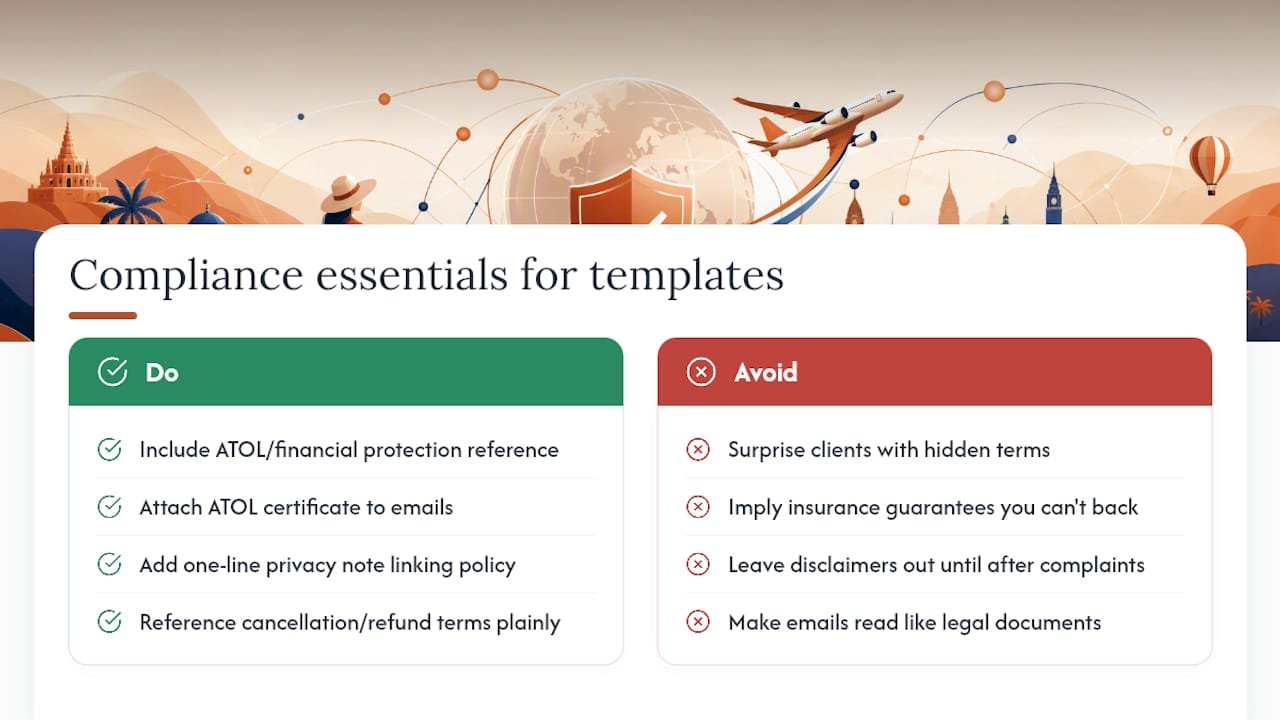
Every template that touches money, personal data, or booking terms needs to carry the right disclaimers, and it’s far easier to build these in once than to add them retroactively after a complaint.
Financial protection. Any booking confirmation involving flights or packages should reference ATOL protection where it applies, with the certificate attached rather than just mentioned. If you’re ABTA-affiliated, that reference belongs in your signature block too.
Data privacy. If you’re storing client details like passport numbers or payment information to populate placeholders, your templates and booking process need to reflect how that data is handled, in line with UK data protection law. A one-line privacy note in your booking confirmation, linking to your full policy, covers this without cluttering the email.
Cancellation and refund terms. Don’t let a client discover your cancellation policy for the first time when they want to cancel. Reference it plainly in your proposal and confirmation templates, with a link to full terms.
Insurance disclaimers. If you recommend or sell travel insurance, your template should be clear about what it covers and steer clear of implying guarantees you can’t back.
None of this needs to make your emails feel like a legal document. A single well-placed line in your signature and confirmation templates covers most of it, and it’s worth reviewing that wording whenever your terms or supplier agreements change.
What actually breaks when agents roll out templates
I’ve watched agents build a beautiful template set and then trip over the same handful of mistakes. Here’s the short version.
Don’t over-automate anything promotional, holiday offers and newsletters need a human decision behind each send. Do keep transactional messages (bookings, payments, documents) tight, clear, and automated wherever possible. Test every placeholder with a colleague before it goes live; a booking reference or trip date pulled from the wrong record is the fastest way to lose a client’s trust. And review your templates every quarter, or immediately after any policy or supplier change, because a template left untouched for a year is usually the one with the outdated cancellation line.
Sources
- Travel Agent Email Templates: 15 Client Emails for Every Trip Stage
- Travel Agency Email Templates: 15 Ready-to-Send Examples – CampaignHQ Blog