
How to become an independent travel agent in the UK
Learn how to become an independent travel agent in the UK quickly and legally by partnering with a compliant white-label platform.

The fastest compliant way to become an independent travel agent in the UK is to partner with a white-label platform operating under a principal ATOL, rather than applying for your own licence. TimesHunters is a strong option for most solo or aspiring agents: it puts you under Times Travel group’s ATOL protection, issues certificates automatically at the point of sale, and pays partners 70% commission on bookings, against the roughly 4% typical of online travel agency affiliate schemes.
Before signing anything, check two things:
- ATOL certificate automation. The ATOL Regulations require the certificate to be issued the moment a customer pays. If a platform can’t do this instantly, walk away.
- A written agency agreement with the CAA’s Schedule of Terms. Without it, you could be personally liable if the ATOL holder collapses.
Key Takeaways
Partnering under a principal ATOL through a white-label platform is the fastest legal route to becoming an independent travel agent in the UK, provided the agency agreement and certificate automation both check out.
| Point | Details |
|---|---|
| Choose the right route | A white-label partner under a principal ATOL suits most solo agents; your own ATOL suits high-volume or wholesale operators. |
| Verify the agency agreement | Confirm it includes the CAA’s Schedule of Terms before signing anything. |
| Check certificate automation | ATOL certificates must issue instantly at payment, not by manual email later. |
| Cover legal gaps beyond ATOL | Insurance, PTR 2018 disclosures, and GDPR compliance sit alongside ATOL, not inside it. |
| Start with TimesHunters due diligence | Request a sample ATOL certificate and agency agreement before committing to the 70% commission partnership. |
Table of Contents
- Independent travel agent UK: which route is actually legal?
- How do you actually launch and get your first booking?
- What legal duties sit alongside ATOL?
- What should you ask before choosing a platform?
- What red flags should make you walk away?
- How do you stay compliant once you’re trading?
- How do independent agents win their first clients?
- What support exists once you’re up and running?
- Ready to start? Here’s what to check first
- Frequently asked questions
- Sources
Independent travel agent UK: which route is actually legal?
Every UK business selling flight-inclusive holidays or flight-only products must either hold its own ATOL or act as an authorised agent under a compliant written agency agreement. Selling air travel without either is a criminal offence, not a grey area. That leaves three real routes into the trade.
1. White-label partner under a principal ATOL. You sell under your own brand, but bookings sit legally under your platform provider’s ATOL, such as Times Travel group’s licence via TimesHunters. The provider issues the certificate, holds the consumer’s money in trust, and you take a commission split.
2. Your own ATOL. You become the Accountable Body yourself. This gives full control over pricing and supplier contracts, but the CAA’s application process demands a certified opening balance sheet, financial projections, and a named Accountable Person who meets fitness and competence criteria. It’s built for operators with real trading history, not someone launching from a spare room.
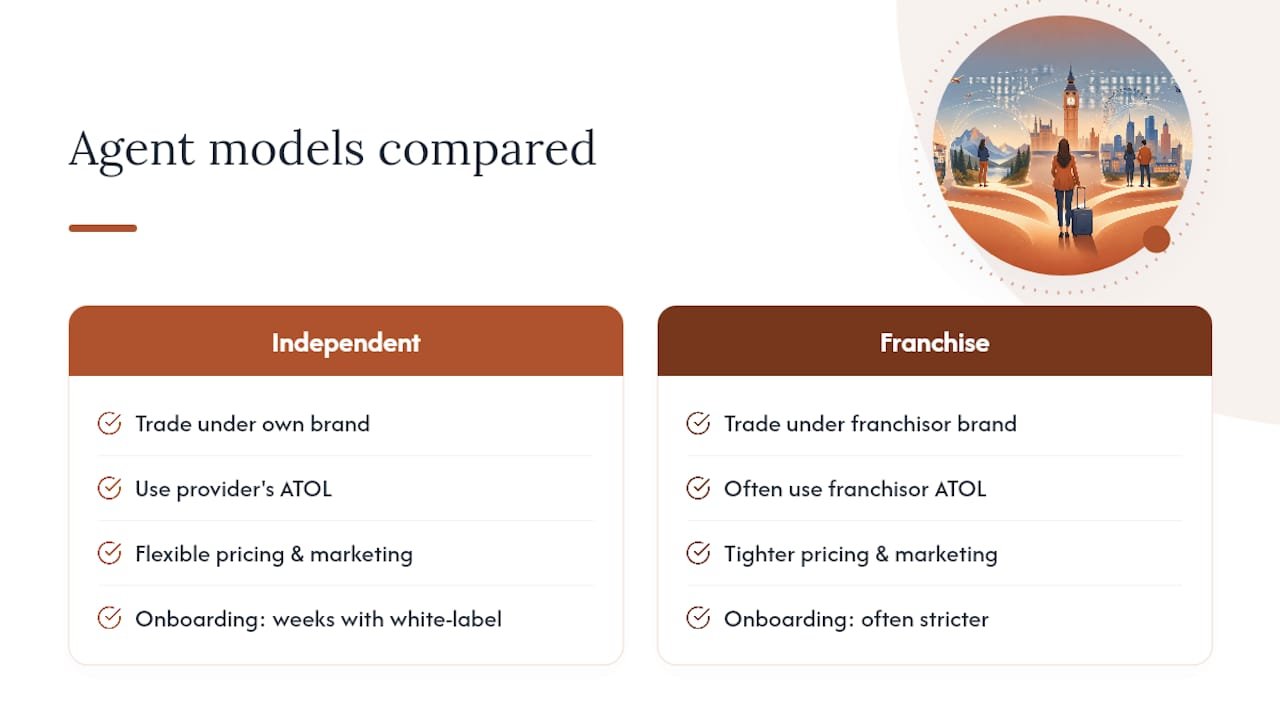
3. Broker or franchise membership. Some networks let you trade under a shared brand with less independence over your own identity, usually with tighter rules on pricing and marketing.
For a freelancer or small business owner starting today, the choice usually comes down to speed versus control:
- White-label partner wins on speed. You can be trading within weeks, with no balance sheet hurdle and certificate issuance handled automatically.
- Own ATOL wins on margin retention and contract flexibility, but only if you already have the trading history and capital the CAA wants to see.
- Franchise/broker sits in between, though it often caps how “independent” your brand really feels.
| Criteria | White-label partner | Own ATOL |
|---|---|---|
| Commission split | Up to 70% with providers like TimesHunters | Full margin retention, minus supplier and operating costs |
| ATOL arrangement | Trades under principal’s ATOL | Own ATOL, own Accountable Person |
| Certificate automation | Usually native to the platform | Must be built or bought separately |
| Onboarding time | Typically weeks | Often several months, subject to CAA approval |
If you’re weighing this up against the cost of an ATOL application, the CAA’s published fee bands give a sense of scale: a Standard ATOL runs to £2,606, with a Small Business ATOL at £1,583, before you’ve booked a single client. That’s before accounting for the balance sheet and financial projections the application demands. Weigh that against a platform’s onboarding fee, and the maths tends to favour the white-label route for anyone starting from scratch.
How do you actually launch and get your first booking?
Once you’ve picked a route, the sequence from sign-up to first sale is fairly predictable if you follow it in order.
- Vet the ATOL holder. Ask for the ATOL licence number, the name of the protecting entity, and a sample certificate showing both. If a provider hesitates, that’s your answer.
- Request the agency agreement. Confirm it contains the CAA’s Schedule of Terms. Read the clause on liability if the ATOL holder fails.
- Set up your brand. Register your business name, sort your logo and portal domain or subdomain, and get your booking site live under your own identity.
- Confirm payment separation. The CAA expects invoices to clearly show which funds are ATOL protected. Ask how the platform’s receipts handle this.
- Launch with a narrow offer. Pick one or two destinations or trip types you can speak about credibly, rather than trying to sell everything at once.
- Onboard your first clients. Lean on your existing network, whether that’s a hospitality customer base, a social following, or personal contacts.
- Set a 90-day milestone. Aim for a fixed number of enquiries in month one, quotes in month two, and confirmed bookings by month three.
Pro Tip: Ask any platform to show you a real ATOL certificate, not a mock-up, before you commit. If the holder’s name and licence number aren’t clearly printed, that’s a compliance gap you’ll inherit.
What legal duties sit alongside ATOL?
ATOL protection covers the financial failure risk on flight-inclusive holidays, but it isn’t your only legal obligation. The Package Travel and Linked Travel Arrangements Regulations 2018 require clear pre-contractual information before a customer books: price, itinerary, and cancellation terms, all disclosed upfront rather than buried in follow-up emails.
You’ll also need public liability and professional indemnity cover, even when trading under someone else’s ATOL, because client disputes over advice given or bookings mishandled sit with you as the seller of record. Data protection matters too: storing passport details, payment information, and travel preferences puts you squarely under UK GDPR, which means secure storage and a clear retention policy, not just a spreadsheet on a laptop.
Consumer protection law also governs how you advertise. Pricing must be accurate and inclusive of unavoidable charges, and any claims about availability or “deals” need to be genuine at the time you publish them. None of this replaces ATOL. It sits alongside it, and a platform that only talks about ATOL compliance without mentioning insurance or data handling probably hasn’t thought through the whole picture.
What should you ask before choosing a platform?
Not every white-label provider is built the same way, so the vetting conversation matters more than the sales pitch. Start with the licence itself: which ATOL protects your bookings, and can the provider show you the certificate template a customer would actually receive?
Ask how commission is calculated and paid; a 70% headline split means little if it’s calculated after undisclosed deductions. Push on the technology too: does the booking engine connect to a genuine GDS or bed bank, or is inventory limited to a narrow set of packaged deals? A platform with real wholesale access, similar to the booking depth offered by tour operator software like Riddlio, gives you far more to sell than a thin affiliate feed.
Training and support deserve equal scrutiny. Ask what onboarding actually involves, whether there’s a dedicated contact once you’re live, and how disputes with clients get handled if a supplier cancels. Finally, ask what happens if you want to leave: can you take your client list with you, or does the brand you’ve built stay locked to their platform? A provider confident in its own service usually answers that question without flinching.
What red flags should make you walk away?
Some warning signs are obvious once you know to look for them, others less so. The clearest is any platform that can’t produce a written agency agreement with the CAA’s Schedule of Terms on request. If they stall or offer a vague summary instead of the actual document, that’s a legal exposure sitting on your desk, not theirs.
Watch for delayed or manual ATOL certificate issuance. If certificates arrive by email “within 24 hours” rather than instantly at payment, the provider is already out of step with the regulation. Vague commission structures are another tell: providers who won’t state the split in writing, or who bury deductions in small print, tend to disappoint at payout time.
Be wary too of platforms offering no visible complaints process, no named Accountable Person, or licence numbers that don’t match anything searchable on the CAA register. A provider unwilling to let you speak to an existing partner before you commit is worth treating with caution, since genuine partner testimonials are usually easy to produce when the economics are real.
How do you stay compliant once you’re trading?
Compliance isn’t a one-off tick box at sign-up. The CAA can review agency agreements and certificate practices at any point, so keeping records tidy matters as much as getting them right on day one.
Keep a dated copy of every agency agreement version you’ve signed, along with correspondence confirming any changes to commission terms. Reconcile your booking records against certificates issued at least monthly, checking that protected and non-protected amounts are clearly separated on every invoice, as CAA guidance requires. If your platform updates its terms, read the changes rather than clicking through; a shift in the Accountable Person or ATOL number affects what protection your clients actually have.
Review your insurance annually, particularly if your booking volume or destination mix changes. A platform with genuine audit-trail features, showing who booked what, when, and under which certificate, makes this far less painful than chasing down paper receipts. Treat this as a quarterly habit rather than an annual scramble.
How do independent agents win their first clients?
Marketing for a new independent travel agent usually works better as a narrow, relationship-led approach than a broad advertising spend. Your existing network is the obvious starting point: past colleagues, hospitality clients, or a social media following you’ve already built trust with.

Specialising helps more than trying to cover every destination. An agent known for honeymoon planning in the Maldives or family villa holidays in Portugal earns referrals faster than a generalist competing on price against comparison sites. Content that demonstrates real knowledge, detailed itinerary breakdowns, cost comparisons, or destination guides, tends to convert better than generic promotional posts, particularly when paired with real-time itinerary tools that let you adjust a quote live while a client is still deciding.
Referral incentives work well in travel because a good holiday is memorable and clients talk about it. A small thank-you discount on a future booking for every referral tends to outperform paid advertising for a new agent with a limited budget. Local partnerships, with wedding planners, gyms, or corporate HR teams organising incentive trips, can also generate steady, low-cost leads once trust is established.
What support exists once you’re up and running?
The gap between agents who succeed and those who quietly stop trading usually comes down to whether they used the support on offer. Most white-label providers, TimesHunters included, build onboarding training into the partnership: how to price a quote, how to handle a supplier cancellation, and how to read your commission statement correctly.
Beyond formal onboarding, look for ongoing access to a partner community or account manager rather than a one-off welcome call. Questions come up constantly in the first year: how to handle a client dispute, how to price a complex multi-stop itinerary, or what to do when a supplier changes terms mid-booking. Providers who offer live chat support or scheduled check-ins tend to retain partners longer than those who disappear after sign-up.
Ongoing product training matters too, particularly as booking platforms add new destinations or supplier relationships. An agent who never revisits the platform’s training materials after month one is usually the one who misses a pricing update or a change to certificate wording.
Author perspective: who this model actually suits
This route suits freelancers, influencers, and hospitality owners with an existing audience. If you’re already contracting wholesale rates or chasing corporate volume, your own ATOL earns its complexity. Otherwise, start with platform due diligence.
Ready to start? Here’s what to check first
Timeshunters is the practical alternative to building your own ATOL from scratch, or trading through a low-commission affiliate scheme. Rather than spending months on a CAA application and balance sheet review, you go live under an established, well-protected licence and keep 70% of the commission on what you sell, against the roughly 4% typical of online travel agency partner programmes.
Before committing, ask TimesHunters for three things: a sample ATOL certificate showing the protecting licence number, the agency agreement’s Schedule of Terms, and a walkthrough of the onboarding checklist. Those three documents tell you almost everything about whether a partnership is worth your time. If they hold up, request a demo or the partner brochure directly through TimesHunters and get a clear view of your branded portal before you commit to anything.
Frequently asked questions
Do I need my own ATOL to become an independent travel agent in the UK?
No. You can legally trade as an agent under a principal ATOL holder’s licence, provided you have a compliant written agency agreement in place. Many freelancers choose this route precisely to avoid the CAA’s financial testing requirements for individual ATOL applicants.
How much commission can a home based travel agent expect to earn?
Is a home based travel agent UK setup legal without business premises?
Yes. There’s no requirement to trade from commercial premises. What matters legally is ATOL compliance, a written agency agreement, and appropriate insurance, not your physical location.
What’s the difference between independent and franchise travel agent models?
An independent white-label partner trades under their own brand while borrowing the provider’s ATOL and systems. A franchise model typically requires you to trade under the franchisor’s brand, often with tighter restrictions on pricing and marketing.
How long does it take to become a home based travel agent in the UK?
With a white-label platform, onboarding typically takes a matter of weeks, since there’s no ATOL application or balance sheet review to wait on. Applying for your own ATOL can take considerably longer.
This article is general information, not a substitute for advice from a qualified lawyer. Consult a qualified legal professional about your own circumstances before acting on anything here.
Sources
- Travel trade selling through agents | UK Civil Aviation Authority
- Civil Aviation (Air Travel Organisers’ Licensing) Regulations 2012 — requirement for a written agency agreement (Reg 22)