
Travel agency business plan: template and launch checklist
Create a fundable travel agency business plan with our essential template and launch checklist to attract investors and partners.

A fundable travel agency business plan needs three things in place before anyone takes it seriously: a clear executive summary that states the ask in one paragraph, five-year financial projections built on realistic booking volumes, and documented proof you can actually access ATOL protection and supplier inventory. Miss any one of those and a lender, investor, or host agency partner will stop reading.
Everything else in a strong plan supports those three pillars. Here’s the compact structure to work from before you write a single word:
- Executive summary with a funding ask stated in the first paragraph
- Company overview and legal structure
- Market analysis and target customer profile
- Services, pricing and revenue model
- Operations, suppliers and technology stack
- Marketing and customer acquisition plan
- Financial plan: P&L, cash flow, balance sheet, break-even
- Funding requirements and use of funds
- Milestones, management team and risk register
- Appendix: templates, supplier agreements, regulatory evidence
The starting benchmark: LivePlan’s published sample plan for a niche travel agency uses a $60,000 start-up scenario with a full five-year projection structure. That’s a reasonable ceiling for a lean, home-based launch. If you want a working document rather than a blank page, download an editable template and start with the one-page version first. It forces the discipline that a 20-page draft doesn’t.
Key Takeaways
A fundable travel agency business plan combines a clear funding ask, conservative five-year financials, and documented proof of ATOL and supplier access before a lender or partner will engage seriously.
| Point | Details |
|---|---|
| Write the executive summary last | Draft it only once financials and operations sections are finished, so it reflects real figures. |
| Model conservative cash flow first | Build a three-year cash-flow forecast before writing marketing copy, since it reveals whether the model works. |
| Prove supplier and regulatory access | Include ATOL, ABTA or host-agency evidence in the appendix, not just a promise to obtain it later. |
| Track qualified inquiries, not leads | Measure cost per qualified trip brief and booking conversion rather than raw lead volume. |
| Consider a white-label route for speed | Platforms like Timeshunters offer immediate ATOL-protected access and a 70% partner commission split, reducing startup friction. |
Table of Contents
- Travel agency business plan template: section by section
- How do you draft a travel agency business plan fast?
- How do you size the market for a travel agency plan?
- What pricing model should a travel agency plan use?
- What startup costs and financial projections does a plan need?
- How does a white-label host agency change the numbers?
- What UK regulatory checks belong in the plan?
- How do you structure the operations and supplier section?
- How should the marketing and sales plan be structured?
- What milestones and risks should investors see first?
- What exit strategy should a travel agency plan include?
- What staffing plan does a travel agency need at launch?
- How do you build customer retention into the plan?
- Author perspective: what most first-time plans get wrong
- How TimesHunters can accelerate your plan
- Frequently asked questions
- Sources
Travel agency business plan template: section by section
Every credible sample plan, from Growthink’s template to Bplans’ worked examples, follows the same nine-section skeleton. What changes is the depth you put into each one. Here’s what to write in each section and the questions it needs to answer.
Executive summary. This gets written last but read first. It needs your mission in one sentence, a market snapshot, topline financial figures, and the funding ask. Sample phrasing: *“[Agency name] will serve UK-based luxury honeymoon travellers through a specialist consultancy model, targeting £180,000 in revenue by year two, and is seeking £15,000 in start-up capital.”
Three questions it must answer:
- What specific problem are you solving for a specific customer?
- What will the business look like financially in year one and year three?
- How much money do you need and what will it buy?
Company overview and legal structure. State whether you’re a sole trader, limited company, or partnership, and whether you’re launching independently, through a host agency, or via a white-label platform. This section is where you prove supplier access exists on day one rather than as a future promise.
Three questions to answer: What’s your legal structure and why? Who owns the business and who else is involved? How will you access ATOL protection and negotiated supplier rates?
Market and customer analysis. Define your target segments with enough precision that a stranger could picture the client. Vague personas (“people who like travel”) get plans rejected. Show how you sized the opportunity, even if the method is simple.
Operations, suppliers and technology. Map the booking flow from first inquiry to post-trip follow-up. List which suppliers you have agreements with, or which host agency or wholesaler is giving you access to GDS or consortium rates. Mention your CRM and booking software choices.
Financial plan. This is the section investors flip to first. Include:
- A five-year profit and loss statement
- A monthly cash-flow forecast for year one, quarterly thereafter
- A balance sheet showing assets, liabilities and equity
- Break-even analysis with the assumptions stated explicitly
Startups.co.uk’s guide to starting a UK travel agency makes the same point: write the plan before you pick a model, not after, because the model you choose (independent, host, or franchise) changes almost every number in the financial section.
How do you draft a travel agency business plan fast?
Write the plan in a deliberate order, not the order it will be read in. Executive summaries written first are usually vague and get rewritten anyway, so save that section for the very end.
The priority sequence that works:
- Model assumptions first. Decide your operating model (independent, host agency affiliate, or white-label partner), your niche, and your target average booking value before touching the financials.
- Three-year cash flow next. This is the schedule that reveals whether the business idea survives contact with reality. If the numbers don’t work at a conservative booking volume, no amount of marketing copy fixes that.
- A one-page plan for market testing. Before writing the full document, condense it to one page and use it to test reactions with potential clients, a mentor, or a host agency recruiter.
- Full sections, then the executive summary last.
Here’s a realistic two-week schedule for getting from blank page to a document you’d hand to a bank manager:
Days 1 to 3: Research your niche, competitor positioning and target customer. Call two or three host agencies or wholesalers to get rate sheets and commission terms.
Days 4 to 6: Build the financial spreadsheet: startup costs, monthly cash flow for 12 months, and a simplified five-year P&L. Use supplier rate sheets you’ve already collected rather than guessing at commission percentages.
Days 7 to 9: Write the operational sections: company overview, services and pricing, operations and suppliers, marketing plan.
Days 10 to 12: Draft the market analysis and management/milestones sections. Build the risk register.
Days 13 to 14: Write the executive summary, assemble the appendix, and proofread the whole document against the financial figures for consistency.
Once the plan is written, the operational launch itself typically takes 60 to 90 days: securing ATOL cover or host affiliation, setting up booking and accounting software, building a basic website, and running a soft launch with a handful of test bookings before a public marketing push.

Pro Tip: Don’t build your rate assumptions from scratch. Ask a host agency for a sample commission schedule during your discovery call, then use their real numbers as your baseline rather than an estimate pulled from a generic blog post.
How do you size the market for a travel agency plan?
Three methods work, and none of them require expensive market research subscriptions.
Top-down market share. Take the total UK outbound travel spend in your niche (say, luxury honeymoons or ski holidays), estimate a realistic capture percentage for a new small agency (typically well under 1% in year one), and work forward from there. This method is fast but easy to inflate, so pair it with a sanity check.
Bottom-up bookings approach. Estimate how many trip inquiries you can realistically generate per month through your actual channels, apply a conversion rate, and multiply by your target average booking value. This is the method lenders trust most because it ties directly to your marketing plan rather than an abstract market figure.
Comparable-centre benchmarking. Look at what similar-sized independent agencies or host affiliates report as typical annual booking counts and revenue, then adjust for your niche and location.
Build two or three customer personas with enough specificity to guide your marketing spend:
- Luxury couples: Higher average booking value, longer research phase, respond to bespoke itinerary detail and personal service.
- Family groups: Price-sensitive on flights, but will pay for convenience and hassle-free logistics; strong repeat-booking potential.
- Corporate travel managers: Lower per-trip margin but high volume and predictable, recurring revenue.
For each, record average booking value, expected booking frequency, and preferred contact channel. Then build a simple competitive map using generic category labels, such as “independent boutique agencies,” “large online travel platforms,” and “host-agency affiliated advisors,” rather than naming specific rivals. The point isn’t a directory of competitors, it’s showing where you sit and why a client would choose you over the alternative category.
Pro Tip: If you can’t afford formal market research, run 15 to 20 short conversations with people in your target persona. Ask what they paid last time, what frustrated them, and what would make them switch advisors. That’s usually more useful than a paid report.
What pricing model should a travel agency plan use?
Most agencies blend several revenue streams rather than relying on one. Your financial plan needs to model each separately, because they carry very different margins and cash-flow timing.
| Revenue stream | Typical structure | Margin characteristic |
|---|---|---|
| Supplier commissions | Paid by hotel, cruise line, or tour operator, typically 10 to 20% depending on product | Volume-dependent, delayed payment |
| Planning or service fees | Flat fee charged directly to client for complex itineraries | Immediate cash, no supplier dependency |
| Group and corporate markups | Percentage added to negotiated group rates | Higher absolute value per booking |
| Ancillaries | Travel insurance, eSIMs, airport transfers | Small individual value, high margin, easy upsell |
Add a £75 planning fee for complex trips and a £15 insurance ancillary margin, and a single booking can generate closer to £450 in gross revenue to the agency. Build sensitivity into your model.
Charge planning fees when the trip requires substantial custom research, multi-supplier coordination, or when a client is likely to book direct after you’ve done the legwork. State the fee policy explicitly in your plan, because lenders read pricing clarity as a sign of a considered business model rather than guesswork.
Pro Tip: Present your revenue mix as a percentage split (for example, 70% commissions, 20% fees, 10% ancillaries) rather than a single blended number. It shows you understand where your cash actually comes from and makes the plan easier to stress-test.
What startup costs and financial projections does a plan need?
Investors and lenders expect four schedules as a minimum: a five-year profit and loss statement, a 12-month (then annual) cash-flow forecast, a balance sheet, and a break-even analysis tied to a funding-use table. Upmetrics’ funding-ready sample plan structures these around conservative ramp assumptions, which is exactly the tone a lender wants to see. Wildly optimistic year-one booking volumes are the fastest way to get a plan rejected.
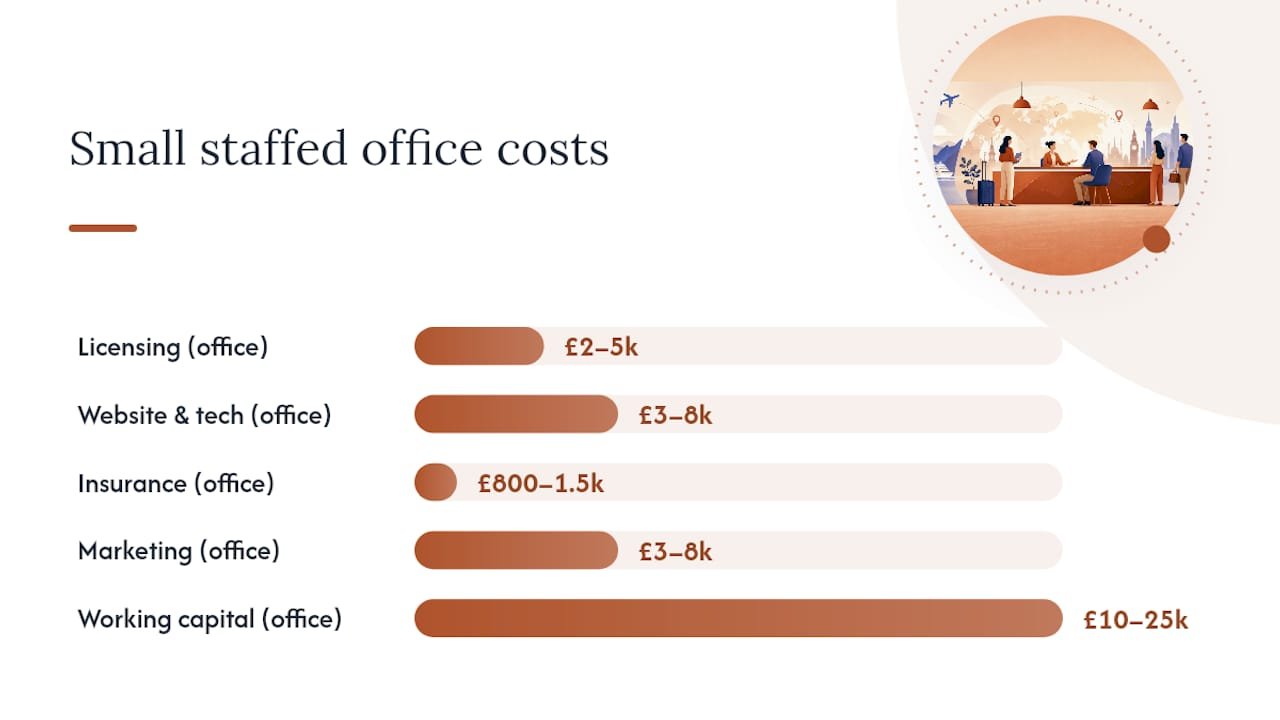
Startup costs vary enormously depending on the model. A lean, home-based agency running through a host agency or white-label platform can often launch within a low five-figure budget, largely covering licensing, insurance, a basic website, and working capital. A small storefront or staffed office typically needs tens of thousands of pounds once you account for rent deposits, fit-out, and a longer working-capital runway before bookings convert to cash.
Here’s a sample startup-cost table structured around a lean home-based launch versus a small staffed office, so you can copy the categories into your own spreadsheet:
| Cost category | Lean home-based | Small staffed office |
|---|---|---|
| Licensing, ATOL/host fees | £500 to £2,000 | £2,000 to £5,000 |
| Website and booking tech | £500 to £3,000 | £3,000 to £8,000 |
| Insurance (PI, PL) | £300 to £800 | £800 to £1,500 |
| Marketing launch budget | £1,000 to £3,000 | £3,000 to £8,000 |
| Office rent and deposit | Not applicable | £5,000 to £15,000 |
| Working capital (3 to 6 months) | £3,000 to £8,000 | £10,000 to £25,000 |
Your core assumptions need to be stated plainly in the plan, not buried in a spreadsheet nobody reads. State your expected bookings per month, your average revenue per booking, and your assumed commission retention rate (what you keep after any host agency or platform split).
Runway matters more than most new agents plan for. Booking-to-payment cycles in travel can run months from initial deposit to final commission payout, so your working-capital figure needs to cover that lag, not just your monthly overheads.
How does a white-label host agency change the numbers?
Joining a white-label or host-agency platform changes almost every figure in your financial model, usually for the better on cash flow and time to market. Instead of spending months negotiating supplier contracts and waiting on ATOL accreditation, you get immediate access to protected licences and negotiated rates on day one, at the cost of a commission share.
Run the two scenarios side by side in your model. An independent launch might take three to six months to secure supplier agreements and cost several thousand pounds in licensing and accreditation fees before a single booking is made. A host-affiliate or white-label route can compress that to weeks, trading a portion of commission for speed and lower upfront risk.
What to stress-test in your model:
- Commission retention rate under the affiliate agreement versus fully independent
- Booking-volume ramp in months one to six, since affiliated models often convert faster
- Average booking value, which shouldn’t change much between models but should still be tested
Pro Tip: When talking to a platform, ask specifically what percentage split applies at different booking volumes, whether there’s a monthly fee on top of the commission share, and what supplier categories you’ll have access to from day one. Get the answer in writing before you build it into your financial model.
What UK regulatory checks belong in the plan?
A plan without regulatory evidence reads as unfinished to anyone who’s funded a travel business before. The UK’s package travel and linked travel arrangements regulations set out organiser obligations and consumer rights that any UK agency selling package holidays must meet, and your plan needs to show you understand which obligations apply to your model.
The essentials to demonstrate:
- ATOL protection. Required if you’re selling flight-inclusive packages; confirms financial protection for customer payments if a supplier fails.
- ABTA or equivalent membership. Not a legal requirement, but a strong trust signal for both customers and lenders; membership involves an application fee and ongoing subscription.
- Package travel compliance. Confirm whether your bookings count as “packages” under the regulations, since the obligations differ for pure agency sales versus organised packages.
- PCI compliance for payments. Required if you’re processing card payments directly rather than through a payment processor that handles it for you.
- Data protection responsibilities. UK GDPR and the Data Protection Act apply to any customer data you hold, including passport and payment details.
ATIA’s resource on starting a travel business lists practical accreditation steps alongside the legal requirements, which is worth reading alongside the statutory text if you want the compliance and the commercial context side by side.
The clearest signal a plan is investor-ready isn’t the financial model, it’s whether the operations appendix shows exactly how a customer’s money is protected if a supplier collapses. That single page does more to build trust than three pages of projected revenue.
Pro Tip: Include a one-page consumer-protection summary in your appendix showing which bookings are ATOL-covered, how customer payments are held, and what your contingency process looks like if a supplier fails mid-trip. Lenders and partners read this before they read your revenue forecast.
How do you structure the operations and supplier section?
Map the booking workflow as a simple sequence: inquiry, needs assessment, itinerary proposal, booking and payment, pre-trip communication, and post-trip follow-up. Show this as a flow in your appendix, along with the actual documents (a sample supplier agreement, a client terms template) that prove the process exists rather than being aspirational.
Supplier access is the section investors scrutinise hardest, because a travel agency with no confirmed supplier relationships is really just an idea. Your checklist should include:
- Signed or in-progress supplier agreements, with commission terms recorded explicitly
- Confirmation of GDS, consortium, or host-agency access for wholesale rates
- A list of preferred suppliers by product category (hotels, cruise, tours, insurance)
Host agencies solve the “no supplier access” problem immediately, which is precisely why so many new agents choose that route over building direct supplier relationships from zero.
For technology, keep the stack lean at launch:
- A CRM to track client inquiries, preferences and booking history
- Booking and itinerary software integrated with your supplier or host-agency system
- Accounting software for invoicing, commission tracking and tax reporting
- A payment processor with PCI compliance built in
Budget a modest monthly software spend for the first year rather than a large upfront technology investment. Most of these tools are subscription-based and scale with booking volume.
How should the marketing and sales plan be structured?
Prioritise channels by how directly they connect to a booked trip, not by how easy they are to start. Specialist content and SEO tied to a single defendable niche consistently outperforms broad social spending, because it attracts people already searching for exactly what you offer. Referral and partnership channels (venues, wedding planners, corporate HR contacts) come next, followed by paid social for demand generation, email nurture for long-consideration trips, and PR once you have a track record worth writing about.
A sample 90-day launch plan and budget for a lean agency might look like this:
| Channel | Month 1 budget | Month 2 to 3 budget | Primary KPI |
|---|---|---|---|
| SEO/content | £200 (tools/setup) | £200/month | Qualified trip-brief inquiries |
| Referral/partnerships | £0 (time investment) | £100/month (materials) | Referral bookings |
| Paid social | £300 | £400/month | Cost per qualified inquiry |
| Email nurture | £50 (platform cost) | £50/month | Inquiry-to-booking conversion |
The KPI that matters most isn’t cost per lead, it’s cost per qualified trip brief and conversion to booked trip. A cheap lead that never converts is worse than an expensive one that does, and plans that only track cost-per-click tend to underestimate their real customer acquisition cost.
- Track qualified inquiries (people who’ve shared a real trip brief) separately from raw form fills
- Measure conversion rate from qualified inquiry to signed booking, by channel
- Review monthly and reallocate budget away from channels with weak booking conversion, even if their lead volume looks strong
What milestones and risks should investors see first?
Investors and host-agency partners scan the milestones and risk sections before they read the full financial narrative, because those two sections tell them whether you understand your own business.
Typical early milestones worth including:
| Milestone | Expected timing |
|---|---|
| Supplier/host-agency access confirmed | Month 1 |
| First 10 bookings completed | Month 2 to 3 |
| Break-even on monthly overheads | Month 6 to 9 |
| First corporate or group contract signed | Month 9 to 12 |
Your risk register needs at least three entries with honest mitigations, not vague reassurances:
- Cash shortfall from delayed commission payouts: Maintain a working-capital buffer covering three to six months of overheads.
- Supplier rate changes affecting margin: Diversify across two or more suppliers per product category rather than relying on a single wholesaler.
- Regulatory or accreditation delay: Apply for ATOL or host-agency affiliation well ahead of your planned launch date, and have a contingency launch date built into the plan.
What exit strategy should a travel agency plan include?
Most first-time agency founders skip this section entirely, and it’s one of the fastest ways to signal to an investor that you haven’t thought past year one. You don’t need a firm exit date. You need to show you’ve considered how the business could grow, be sold, or hand off, because that tells a lender or partner you’re building something with a lifespan beyond your own involvement.
Three realistic paths are worth naming. The first is organic growth into a small team-based agency, where you hire advisors and the business becomes a going concern that could eventually be sold as a client book and brand. The second is a niche acquisition exit, where a larger consortium or host agency network buys your client list and brand once you’ve proven a defendable specialty and consistent booking volume. The third is simply continuity: a lifestyle business you run indefinitely, drawing income rather than building toward a sale.
State which path you’re aiming for and why. If growth is the goal, show what year-three and year-five revenue needs to look like to be an attractive acquisition target, and name the kind of buyer (a larger agency, a consortium, a private equity-backed travel group) who’d plausibly be interested. If it’s a lifestyle business, say so plainly. Investors would rather fund an honest lifestyle plan than a growth story that doesn’t hold up under questioning.
Long-term growth options worth a paragraph each: adding a second niche once the first is profitable, building a small advisor team under your brand, or moving from a host-agency affiliate model to full independent accreditation once volume justifies the switch in commission retention.
What staffing plan does a travel agency need at launch?
Most agencies start as a one-person operation, and that’s fine for a plan, provided you show how and when that changes. Investors want to see a hiring sequence tied to revenue milestones, not a guess at headcount.
A realistic staffing plan for the first two years might look like this: founder handles sales, client relationships and operations alone through month six or until booking volume exceeds roughly 15 to 20 active client files at once. The first hire is typically a part-time or freelance travel advisor once booking volume justifies it, often around break-even. A second hire, often admin or bookkeeping support, follows once the founder’s time is dominated by sales rather than paperwork.
Roles to define even before you’re hiring:
- Travel advisor: Handles client consultations, itinerary building and booking; commission-linked pay structures are common at this stage.
- Operations/admin support: Manages supplier paperwork, payment processing and post-trip documentation.
- Marketing support: Often outsourced or part-time initially; content and social management.
Training matters more in travel than most small-business plans acknowledge, because a poorly briefed advisor can create a regulatory or customer-protection problem, not just a bad review. Budget for host-agency or ABTA-recognised training modules for any new advisor, and state in your plan how you’ll verify a new hire understands ATOL obligations before they take a booking. A hiring timeline with named triggers (revenue thresholds, booking volume) reads as far more credible than a flat “we’ll hire in year two.”
How do you build customer retention into the plan?
A travel agency’s economics depend heavily on repeat bookings and referrals, so your customer service strategy deserves its own short section rather than a single line buried in operations.
State how you’ll collect feedback after every trip, ideally through a short structured survey sent within a week of return, while the experience is still fresh. Use that feedback for two things: fixing operational gaps and generating testimonials or referral requests from satisfied clients.
Retention mechanics worth naming specifically: a follow-up cadence for past clients (a check-in three to six months after their return, ahead of their next likely booking window), a loyalty or referral incentive for repeat clients, and a clear complaints process that shows how you’d handle a supplier failure or service issue without leaving a client stranded.
Investors read this section as a proxy for lifetime customer value. An agency with no retention plan is implicitly assuming every booking is a one-off transaction, which is a weaker business model than one built on repeat relationships. If your financial model assumes a percentage of repeat bookings in year two and beyond, this is the section that has to justify that assumption with a concrete mechanism, not just an optimistic number in a spreadsheet.
Author perspective: what most first-time plans get wrong
The plans that fail aren’t usually the ones with weak writing. They’re the ones where the founder built the marketing section before testing whether anyone would actually pay the prices assumed in the financial model. Test pricing with real conversations before you hire anyone or commit to office space.
Three lessons worth taking seriously. First, get basic regulatory proof (ATOL access, a host-agency agreement) sorted before you spend heavily on marketing, because a beautiful website with no supplier access behind it converts nothing. Second, track advisor and founder capacity honestly. A one-person agency can realistically manage a finite number of active client files before service quality drops. Third, treat your first 90 days as a live test of your assumptions, not a victory lap. If your qualified inquiry-to-booking conversion is well below what your model assumed, fix the model before scaling spend.
The gap between a plan that looks professional and one that actually works usually comes down to whether the founder tested their numbers against real client conversations first.
How TimesHunters can accelerate your plan
Building the operations and regulatory sections of a travel agency business plan from scratch usually means months chasing supplier agreements and ATOL accreditation before you can even confirm your numbers. Timeshunters removes that bottleneck by giving partners immediate access to Times Travel group’s ATOL-protected licences, a branded booking site under your own name, wholesale hotel, cruise and tour inventory, managed payments, and automated client follow-up, so the operations chapter of your plan is largely written for you on day one.
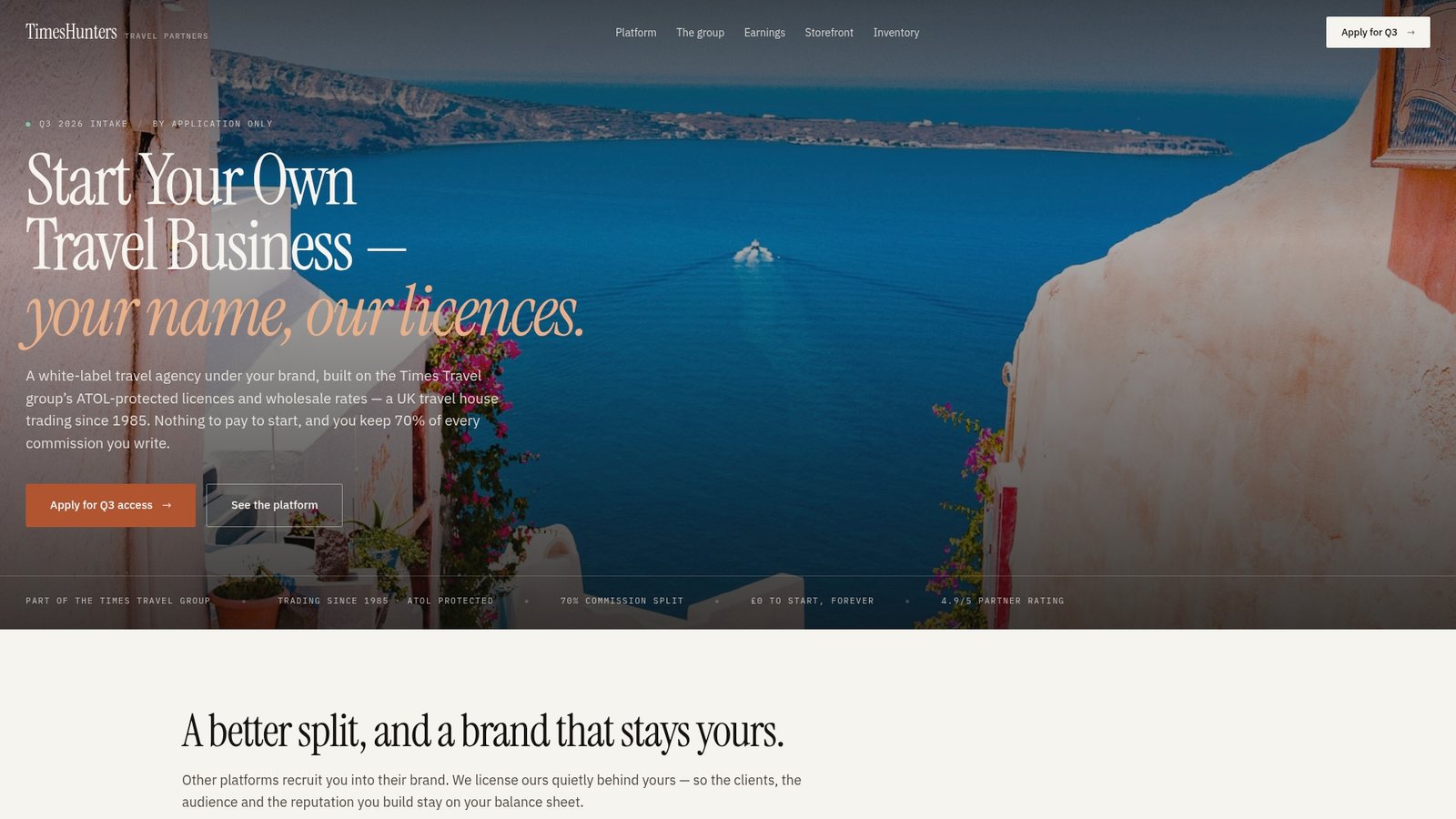
The commission structure changes your financial model directly. One partner has reported increasing their income from £400 to £1,200 per booking after switching to this model, a difference worth building directly into your cash-flow projections rather than treating as a footnote. If you’re weighing an independent launch against a faster, lower-risk route to market, visit the Timeshunters platform to see the partner terms and start the sign-up process.
Frequently asked questions
How long should a travel agency business plan be?
Most funding-ready plans run 15 to 25 pages excluding appendices. A one-page version for early market testing should fit on a single sheet: mission, target customer, revenue model and funding ask only.
Do I need ATOL protection to write a viable travel agency business plan?
If you’re selling flight-inclusive packages, yes, and your plan needs to show either your own ATOL accreditation or access through a host agency or white-label platform. Pure agency sales of non-package products carry different obligations.
What’s a realistic startup cost for a UK travel agency?
A lean, home-based agency operating through a host agency or platform can often launch in the low five-figure range. A staffed office setup typically needs tens of thousands of pounds once rent, deposits and working capital are included.
Should I use a host agency or launch independently?
A host agency or white-label platform gives immediate ATOL and supplier access in exchange for a commission share, which usually beats the time and cost of building independent accreditation from zero, especially for a first-time founder.
What financial statements does a lender expect to see?
A five-year profit and loss statement, a cash-flow forecast (monthly for year one), a balance sheet, and a break-even analysis tied to a clear use-of-funds table for any requested capital.
Sources
A handful of external resources are worth bookmarking alongside your own draft. For the legal backbone, read the UK package travel regulations directly rather than relying on secondhand summaries, and cross-check practical steps against Startups.co.uk’s guide to starting a UK travel agency.
For sample plans to adapt rather than copy, LivePlan’s travel agency template and Upmetrics’ funding-ready example both show credible financial layouts. Growthink’s downloadable PDF offers a similar nine-section structure worth comparing against your own draft.
For deeper marketing planning once your core plan is written, the 90-day digital marketing framework referenced earlier expands on channel sequencing in more detail than the marketing section of most business-plan templates covers.
- Legislation
- How To Start A Travel Agency (6-Step Guide To Success)
- Travel agency business plan | LivePlan
- Travel Agency Business Plan: Funding-Ready Sample Document