
How to become a travel agent in the UK: your route to self-employment
Discover how to become a successful travel agent in the UK quickly and easily. Learn the best routes for self-employment today!

Yes, you can become a UK homeworking travel agent, and for most people the fastest lawful route is trading under an established host, franchise or white-label platform rather than applying for your own ATOL licence from scratch. That single decision determines almost everything else: how quickly you can take your first booking, how much regulatory paperwork lands on your desk, and how much of each commission you actually keep.
Two things to sort in your first week:
- Pick your model. Decide between a host agency, a white-label platform, a franchise, or going fully independent, based on how much capital and admin you want to carry.
- Check financial protection before you touch client money. Confirm your host’s ATOL or ABTA cover, or start your own Small Business ATOL (SBATOL) application if you’re going it alone.
Trading under a reputable host or white-label licence typically gets you compliant and selling within weeks rather than the months a standalone ATOL application demands.
Key Takeaways
Most UK homeworkers reach paid trading fastest and most affordably by launching under a host or white-label platform’s ATOL protection rather than pursuing an independent licence first.
| Point | Details |
|---|---|
| Choose your model first | Host, white-label, franchise or independent each carry different costs, speed and commission tradeoffs. |
| Never trade without protection | Confirm ATOL, ABTA or SBATOL cover before taking a single client deposit. |
| Budget realistically | Home-based startups often run £1,000 to £5,000; independent licensing can reach the tens of thousands. |
| Systems beat hustle | CRM, booking automation and payment tools determine how many bookings you can actually handle. |
| Consider partner commission splits | Timeshunters offers commission under ATOL-protected licences, well above typical host or affiliate shares. |
Table of Contents
- Which business model suits becoming a travel agent in the UK?
- How do you set up as a travel agent in your first 90 days?
- What does it cost to start a travel agency from home?
- What legal and regulatory boxes must you tick?
- What qualifications and skills actually matter?
- How does a white-label platform change the economics?
- What the industry gets wrong about “easy” homeworking
- Ready to trade under your own brand?
- Sources
Which business model suits becoming a travel agent in the UK?
Your choice of model shapes your legal exposure, your startup costs, and your commission. Most newcomers trade under a host agency or CAA Accredited Body rather than holding their own ATOL, which lets them start selling without the capital checks and lengthy processing time a direct application involves.
- Host agency: You trade under the host’s ATOL and ABTA membership, usually for a monthly fee or commission split. Setup is quick and compliance is largely handled for you, but you’re often limited to the host’s preferred suppliers and your commission share can be modest.
- White-label platform: You get your own branded booking site and client list while trading under the platform’s ATOL-protected licence. Automation handles quotes, payments and follow-up, and partner commission splits tend to run far higher than the 3 to 5% many online travel agencies pay affiliates.
- Franchise: You buy into an established brand’s systems, marketing support and supplier deals. Franchise fees and ongoing royalties can be steep, and you’ll have less freedom over branding and pricing than with a host or white-label route.
- Independent agency: You hold your own ATOL or SBATOL, negotiate your own supplier contracts, and carry the full weight of ATOL and accreditation requirements yourself. It’s the highest-effort route, and the one that demands the most capital and admin before you sell a single holiday.
How do you set up as a travel agent in your first 90 days?
Treat the first three months as a checklist, not a vague ambition. Here’s the order that actually works:
- Decide your model and niche. Pick host, white-label, franchise or independent, and choose a travel niche you can speak to with confidence.
- Register your business. Sole trader registration with HMRC is quick and cheap; a limited company through Companies House adds liability protection and slightly more paperwork.
- Confirm financial protection. Never take a client’s deposit until you know exactly how that money is protected, whether through a host’s ATOL, ABTA membership, or your own SBATOL application.
- Build your core systems. You need a booking management tool, a CRM for client history, a payment processor, and basic accounting software from day one.
- Get insured and compliant. Professional indemnity and public liability cover, ICO registration for data protection, and clear written terms and pricing for every client.
- Start marketing on a small scale. Pick one niche, tell your existing network you’re trading, and set up a simple referral routine before you spend a penny on adverts.
Pro Tip: Don’t wait until you have a polished website to start talking to potential clients. Your first five bookings will teach you more about pricing and process than any course.
What does it cost to start a travel agency from home?
Startup costs vary enormously by model, and the Small Business ATOL scheme exists precisely because full ATOL licensing is disproportionate for a one-person operation. SBATOL currently costs approximately £1,223 annually plus separate CAA application fees, significantly less than full ATOL bonding and capital requirements [CAA ATOL fees].
Home-based setups trading under a host or white-label platform typically involve modest startup costs covering insurance, software subscriptions and basic marketing. Franchise and fully independent routes push that considerably higher. Sometimes it reaches into the tens of thousands once licensing, bonding and franchise fees are factored in.
Commission mechanics matter as much as the headline percentage. Suppliers pay a base commission on each booking; your host or platform takes a cut, and you keep the rest. A host might leave you with a modest single-digit share after their cut, while white-label partner arrangements can leave you with considerably more per booking.
- Keep three months of working capital aside for refunds, deposits and the inevitable slow season.
- Track margin per booking, not just revenue, since a busy month with thin commissions can leave you worse off than a quiet one with strong margins.
- Prioritise protection and automation costs over vanity spending like a premium office setup.
What legal and regulatory boxes must you tick?
You cannot legally sell flight-inclusive package holidays without financial protection in place, and this is the single biggest compliance trap for new agents. Trading under a host’s ATOL or ABTA membership covers you automatically; going independent means applying for your own ATOL or SBATOL through the CAA.
- ATOL or SBATOL: Required if you’re selling flight-inclusive packages directly rather than through a protected host.
- Package Travel Regulations: Amendments affecting how package and Linked Travel Arrangements are classified and protected take effect from April 2027, so check your host’s compliance stance regularly rather than assuming it’s fixed.
- ABTA membership: Not a legal requirement, but a strong commercial trust signal that many clients and suppliers expect to see.
- ICO registration: Any business handling client personal data needs to register and pay the relevant fee tier under UK GDPR rules.
What qualifications and skills actually matter?
Formal qualifications help, but they’re not the only door in. The National Careers Service outlines a Travel Consultant Level 3 apprenticeship, typically taking around a year and usually requiring five GCSEs at grades 9 to 4, alongside college diplomas and direct on-the-job entry through a host or platform.
- Apprenticeships and college routes build credibility if you’re starting from scratch with no industry contacts.
- Short industry courses from hosts and platforms get you selling faster, often within weeks rather than a full academic year.
- Day-to-day skills that pay off fastest: confident CRM use, supplier negotiation, accurate document issuing, and knowing where your advisory boundaries sit, particularly around visas and health requirements, where you should always point clients to official government travel advice rather than guessing.
Most host platforms provide structured onboarding and supplier training as standard, which shortens the learning curve considerably compared with figuring out supplier relationships alone.
How does a white-label platform change the economics?
Commission structure is where most new agents underestimate the gap between models.
One partner reported their income per booking rising from £400 to £1,200 after switching to this structure, a direct result of keeping far more of each commission rather than handing the bulk of it to a marketplace.
This model suits people who already have an audience or network, whether that’s an existing hospitality business, a social following, or simply a strong personal network, and who want automated booking management rather than building supplier relationships from zero. It asks partners to actively sell and maintain client relationships; it isn’t a passive income scheme.
Pro Tip: If you’re weighing host fees against partner commission splits, run the maths on your expected booking volume first. A higher commission share only helps if you’re actually generating leads to convert.

What the industry gets wrong about “easy” homeworking
The travel industry sells homeworking as a lifestyle choice, and that framing does new agents a disservice. Running a homeworking travel business is running a small business, with all the cashflow discipline, admin, and client-relationship graft that implies, just without the commute.
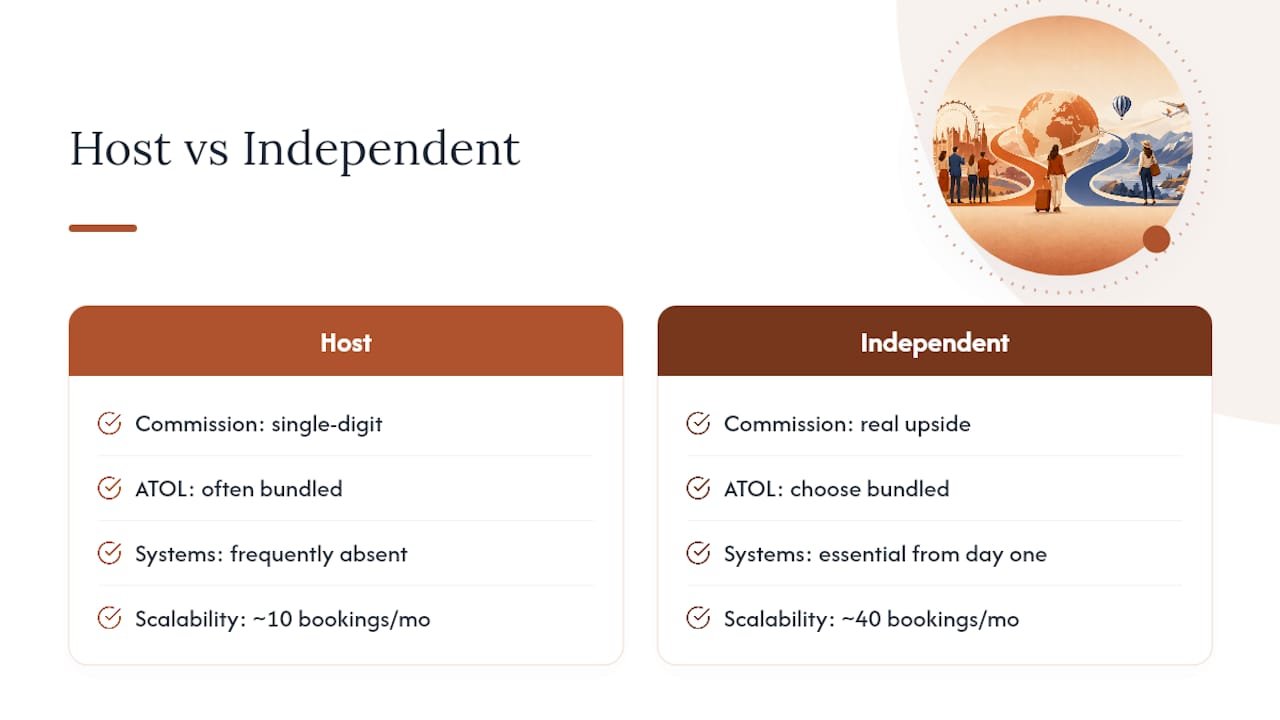
Where conventional advice falls short is in treating the host-versus-independent decision as purely a compliance question. It’s really a commission question dressed up as a compliance question. Plenty of guides walk readers through ATOL and SBATOL requirements in detail, then gloss over the fact that many host arrangements leave new agents with a thin single-digit commission share after the host’s cut. That’s the number that determines whether you’re running a viable business or a hobby with invoices.
The evidence points to automation mattering more than most new agents expect. Booking management, CRM and payment systems aren’t back-office luxuries; they’re what separates agents who can handle forty bookings a month from those stuck at ten because everything’s manual. Prioritise a model that bundles genuine ATOL protection with real commission upside and proper systems from day one, rather than choosing on brand recognition alone.
— Sam
Ready to trade under your own brand?
If you’ve read this far, you already know the tension: host agencies get you compliant fast but often cap your commission, while going fully independent gives you control but demands capital and months of licensing admin you probably don’t have spare right now. Timeshunters sits between those two extremes deliberately. You trade under ATOL-protected licences from the Times Travel group, so the compliance burden that stops most independents from launching quickly simply isn’t yours to carry.
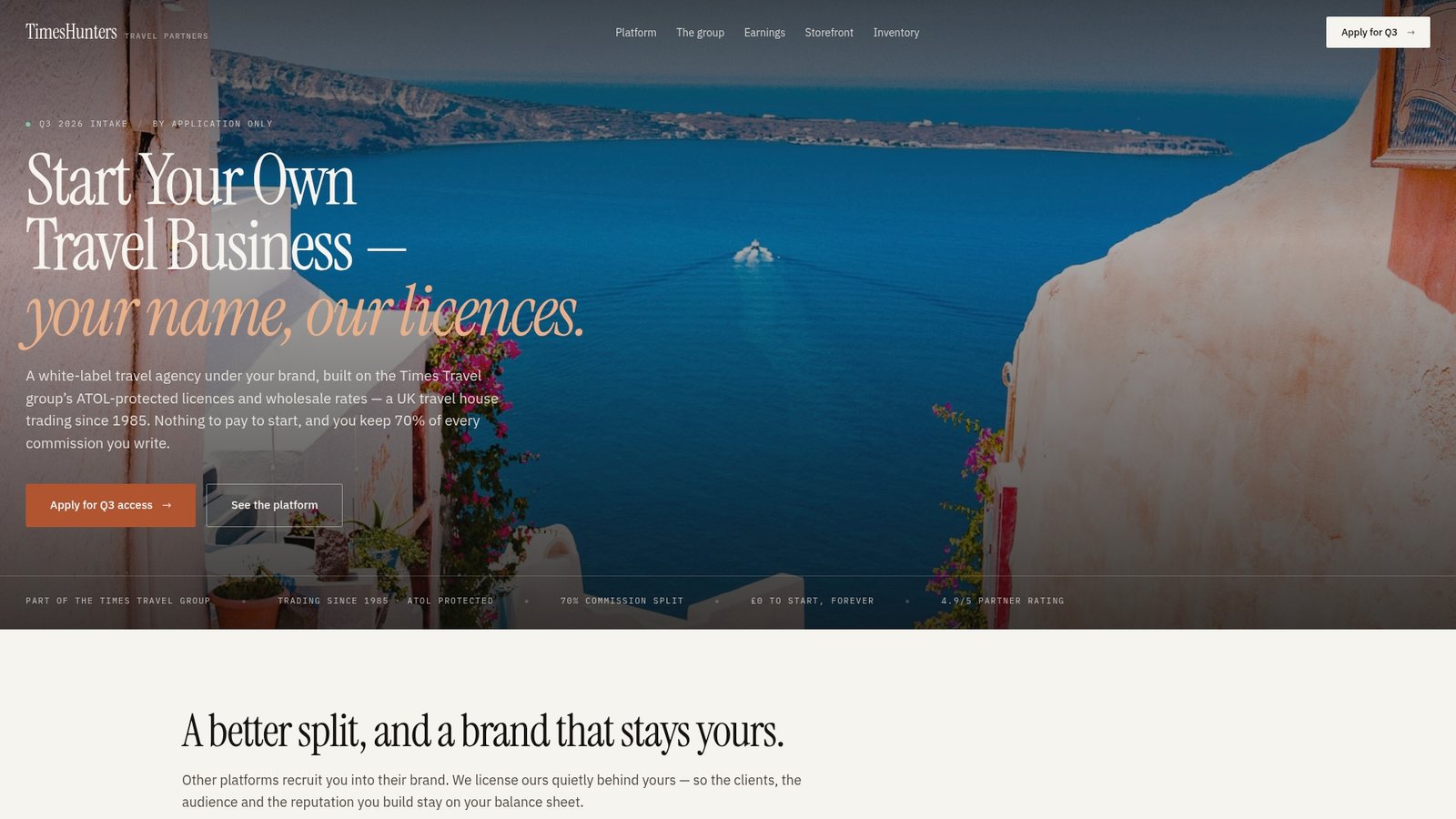
It suits people with an existing audience or network who want to build a personal client list rather than rent one from a marketplace. Fees and commission structures are explained upfront before you commit to anything. If that fits where you are, explore the Timeshunters partner programme and request an exploratory conversation about what onboarding looks like for your situation.
Sources
- Travel agent | Explore careers
- Gov
- How To Start A Travel Agency (6-Step Guide To Success) | Startups