
Travel agent lead generation: fastest wins that work now
Boost your travel agent lead generation with a high-converting website, live chats, and rapid follow-ups for faster bookings.

Start with a converted website, one live capture channel, and a 72-hour follow-up plan. That combination beats every other single tactic for speed to first booking, because it fixes the leak most agencies never notice: visitors who arrive interested and leave unconverted.
Three moves to make today:
- Fix your website’s conversion path. Add a clear enquiry form above the fold and cut load time.
- Turn on live chat or an AI capture agent. Static forms convert visitors at 2 to 3%; conversational tools push that into the 15 to 30% range.
- Build a 72-hour follow-up cadence into your CRM. First reply within minutes, a call within 24 hours, a tailored proposal by hour 72.
These three fix speed and capture rate at once, the two variables that decide whether a browsing visitor becomes a paying client.
The agents who win the booking are rarely the ones with the best itinerary. They’re the ones who replied first.
Expect your first booked client from this setup within two to four weeks if your traffic is already reasonable.
Key Takeaways
Travel agent lead generation works best when a converted website, one live capture channel, and a fast follow-up cadence operate together, with paid or owned channels layered on afterward.
| Point | Details |
|---|---|
| Fix capture before spending | A converted website and live chat catch visitors who would otherwise leave without enquiring. |
| Speed decides bookings | A 72-hour cadence, with first reply in minutes, consistently outperforms slower follow-up. |
| Match channel to timeline | Paid search and lead marketplaces work fastest; SEO and referrals compound over months. |
| Vet every vendor | Ask for sample leads, verification method, and refund terms before paying for leads. |
| Commission structure changes the maths | TimesHunters offers a 70% commission split with ATOL protection, turning owned client relationships into higher-value bookings than most bought-lead models. |
Table of Contents
- What are the best channels for travel agent lead generation?
- Should you buy leads or hire an agency instead of building your own channels?
- How do you convert a travel lead into a booked client?
- What does travel agent lead generation cost, and how long until it pays off?
- How do you choose the right lead source for your agency?
- Which tools speed up lead capture and follow-up?
- How can a white-label platform generate and convert leads for you?
- Frequently asked questions
- Sources
What are the best channels for travel agent lead generation?
Referrals convert best because trust is already built, but they’re slow to scale. Paid search and lead marketplaces move fastest but cost more per enquiry. Content and SEO compound over months and eventually produce your cheapest leads. Most agencies need two or three of these running together, not one.
Here’s how the main channels stack up by funnel position and speed:
- Referral and incentive programmes — bottom-funnel, highest close rate, slowest to scale. A dual-sided incentive (discount for both referrer and new client) consistently outperforms one-sided offers.
- Email marketing — mid-funnel nurture. Segment by intent (booking within weeks vs. still dreaming) so a couple planning a honeymoon isn’t getting the same email as someone browsing inspiration content.
- Content and SEO — top-to-mid funnel, six-plus months to gain traction, but the cheapest cost-per-lead once it ranks.
- Instagram, Facebook, TikTok — top-funnel discovery, works best paired with a lead magnet (a downloadable packing guide, a destination quiz) rather than a bare “book now” post.
- LinkedIn — your best channel if you sell corporate or group travel; personal outreach to HR managers and office admins outperforms cold ads here.
- Google Business Profile — near-zero cost, high local intent; keep it updated with photos and respond to every review.
- Paid search and paid social — fastest to launch, immediate volume, but margins get thin without tight targeting.
- Events and partnerships — venue tie-ups, wedding fairs, corporate lunch-and-learns. Slow to organise, strong close rate once the relationship exists.
Setup checklist for your top three channels: confirm your Google Business Profile is claimed and complete, install a lead capture form with UTM tracking on your site, and set up one automated welcome email sequence before you spend a penny on ads.
Pro Tip: Pair an Instagram funnel with a downloadable lead magnet, then retarget everyone who downloaded it with a Facebook ad for the exact destination they showed interest in. The retargeted click converts far higher than a cold one because the intent signal is already there.
Whatever channel you use to capture contact details, get explicit consent for marketing communications and keep a record of it. GDPR compliance isn’t optional once you’re storing names, emails, and travel preferences.
Should you buy leads or hire an agency instead of building your own channels?
It depends how fast you need bookings and how much time you have to build owned channels. Buying leads gets you enquiries this week. Building your own channels gets you cheaper leads eventually, but takes months. Most established agencies end up doing both.
| Option | Best for | Pricing model | Lead type | Vetting | Avg. cost per lead | Refunds/guarantees | CRM/API integration | Coverage |
|---|---|---|---|---|---|---|---|---|
| TimesHunters | Aspiring entrepreneurs and small agencies wanting a branded business, not just enquiries | Commission split (70% to partner) rather than per-lead fee | Owned client relationships, not third-party leads | N/A. leads come from the partner’s own marketing | Not applicable. no CPL | ATOL-protected bookings, no lead refund needed | Automated booking management built in | UK-based licences |
| Exclusive lead marketplaces | Agents who can respond within minutes and want no competition on the enquiry | Cost-per-lead | Mostly B2C | Filtered by destination, budget, and dates before delivery | Higher than shared leads | Rarely refunded once delivered | Often SMS/email alerts, limited CRM sync | Varies by provider |
| Shared pay-per-lead marketplaces | Agents testing volume on a budget | Cost-per-lead | B2C | Basic screening, sold to multiple agents | Lower than exclusive leads | Rarely offered | Basic or manual | Varies by provider |
| Lead generation agencies/outreach services | Agencies wanting outsourced pipeline building | Monthly retainer | Mostly B2B (corporate, group) | Managed by the agency running outreach | Blended into retainer, not per-lead | Contract-dependent | Reporting dashboards, some CRM integration | Depends on agency |
| AI capture and qualification tools | Agents with existing site traffic who want to convert it | Software subscription | Both | Qualifies via conversation before routing | Low relative to volume captured | Standard software refund terms | Native CRM/API connections | Wherever your site gets traffic |
A few things worth knowing before you commit budget: exclusive marketplaces like TourGrids argue that sending a verified lead to only one agent, with real-time SMS alerts, raises answer and close rates compared with shared models. Platforms such as Lead Hive add intent scoring and built-in CRM tracking so you’re not guessing which enquiries are actually close to booking. Providers like LeadBeet sell on a pay-per-lead basis, pitching leads as travellers already researching with a destination and budget in mind.
- Buying leads makes sense when you need bookings inside the next fortnight and have the follow-up capacity to act on them fast.
- Owned channels make sense when you’re building a sustainable business, not chasing a quarterly gap.
- A platform like TimesHunters sits differently again: rather than buying someone else’s leads, you’re building your own client base under your own brand, with the commission structure to make each booking worth substantially more.
Before paying anyone for leads, ask for sample data, a written refund policy, and evidence of how they verify contact details.
How do you convert a travel lead into a booked client?
Qualify fast, using four questions: what’s the intent (dreaming or booking), what’s the budget, when do they want to travel, and are you speaking to the actual decision-maker. Leads that clear all four go straight into your “hot” pipeline stage; everyone else goes into a nurture sequence.

The cadence that works: reply within minutes if it’s a live chat or phone enquiry, follow up by phone or personalised email within 24 hours, and send a tailored proposal by the 72-hour mark. Automating the reminders in your CRM is what actually makes this achievable when you’re juggling existing clients.
Sample first-contact line: “Thanks for your enquiry about [destination] — I’ve got a couple of questions so I can put together options that actually fit what you want, rather than a generic package.” Follow-up email subject: “Your [destination] options are ready.” For the common “just looking around” objection: “No pressure at all. Can I send you three options so you’ve got something to compare when you are ready?”
A lead that sits untouched for six hours is already colder than one you called back in six minutes.
Tag every lead by destination, budget band, and travel window in your CRM so follow-up messaging is never generic.
What does travel agent lead generation cost, and how long until it pays off?
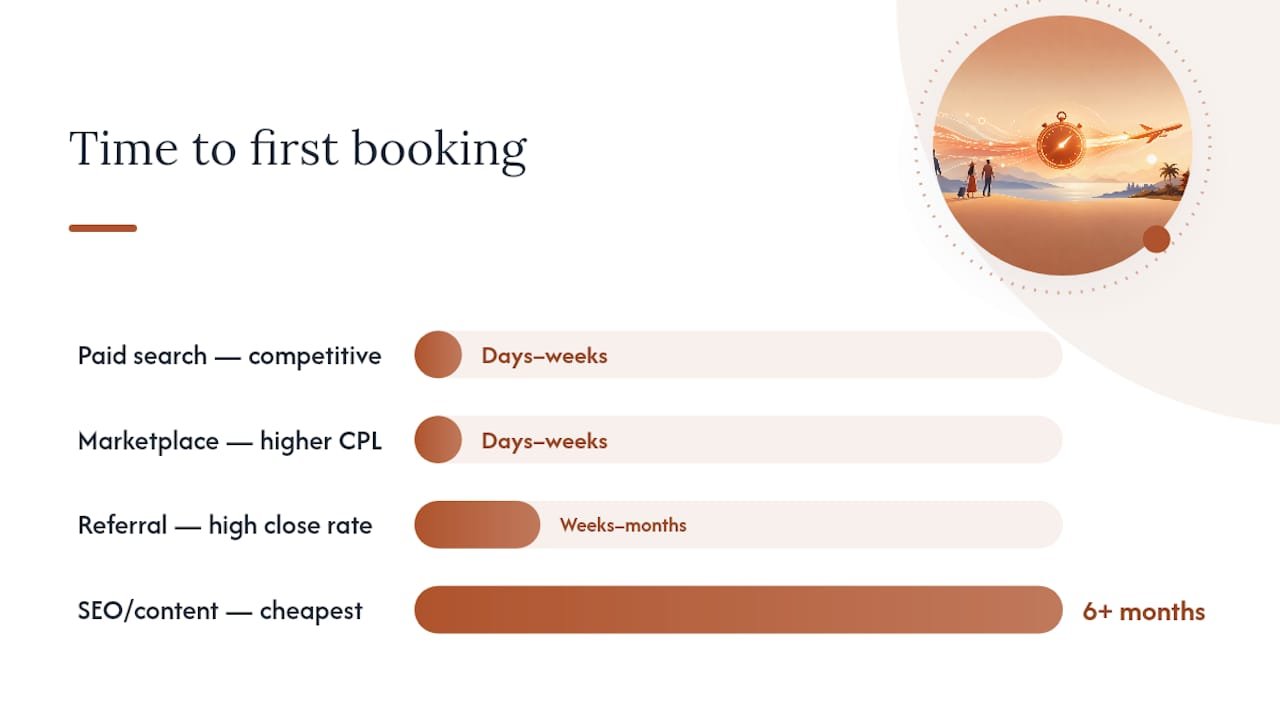
Paid search and lead marketplaces move fastest, often producing a first enquiry within days, but cost per lead varies widely by destination and competition. SEO and content take the longest, often six months or more, but eventually produce your lowest cost per booking.
A simple ROI formula: conversion rate × average booking value × commission rate = expected return per lead.
| Channel | Typical timeline to first booking | Notes |
|---|---|---|
| Paid search / PPC | Days to weeks | Fastest, but competitive on price |
| Exclusive lead marketplace | Days to weeks | Higher CPL, higher answer rate |
| Referral programme | Weeks to months | Slow to build, highest close rate |
| SEO / content | 6+ months | Compounds into the cheapest long-term source |
How do you choose the right lead source for your agency?
Run every vendor through the same checklist before you commit budget:
- Ask how leads are verified. is it a real person with confirmed contact details and stated intent?
- Ask whether leads are exclusive or shared with competing agents.
- Ask for a sample batch or delivery log before signing anything.
- Confirm the refund or replacement policy for invalid leads.
- Check how easily the leads or platform integrate with your existing CRM.
- Red flag: opaque pricing with no published CPL or retainer range.
- Red flag: a vendor that won’t provide sample leads or case studies on request.
- Red flag: long onboarding with no pilot period to test quality first.
Pilot a paid provider for a month before committing further. If your own channels already produce steady enquiries, put fresh budget into content and referrals instead. cheaper long-term, and you own the client relationship rather than renting it.
Which tools speed up lead capture and follow-up?
The categories worth setting up first: a conversational AI or chatbot on your site, a CRM that supports tagging and automation, an email sequence tool, scheduling links, and a quoting tool that can send a payment link in the same message.
Three templates worth copying today:
- Acknowledgement email: “Got your enquiry. I’ll have options for you within 24 hours.”
- Quote follow-up: “Here’s your proposal. happy to adjust anything before you decide.”
- Urgency nudge: “This rate is held for 48 hours. want me to confirm it?”
Every manual step between a lead landing and a proposal going out is a chance for them to book with someone else instead.
Connect your chatbot to your CRM via a native integration or Zapier so no enquiry ever needs retyping by hand.
How can a white-label platform generate and convert leads for you?
A platform built around your own brand changes what a lead is worth. Instead of a one-off commission of a few percent from an online travel agency, TimesHunters structures partner commission at 70%, using Times Travel group’s ATOL-protected licences so bookings carry proper financial protection without you needing your own licence.
- ATOL-protected licences mean clients book with confidence and you’re not carrying the compliance burden alone.
- A branded booking site means the leads you generate through referrals, social, or your own outreach stay under your name, not a marketplace’s.
- Wholesale inventory access gives you pricing that’s harder to beat with DIY booking sites.
- Automated booking management handles the admin so a solo entrepreneur can run a client base that would otherwise need a small team.
Picture the sequence: a lead comes from a referral or an Instagram enquiry, you send an instant pricing proposal from the platform’s inventory, the client books through your branded site, and the automated system handles payment and confirmation while you move to the next enquiry. One partner reported income per booking rising from £400 to £1,200 using this structure, purely from the commission split.
The lead generation tactics matter less once the commission on each one is three times higher.
Choose a white-label platform over buying leads when you want to build a business with your name on it, not just a stream of one-off enquiries.
Author perspective: what works now for travel agents
Referrals and a fast, automated follow-up are the two most dependable levers right now. paid leads work, but only if you can answer within minutes, not hours. I’d rather see an agent spend the first three months tightening their website and follow-up cadence than pouring money into ads that convert poorly because nobody’s answering fast enough. Volume without a conversion system is just an expensive vanity metric.
A faster route to branded bookings with TimesHunters
Most of the tactics above generate enquiries. There’s no need to become a licensing expert or build booking infrastructure from scratch.
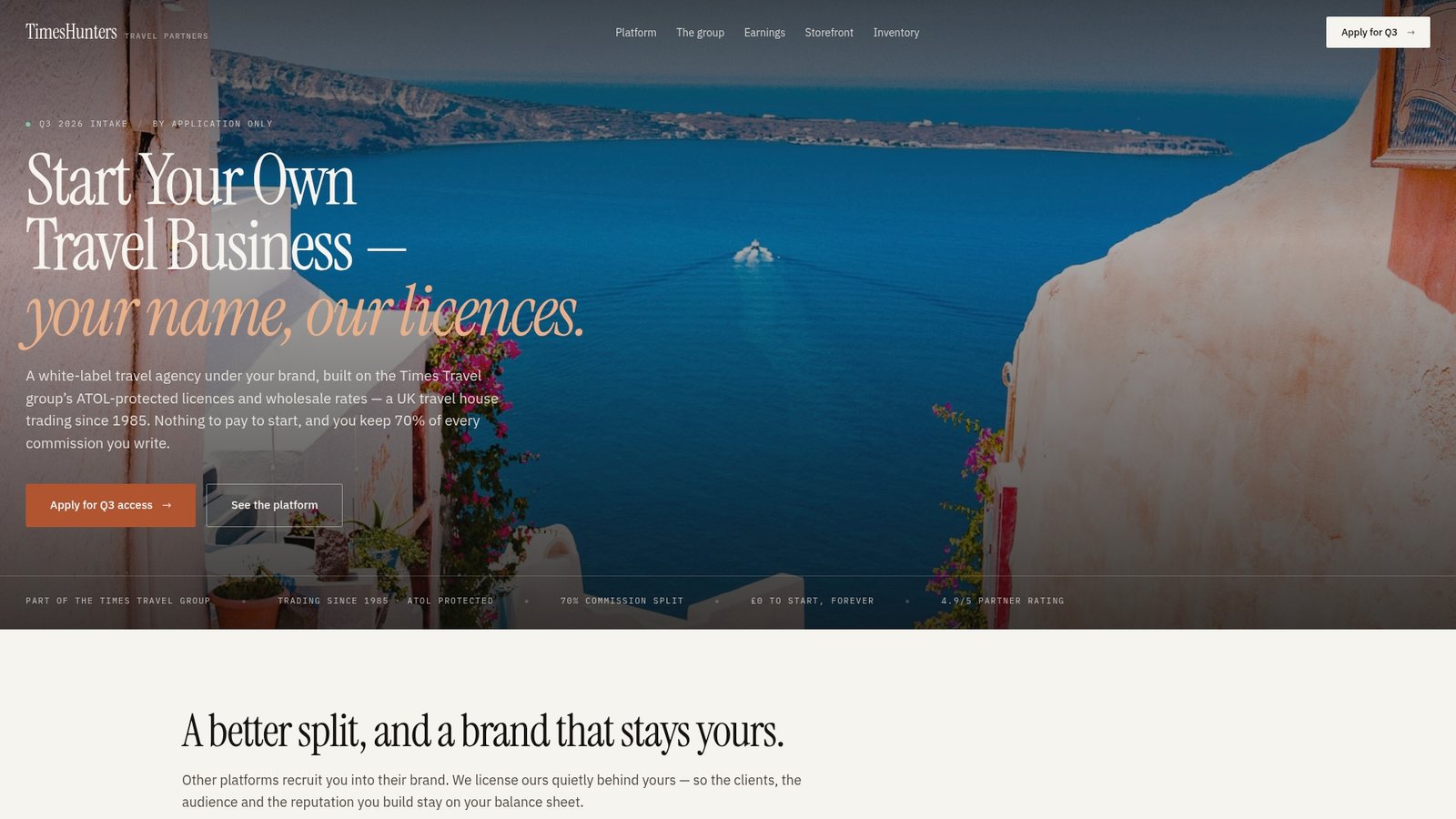
Onboarding gets you a branded booking site, access to wholesale hotel, cruise, and tour inventory, and automated booking management from day one, so the leads you’re generating with the strategies above actually convert into commission that reflects the work you put in. If you’re ready to see what that commission structure looks like against your own numbers, start your TimesHunters application and get pricing and onboarding details directly.
Frequently asked questions
What is the fastest way to generate travel agent leads?
Fixing website conversion and adding live chat or an AI capture tool produces results within days, since it converts traffic you’re already getting rather than waiting on new channels to build.
How much does a travel lead typically cost?
It varies by exclusivity and niche. exclusive, verified leads carry a higher cost-per-lead than shared marketplace leads, but tend to convert better because there’s no competing agent racing you to respond.
How long does travel agent lead generation take to produce a booked client?
Paid channels and lead marketplaces can produce a first booking within weeks. SEO and referral programmes usually take months to build momentum but produce cheaper leads long-term.
Is buying travel leads worth it compared with building my own audience?
Buying leads suits agents who need bookings quickly and can respond fast. Building owned channels, referrals, content, and email, generally produces a lower cost per booking over time but takes longer to establish.
What should I ask a lead provider before paying?
Ask how leads are verified, whether they’re exclusive or shared, what the refund policy covers, and whether you can see a sample batch before committing.
Sources
- Promodo
- Buy Exclusive Travel Leads for Agents | TourGrids
- Lead Generation AI Agent for Travel Agencies | Tars
- Lead Hive | TravelOnly’s Lead Generation & Partnership Platform for Travel Advisors and Suppliers
- LeadBeet | Travel Agent Leads