
Build a travel agency website that starts earning in weeks, not months
Launch your travel agency website and start earning in weeks! Follow our proven steps to build a site that attracts clients and boosts bookings.

The fastest way to build a professional travel agency website is to pick a platform matched to your scale, install a travel-ready template, wire in a booking enquiry form and payments, then launch behind a short trust checklist. Most solo agents can be live within a week using a white-label travel platform or a well-configured WordPress site.
Three things to do today:
- Pick your platform (site builder, WordPress, or a white-label travel platform).
- Add a booking or enquiry form that captures the trip, dates and budget.
- Connect a payment method and write a one-paragraph terms page.
Before you take a single booking, add SSL, a clear terms and conditions page, and a visible note on how client money is protected.
A travel website has one job before it has any other: make a stranger trust you enough to hand over a deposit. Everything else, imagery, copy, integrations, serves that single goal.
Key Takeaways
Launching a travel agency website fast means matching your platform to your scale, building a real lead-capture form before a homepage, and putting trust signals in front of every booking button.
| Point | Details |
|---|---|
| Pick platform by need | Choose DIY builders for speed, WordPress for control, white-label platforms for built-in booking and compliance. |
| Lead capture comes first | Build your enquiry form before your homepage so no visitor interest gets lost. |
| Mobile speed decides conversions | A slow mobile site is consistently cited as the top barrier to travel bookings. |
| Trust signals near the booking button | Show financial protection, testimonials and clear terms right where visitors decide to enquire. |
| White-label route shortens launch | Timeshunters offers ATOL-protected branded sites with a 70% commission split versus roughly 4% from online travel agencies. |
Table of Contents
- How to build a travel agency website in seven steps
- DIY builder, WordPress, or a white-label travel platform?
- What pages actually turn visitors into enquiries?
- Which integrations should you install first?
- Does your site actually convert on mobile?
- What belongs on your pre-launch checklist?
- How does a white-label partner speed things up?
- What trips people up most when building a travel site
- Want a branded site without building the backend yourself?
- Frequently asked questions
- Sources
How to build a travel agency website in seven steps
Building a travel agency website is not a single task, it’s seven smaller decisions made in the right order. Skip the order and you end up redesigning pages three times, which costs more than getting them right once.
1. Define your niche and services (half a day). Generalist agencies compete against giant online travel agents on price, and lose. Specialists, honeymoon planners, ski specialists, faith-based group tours, win on trust and depth. Decide what you sell before you decide what the site looks like.

2. Lock your brand and domain (one day). Buy a domain that matches your business name, not a keyword-stuffed guess. Pick two or three brand colours and one font pairing and stop there. A restrained palette reads as more professional than a busy one, particularly against warm, editorial imagery.
3. Choose your platform (covered in detail below). This decision shapes everything that follows, so don’t rush it, but don’t overthink it either. Most first-time agency owners spend too long comparing builders and not enough time on page content.
4. Design with conversion in mind, not decoration in mind. Every page needs one obvious next step; a “Get a Quote” button, an enquiry form, a phone number. A curated round-up of agency sites shows the pattern repeatedly: large hero imagery, a visible price cue, and a single clear call to action above the fold.

5. Add the booking flow and payment gateway. Even a simple enquiry form that routes to your inbox beats no form at all, but a proper booking or quote-request tool that captures dates, party size and budget will convert better and save you hours of email back-and-forth.
6. Integrate a CRM or lead-capture tool. Automated enquiry forms that route straight into a CRM or booking queue, tagged by source and service type, capture considerably more usable leads than a site that just emails you and hopes you reply in time.
7. Test on mobile, then launch. Check every form on a phone, check page load speed, and check that your booking button is reachable with a thumb, not just a mouse.
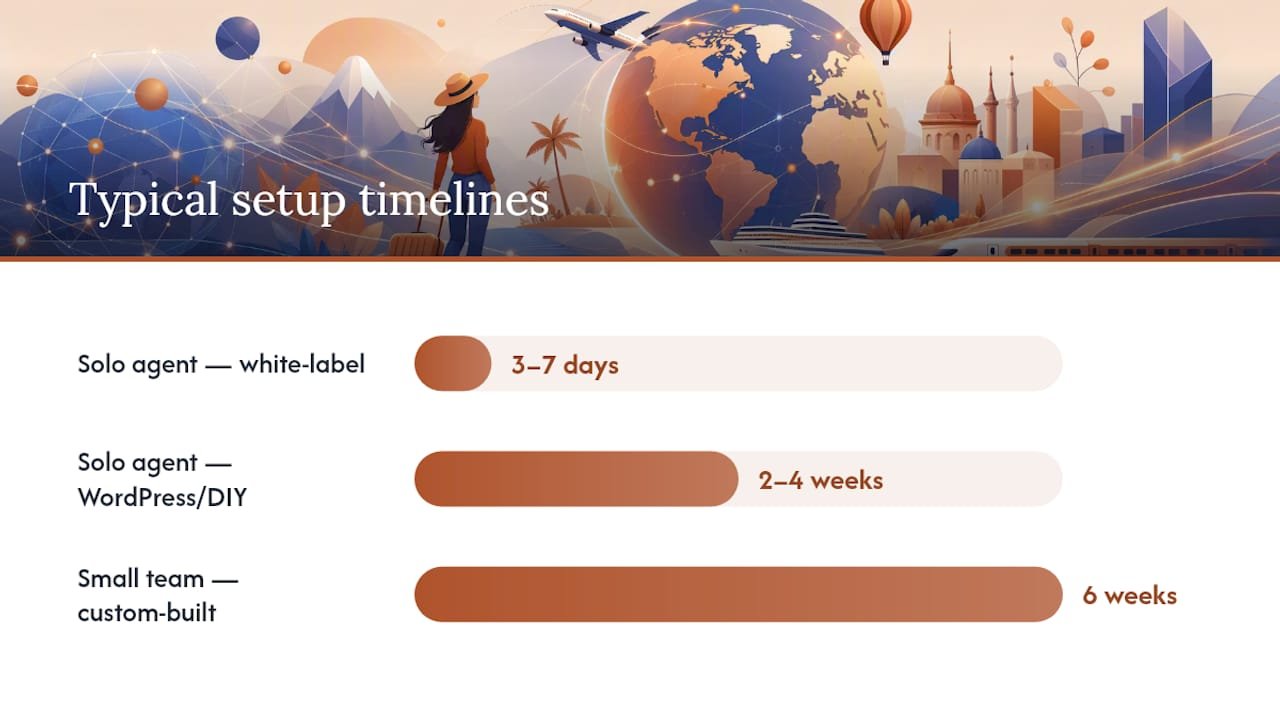
Realistic timelines
| Setup | Typical timeline |
|---|---|
| Solo agent, white-label platform | 3 to 7 days |
| Solo agent, WordPress/DIY builder | 2 to 4 weeks |
| Small team, custom-built site | 6 weeks |
Pro Tip: Build your enquiry form before you build your homepage. If the form isn’t ready, you’ll be tempted to launch without it, and a site with no lead capture is a brochure, not a business.
Launch-day checklist
- Domain live with SSL active (padlock showing in the browser bar).
- Booking or enquiry form tested end to end, including the confirmation email.
- Payment method connected and tested with a small transaction.
- Terms and conditions and financial protection notice published.
- Google Analytics and Search Console connected.
Post-launch, your priorities shift to monitoring: check form submissions daily for the first fortnight, confirm backups are running automatically, and glance at your analytics weekly rather than obsessively.
DIY builder, WordPress, or a white-label travel platform?
Three platform categories cover almost every small travel agency, and they suit genuinely different situations. Getting this choice right saves months of rebuilding later.
DIY site builders (Wix, Squarespace and similar) win on speed. You can have pages live within a day, updates are simple, and hosting is bundled in. The trade-off is that booking functionality is usually bolted on rather than built in, so anything beyond a basic enquiry form means third-party plugins or manual workarounds. Fine for a single-person operation testing an idea; limiting once you’re taking real bookings weekly.
WordPress or another CMS gives you the most flexibility. Thousands of themes and plugins exist for travel-specific needs, and you own your content outright rather than renting it from a platform. The cost is maintenance: plugin updates, security patches and occasional conflicts between tools are your responsibility, or your developer’s.
White-label travel platforms bundle the booking workflow, wholesale inventory access and often the financial protection compliance into one package. Specialist platforms in this category typically ship with trip listing pages, booking forms and CRM hooks already built, which removes a huge amount of developer work. The trade-off is less design flexibility than a custom WordPress build, and you’re tied to that provider’s inventory and terms.
Match the choice to your situation:
- Solo advisor testing a niche: DIY builder or a white-label platform, both get you live within days.
- Established agent with existing supplier relationships: WordPress, so you control every integration.
- Anyone who wants wholesale rates and ATOL protection without building it themselves: a white-label travel platform, because the compliance and inventory work is already done.
Pro Tip: Don’t choose a platform based on what it can theoretically do. Choose it based on what you’ll actually use in the first three months. A powerful CMS you never fully configure is worse than a simple builder you use properly.
What pages actually turn visitors into enquiries?
Eight pages cover nearly every conversion job a travel agency site needs to do. Miss one and you leave money on the table; add ten more and you dilute the ones that matter.
- Home: hero image, one clear headline about who you serve, and a single primary call to action.
- Packages or trips: each with a hero image, three to five highlights, what’s included, a pricing cue, and a “Request This Trip” button.
- Destination guides: build trust and capture search traffic from people still researching, not yet ready to book.
- Booking or enquiry form: dates, party size, budget range, and a free-text field for special requests.
- About: your story, your credentials, and why a client should trust you over a search engine.
- Testimonials: ideally with a photo and the client’s first name and trip type.
- Terms and financial protection: plain-English explanation of deposits, cancellations, and how client money is protected.
- Contact and FAQs: phone, email, response-time expectation, and answers to the five questions you get asked most.
For trip pages specifically, structure matters more than word count: hero image first, three bullet highlights, a clear inclusions list, a price indication (even “from £X”), and one obvious next-step button. Try CTA phrasing like “Get a Tailored Quote” or “Check Availability” rather than a flat “Submit”, it reads as service, not paperwork.
Pro Tip: Write your CTA button copy last, after every other page is finished. By then you’ll know exactly what action matters most, and it’s often different from what you assumed on day one.
Which integrations should you install first?
Not every integration deserves equal attention in week one. Get the lead-capture and payment tools working before you touch analytics dashboards nobody will look at for a month.
- Enquiry form and lead routing comes first, because a booking site with no way to capture interest is just a digital leaflet.
- Payment gateway next, so you can actually take deposits once enquiries start converting.
- Calendar and availability tools prevent the double-booking headaches that damage a young agency’s reputation fastest.
- CRM and email automation (tools like HubSpot, or simple Zapier connections between your form and your inbox) turn one-off enquiries into a follow-up sequence instead of a forgotten email thread.
- Analytics and tag management, Google Analytics 4 alongside Google Tag Manager, comes last, useful, but it won’t generate a single booking on its own.
| Integration | Purpose | Launch priority |
|---|---|---|
| Enquiry/booking form | Capture trip interest and details | Immediate |
| Payment gateway | Take deposits and final payments | Immediate |
| Calendar/availability | Prevent double-booking | High |
| CRM/email automation | Follow up leads automatically | High |
| GA4 + Google Tag Manager | Track traffic and conversions | Medium |
Does your site actually convert on mobile?
Most travel bookings now start with a search, not a phone call to an agent, and market data confirm that the bulk of trips are researched and initiated online rather than through a traditional walk-in agency. That means your mobile experience isn’t a nice extra, it’s where most first impressions actually happen.
Run through this before launch:
- Hero section loads fast and resizes properly on a phone screen, not just a tablet.
- Booking or enquiry button stays visible without excessive scrolling, ideally sticky.
- Images are compressed; a slow, poorly formatted mobile site is repeatedly flagged as the single biggest barrier to conversion on travel websites.
- A financial protection note and a couple of testimonials sit near the booking form, not buried on a separate page.
Microcopy earns its keep here too. “Reserve Your Spot, Fully Refundable for 48 Hours” does more work than “Book Now”. A line under the enquiry button like “We reply within 24 hours” reduces the anxiety of sending a form into the void.
Pro Tip: Editorial-style destination imagery, wide, warm, unposed, consistently outperforms generic stock photography on travel sites. If you can only afford one or two professional photo sessions, spend them on your top three destinations, not your homepage banner.
What belongs on your pre-launch checklist?
A handful of technical and legal boxes need ticking before you accept a single payment, and they’re quicker to sort now than to retrofit after a customer complaint.
- Domain registered and SSL certificate active.
- XML sitemap submitted and robots.txt configured correctly.
- GA4 and Google Tag Manager installed.
- On-page basics done: unique title tags, meta descriptions, and one clear H1 per page.
- Privacy policy and terms and conditions published in plain language.
- A visible financial protection statement, ATOL or equivalent, where applicable to UK-based clients.
- Payment handling reviewed for PCI DSS basics, and any customer data collection checked against UK GDPR requirements.
| Setup type | Rough cost range | Typical timeline |
|---|---|---|
| Solo agent, DIY builder | £200 to £600 | 1 to 3 weeks |
| Solo agent, white-label platform | Setup fees vary by provider | 3 to 7 days |
| Small team, custom WordPress build | £1,500 to £5,000 | 6 weeks |
Treat these ranges as a starting point rather than a quote, actual costs shift with how much custom design and copywriting you commission.
How does a white-label partner speed things up?
Building booking infrastructure, wholesale supplier relationships and financial protection compliance from scratch takes most independent agents the better part of a year. A white-label partner compresses that into days because the hosting, inventory access and payment handling already exist, you’re plugging into infrastructure rather than building it.
That’s the appeal behind platforms like Timeshunters, which gives partners a branded booking site backed by Times Travel group’s ATOL-protected licences, access to wholesale hotel, cruise and tour rates, and automated booking management, without the partner needing to negotiate supplier contracts or build a payment system themselves.
One Timeshunters partner reported income per booking increasing significantly after switching to a commission structure built around a high-percentage split, compared with the much lower percentage typically paid by online travel agencies.
That 70% commission figure is the headline, but the more important number for most new agents is time to first booking, often weeks rather than months. Whichever white-label route you consider, confirm exactly how financial protection is provided, what happens to client funds, and who handles refunds or chargebacks, before you sign anything.
What trips people up most when building a travel site
The mistake I see most often isn’t a design failure, it’s underbuilt lead capture: a contact page instead of a proper enquiry form that captures dates and budget. Second most common is overengineering the booking flow before a single customer has asked for one. Third, mobile speed gets tested last, when it should be tested first.
Three fixes that pay off fast: launch with one enquiry form, not three competing ones. Use real trip photography over stock imagery wherever budget allows. And test your site on a genuinely old phone, not just your own.
Want a branded site without building the backend yourself?
If you’d rather skip the months of stitching together a booking engine, a payment processor and supplier contracts, Timeshunters gives you a working travel business faster than building one from scratch. You get a branded booking site, ATOL-protected licences through Times Travel group, wholesale hotel, cruise and tour inventory, automated booking management, and a 70% commission split on every booking you make.
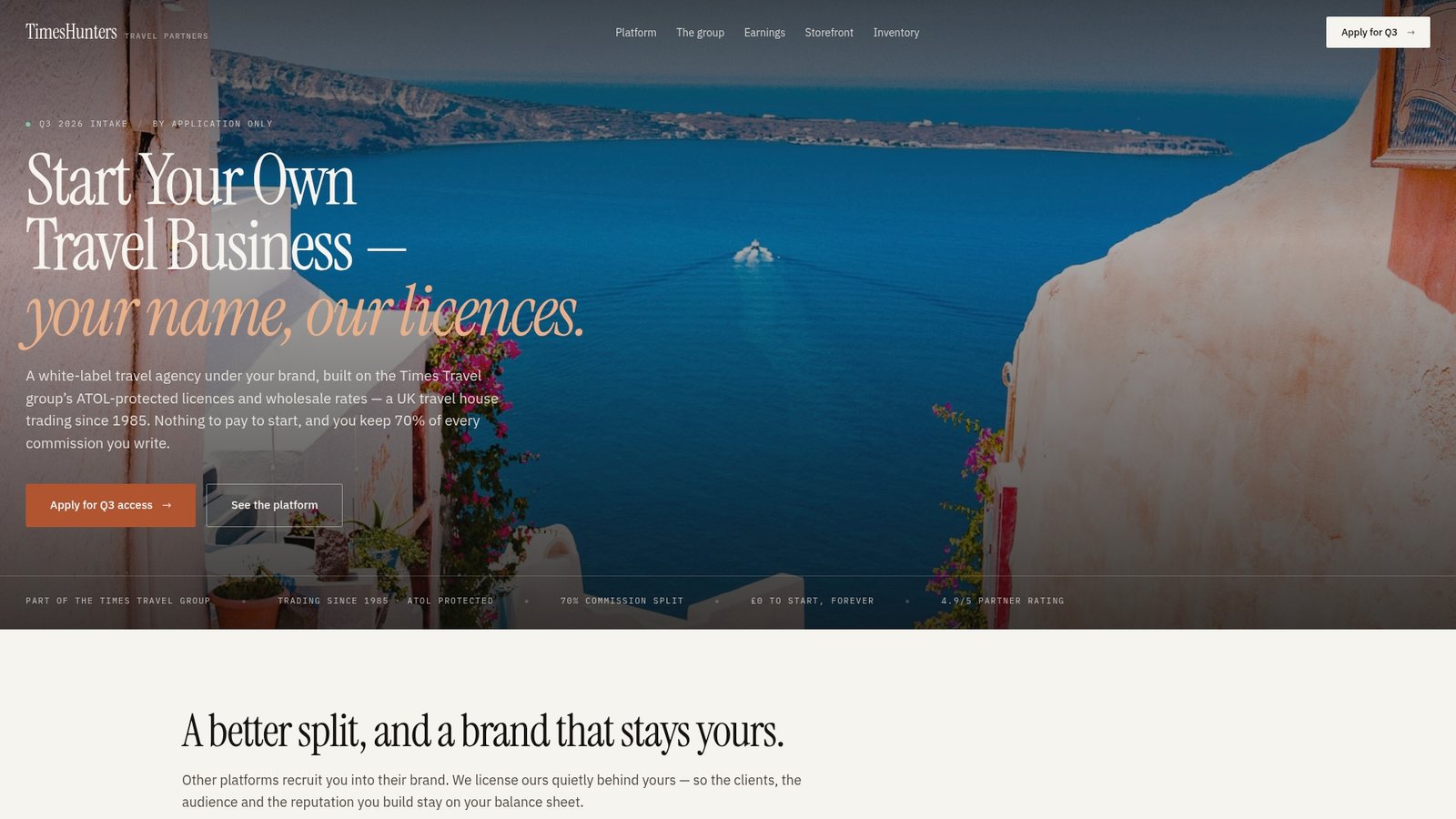
Before joining any white-label programme, check the commission structure, what support and training is included, and how financial protection is documented in the partner agreement. Timeshunters covers all three as standard, along with instant pricing proposals and automated client follow-up, so you spend your time on clients rather than admin.
If you’re ready to see what a branded, ATOL-backed agency looks like under your own name, visit the Timeshunters partner page and check what it takes to get started.
Frequently asked questions
How long does it take to build a travel agency website?
A solo agent using a white-label platform can launch within three to seven days. A custom WordPress build for a small team typically takes six to ten weeks once design and content are factored in.
Do I need ATOL protection to run a travel agency website?
If you’re selling package holidays or flight-inclusive trips in the UK, you generally need financial protection cover. A white-label platform with existing ATOL-protected licences removes the need to apply for your own.
What’s the cheapest way to build a travel agency website?
A DIY site builder is usually the lowest upfront cost, often £200 to £600, but it lacks travel-specific booking features. Many small agencies find a white-label platform delivers more functionality for a comparable or lower total cost once booking tools are factored in.
Can I use WordPress to build a travel agency website?
Yes. WordPress gives you full control over design and content, and plenty of travel-specific plugins exist for itineraries and bookings. It requires more ongoing maintenance than a hosted builder or white-label platform.
What pages does a travel agency website need at minimum?
A home page, package or trip pages, a booking or enquiry form, an about page, testimonials, and a terms and financial protection page cover the essentials most agencies need to start taking bookings.
Sources
- PhocusWire: optimise conversions across the customer journey
- Statista chart: travel bookings online vs agency
- 30 travel agency website examples — Colorlib