
Travel Platforms: GDS vs Bedbanks, Start with 4–6 Suppliers
Practical comparison for travel platforms: when to use GDS or bedbanks, the 4–6 supplier rule, integration timelines and parity controls to avoid duplication.

Choose GDS when your business sells corporate or chain inventory, choose bedbanks when you serve leisure travellers and independent hotels, and blend both through an aggregator if you need broad coverage without building every connection yourself. The right answer depends on rate model, coverage and how much integration work your team can absorb.
TL;DR:
- GDS pays commissions post-stay and works best for corporate bookings with negotiated rates, while bedbanks require upfront capital for net rates and mainly serve leisure markets.
- Coverage differs: GDS focuses on chains and branded properties with weekday booking patterns, whereas bedbanks cover independents and regional hotels with weekend and seasonal peaks.
- Technical integration takes four to eight weeks per supplier, but aggregators can reduce onboarding to days or weeks, though data hygiene and deduplication are critical long-term concerns.
- Bedbank models demand more working capital upfront and have tighter contract restrictions, making margin management and compliance vital for sustainable operations.
- Using an aggregator or white-label platform streamlines inventory access for entrepreneurs and small businesses, avoiding complex supplier negotiations and reducing infrastructure costs.
Table of Contents
- Key differences: rate models, coverage and commercial outcomes
- Technical and operational implications of integrating each source
- Commercial costs, cash-flow and contract considerations
- When to choose GDS, bedbank, direct API or an aggregator
- How to combine channels and manage operational risks
- Perspective: an industry practitioner on distribution strategy
- How a white-label platform simplifies access to inventory
- Sources
- FAQ
Key differences: rate models, coverage and commercial outcomes
The two channels sit on opposite sides of the pricing equation. GDS pays commission after the stay on a rate the hotel controls, so cash flow is predictable but margin is capped. Bedbanks require you to commit capital to a net rate upfront and then set your own retail price, which rewards good demand forecasting but punishes overbuying.
Coverage splits along similar lines: chains and branded properties dominate GDS listings, while independents and regional leisure hotels are more likely to route through a bedbank. That difference shows up in booking behaviour too. Corporate GDS bookings skew towards weekday stays at negotiated rates with lower cancellation volatility, while bedbank-sourced leisure bookings tend to cluster around weekends and peak seasons with more price sensitivity.
A single inventory source rarely covers a whole market. Most OTAs run a blend of bedbanks, GDS and direct contracts, because no one channel covers every market and rate type, and aggregators exist specifically to solve the integration and deduplication problems that blending creates.
- Rate model: GDS is commissionable and post-stay; bedbanks are net wholesale and prepaid.
- Coverage bias: GDS leans corporate and chain; bedbanks lean leisure and independent.
- Booking pattern: GDS bookings cluster on weekdays; bedbank bookings cluster around leisure peaks.
Technical and operational implications of integrating each source
Direct integrations are rarely quick. Onboarding a single supplier, whether GDS or bedbank, commonly takes 4 to 8 weeks of engineering effort, covering authentication, rate mapping, booking flow testing and certification where the supplier requires it. Aggregators can cut that to days or a few weeks by offering prebuilt connectors, though you trade some control for speed.
The bigger long-term cost is data hygiene. Inconsistent room-type mapping across suppliers is the most common technical pitfall, and it causes the same room to appear multiple times under different names unless you build automated canonical mapping and a deduplication layer before showing results to customers.
- Map each supplier’s room types and rate plans to a single canonical property and room ID before go-live.
- Build automated deduplication so a guest never sees the same room listed twice at different prices.
- Set up reconciliation checks for failed bookings, voucher issuance and refund handling across every source.
- Confirm certification or accreditation requirements early, since some GDS connections require formal testing before launch.
Pro Tip: Build your deduplication layer before adding a third supplier, not after; retrofitting it once duplicate listings are live is far more disruptive.
Commercial costs, cash-flow and contract considerations
The cash-flow difference between the two models is the first thing to budget for. Net wholesale rates from a bedbank require working capital committed before the guest checks in, while commissionable GDS bookings pay out after the stay, which is gentler on cash flow but slower to realise. Net-rate models also shift margin control to the reseller but raise working-capital needs, and pricing discipline becomes critical to avoid margin erosion further down the resale chain.
Connectivity and per-transaction fees vary by supplier, so model them against expected booking volume rather than assuming they wash out. Contracts also carry clauses worth reading twice: allotment minimums that commit you to unsold rooms, parity clauses that restrict how you price against other channels, and resale restrictions that limit which markets or channels you can sell into.
- Cash-flow rule: net rates need working capital upfront; commission pays out later but caps margin.
- Fee check: confirm per-transaction and connectivity fees before committing to a volume forecast.
- Contract watch: allotments, parity clauses and resale restrictions can quietly limit your pricing freedom.
- Margin modelling: run your expected occupancy and average rate through both commission and net-rate scenarios before choosing a primary supplier.
When to choose GDS, bedbank, direct API or an aggregator
The starting point is your business model, not the channel’s reputation. A corporate travel agency or travel management company should prioritise GDS first, since its buyers need reporting and negotiated rates. A leisure-focused OTA or entrepreneur should prioritise bedbank access first, since independent and regional coverage matters more than chain depth. A platform trying to launch quickly with limited engineering resource should start with an aggregator.
Practitioners commonly point to a workable rule: four to six well-chosen suppliers, typically one global bedbank, one GDS, one OTA-wholesale connection and one or two regional specialists, cover the majority of bookable inventory. Beyond that range, complexity and duplicate listings tend to grow faster than any genuine gain in coverage.
- Identify your dominant buyer type (corporate, leisure, regional niche, white-label reseller) before picking a channel.
- Start with an aggregator if speed to market matters more than owning every supplier relationship.
- Add direct integrations only once a supplier’s volume justifies the engineering cost.
- Cap your primary supplier list at four to six connections and review the mix annually.
- Ask any prospective supplier how they handle deduplication, parity enforcement and failed-booking reconciliation before signing.
How to combine channels and manage operational risks
Running several inventory sources at once invites two recurring problems: rate leakage and mapping errors. Rate leakage happens when net rates meant for closed groups end up visible to the public, usually through resale chains or poorly fenced closed-user-group agreements. Defences include dynamic net rates, clear fencing rules in contracts, and monitoring tools that flag when a wholesale rate surfaces somewhere it shouldn’t.
Mapping errors are largely a data problem. Automated canonical property IDs and a deduplication layer, built early rather than bolted on, prevent the same room appearing twice at different prices across sources. Ongoing reconciliation and alerting catch parity breaks and failed bookings before they reach the guest, and improving real-time APIs alongside AI-based routing are increasingly used to detect and route inventory faster than manual checks allow.
- Rate leakage defence: use closed-user-group fencing and dynamic net rates rather than static wholesale prices.
- Mapping defence: canonical property IDs plus automated deduplication before adding new suppliers.
- Monitoring defence: reconciliation and alerting on parity breaks and failed bookings, checked daily rather than weekly.
Pro Tip: Treat parity monitoring as a daily task, not a monthly audit; leakage compounds quickly once a net rate starts circulating.
Perspective: an industry practitioner on distribution strategy
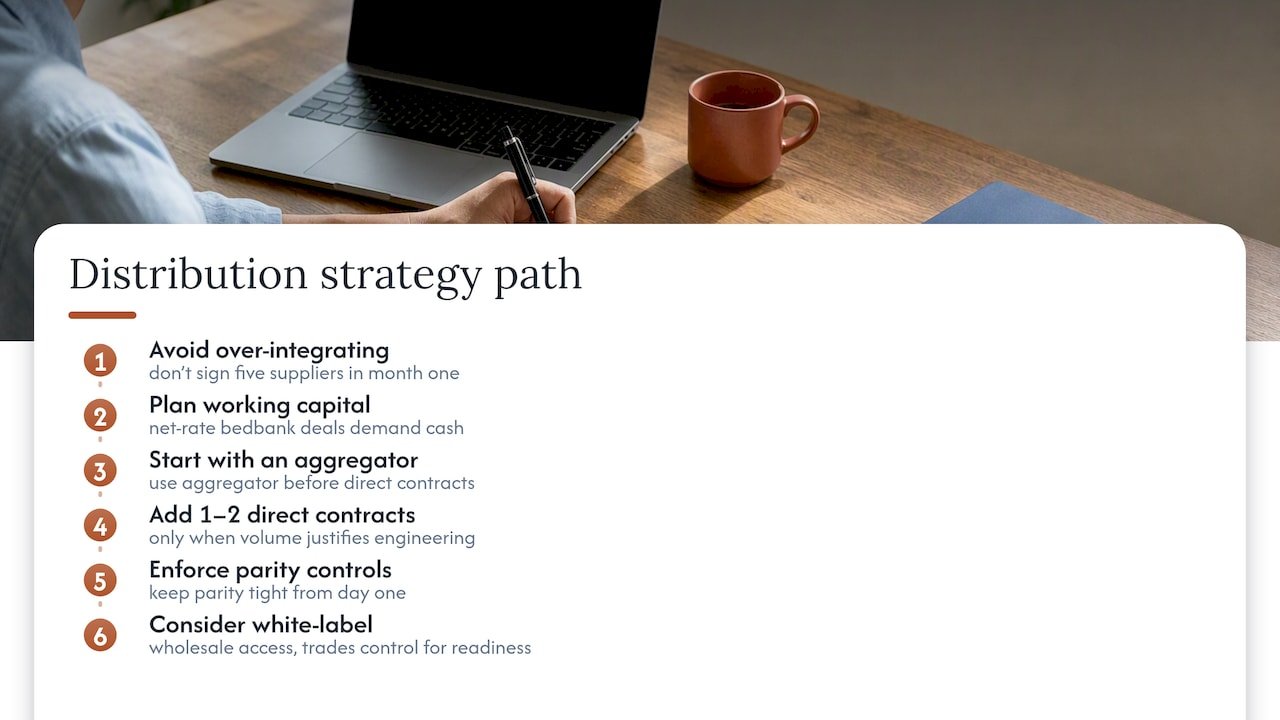
The most common mistake is over-integrating before the business model is proven. Teams sign five supplier contracts in month one, then spend the next year fighting duplicate listings instead of selling. A close second is underestimating the working capital that net-rate bedbank deals demand, which leaves platforms cash-strapped exactly when demand peaks.
A more realistic path starts with an aggregator, layers in one or two direct contracts once volume justifies the engineering cost, and keeps parity controls tight from day one. For entrepreneurs without an engineering team, a white-label platform that already holds wholesale access removes most of this burden entirely, trading some control for a working system on day one.
— Sam
How a white-label platform simplifies access to inventory
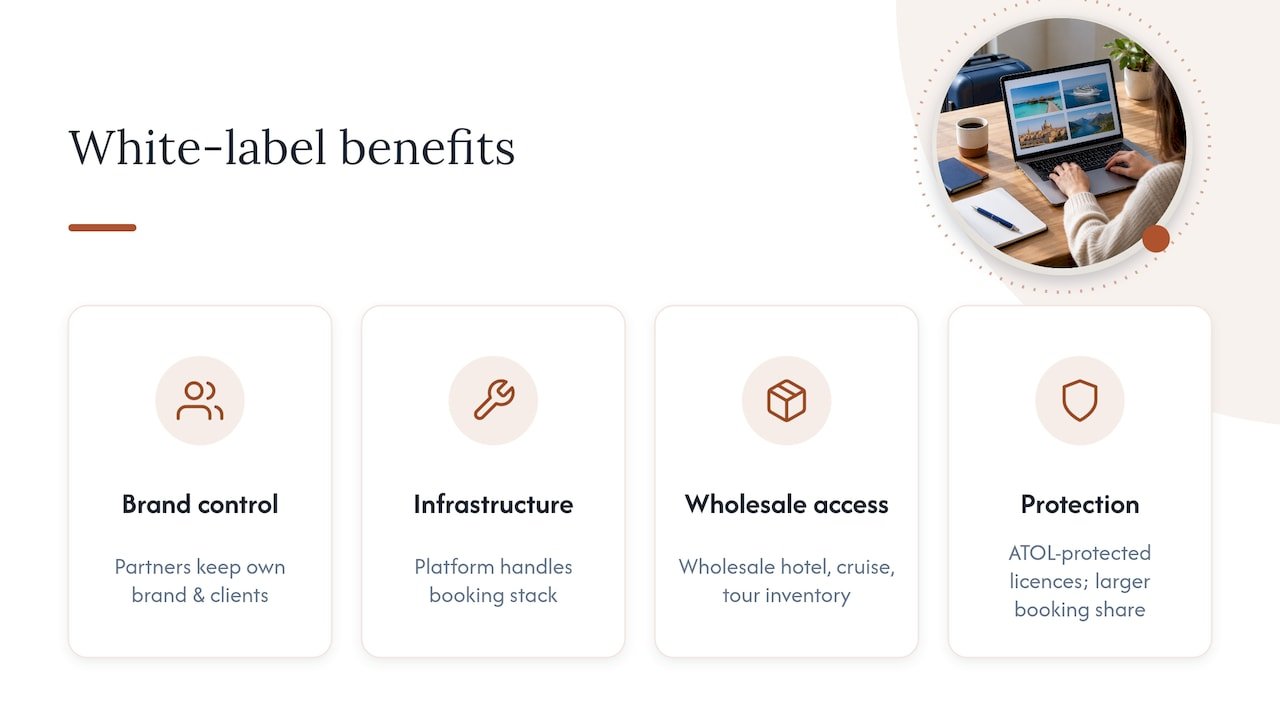
If direct integrations and supplier contracts sound like more infrastructure than you want to build, TimesHunters offers a route around that work entirely. It’s a white-label travel agency platform that gives partners their own branded business, backed by ATOL-protected licences and access to wholesale hotel, cruise and tour inventory without any direct supplier negotiation.

Partners keep their own brand and client relationships while a white-label platform handles the booking infrastructure, offering partners a larger share of each booking compared to typical online travel agency arrangements. This suits entrepreneurs, freelancers and hospitality professionals who want to start a branded travel business without hiring engineers or negotiating hotel contracts themselves.
Explore the white-label travel agency model to see how the wholesale access and commission structure work.
Sources
A bedbank is a B2B wholesaler that contracts net rates directly with hotels, tour operators and ground handlers, then resells that inventory to travel sellers who add their own markup. Rather than commission on top of a public rate, the seller buys at a wholesale net price and decides what to charge the traveller, which gives more control over margin but shifts risk onto the reseller.
Bedbanks are B2B wholesalers that contract net rates and resell to travel resellers, and the industry is shifting toward API-first distribution for real-time pricing rather than static rate loads. That depth tends to concentrate in leisure and independent-hotel markets, filling regional gaps that GDS coverage misses. Their commercial role is largely tactical: filling need periods, supporting long-lead leisure demand and handling package flows that a corporate-focused GDS was never built for, as bedbanks remain valuable for leisure depth rather than as a full replacement for other channels.
- Hospitality
- Hotel API vs GDS vs Bedbank: Which Wins for OTAs? (ZentrumHub)
- GDS vs bedbank inventory (Vervotech)
FAQ
Is GDS still relevant today?
Yes, GDS remains central to corporate travel because it now handles the largest share of corporate room nights, alongside reporting and duty-of-care tools that travel management companies depend on, as shown in recent industry analysis. It has not been displaced by direct or wholesale channels for this segment.
Do hotels use GDS?
Chains and larger independent hotels commonly load rates into GDS to reach corporate travel agents and travel management companies. Smaller independents often rely more on bedbanks or direct contracts, since GDS coverage skews towards branded and chain properties.
What does GDS stand for in hospitality?
GDS stands for Global Distribution System, the network connecting travel agents and corporate booking tools to airline, hotel and car rental inventory. In hospitality specifically, it is the channel most associated with corporate rates and negotiated agreements rather than leisure bookings.
What does GDS mean in BPO?
Outside travel, GDS can also refer to Global Delivery Services or similar outsourcing terms used in business process outsourcing, which is unrelated to the Global Distribution System used in hotel and travel booking. Readers researching hotel distribution should treat these as entirely separate uses of the same acronym.
Should a new travel platform start with GDS or a bedbank?
It depends on the buyer: platforms serving corporate travellers should prioritise GDS, while those serving leisure travellers or independent hotels typically get more value from a bedbank first. Many platforms use an aggregator to blend both while they establish which channel their customers actually need.