
Start Selling This Quarter: ATOL, UK Travel Accreditation & White-Label
Learn when ATOL is legally required, how it differs from UKAS/BTA/VisitEngland marks, and how a white-label ATOL route can get your UK travel business...

ATOL is the statutory licence the Civil Aviation Authority (CAA) uses to protect UK consumers who buy flight-inclusive packages, and most businesses that sell or assemble such packages for UK customers will need one. Voluntary schemes run by UKAS, the Business Travel Association (BTA) and VisitEngland sit alongside ATOL, but do not replace it. If you are building a travel business from scratch, options such as a white-label ATOL route through TimesHunters can shorten the path to trading legally.
TL;DR:
- Companies assembling flight-inclusive packages for UK consumers must hold an ATOL licence, which is a legal requirement, not a quality accreditation.
- The application process involves a £2,606 fee plus an assessment of financial documents, and it can take several weeks to months to complete.
- Renewal requires updated financial statements and ongoing compliance, with delays causing suspension of sales until the licence is renewed or reinstated.
- A white-label ATOL arrangement allows businesses to trade under an existing licence, avoiding lengthy application processes and enabling immediate selling under protected schemes.
- Voluntary quality schemes like VisitEngland and trade memberships such as BTA help build customer trust but do not replace legal ATOL licensing requirements.
Table of Contents
- What ATOL is and why it exists
- Who needs an ATOL and common exemptions
- How to apply for an ATOL step by step
- Renewal and ongoing obligations after you’re licensed
- Accreditation, certification and quality schemes explained
- Getting ATOL-ready: a checklist and the mistakes to avoid
- Brexit’s effect on travel supplier accreditation
- Why trade association membership still matters
- How accreditation affects customer trust and booking conversion
- Own licence or white-label: choosing your route
- How TimesHunters gets you trading under ATOL protection faster
- Sources
- FAQ
What ATOL is and why it exists
ATOL stands for Air Travel Organiser’s Licence. It is a legal scheme, not a marketing badge, and the CAA administers it to protect consumers if a travel organiser stops trading. When a company holding an ATOL collapses, customers already abroad are brought home and those who have paid but not yet travelled get their money back. That protection is funded by a per-passenger contribution built into the price of every ATOL-protected booking.
This is where confusion often starts. People hear “accreditation” and assume it means a quality stamp similar to a hotel star rating or an industry award. ATOL is different: it is a condition of legally trading in flight-inclusive packages, enforced through licensing rather than reputation.
- Statutory basis: ATOL sits under aviation and consumer protection law, not a voluntary code.
- Financial backstop: A trust fund and per-passenger charge cover refunds and repatriation.
- Different from a quality mark: Voluntary accreditation signals competence or standards; ATOL is a legal permission to trade.
The distinction matters because a business can hold every quality accreditation going and still be operating illegally if it lacks an ATOL where one is required.
Who needs an ATOL and common exemptions
The core rule is straightforward: if you sell or assemble flight-inclusive holidays for UK consumers, you almost certainly need an ATOL. This covers travel agents who package flights with accommodation, tour operators building bespoke itineraries, and increasingly, influencers or entrepreneurs selling holiday packages directly to followers.
Exemptions exist but they are narrower than many assume:
- Flight-only sales through an airline or its direct agents are usually outside ATOL, since the airline carries its own regulatory obligations.
- IATA-accredited agents selling flights on behalf of airlines, without adding other elements, often fall outside the scheme.
- Small or incidental sales, such as a charity organising a one-off trip with no profit motive, can sometimes be exempt, though the threshold is narrow and case-specific.
- Pure accommodation or car hire sales with no flight element are not ATOL-licensable, though they may fall under separate consumer protection rules.
Pro Tip: If you are unsure whether your business model counts as “organising” rather than simply “selling”, check CAA guidance directly or speak to an ATOL reporting accountant before you take a single booking.
Calling yourself an “agent” does not automatically remove the obligation. If you are assembling the components of a holiday, the CAA treats you as an organiser regardless of how your website describes your role, and that classification error is one of the most common reasons new businesses find themselves trading illegally.
How to apply for an ATOL step by step
Applying for an ATOL is a financial and administrative process, not a quick form-fill. Budget several weeks to a few months, depending on how prepared your paperwork is.
- Register for an ATOL Online account with the CAA and begin the application, selecting whether you need a Standard ATOL, a Small Business Accredited Body (SBA) arrangement, or a franchise route under an existing licence holder.
- Prepare your financial documents, including a certified opening balance sheet, recent accounts or projections for new businesses, and, for sole traders or partnerships, a Statement of Personal Assets and Liabilities.
- Complete the Annual Standard Application Tool (ASAT), the CAA’s financial reporting format used to assess whether your business can meet its obligations to customers.
- Pay the relevant fees. The CAA’s Standard ATOL fee schedule sets a fixed application charge of £2,606, plus a per-passenger charge of 16.35 pence, while the SBA route carries a fixed fee of £1,583.
- Attend the formal CAA meeting. New applicants are typically required to meet the CAA in person or remotely, where financial resilience, booking systems and consumer protection arrangements are discussed in detail.
- Address any conditions. The CAA may require a cash injection, a bond, or other safeguards before granting the licence.
A single figure explains why so many applicants stumble at this stage: the standard application fee alone is £2,606, before accountant fees, bonding costs or any cash injection the CAA might require. That upfront cost is one reason smaller start-ups often look at franchise or white-label arrangements instead of applying independently.
The financial assessment is generally the hardest part of the process. An ATOL reporting accountant familiar with ASAT can flag weaknesses in your balance sheet before the CAA does, reducing the chance of last-minute conditions or a rejected application.
Renewal and ongoing obligations after you’re licensed
Holding an ATOL is not a one-off achievement. The CAA treats renewal as a fresh assessment rather than a formality, and failing to renew on time can force a business to stop selling licensable products altogether.
- Updated financials: Renewal requires current accounts and, where applicable, an Annual Accountants’ Report Part 2 confirming your ongoing financial fitness.
- APC reporting: You must continue reporting Air Travel Organisers’ Licensing (ATOL) Protection Contribution figures accurately, since these fund the consumer protection scheme.
- Maintained safeguards: Bonds, trust arrangements or insurance put in place at grant stage need to stay current, not lapse quietly in year two.
- Direct debit and fee arrangements: Renewal fees and per-passenger charges must be kept up to date to avoid administrative delays.
If a renewal is refused or missed, the practical consequence is immediate: you cannot legally sell ATOL-protected packages until the position is resolved. Businesses in that position typically need to pause flight-inclusive sales, address the CAA’s concerns (often financial), and reapply, which can take weeks a growing business can ill afford to lose.
Accreditation, certification and quality schemes explained
A lot of the confusion around “travel accreditation” comes from mixing up legal licensing with voluntary quality schemes. They serve different purposes and neither substitutes for the other.
- UKAS is the UK’s national accreditation body, appointed under UK legislation to accredit conformity assessment bodies, such as certification and inspection organisations, against recognised standards. UKAS does not accredit individual travel companies directly; it accredits the bodies that certify them.
- BTA (Business Travel Association) offers accreditation aimed at corporate travel credibility, distinct from mandatory licences like ATOL and valued mainly by business buyers assessing a supplier’s standing.
- VisitEngland runs voluntary quality schemes such as star ratings, which help tourism businesses market themselves but carry no legal weight regarding consumer refunds or repatriation.
The practical order of priorities is simple: get ATOL compliance sorted first, since trading without it where required is illegal. Quality marks and trade accreditations are worth pursuing afterwards, as commercial polish rather than legal necessity.
Getting ATOL-ready: a checklist and the mistakes to avoid
Before you open an ATOL Online account, line up the people and paperwork that will make the process faster.
- Appoint an accountable person and ensure they have completed any CAA-recognised training relevant to your application type.
- Engage an ATOL reporting accountant early, since they will prepare or review your ASAT submission and later your Annual Accountants’ Reports.
- Confirm your insurer or bonding arrangement, as the CAA will want evidence of financial protection mechanisms before granting a licence.
- Gather certified financial statements, including the opening balance sheet and, for new entities, credible projections rather than optimistic guesses.
The most common pitfall is underestimating cash requirements. Many new applicants assume booking volume will cover working capital, then find the CAA’s financial test exposes a shortfall that triggers a bond requirement or outright delay. A second frequent error is misclassifying the business as an “agent” when it is, in substance, assembling packages and therefore an organiser.
Pro Tip: Run your numbers past an ATOL reporting accountant before you submit anything. A pre-check that costs a few hundred pounds can save months of delay if the CAA’s own assessment finds gaps.
For entrepreneurs who want to start trading without building this infrastructure from the ground up, a white-label ATOL arrangement, such as the one TimesHunters offers, lets you trade under an existing licence holder’s ATOL protection while operating under your own brand, which removes much of the financial assessment burden described above.
Brexit’s effect on travel supplier accreditation
The UK’s departure from the EU changed some of the commercial mechanics of running a travel business, but it did not remove or replace ATOL as the core consumer protection scheme. ATOL is a UK domestic licensing regime administered by the CAA, and it continued to operate under UK law after the transition period ended.
What did shift is the wider regulatory context for UK travel sellers packaging trips that include EU travel. UK-based Package Travel Regulations still apply to UK organisers, and the framework for holidays sold to UK consumers has not required a new UK accreditation body. UKAS, similarly, has remained the single national accreditation body under UK legislation throughout, since accreditation regulation is a domestic legal appointment rather than an EU-administered function.
For most UK travel entrepreneurs, the practical takeaway is that the compliance basics have not changed: you still need to work out whether you are selling flight-inclusive packages, still need an ATOL if you are, and still need to check Package Travel Regulations coverage for non-flight packages. Where Brexit has added friction is in areas like staff travel documentation, customer entry requirements to EU destinations, and administrative costs, none of which alter whether ATOL itself applies to your business.
Why trade association membership still matters
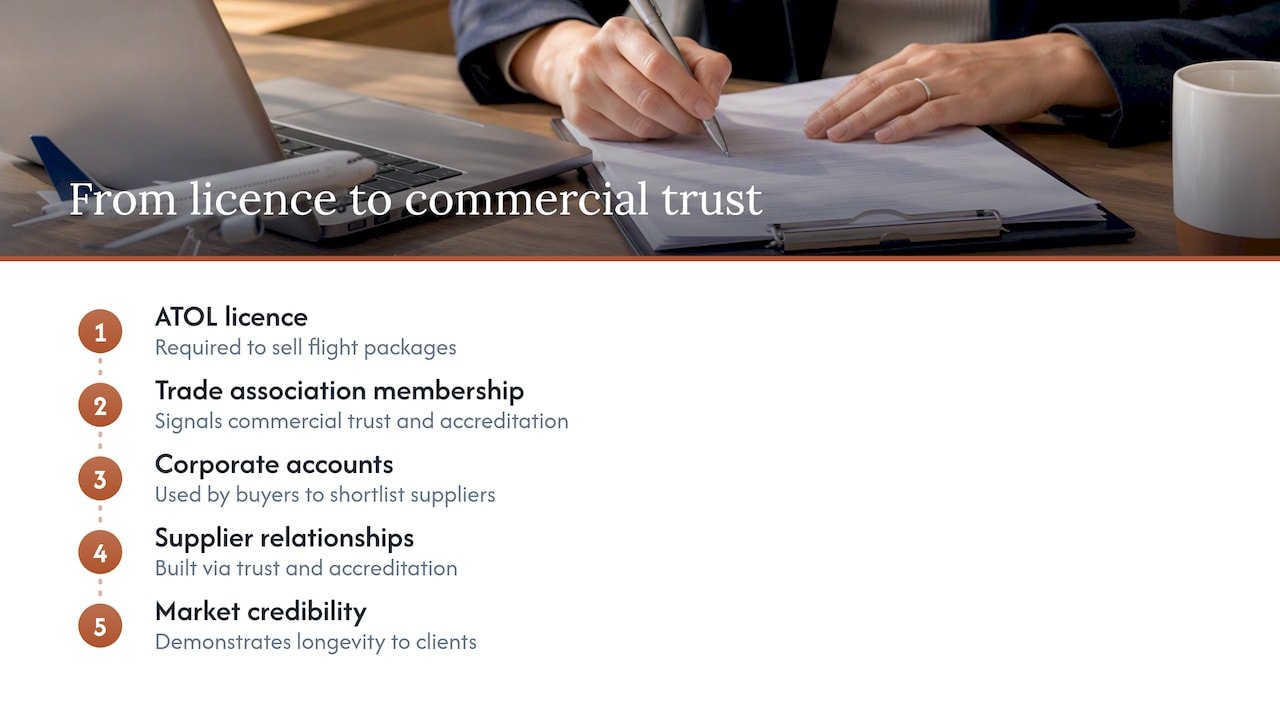
ATOL covers the legal minimum, but trade associations fill a gap that licensing alone does not address: commercial trust among peers, suppliers and corporate clients. Membership bodies such as ABTA and the Business Travel Association exist specifically to give travel businesses a recognisable badge of industry standing beyond what a licence number communicates to the public.
The Business Travel Association distinguishes mandatory licensing from its own accreditation, positioning BTA membership as a market differentiator rather than a legal requirement, particularly useful when selling into corporate accounts that expect suppliers to demonstrate professional credibility beyond statutory minimums. In corporate travel procurement, buyers often use trade body membership as a quick filter when shortlisting suppliers, since it signals familiarity with industry norms and terminology that a bare ATOL number does not convey.
For a new travel business, the sequencing question is usually one of priority rather than choice. ATOL determines whether you can legally sell flight-inclusive packages at all. Trade association membership, once that legal base is secure, becomes a tool for winning corporate accounts, building supplier relationships and demonstrating longevity in a market where new entrants are common and trust takes time to establish.
How accreditation affects customer trust and booking conversion
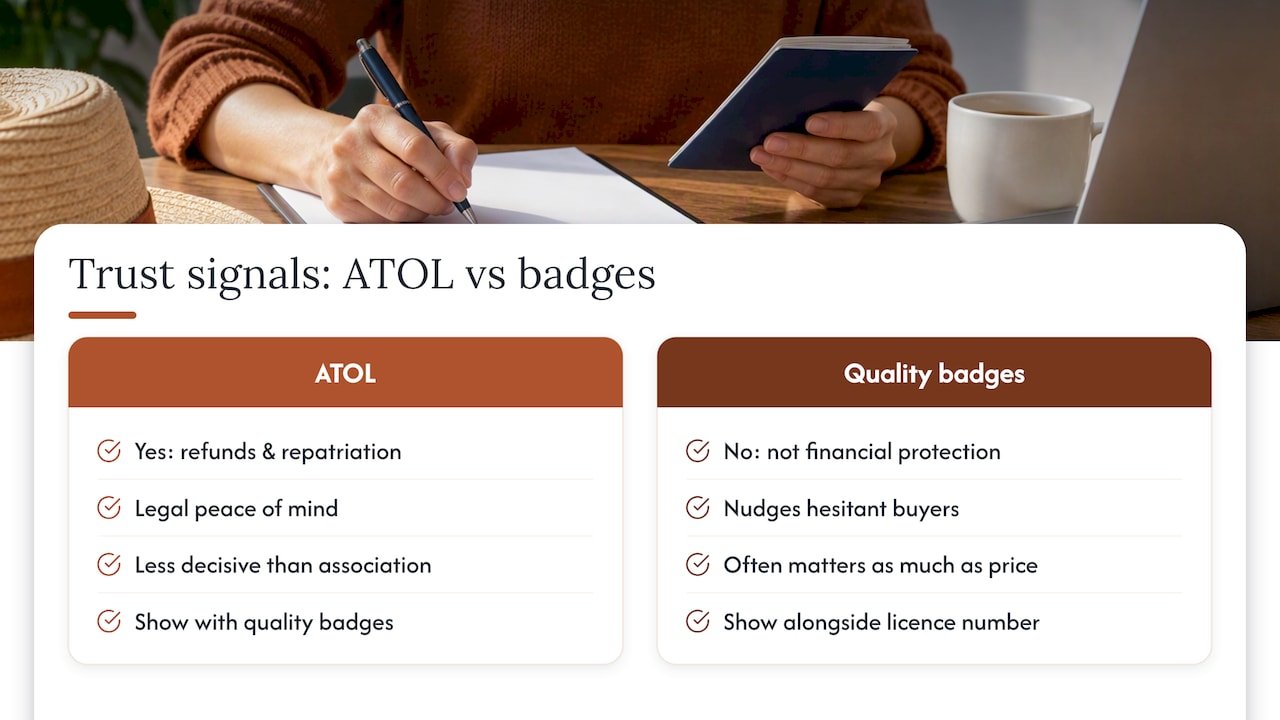
Consumers rarely research the fine print of consumer protection law before booking a holiday, but the presence of an ATOL number and logo on a website does measurable work in the background. It signals that, if the worst happens and the organiser fails, refunds and repatriation are guaranteed rather than left to chance.
Voluntary quality marks play a different role in the buying decision. A VisitEngland rating or BTA membership badge does not protect a customer’s money the way ATOL does, but it can nudge a hesitant buyer by suggesting the business meets recognised standards of service or professionalism. For corporate travel buyers in particular, association membership often matters as much as price when comparing suppliers, because it reduces the perceived risk of an unfamiliar name.
The practical implication for a new travel business is that ATOL protection is the trust signal that matters most for legal peace of mind, while accreditation and association badges are the ones that help convert a browsing customer into a paying one. Displaying both, once you have earned them, tends to work better than treating either as optional. A licence number without visible quality signals can look bureaucratic; quality badges without a licence number, where one is required, can look evasive to a customer who checks.
Own licence or white-label: choosing your route
Applying for your own ATOL gives full control over pricing, branding and financial structure, but it demands upfront capital, an accountant familiar with ASAT, and months of preparation before your first legal booking. That route suits businesses with existing capital reserves, a clear multi-year growth plan and the appetite to manage ongoing renewal and audit obligations directly.
A white-label arrangement suits a different profile: someone with an audience or client base who wants to start selling flight-inclusive holidays quickly, without first clearing the CAA’s financial bar alone. It trades some independence for speed and reduced compliance overhead, since the licence holder carries the regulatory burden.
If you have the capital and long-term ambition to build a licensed operator, start the CAA application and bring in an accountant now. If you want to trade this quarter rather than next year, a white-label partner is worth a conversation before you commit to the standalone route.
— Sam
How TimesHunters gets you trading under ATOL protection faster
Building your own ATOL from scratch means months of financial assessment, accountant fees and a formal CAA meeting before you take a single booking. TimesHunters offers a different starting point: a white-label travel agency platform that lets you trade under your own brand while using Times Travel group’s ATOL-protected licences, so the legal groundwork is already in place.
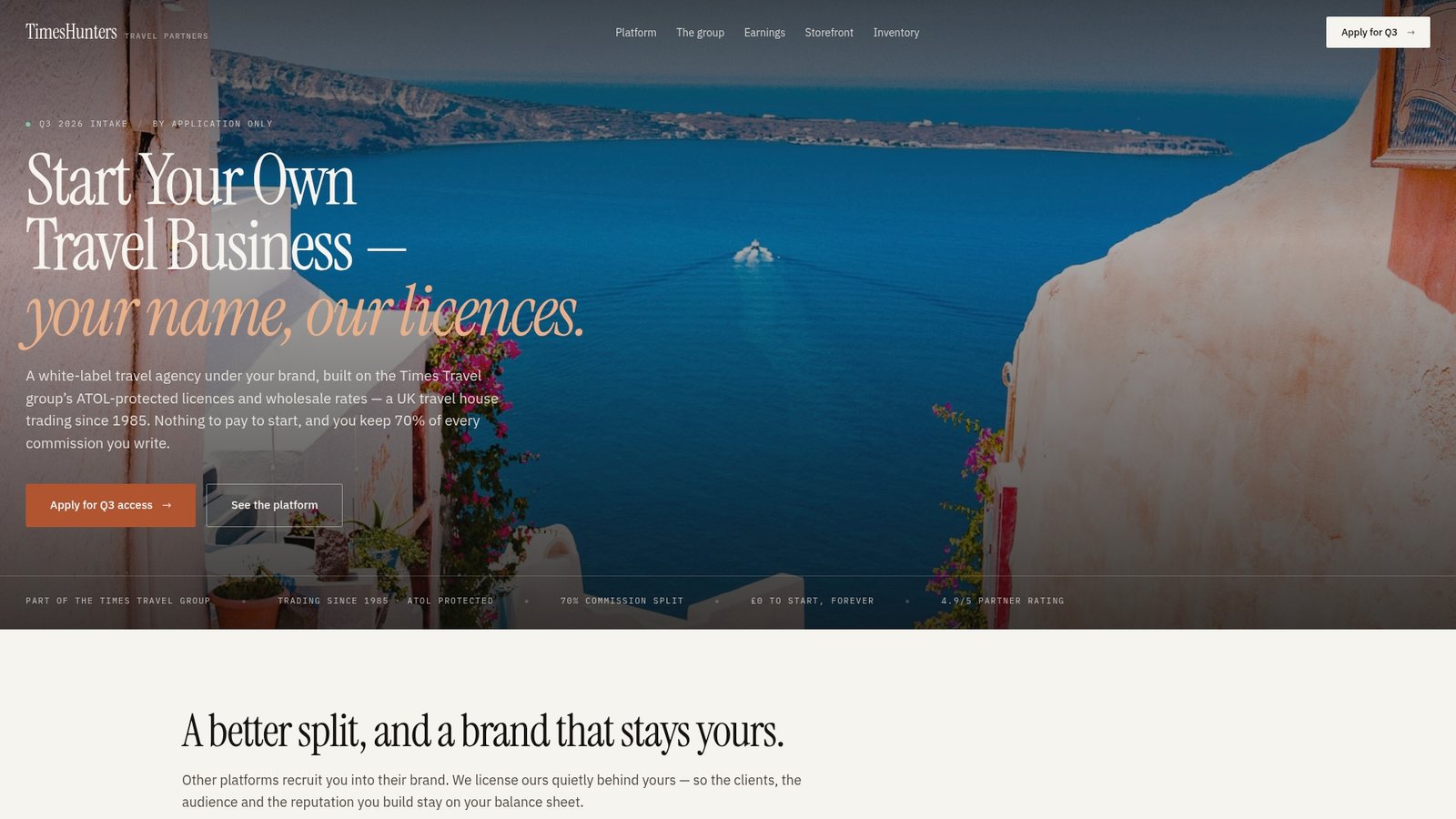
- Your brand stays yours: Clients see your name and your service, not the licence holder behind it.
- No licensing wait: You skip the CAA application timeline and start selling packages under existing ATOL protection.
- Commission on every booking: Partners keep a commission split on bookings made through the white-label travel agency platform.
- Wholesale access included: Hotels, cruises, tours, villas, safari camps and rail are available through the platform without separate supplier negotiations.
If the CAA application process outlined above looks like more time and capital than you want to commit right now, TimesHunters’ white-label travel agency platform is worth a look before you start your own licence application.
Sources
- Do I need an ATOL | UK Civil Aviation Authority
- Gov
- Get quality assessed | VisitEngland / VisitBritain
FAQ
What is ISO accreditation in the UK?
ISO accreditation in the UK generally refers to a business being certified against an ISO management standard by a certification body, which is itself accredited by UKAS. UKAS is the UK’s national accreditation body, and it accredits the certification bodies rather than certifying travel companies directly. This is a separate process from ATOL, which is a legal licence rather than a quality standard.
Do I need an ATOL if I only sell flights?
Generally, flight-only sales made through an airline or as its direct agent fall outside ATOL requirements, since the airline carries its own regulatory obligations. If you combine flights with accommodation or other elements to create a package, you are likely to need an ATOL regardless of how the sale is described on your website.
How much does an ATOL application cost?
The Standard ATOL fee schedule sets a fixed application charge of £2,606, plus a per-passenger charge of 16.35 pence, while the Small Business Accredited Body route carries a fixed fee of £1,583. These figures cover the licence itself and do not include accountant fees, bonding costs or any cash injection the CAA may require.
What happens if I don’t renew my ATOL on time?
If a renewal is not submitted or is refused, the business must generally stop selling ATOL-protected packages until the licence position is resolved. This can mean weeks of lost flight-inclusive sales while updated financials are prepared and reassessed.
Can I start selling holidays without applying for my own ATOL?
Yes, a white-label arrangement lets you trade under an existing ATOL holder’s protection while operating under your own brand. TimesHunters offers this model, giving partners access to ATOL-protected wholesale inventory without going through the CAA’s standalone application process themselves.