
Make CLIA Membership Pay: 90 Day Plan for Cruise Travel Agents
Cruise agents: a pragmatic look at CLIA membership, a 90 day sales plan to boost bookings, and a white label option for keeping higher commissions.

Cruise-focused agents should join CLIA the moment they start selling cruises seriously. The immediate gain is the EMBARC ID, the industry’s recognised credential, which unlocks bonus commissions, certification and free training that clients and cruise lines both recognise. For anyone building a cruise specialism, that combination of credibility and cash makes membership close to essential.
TL;DR:
- CLIA membership, through an EMBARC ID, unlocks bonus commissions, free training, and a recognized industry credential that builds credibility quickly.
- The main membership types are agency-based TAM and PAM, and individual IAM, with eligibility tied to agency status and regional rules.
- Success in selling cruises relies on actively completing training, optimizing your Agent Finder profile, and emphasizing your specialty niche.
- Bonus commission programs vary by cruise line and region, and CLIA does not replace formal legal or financial protections for agencies.
- Partnering with platforms like Timeshunters can help agents establish their own branded agency with higher commission splits and operational support.
Table of Contents
- What is CLIA membership and what does it actually get you?
- What are the CLIA membership categories and who qualifies?
- How do you apply for CLIA membership?
- How can new members start selling more cruises in the first 90 days?
- What role does CLIA actually play in the cruise industry?
- What marketing and sales support do CLIA members actually get?
- How does CLIA compare with other cruise credentials?
- What do agents actually say about CLIA membership?
- Are there limits to what CLIA membership actually covers?
- How do you contact CLIA member services?
- Publisher perspective: how Timeshunters complements CLIA membership
- Start your own agency with a higher commission split
- Sources
What is CLIA membership and what does it actually get you?
CLIA, the Cruise Lines International Association, is the trade body that connects travel agents to the world’s cruise lines through a single recognised credential system. That credential is the EMBARC ID, and it functions as your professional passport within the cruise trade: cruise lines, port authorities and fellow agents recognise it instantly, in a way a generic travel qualification never quite manages.
Membership itself is not a certificate you frame and forget. It’s a working toolkit. CLIA’s travel trade membership gives agents access to bonus commissions on top of standard cruise line rates, four free online training courses, a structured certification pathway, and a listing on CLIA’s Agent Finder tool, where cruise-curious travellers search for a specialist near them.
Here’s what that looks like in practice:
- Bonus commissions: many cruise lines run CLIA-exclusive incentive schemes that pay above the standard commission split
- Free training: four online courses included in membership, plus a paid certification track for agents who want to go further
- Agent Finder listing: a public-facing profile that puts you in front of travellers actively searching for a cruise expert
- Member savings: discounts on CLIA events, conferences and additional training
- Industry recognition: an EMBARC ID that cruise lines, ports and fellow trade professionals recognise on sight
Membership snapshot: CLIA membership is built around the EMBARC ID, which is what actually opens the door to bonus commissions, professional development and the savings programmes members rely on to grow their cruise business.
None of this replaces selling skill. What it does is compress the time it takes a new agent to look credible to a cruise-buying client, and give an established one a fresh commission lever to pull.
What are the CLIA membership categories and who qualifies?
CLIA runs three main categories, and picking the wrong one is the most common mistake new applicants make.
Travel Agency Membership (TAM) is the agency-level membership, held by the business itself rather than an individual. It’s the foundation category, and in most regions it’s a prerequisite: you generally can’t get an individual credential without an agency already holding one.
Individual Agent Membership (IAM) is the personal credential most working agents actually want. It produces your own EMBARC ID, tied to you rather than your employer, and it’s usually only available to advisors affiliated with an agency that already holds a TAM.
Premier Agency Membership (PAM) sits above standard TAM, aimed at larger or higher-volume agencies. Agencies on a Premier package often pass on discounts to their affiliated individual members, and some PAM arrangements include at least one complimentary IAM as part of the package.
A few practical points trip people up:
- A standard agency membership typically permits up to 10 individual profiles, while a homeworker agency membership allows a small number of individual profiles.
- If you’re an independent advisor working under a host agency, your IAM eligibility depends entirely on that host agency’s TAM status, not your own standing.
- Membership is administered regionally. UK-based agents apply through CLIA UK & Ireland, not the North American or other regional offices, and fees, forms and rules differ by region accordingly.
Check your eligibility against your agency’s category before applying. It saves a wasted application and a second fee.
How do you apply for CLIA membership?
Enrolment runs almost entirely through myclia.cruising.org, CLIA’s member portal, and the process is faster if you gather the right information first.
- Confirm your agency’s status. Check whether your employer or host agency already holds a TAM. Without it, an individual IAM application usually can’t proceed.
- Gather your details. You’ll need agency name and address, your role, contact details, and (for renewals) your existing EMBARC ID number.
- Choose your membership type. Decide between agency-level TAM/PAM administration and an individual IAM application, since the portal handles them through separate flows.
- Log in to myCLIA. myCLIA’s join-or-renew portal is the primary online gateway for both new applications and renewals, agency and individual.
- Pay the applicable fee. Regional fee schedules vary; UK examples have historically listed Standard and Homeworker membership rates, with pro-rata discounts for agents joining later in the year, with pro-rata discounts for agents joining later in the year. Always check the current regional fee page before paying, since rates are periodically revised.
- Wait for confirmation and your EMBARC ID. Once approved, your credential is issued to your individual profile.
Timing matters more than most new members realise. CLIA memberships run on a fixed calendar: they’re valid through 31 December each year regardless of when you joined, which is exactly why pro-rata pricing exists for mid-year applicants. Renewal is annual, not rolling, so mark your calendar well before the December cut-off rather than relying on a reminder email alone.
If you’re new to cruise sales and not yet writing bookings in volume, it’s worth weighing whether to apply immediately or wait until you’re actively selling, since the value of bonus commissions and Agent Finder visibility scales with how much cruise business you’re already generating.
How can new members start selling more cruises in the first 90 days?
Getting the EMBARC ID is the easy part. Turning it into revenue takes a deliberate first quarter.
Start by making the credential visible everywhere a client might look: your email signature, your website footer, and every proposal you send. An EMBARC ID sitting unused in a drawer helps nobody.
- Activate and complete your Agent Finder profile so cruise-curious searchers can actually find you
- Finish the four core online courses early, since several bonus commission programmes require completed training as a condition of eligibility
- Check current bonus commission offers across your preferred cruise lines and note which ones apply to your region
- Build one or two specialty angles using CLIA’s coursework, such as river or expedition cruising, where client knowledge gaps are widest and margins tend to be healthier
- Draft two or three sample proposals in advance for your chosen specialty, so you’re ready the moment a lead arrives
- Plan a familiarisation (fam) trip through your cruise line contacts to build first-hand product knowledge you can’t get from a brochure
Pro Tip: Lead with your specialty, not your credential. “I focus on expedition cruising” earns more client trust in a first email than “I’m CLIA certified” ever will, even though the certification is what makes the specialty claim credible.
CLIA’s certification pathway is a genuine differentiator when you’re pitching higher-value niches like luxury or expedition cruising, where clients expect real expertise before they hand over a five-figure booking.
What role does CLIA actually play in the cruise industry?
CLIA isn’t a marketing club that hands out badges. It’s the formal link between cruise lines and the agent network that sells on their behalf, and most major ocean and river cruise lines run their trade partner programmes through it.
That position gives CLIA a dual function most agents underuse. On one side, it’s a training and certification body, setting the standard for what “cruise specialist” means in a trade with no government licensing requirement. On the other, it’s a commercial channel: cruise lines route bonus incentives, fam trip invitations and early access to new itineraries through CLIA-recognised agents first.
The reputation this builds matters more than it sounds. A client comparing three quotes for a same cruise sailing has no easy way to judge agent competence. An EMBARC ID and visible CLIA certification give that client a third-party signal they didn’t have to take on faith, and it does the same job for cruise line partners deciding which agents deserve preferential allocation on a sold-out sailing.
For newer agents, this reputation effect compounds. Two years of CLIA-tracked training and consistent bonus commission qualification builds a trade history that host agencies and cruise line business development managers notice, well before it shows up in booking volume.
What marketing and sales support do CLIA members actually get?
Beyond the credential itself, CLIA membership includes a set of resources built specifically to help agents get in front of buyers and close bigger bookings.
The Agent Finder listing is the most visible of these: a searchable, public directory where cruise shoppers filter by specialty and location to find a member agent. It’s free with membership, and it’s one of the few pieces of promotion an independent advisor gets without paying separately for a listing service or advertising placement.
Beyond the directory, CLIA runs a steady calendar of webinars, newsletters and events that double as both education and informal networking. These sessions cover new ship launches, itinerary changes, and cruise line incentive updates, which gives members a head start on selling points before the general public sees the marketing campaign.
Member savings extend to CLIA’s own conferences and training events, discounted against non-member pricing, and several cruise lines coordinate co-op marketing opportunities exclusively through CLIA channels, giving smaller agencies access to promotional reach they couldn’t otherwise afford alone.
None of this substitutes for an agent’s own marketing effort. What it does is remove the cost and time barrier to a baseline level of visibility and market intelligence, so the agent’s own effort goes further from day one rather than starting from nothing.
How does CLIA compare with other cruise credentials?
CLIA is the dominant trade body for cruise-specific credentials, but it isn’t the only training path available to agents, and it’s worth knowing where it sits relative to the alternatives.
Individual cruise lines run their own certification programmes, typically shorter and product-specific: an agent might complete a single line’s course to unlock that line’s own bonus commission tier. These are useful add-ons but carry no weight outside that one brand’s booking system.
Broader travel industry certifications, such as general travel agent qualifications offered by national trade associations, cover cruise selling as one module among flights, packages and insurance. They’re a reasonable general foundation, but they don’t carry the cruise-specific recognition that cruise lines, ports and cruise-focused clients respond to.
CLIA’s advantage is coverage and portability. One credential works across dozens of cruise line partners rather than requiring a separate qualification per brand, and it’s recognised industry-wide rather than by a single trade body’s own network. For an agent building a genuine cruise specialism, stacking CLIA’s core certification with one or two individual cruise line courses tends to work better than treating them as competing options: the CLIA credential establishes general standing, and the line-specific courses unlock brand-level bonus commissions on top.
What do agents actually say about CLIA membership?
Agent feedback on CLIA membership tends to cluster around two themes: faster client trust, and easier access to cruise line relationships that would otherwise take years to build independently.
New agents in particular report that having an EMBARC ID changes the tone of a first client conversation. A prospective cruiser comparing agents online is more likely to book with someone whose credential they can independently verify through Agent Finder, rather than taking a website claim at face value.
Established agents tend to value the commercial side more heavily: bonus commission programmes that pay meaningfully above standard rates once qualification thresholds are met, and cruise line fam trip invitations that give them first-hand product knowledge competitors without CLIA standing simply don’t get offered.

The consistent pattern across both groups is that the value compounds with active use. Agents who complete the free courses, keep their Agent Finder profile current and actually track bonus commission eligibility get noticeably more out of membership than those who pay the fee and let the credential sit dormant. CLIA membership rewards engagement; it doesn’t do the selling for you.
Are there limits to what CLIA membership actually covers?
Membership has real boundaries worth understanding before you rely on it as your only professional credential.
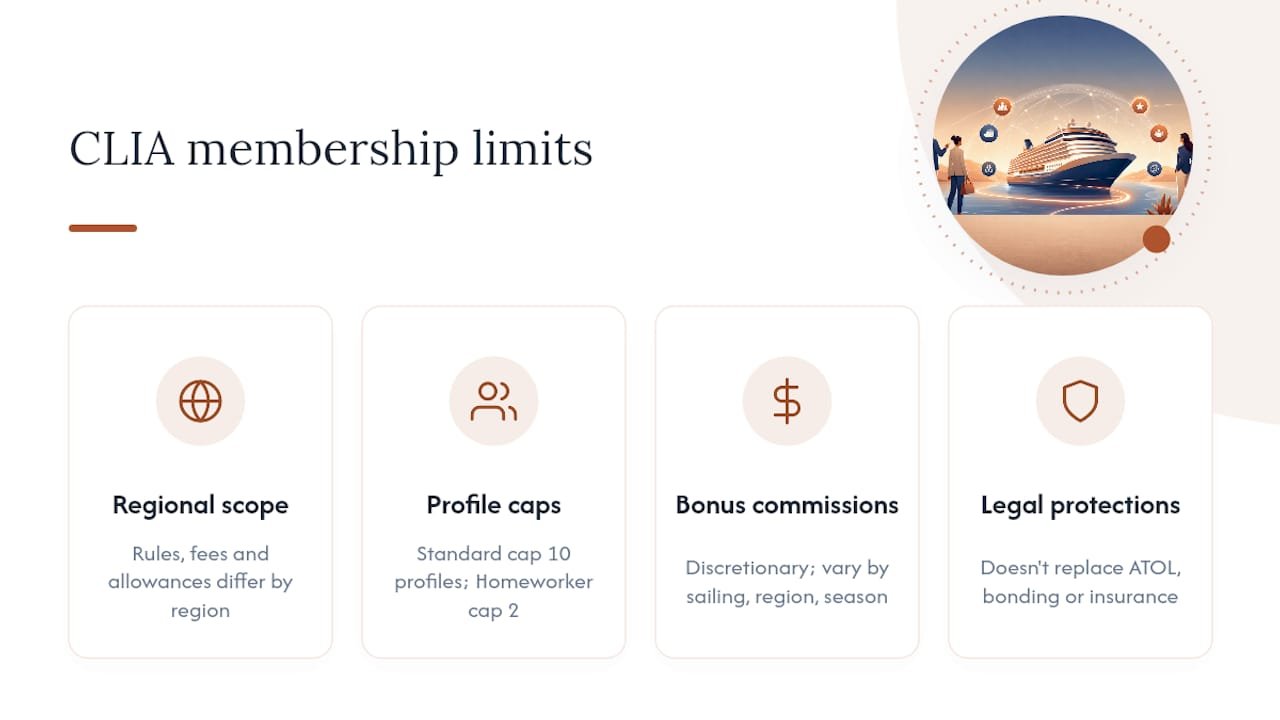
Geographic scope is the first limit. CLIA operates through regional offices, and rules, fees and profile allowances differ by region. A benefit or fee structure you read about on a US-focused forum may not apply to a UK & Ireland membership, so always confirm details against your own regional terms page rather than a general reference.
Agency size creates a second constraint. Standard agency membership caps at 10 individual profiles, and homeworker agency membership caps at 2. A growing agency that outgrows its category needs to upgrade its TAM tier, and the individual advisors under it can’t get their IAM until that happens.
Bonus commission programmes are not universal or permanent. They’re offered at the discretion of individual cruise lines, vary by sailing, region and season, and can change or lapse without much warning. Treat them as a genuine perk, not a guaranteed income line.
Finally, membership confers credibility and access. It does not replace ATOL protection, financial bonding, or the regulatory and insurance obligations an agent or agency needs to trade legally. Those sit entirely outside CLIA’s remit and need to be arranged separately, whatever route into the trade you take.
How do you contact CLIA member services?
Most day-to-day queries, profile updates and renewal issues go through the myCLIA portal itself, where logged-in members can update contact details, check EMBARC ID status and manage renewal payments directly.
For questions the portal doesn’t resolve, each CLIA regional office runs its own member services line. UK & Ireland members should use the CLIA UK & Ireland contact channels listed on the regional terms page rather than a North American or other regional office, since account records and fee schedules are managed separately by region.
Common reasons agents contact member services include EMBARC ID delivery issues, since the credential is typically mailed to the individual and can go astray if contact details are out of date, agency profile changes when an advisor moves host agencies, and renewal payment queries around the December year-end cut-off.
Keep your profile details current year-round rather than only at renewal time. An outdated address or email is the single most common cause of a missing EMBARC ID or a lapsed membership nobody noticed until bonus commission eligibility quietly disappeared.
Publisher perspective: how Timeshunters complements CLIA membership
CLIA membership solves a credibility problem. It doesn’t solve a business infrastructure problem, and that gap trips up more agents than the credential itself ever will.
An agent with a fresh IAM but no agency backing, no branded booking site and no wholesale rate access has a certificate and not much else to sell against. That’s where a platform like Timeshunters fits: it gives agents a branded agency identity, ATOL-protected licensing, and wholesale hotel, cruise and tour inventory, which for many advisors is the missing piece that satisfies the agency affiliation that IAM eligibility depends on.
The distinction worth holding onto: CLIA supplies the credential and the cruise industry community. Timeshunters supplies the commercial engine, the branded presence and the commission structure that turns that credential into a working business.
— Sam
Start your own agency with a higher commission split
Most routes into cruise selling still run through a traditional host agency, splitting commission and leaving you working under someone else’s brand name. Timeshunters takes a different route entirely: a white-label platform that gives you your own branded travel business, ATOL-protected licences to trade under, and a 70% commission split, well above the roughly 4% typical of online travel agency arrangements.
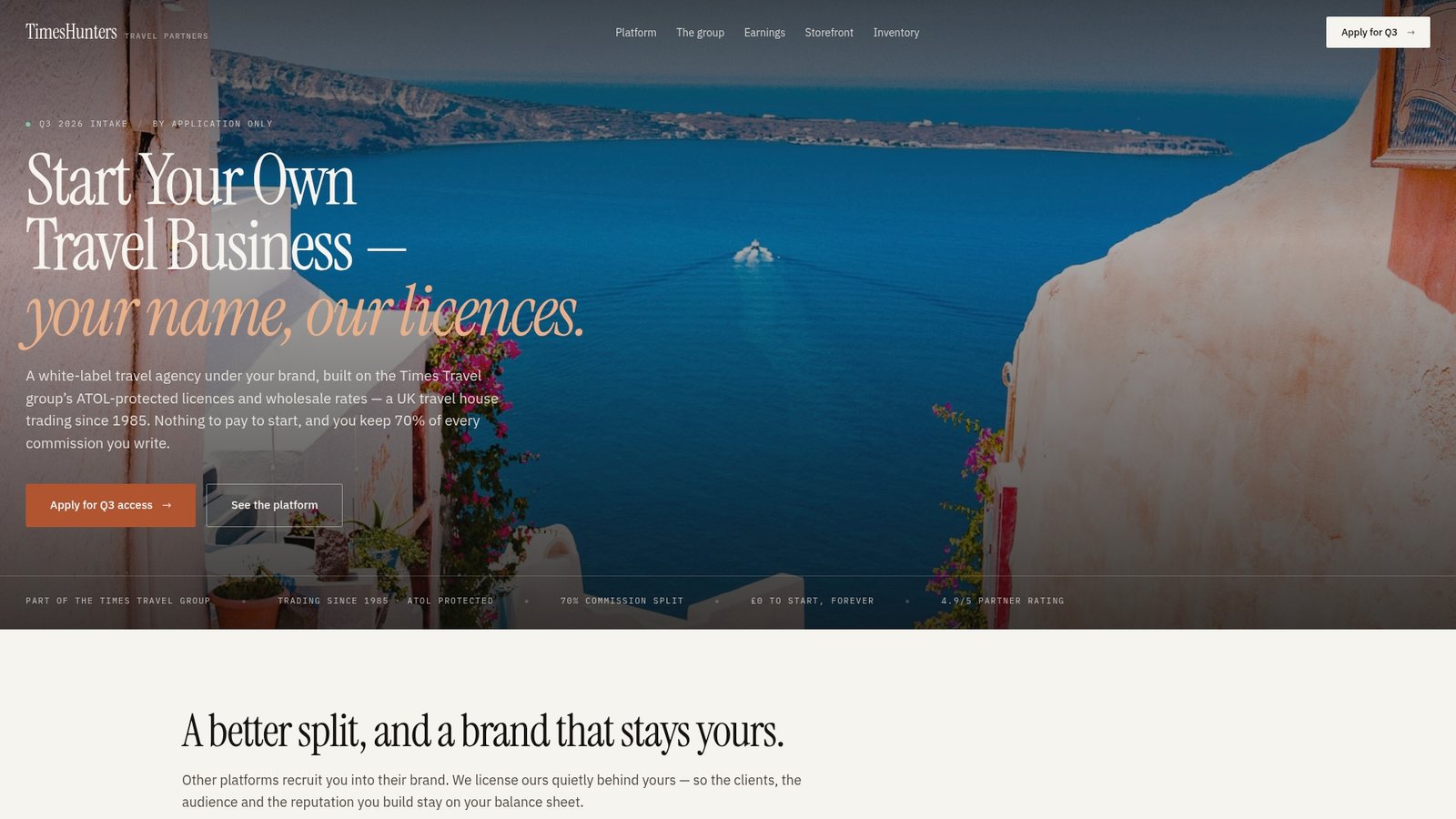
It suits agents who already hold or plan to pursue CLIA credentials but want to sell under their own name rather than an employer’s, and it works equally well for freelancers, hospitality professionals or anyone with an existing audience who wants wholesale cruise, hotel and tour access without building booking infrastructure from scratch. Automated booking management, managed payments and instant pricing proposals handle the operational load, leaving more time for the client relationships and cruise specialism CLIA training is designed to support.
If a branded agency with a stronger commission split sounds like the missing piece in your cruise-selling plan, take a look at how Timeshunters works and see whether it fits alongside your CLIA credentials.