
Wholesale Travel Pricing: How Net Rates and Mark-Ups Work
How wholesale travel pricing works in the UK: net rates, mark-ups, commission benchmarks and how to get trade access without chasing supplier accreditation alone.

Wholesale travel pricing is the price a supplier gives the trade before anyone adds their margin. You buy at that net rate, add a mark-up, and the difference is what you earn. The harder question for a new seller is not the sum. It is getting access to trade rates in the first place, and keeping a large share of the margin once you have it. That is where a white-label model built on ATOL-protected licences changes the economics: you sell under your own name, and our partners keep 70% of the commission on each booking.
This guide explains the numbers in plain terms, shows a worked example, gives the UK commission benchmarks and lists the terms to check before you sell.
TL;DR
- A net (wholesale) rate is the supplier’s price with no reseller margin in it. You add your mark-up to reach the price your client pays.
- UK trade commission benchmarks run from roughly 10% to 30% depending on the channel, and retail agents sit at the lower end.
- Many wholesalers sell only to the trade, so credentials and licences decide whether you see the rates at all.
- Mark up with the right formula: divide the net rate by (1 minus your target margin), not net rate times the percentage.
- With our white-label platform you sell under your own brand on ATOL-protected licences and keep 70% of the commission, with a 30% split to us and no cost to start.
Table of Contents
- What wholesale travel pricing actually means
- Net rates versus commissionable rates
- How to mark up a net rate without short-changing yourself
- Typical UK commission benchmarks
- Why access is the real hurdle
- Terms to check in any wholesale rate arrangement
- Is wholesale pricing a viable margin for a new seller?
- Where our white-label platform fits
- Start selling at wholesale rates
- Our view on wholesale pricing
- FAQ
- Sources
What wholesale travel pricing actually means
Three prices sit on every holiday component, whether it is a hotel room, a cruise cabin or a tour.
- Net rate: what the supplier needs to cover its costs and make its profit. VisitBritain’s guidance calls this the net or contract rate.
- Gross (retail) rate: the net rate plus the distribution cost, which is the commission paid to the people who sell it.
- Your selling price: the gross rate if you earn commission, or net plus your own mark-up if you buy net.
VisitBritain gives a clean illustration: a £125 gross hotel rate with 20% tour-operator commission leaves a £100 net rate once the £25 commission is taken out. The same £100 is what the supplier receives whichever route the booking takes. Only the split of the £25 changes.
Wholesalers and bulk buyers get better prices because of volume. An open hospitality textbook explains that wholesalers typically buy at 25 to 30% discounts, against 15 to 20% for retailers, so a $100 product might go to a wholesaler for $70 to $75 and to a travel agent for $80 to $85. The exact figures vary by supplier, but the principle holds: the nearer you are to the source, the lower your cost and the larger your margin.
Net rates versus commissionable rates
There are two ways the trade is usually paid, and they behave differently in your accounts.
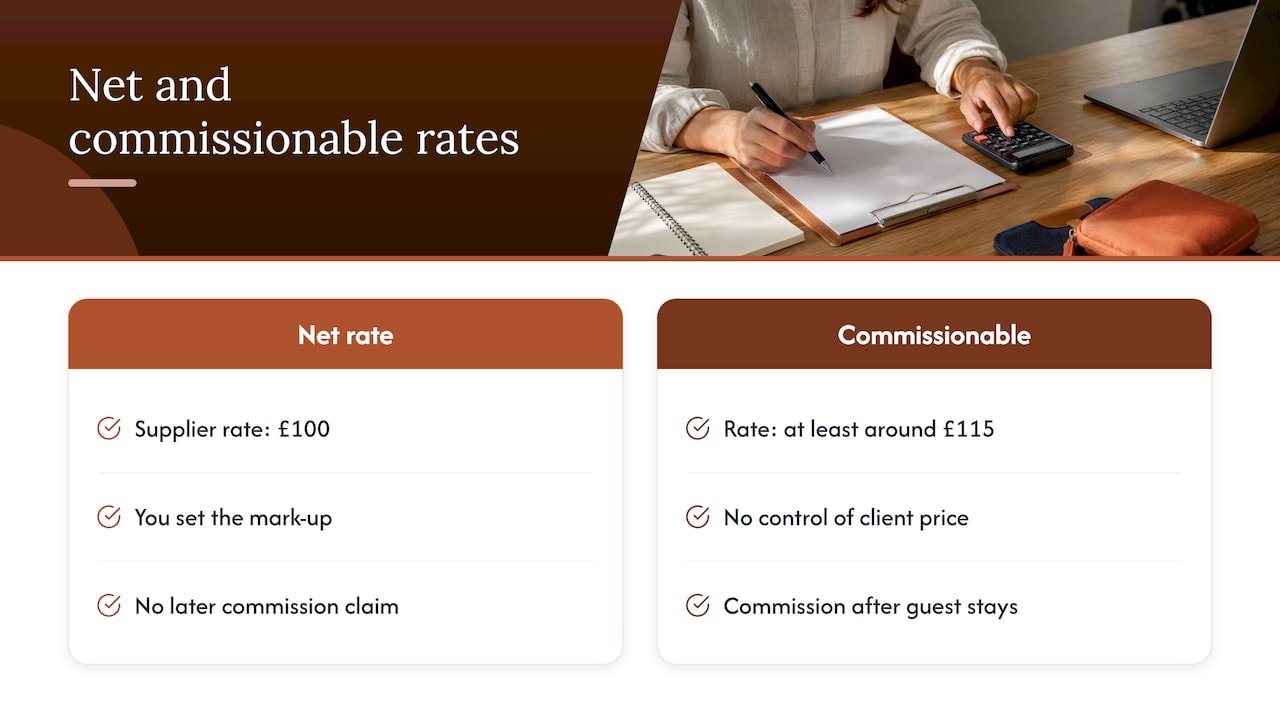
Commissionable rates. The supplier publishes one price and pays you a percentage when the booking completes. ETAG, the English Tourism Association Group, explains that commissionable trade rates pay an agreed commission, usually 10 to 30%, on the best available rate, invoiced after the guest has stayed. You do not control the client price, and you wait for the money.
Net rates. The supplier gives you a fixed price and you decide the mark-up. The same ETAG guide says net trade rates are static, contracted 18 to 24 months ahead, kept confidential and need no later commission claim. You control the margin, but you also carry the job of pricing correctly.
ETAG’s own example shows why the two differ. A supplier that needs £100 to cover costs might offer a £100 net rate for you to mark up, or a commissionable rate of at least around £115 so that a 10 to 30% commission can be paid on it. Both routes pay the supplier the same. The difference is who sets the final price and when cash arrives.
If you want to see how fixed and fluctuating hotel prices affect a seller’s margin, our guide to static versus dynamic hotel rates walks through each.
How to mark up a net rate without short-changing yourself
The most common arithmetic mistake is to multiply the net rate by the margin you want and add it on. That gives you a smaller margin than you think.
The correct method: divide the net rate by (1 minus your target margin).
| Net rate | Target margin | Wrong: net × 1.15 | Right: net ÷ 0.85 | Margin actually earned by the wrong method |
|---|---|---|---|---|
| £1,000 | 15% | £1,150 | £1,176.47 | 13.0% |
| £2,500 | 15% | £2,875 | £2,941.18 | 13.0% |
| £4,250 | 15% | £4,887.50 | £5,000.00 | 13.0% |
On the £4,250 net rate, £750 is exactly 15% of the £5,000 selling price, while the shortcut leaves you £112.50 light. Across a year of bookings that gap adds up quickly. Our article on increasing booking margins goes further into pricing decisions.
Typical UK commission benchmarks
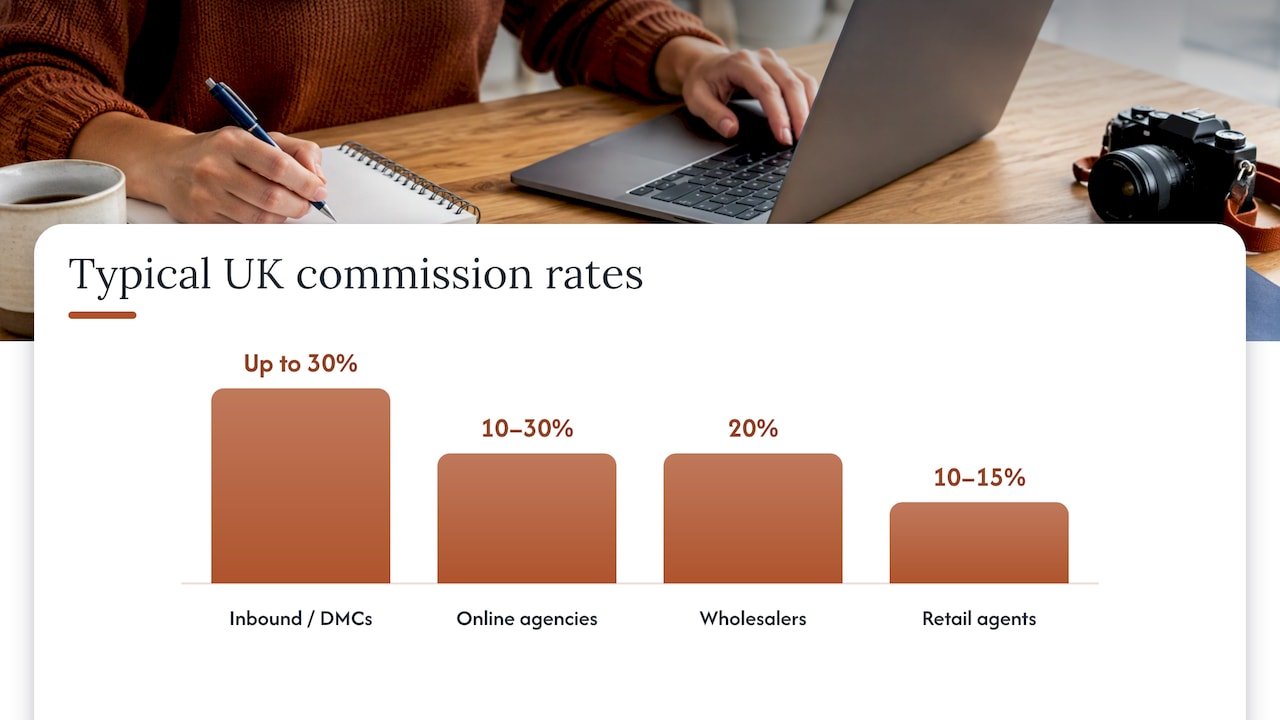
When you are not buying net, the commission you are offered depends on who you are in the chain. Two UK tourism bodies publish the same guide figures: National Park Experiences and VisitAberdeenshire. Both describe them as guides only.
| Channel | Typical commission |
|---|---|
| Inbound tour operators and destination management companies | Up to 30% |
| Online travel agencies | 10 to 30% |
| Wholesalers | 20% |
| Retail travel agents | 10 to 15% |
| Direct to consumer | None, the consumer pays the retail rate |
The beam Code of Practice for 2026 adds that agent-to-supplier commission has historically been commonly 8 to 10% of booking value for qualifying items, agreed before contracting.
Read those two tables together and the position of a conventional retail agent is plain: the people closest to the client are paid the least of the whole chain. PhocusWire’s Olan O’Sullivan argues that retail agency commissions should sit at 10 to 15%, while online agencies often contract 20 to 30%. That gap is exactly why many freelancers and home-based agents look for a model where the split is better.
For more on what UK agents earn by product, see typical travel agent commission rates and how to increase travel agent commission.
Why access is the real hurdle
Wholesale prices are not on the open market. The Official Travel Industry Directory notes that most hotel wholesalers sell only to the trade and ask for credentials such as an IATA, CLIA or TIDS number or proof of agency status, sometimes with a credit application. IATA is the global airline trade body and TIDS is its travel-agent identification scheme.
The credential question matters for money, too. The beam Code of Practice states that agencies must hold IATA accreditation or a TIDS code to claim and collect commission, and that supplier members are not obliged to pay commission to organisations without one.
Then there is the licence. In the UK, selling flight-inclusive packages requires ATOL protection, the Civil Aviation Authority scheme that protects travellers’ money. Independent sellers either apply for their own licence or sell under someone else’s. Our guide to tour operator bonding in the UK covers what the cost of going it alone looks like, and how a tour operator differs from a travel agent explains why the distinction matters.
This is the problem our model is built around. Partners use Times Travel group’s ATOL-protected licences, so you start with access to wholesale hotel, cruise and tour inventory rather than spending months assembling supplier accounts and credentials yourself.
Terms to check in any wholesale rate arrangement
Whether you work through us or evaluate a supplier on your own, the same questions decide how profitable a rate is in practice.
- Confidentiality. ETAG states that net rates must stay confidential. Posting them publicly, or passing them on, can end your access.
- Rate parity. National Park Experiences states that the gross rate must be the same across all distribution channels, and that a better direct price means the trade will not market the product. If you plan to undercut, you may find the supplier removes you from its trade list.
- Hidden mark-ups. Net rates given to wholesalers and destination companies are marked up inside packages, so the client sees one price. Plan your own margin in the same way.
- When commission is paid. Commissionable rates are usually paid after the stay, and many agreements pay commission only on confirmation and not on cancelled bookings. Cash flow can be tighter than the headline percentage suggests.
- Contract length. ETAG says trade rates are typically contracted 18 to 24 months ahead. Know whether your price is fixed or can move with demand.
We set out five contract checks for agents in more detail in travel agent net rates, including how they protect your cash flow.
Is wholesale pricing a viable margin for a new seller?
The test is not the percentage. It is what you keep per booking after the costs of getting that booking.
PhocusWire’s analysis defines the net rate as operating costs plus profit margin and the retail rate as net rate plus distribution costs. Its argument is that who sells the product and how much they cost to acquire the customer shapes the whole margin. If a booking comes from your own audience, your acquisition cost is your time and content, not a platform’s advertising budget.
A simple way to judge it:
- Take an average booking value you expect to sell.
- Work out the commission pool on it (the gross rate minus the net rate).
- Apply your split. Under our model, partners receive 70% of the commission and we collect 30%.
- Subtract your running costs, such as a website, marketing and insurance.
- Divide your monthly costs by what you keep per booking to find how many bookings you need.
As an illustration only: on a booking that earns £300 in commission, a 70% share is £210, while a 10% retail split of the same pool would be £30. Those are round numbers to show the sum, not a forecast. One of our partners reports moving from £400 to £1,200 per booking after joining.
Our break-even playbook for UK home agents works through the cost side, and the tour operator commission calculator shows net earnings per booking.
Where our white-label platform fits
Most wholesale guides stop at the definition and leave you to work out the supply. Selling travel under your own name brings together several jobs: supplier access, a licence, a booking site, pricing, payments and client follow-up. We designed the platform to put these in one place.
What partners get:
- Wholesale rates on hotels, cruises, tours, villas, safari camps and rail.
- ATOL-protected licences, with the licence branding invisible to your clients so the brand they see is yours.
- A branded booking site and instant pricing proposals.
- Managed payments and financial protection.
- Automated booking management and automated client follow-up.
- Training and support.
You keep your client relationships and your autonomy. Our own cruise example, £112 from a £2,000 cruise, shows how wholesale rates reach you through the platform.
Start selling at wholesale rates
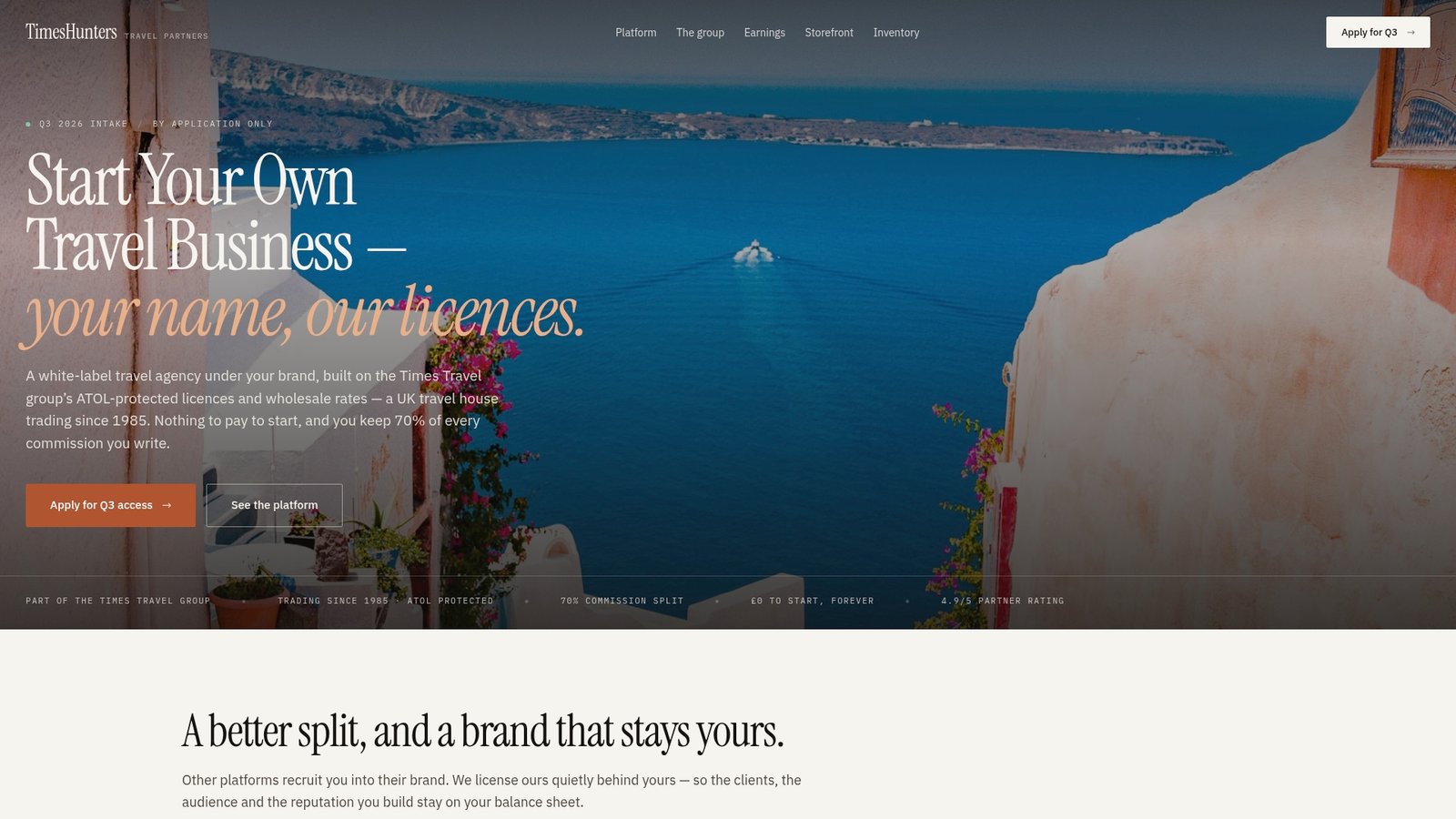
If you already have an audience, a client list or a hospitality business and want to sell travel under your own name, our white-label travel agency gives you ATOL-protected licences, wholesale inventory and a 70% commission share. There is no cost to start.
If you want to see how the commission works for your situation first, read about our referral programme for UK travel agents, or see how creators sell travel as a white-label agency. For a structured start, our UK travel agent training covers launching in four weeks.
Our view on wholesale pricing
Wholesale pricing is often presented as a secret. In practice it is a division of one margin between the people in the chain, and the person closest to the client usually gets the smallest slice.
We built TimesHunters to move that slice. A freelancer, a hotelier with regular guests or a creator with a loyal audience already does the hard part: earning the client’s trust. Under the usual structure, that trust is paid at a retail agent’s rate. We think it should be paid like the asset it is.
That is why our partners keep 70% of the commission, sell under their own name and use ATOL-protected licences without building the infrastructure themselves. The licence is invisible to your clients, so the brand and the relationship stay yours.
If you are weighing up whether to chase supplier accounts one by one or to start selling, we would start selling. The maths in this article works best when your cost of access is low and your share of the margin is high.
Sam
FAQ
What is the difference between wholesale and retail travel pricing?
Wholesale pricing is the net price a supplier offers to the trade, with no reseller margin included. Retail pricing is that net price plus the commission or mark-up of whoever sells it to the public. VisitBritain’s example has a £125 gross rate and a £100 net rate, with the £25 gap being the sales commission.
Can anyone buy wholesale travel rates?
Generally not. Many wholesalers sell only to the trade and ask for credentials such as an IATA, CLIA or TIDS number or proof of agency status. Packages that include flights also need ATOL protection. Selling through our platform means you use our ATOL-protected licences and access wholesale inventory from the start.
How much commission do UK travel sellers earn?
UK tourism bodies give guide figures of 10 to 15% for retail agents, 10 to 30% for online agencies and around 20% for wholesalers. Our partners receive 70% of the commission on each booking, with a 30% split to us. What that is worth in pounds depends on the commission pool on the booking.
How do I calculate a mark-up on a net rate?
Divide the net rate by 1 minus your target margin. For a 15% margin on a £4,250 net rate, £4,250 divided by 0.85 gives £5,000, and £750 of that is exactly 15%. Multiplying £4,250 by 1.15 gives £4,887.50 and leaves you with a lower margin than intended.
Can I advertise net rates publicly?
No. Net rates are kept confidential under trade agreements, and the selling price you publish has to respect the supplier’s rate parity across channels. Quote your clients a final price, and keep the net rate in your own records.
Sources
- VisitBritain: Pricing, it’s all about balance
- Introduction to Hospitality: Today’s Travel Trade
- ETAG: Rates and Pricing, a little more detail (2022)
- National Park Experiences: Becoming Travel Trade Ready
- VisitAberdeenshire: Your guide to working with the travel trade
- beam Code of Practice 2026
- Official Travel Industry Directory: Hotel wholesalers
- PhocusWire: As travel giants circle, understanding the economics