5,000 Followers? Launch an ATOL Influencer Travel Agency in the UK
UK creators' step by step guide to launching a white label ATOL protected influencer travel agency. Setup, compliance, pricing and marketing.

An influencer travel agency is a white‑label travel agency that lets creators sell ATOL‑protected trips under their own brand and earn meaningful commission. It suits anyone with an engaged audience and repeat bookings potential, rather than a one‑off giveaway. The upside: instead of the low cut you get from ad‑hoc affiliate links, you keep the bulk of the margin and control the customer relationship.
TL;DR:
- Using a white-label influencer travel agency platform simplifies setup by providing ATOL protection, supplier inventory, and automation, reducing legal and operational risks.
- A strong focus on compliance, including issuing ATOL certificates at sale and maintaining proper documentation, is essential to avoid legal penalties and reputational damage.
- Successful campaigns rely on consistent, detailed content and scarcity tactics, such as limited spots and real-time updates, to build urgency and trust.
- Higher-margin earnings come from personalized itineraries with higher fees that address a niche audience, rather than mass-market packages with low affiliate commissions.
- Managing admin, supplier relationships, and legal documentation effectively determines whether the business can thrive beyond initial bookings.
Table of Contents
- What is an influencer travel agency and does it suit you?
- How to set up your influencer travel agency and take your first booking
- ATOL and the Package Travel Regulations: what you legally must have
- How influencer travel agency commissions actually add up
- Marketing and selling trips: what actually converts followers into bookings
- What successful influencer travel agency campaigns actually look like
- Common pitfalls in running an influencer travel agency
- Contracts, consumer rights, and other legal essentials
- What I’ve learned watching creators build this business
- Ready to launch your own branded travel agency?
- Sources
What is an influencer travel agency and does it suit you?
A white‑label influencer travel agency is a ready‑built platform you brand as your own. Behind the scenes, a licensed operator supplies the ATOL‑protected inventory, the booking engine, and the payment processing. You supply the audience, the recommendations, and the personal relationship that makes a follower trust your itinerary over a generic search result.
The mechanics are simple: a branded booking site sits under your name or handle, wholesale hotel, cruise, and tour inventory is priced and displayed automatically, and booking confirmations, invoices, and follow‑ups run without you manually chasing anyone.
This model suits creators with a genuinely engaged niche audience, whether that’s five thousand devoted hiking followers or fifty thousand who tag you in every “where should I stay” comment. It’s less suited to accounts built purely on reach with little booking intent, or to someone unwilling to handle customer service when a flight gets delayed.
- You want to monetise trust, not just impressions
- Your audience asks you travel questions unprompted
- You’re comfortable being the named point of contact for a booking
Pro Tip: Test demand before building anything elaborate. Post one detailed sample itinerary with a “DM me to book” call to action and see how many replies you get. That single post tells you more than any amount of planning.
How to set up your influencer travel agency and take your first booking
Getting from idea to first sale is mostly a sequence of unglamorous admin tasks, done properly once so you never have to think about them again.
- Choose your legal structure. Most creators start as a sole trader for simplicity, moving to a limited company once turnover justifies the extra paperwork; either way, register the business before you take a single payment.
- Set up a business bank account and bookkeeping. Keep client money separate from personal funds from day one, and use accounting software to track VAT and tax obligations as the ANNA Money guide on starting a UK travel agency recommends.
- Decide your platform approach. Building your own booking system, contracting with a host agency, or joining a white‑label platform each carry different cost and compliance burdens. A white‑label route generally gets you trading fastest because the ATOL licensing and supplier contracts already exist.
- Build your branded booking flow. Your logo, your domain, your tone of voice, sitting on top of the platform’s pricing and payment engine.
- Draft client‑facing paperwork. Booking confirmations, receipts, and terms need to state clearly what’s protected and under whose ATOL licence, not vague marketing language.
- Run test bookings. Book a low‑value trip yourself, end to end, before you send a single real customer through the system.
- Confirm your supplier inventory. Whether that’s platform‑provided wholesale rates or your own negotiated deals, check availability and pricing accuracy before promoting anything publicly.
- Price your first offers. Start with a small, clearly bounded launch offer rather than opening every product on day one.
Rushing step six is the most common mistake. A confirmation email that arrives twenty minutes late, or a certificate that doesn’t reference the right ATOL number, erodes trust with your very first paying follower.
ATOL and the Package Travel Regulations: what you legally must have
This is the section that separates a proper travel business from a liability. If you sell a flight‑inclusive package, you must either hold an ATOL licence yourself or act as an authorised agent for an existing ATOL holder, according to the Civil Aviation Authority. There’s no informal workaround. Selling flights and accommodation together without that protection in place is a regulatory breach, not a grey area.
The Package Travel and Linked Travel Arrangements Regulations 2018 go wider than flights. They make the organiser liable for the performance of every service inside a package and require insolvency protection through a trust account, bonding, or insurance-backed scheme. The government is currently consulting on reforms to make these protections more flexible for smaller organisers, but the core liability rules remain firmly in force today.
The trap most new creators fall into: assuming a flight‑free trip doesn’t need statutory protection. It often still does. Relying on ordinary travel insurance instead of proper insolvency protection does not satisfy the legal requirement, and that gap is where enforcement action and reputational damage both start.
Practical actions worth building into your process from day one:
- Issue ATOL certificates automatically at the point of payment, not as an afterthought
- Keep booking documentation and receipts that clearly separate protected and unprotected elements
- Record supplier contracts and insolvency protection arrangements somewhere auditable
- Review your compliance route (ATOL holder versus authorised agent) whenever your product range changes
Modern booking platforms can automate certificate issuance and compliance paperwork at the point of sale, which removes a huge amount of manual risk compared with drafting documents by hand for every booking.
How influencer travel agency commissions actually add up
The arithmetic here is what makes this model worth the admin. A typical online travel agency affiliate link pays around 4% commission. On a £2,000 booking, that’s £80.
Retail pricing itself comes from wholesale rates plus your mark‑up or service fee. Some creators price everything as a flat planning fee regardless of trip cost; others take a percentage mark‑up scaled to the complexity of the itinerary. Startups.co.uk notes that the right approach depends on what your audience expects and how much hands‑on service you’re providing, and that modelling realistic conversion rates matters more than chasing an ambitious headline price.
- Higher-touch, bespoke itineraries generally command higher fees but lower volume.
- Simple, repeatable packages (a specific resort, a set cruise line) convert faster with less back‑and‑forth.
- Test both models against your own audience before committing to one pricing structure.
Marketing and selling trips: what actually converts followers into bookings
Selling trips is a funnel, not a single post. At the awareness stage, short‑form video showing real destinations does the heaviest lifting, because it’s the format your audience is already scrolling through. Mid‑funnel, a detailed sample itinerary post, with real prices and real hotel names, does more to build buying confidence than a generic “come travel with me” caption ever will. Behind‑the‑scenes planning content, showing you actually negotiating a group rate or comparing two hotels, builds the sense that you’re doing real work on the follower’s behalf.
- Awareness: short‑form video and destination reels that showcase real trips you’ve run
- Consideration: a detailed sample itinerary with transparent pricing, published as a carousel or blog post
- Decision: an email list offer or limited‑availability booking window that creates a clear next step
- Booking: a branded landing page with an embedded booking widget, so followers never have to DM you just to check a price
- Retention: automated follow‑up sequences that offer the next trip before the current one even ends
An ANNA Money guide on starting a travel business points to exactly this combination, short‑form content, sample itineraries, email offers, and low‑friction booking widgets, as the practical channel mix that works for small operators. Referral incentives, where a past client gets a discount for bringing a friend, tend to outperform generic discount codes because they carry social proof baked in.
Pro Tip: Publish your pricing openly on at least one sample itinerary. Hiding prices behind a “DM for quote” wall filters out exactly the buyers who were ready to book.
What successful influencer travel agency campaigns actually look like
The pattern behind the creators who make real money from this model is rarely a single viral post. It’s a consistent content rhythm built around trips they’ve genuinely run, published with enough detail that followers can picture themselves doing the same thing.
A creator focused on a specific niche, group trips to one particular destination, a cruise line, a wellness retreat format, tends to outperform generalist travel accounts. Repetition builds authority: post the same type of trip often enough and your audience starts to see you as the person who knows that destination or that style of travel better than anyone else in their feed.
The most effective campaigns treat the booking window itself as content. A limited number of spots on a group trip, announced with a countdown and real‑time updates as places fill, creates urgency that a static “book now” link never manages. Followers who see three of ten spots left behave differently to followers who see an open‑ended booking form with no scarcity signal at all.
Post‑trip content matters just as much as pre‑trip promotion. Photos, video, and testimonials from a completed group trip become the sales material for the next one, closing the loop between “here’s what we did” and “here’s how you join the next one.” Creators who skip this step and move straight onto promoting the next destination lose the single most persuasive asset they have: proof that the last trip actually happened and people had a great time.
Common pitfalls in running an influencer travel agency
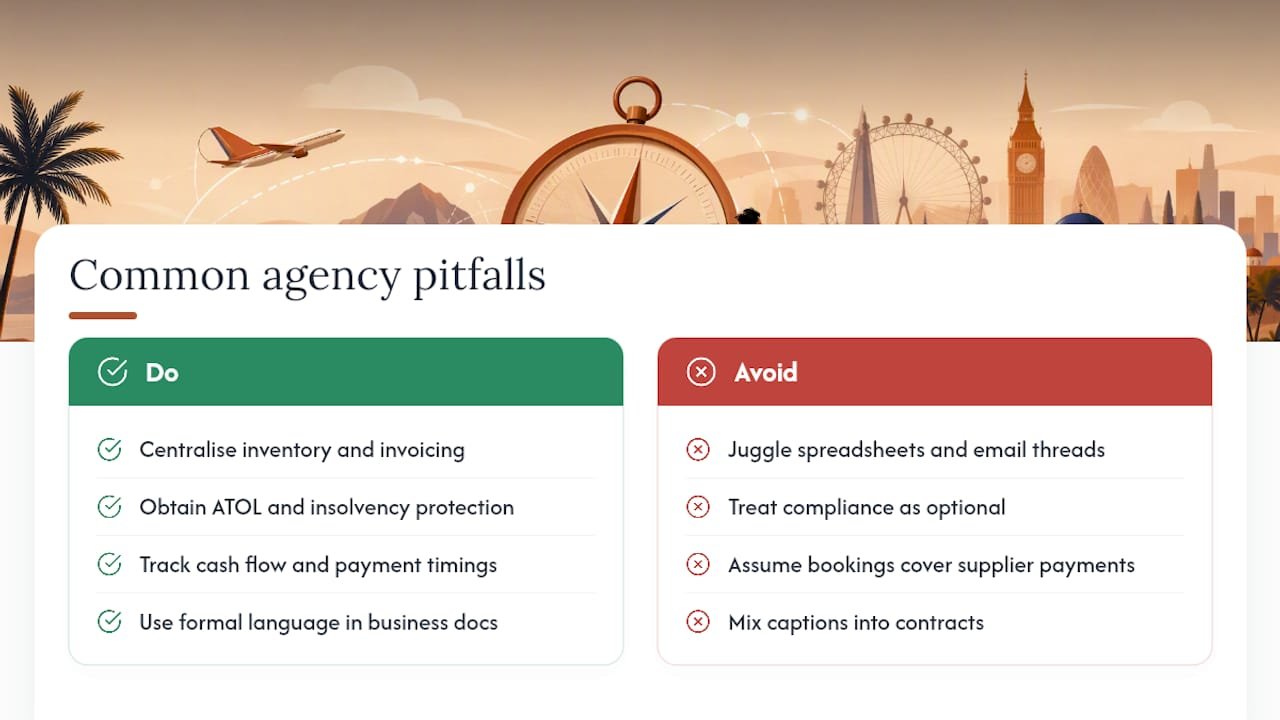
The single biggest pitfall is underestimating admin load. Creators often assume the hard part is selling the trip; in reality, managing supplier relationships, chasing payments, and keeping booking documentation in order takes up far more time than the marketing side ever does. Centralising supplier inventory and invoicing through one platform, rather than juggling separate spreadsheets and email threads for every hotel and tour operator, removes most of that burden.
A second common mistake is treating compliance as optional until something goes wrong. Skipping ATOL certificates, or assuming a non‑flight trip doesn’t need insolvency protection, feels harmless right up until a supplier collapses or a customer disputes a payment. At that point, the gap in your paperwork becomes a legal problem, not just an oversight.
Cash flow catches out plenty of new operators too. Wholesale suppliers often require payment before you’ve collected the full retail price from every traveller, especially on group trips with staggered deposits. Without a clear view of what’s owed and when, it’s easy to end up short on a supplier payment despite having plenty of bookings on paper.
Finally, mixing personal brand tone with formal business communication trips people up. Followers respond to authenticity, but a booking confirmation, a refund policy, or a contract needs to read like a real business document, not a caption. Keep the personality in your marketing and the precision in your paperwork, and treat the two as separate skills worth developing.
Contracts, consumer rights, and other legal essentials
Beyond ATOL and the PTRs, a handful of legal basics protect both you and your customers. Every booking needs clear terms and conditions covering cancellation policy, refund timelines, and what happens if a supplier changes an itinerary. Vague or missing terms leave you exposed to disputes you have no documented answer for.
If you collaborate with other influencers, whether that’s a joint hosted trip or a referral arrangement, put the commercial terms in writing before you promote anything jointly. Who’s liable if a customer complains, how referral fees are split, and who owns the customer relationship afterwards all need to be settled on paper, not assumed based on a friendly conversation.
Consumer rights law also means your marketing claims need to match reality. Advertising a trip as “all‑inclusive” when transfers or certain meals are excluded isn’t just poor practice, it’s a misrepresentation that can trigger a legitimate complaint. Data protection matters too: storing customer passport details, payment information, and travel preferences means you’re handling personal data under UK GDPR, which requires a lawful basis for processing and reasonable security measures around storage.
None of this needs a legal department. It needs a habit of writing things down clearly before you sell, not after a customer asks a difficult question.
What I’ve learned watching creators build this business
Most creators overestimate how hard the marketing side is and underestimate how much the compliance and operational groundwork determines whether the business survives its first year. The influencer travel agency model works precisely because ATOL protection and proper insolvency cover are unglamorous, boring even, and most casual affiliate marketers never bother with either.
That’s genuinely the whole edge. A white‑label platform that handles supplier inventory and automated booking management removes the excuse for skipping the paperwork, because it’s built into the system rather than left to your memory. Some users have reported increased income per booking after switching from affiliate links to a branded agency setup. When you’re evaluating any platform, ask specifically how onboarding support works and how quickly a real question gets a real answer, because that’s where the difference between a good partner and an absent one shows up fastest.
— Sam
Ready to launch your own branded travel agency?
Running your own influencer travel agency solves the three barriers that stop most creators from ever starting: getting proper ATOL protection sorted, sourcing wholesale inventory without months of supplier negotiation, and building booking automation you’d otherwise need a developer for.
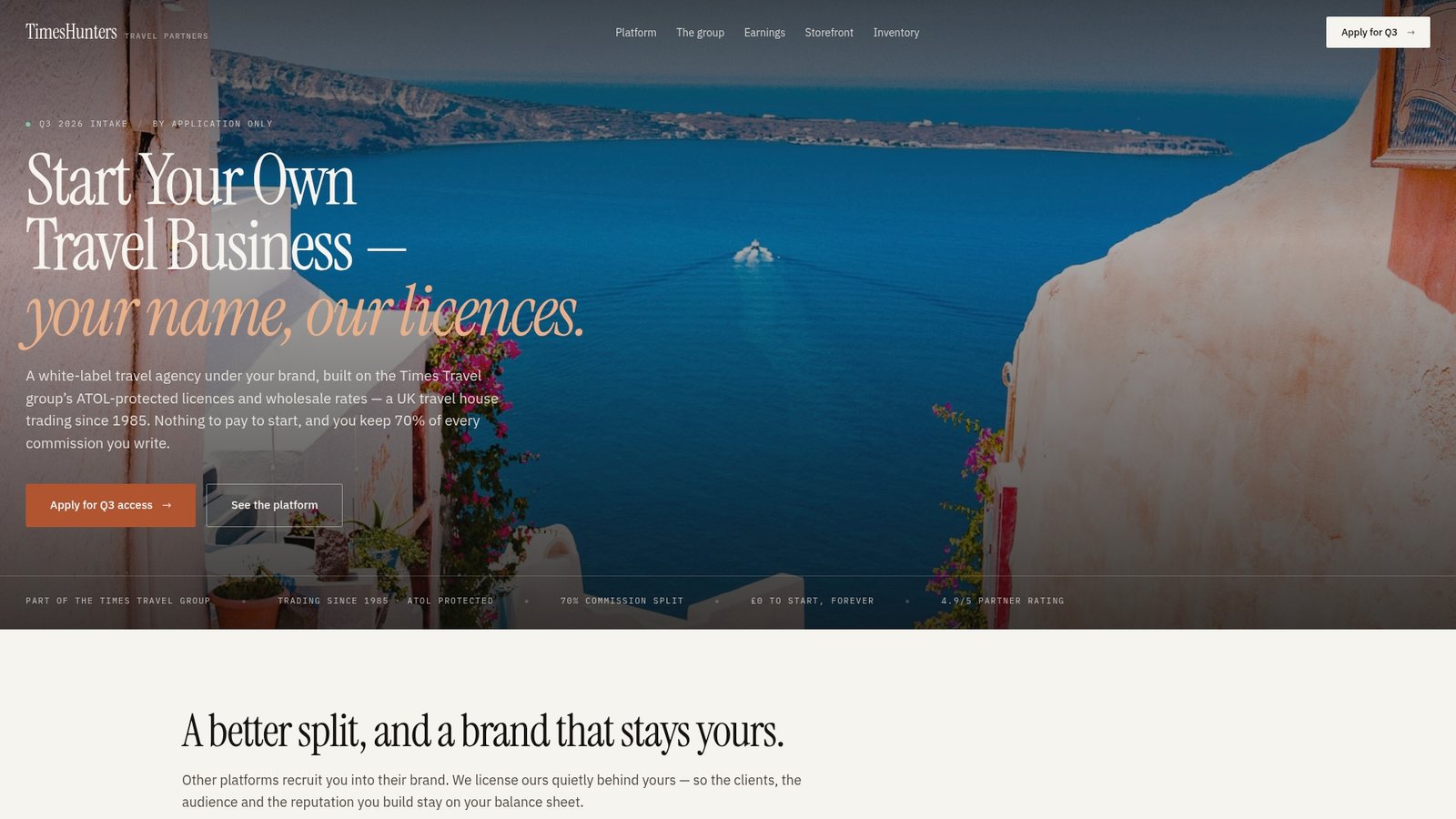
Before you commit to any platform, check three things: whether ATOL protection is genuinely built in rather than bolted on, what commission split you actually keep on each booking, and how much hands‑on onboarding support you get in your first weeks trading. If you want a second opinion on tools worth pairing with your booking flow, an AI travel companion can help preview itineraries for clients before you finalise a quote. The next step is straightforward: visit TimesHunters to see how onboarding works and start setting up your branded agency.