
5 Checks White Label Partners Need for Client Money Protection (UK)
White label partners: five checks to verify ATOL, the agency agreement, pipeline records and insolvency cover before taking client money.
Protection for a UK travel booking depends entirely on what you’re selling and what legal role you hold, not on which platform you use. Flight-inclusive packages need ATOL cover; non-flight packages and linked travel arrangements need bonding, insurance, or a trust account under the Package Travel Regulations 2018. Before you take a single payment as a white-label partner, get the written agency agreement and a product-by-product protection map from your platform, so you know exactly what covers each booking you sell.
TL;DR:
- Only bookings including flights require ATOL protection, while non-flight packages rely on bonding, insurance, or trust accounts under the Package Travel Regulations 2018.
- ATOL certificates must be issued immediately at the first payment, including card or cheque details, to ensure compliance and quick claim processing.
- Verifying protection involves checking ATOL numbers on the CAA register for flight packages and confirming security arrangements for non-flight bookings before accepting client payments.
- Segregation of client funds depends on whether the protection is via the Air Travel Trust or trust accounts, with managed payment systems reducing delays and improving claim handling.
- Agents must maintain accurate booking records, clear communication, and proper documentation to facilitate fast claims and demonstrate protection during insolvency events.
Table of Contents
- Which bookings are protected in the UK: ATOL, Package Travel Regulations, and what isn’t covered
- ATOL certificates, receipts, and the agency agreement you must have
- Bonding, insurance, and trust accounts for non-flight bookings
- What operational records do you need to prove protection?
- What should white-label partners check before taking any client money?
- What is the Client Money Protection scheme for travel agents?
- ATOL or Package Travel Regulations: which one covers your booking?
- How does client money segregation actually work?
- What obligations do travel agents have for handling client funds?
- How do I check if a travel agent has valid protection?
- What happens if my travel agent becomes insolvent?
- Author perspective: why transparent protection is a commercial edge, not just a compliance box
- How Timeshunters supports client money protection compliance
- Sources
- FAQ
Which bookings are protected in the UK: ATOL, Package Travel Regulations, and what isn’t covered
Whether a booking is protected under client money protection UK rules comes down to one question: does it include a flight, and is it sold as a package?
A holiday counts as a package when a business combines at least two different travel elements (flight, accommodation, car hire) for one price, sold or offered together. Any package that includes a flight needs an ATOL, issued by the Civil Aviation Authority. That’s the baseline test every white-label partner needs to run on every product line before it goes live.
Non-flight packages, such as a hotel-plus-tour bundle or a cruise-plus-rail combination, fall under the Package Travel and Linked Travel Arrangements Regulations 2018 instead. These require the organiser to hold effective insolvency security, but the mechanism is different from ATOL. Linked travel arrangements, where a customer books separate elements through connected sales processes without a single combined price, carry lighter obligations but still need some financial protection.
What typically isn’t protected:
- A single flight-only booking where the airline issues the ticket immediately and takes full responsibility.
- Accommodation booked directly with a hotel, with no other element bundled in.
- Car hire or transfers booked as standalone products, outside any package.
Get this classification wrong and you risk selling a customer a false sense of security, or worse, failing to arrange any protection at all.
ATOL certificates, receipts, and the agency agreement you must have
The moment you take a payment for a flight-inclusive package, the clock starts. The Civil Aviation Authority requires an ATOL Certificate to be issued immediately at the point of first payment, and “taking payment” has a wider definition than most new entrepreneurs expect.
Pro Tip: Accepting card details or a cheque counts as taking payment for ATOL purposes, even if the money hasn’t actually cleared yet. Your booking system needs to trigger certificate issuance at that exact moment, not after processing.
The receipt itself has specific legal content requirements. It must show:
- The name and ATOL number of the ATOL holder providing the flight or package.
- Which part of the total payment is protected under that ATOL.
- The ATOL protection statement, worded as the CAA specifies.
- A reference matching the certificate issued to the customer.
Your agency agreement, the contract between you and the ATOL-holding principal, needs to cover the same ground the 2012 ATOL Regulations set out: a written agreement with defined terms, clarity on who actually issues certificates, and the CAA’s Schedule of Terms incorporated by reference. Skip this step and you’re operating without the paperwork that proves protection exists at all.
Bonding, insurance, and trust accounts for non-flight bookings
Cruises, standalone hotel packages, and multi-day tours without flights fall outside ATOL but still need insolvency security under the Package Travel Regulations. Three mechanisms cover this, and each behaves differently when a business fails.
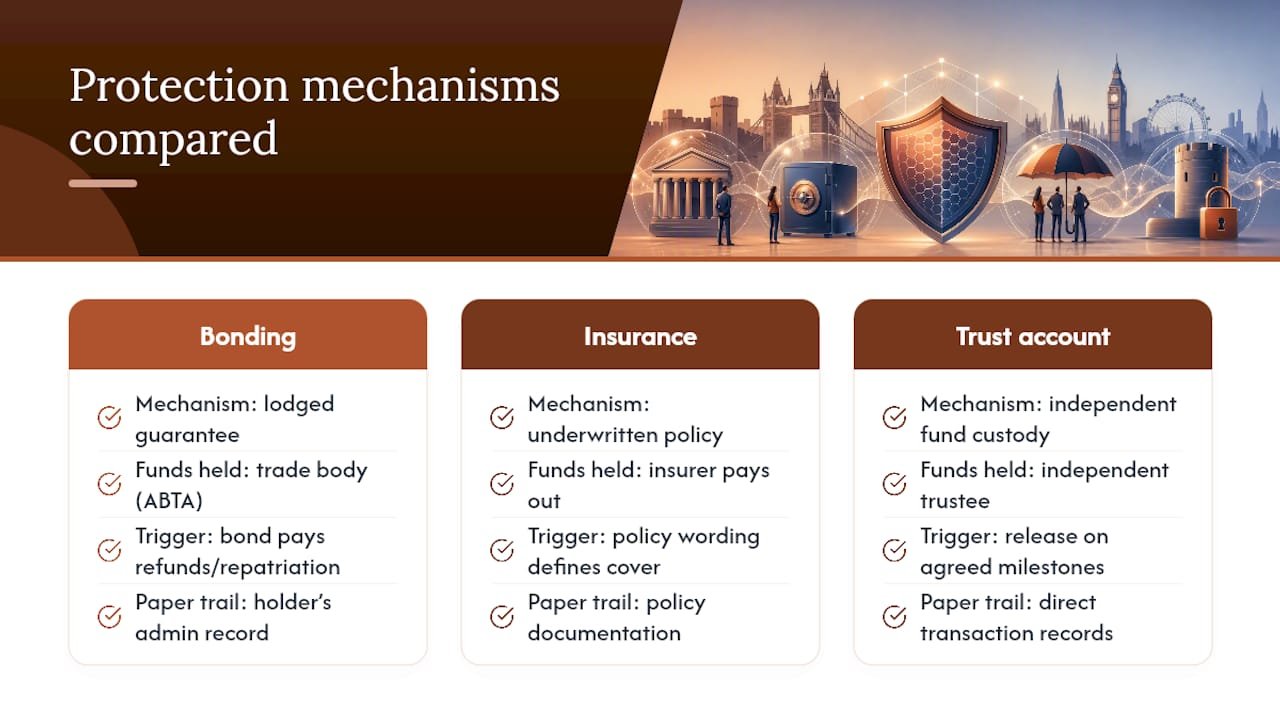
Bonding works like a financial guarantee lodged with a body such as ABTA or another approved trade association. If the organiser collapses, the bond pays out to cover refunds and repatriation costs, administered by the body holding it. ABTA is explicit that membership itself doesn’t guarantee protection; the specific arrangement sold has to carry the security, not just the seller’s trade association badge.
Financial Failure Insurance covers the same insolvency risk through an underwritten policy rather than a lodged bond. Check the policy wording carefully: cover limits, excess levels, and exactly which failure scenarios trigger a payout vary between insurers, and gaps here are where customers get caught out.
Trust accounts hold customer money with an independent trustee until the holiday is delivered, releasing funds to the organiser only against defined milestones. This gives the clearest paper trail of the three, but it also ties up cash flow longer, which matters if you’re planning growth around reinvested commission.
Expect any provider offering these routes to ask for underwriting and financial forecasting before agreeing terms; protection isn’t a commodity you can buy off the shelf without scrutiny of your business.
What operational records do you need to prove protection?
Legal protection only helps if you can prove a booking was covered when a claim is made. That’s where “pipeline monies” come in, the funds sitting between the customer’s payment and the point they reach the ATOL holder or trust account, often held briefly by the agent, a payment processor, or the Air Travel Trust.
If your ATOL principal fails, the CAA doesn’t just take your word for it. It asks for booking-level evidence:
- The ATOL Certificate reference issued for that booking.
- Confirmation of who issued the certificate and when.
- Payment records showing timestamps and amounts passed through to the principal.
- Details of any funds still sitting in the pipeline at the point of failure.
Managed payment systems that segregate client funds, reconcile automatically, and generate immutable receipts don’t change your legal protection status, but they make the difference between a claim settled in days and one stuck in dispute for months.
Pro Tip: Ask any platform you’re considering whether ATOL certificates are generated automatically at the payment step, or manually afterwards. Manual, delayed issuance is where compliance gaps and slow claims both start.
What should white-label partners check before taking any client money?
Before you accept a single booking payment under someone else’s ATOL licence, run through this list on a call with the platform or principal:
- Request the full written agency agreement, and confirm it references the CAA’s Schedule of Terms directly, not a paraphrased summary.
- Ask for a written map showing which protection route applies to each product category you’ll sell: flights and flight packages under ATOL, everything else under the relevant Package Travel Regulations option.
- Get sample ATOL Certificates and receipt templates so you can see exactly what a customer will receive and when.
- Confirm how pipeline monies are handled between the moment a customer pays and the moment funds reach the protected account, and ask what reconciliation reporting you’ll see.
- Verify that certificates and receipts are issued automatically at the point of payment, not batched or delayed, and that booking records are stored in a way that can’t be edited after the fact.
Any principal or platform that can’t answer these clearly in one conversation is a warning sign worth taking seriously.
What is the Client Money Protection scheme for travel agents?
There is no single named “Client Money Protection” scheme in UK travel the way the phrase might suggest. Instead, the term describes the combined effect of two separate legal frameworks working together: ATOL for flight-inclusive bookings and the Package Travel Regulations 2018 for everything else.
The purpose behind both is identical, keeping customer money safe if the business holding it collapses before the holiday happens. ATOL does this through a licensing regime overseen by the Civil Aviation Authority, backed by the Air Travel Trust, which holds and disburses funds when an ATOL holder fails. The Package Travel Regulations achieve the same outcome for non-flight products through bonding, insurance, or trust arrangements instead of a licence.
The legal requirement isn’t optional at any point in the chain. An organiser selling flight packages without a valid ATOL is operating unlawfully, and a non-flight package organiser without one of the approved insolvency security options is in breach of the 2018 Regulations. For a white-label partner, the practical requirement is narrower but just as firm: you must know which protection framework applies to each product you sell, and you must be able to show a customer, in writing, that it’s in place before they pay.
This is why classification comes before anything else. Get the product type wrong, and you either misrepresent protection that doesn’t exist or apply the wrong compliance route entirely.
ATOL or Package Travel Regulations: which one covers your booking?
The two frameworks don’t overlap, they divide the market by whether a flight is involved. ATOL applies to any package, or any flight sold as part of one, that includes air travel. The Package Travel Regulations 2018 apply to every other package and to linked travel arrangements, covering cruises, coach tours, rail holidays, and multi-element bookings that never touch an aircraft.
The practical difference shows up in how protection actually works. ATOL is a licensing system: the CAA grants a licence to a specific business, that business is legally accountable for every ATOL-protected booking it sells, and the Air Travel Trust sits behind it as the fund that pays out on failure. There’s a single, centralised structure and a certificate that names the exact ATOL number covering the booking.
The Package Travel Regulations, by contrast, don’t mandate one single mechanism. An organiser can choose a bond lodged with a trade body, an insurance policy, or a trust account, provided the option chosen genuinely secures the customer’s money against insolvency. This flexibility means two non-flight package sellers can have completely different protection structures behind seemingly identical holidays.
For a white-label partner selling a mixed catalogue, the working rule is straightforward: check every product for a flight element first. If there’s a flight in the package, ATOL governs it regardless of what else is bundled in. If there isn’t, look to whichever Package Travel Regulations option your principal has arranged, and confirm which one it actually is before you promise a customer anything.
How does client money segregation actually work?
Segregation is the mechanical part of protection, keeping customer money separate from the business’s operating funds so it can’t be spent on overheads, salaries, or debts before the holiday is delivered or, if the worst happens, before a refund is due.
Under ATOL, this happens through the Air Travel Trust structure. Money customers pay for ATOL-protected bookings is treated as held for the customer’s benefit, not as general business revenue, and the Trust exists specifically to receive and disburse these funds if an ATOL holder fails. The ATOL holder doesn’t get unrestricted access to treat that money as its own cash flow.
Under the Package Travel Regulations, segregation depends on which insolvency option the organiser has chosen. A trust account is the most literal version: an independent trustee holds the funds and releases them to the organiser only against agreed milestones, such as confirmed supplier payments or the holiday’s completion. A bond doesn’t segregate money in the same physical sense, it sits as a standing guarantee that pays out if needed, funded separately from customer receipts. Insurance works similarly, as a promise to pay on a defined trigger rather than a pot of ring-fenced cash.
For a white-label partner, the point that matters practically is this: managed payment systems that automatically route customer funds toward the protected structure, whether that’s an ATOL holder’s designated account or a trust, reduce the chance of money getting mixed up or delayed. That’s an operational safeguard, not a substitute for the legal protection itself, but it’s the difference between a clean paper trail and a messy one when a claim needs settling.
What obligations do travel agents have for handling client funds?
As an agent selling on behalf of an ATOL holder or package organiser, you’re not just a sales channel. You carry specific duties around how you handle, document, and pass on customer money.
The first obligation is issuing correct documentation at the correct moment. That means the ATOL Certificate at first payment for flight packages, and equivalent confirmation showing which insolvency protection applies for non-flight bookings. Getting this timing wrong, issuing late or not issuing at all, is a compliance failure even if the underlying protection technically exists.
The second is accurate accounting for the money itself. You need to know, and be able to show, how much of each payment is protected, which principal or trust it’s destined for, and when it actually left your hands and reached the protected structure. This is the “pipeline monies” question again: money sitting with an agent or payment processor between customer payment and arrival at the protected account is still the agent’s responsibility to track.
The third obligation is honest communication with the customer. Overstating protection, implying a trade association membership guarantees cover when the specific booking doesn’t carry it, or failing to explain which part of a payment is protected, all breach the spirit of the regulations even where no single rule is broken outright. ABTA has been explicit that protection depends on the arrangement sold, not on membership status alone, a distinction every agent needs to pass on clearly.
Finally, agents are expected to keep records that would satisfy a regulator or the CAA on request, not just satisfy the customer at the point of sale.
How do I check if a travel agent has valid protection?
Verifying cover takes minutes, and it should be standard practice before you commit to a partnership or before a customer commits to a booking through your brand.
For ATOL-protected bookings, ask for the ATOL number and check it against the CAA’s public register, which lists every currently licensed ATOL holder. A genuine certificate will name a specific ATOL holder and number, not a vague reference to “industry protection.” If a business can’t produce a certificate immediately on payment, that’s a red flag regardless of what else it claims.
For non-flight packages, verification is less centralised because there’s no single public register covering every bonding, insurance, and trust arrangement in the same way. The practical check is asking the organiser directly which mechanism applies, requesting evidence (a bond certificate reference, an insurance policy number, or trust account details), and confirming the provider or trustee named actually exists and is currently active.
As a white-label partner yourself, the same standard applies to your own principal. Before you launch under someone else’s ATOL licence, verify the licence is current, ask to see the agency agreement naming you as an authorised agent, and confirm in writing what happens to customer funds you collect on the principal’s behalf. Don’t rely on a logo or a claim of ATOL backing without seeing the paperwork that proves it.
What happens if my travel agent becomes insolvent?
Claims following an insolvency move at different speeds depending on which protection framework applies and how well documented the failed business’s bookings were.
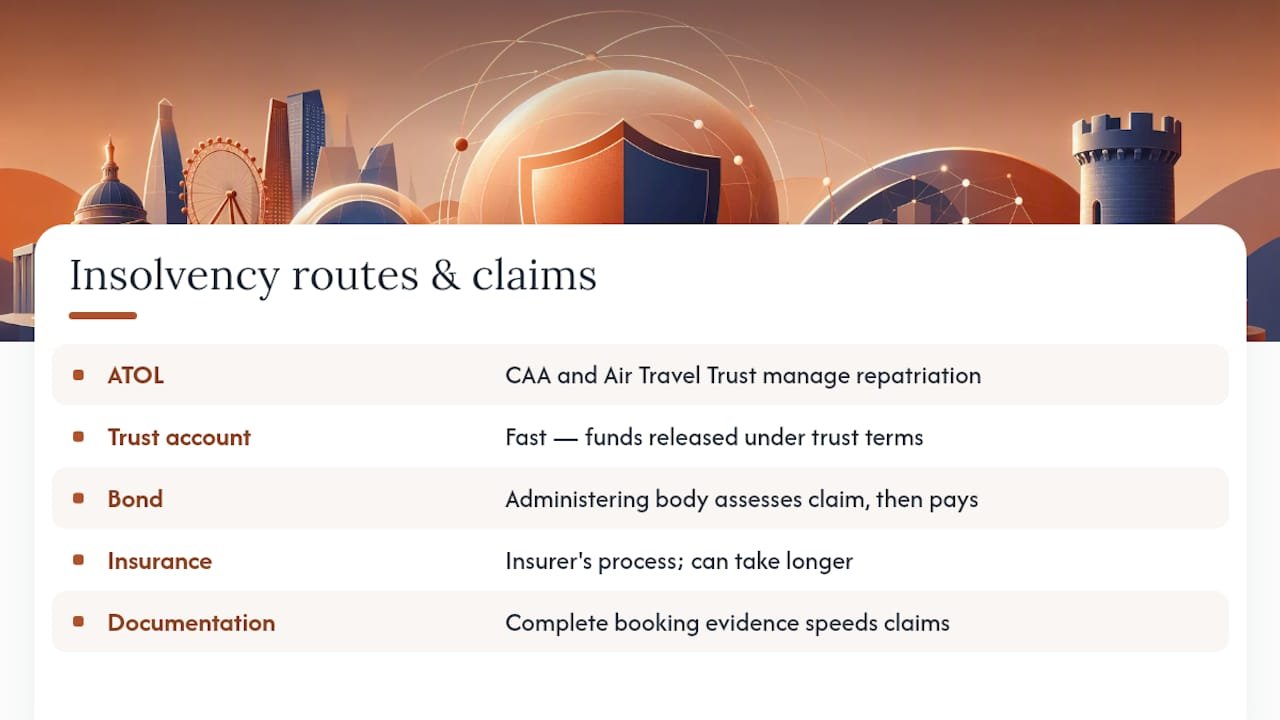
Under ATOL, when a holder fails, the CAA and the Air Travel Trust step in to manage repatriation for customers currently abroad and process refunds for those who haven’t yet travelled. The CAA’s guidance for the travel industry on ATOL holder failure sets out exactly what it needs from agents who sold the failed holder’s bookings: agency agreements, receipts, booking records, and details of any pipeline monies still in transit. Agents who can produce this evidence quickly see customer claims settled faster; agents with incomplete or manual records slow the whole process down, sometimes materially.
Under the Package Travel Regulations, timelines depend on which insolvency option was in place. A trust account tends to move fastest because funds are already held separately and simply need releasing under the trust’s terms. A bond claim goes through the administering body, commonly ABTA or a similar trade association, which assesses the claim against the bond’s terms before paying out. An insurance claim follows the insurer’s own process, which can take longer if policy wording requires detailed proof of the failure circumstances.
There’s no fixed statutory number of days across every route, because the mechanisms differ. What consistently speeds things up, across ATOL and every Package Travel Regulations option, is complete booking-level evidence submitted promptly. What consistently slows things down is exactly the opposite: missing certificates, unclear payment trails, or an agent who can’t confirm which protection applied to which booking.
Author perspective: why transparent protection is a commercial edge, not just a compliance box
Most new entrants treat client money protection as paperwork to survive an audit. That’s backwards. A customer who receives a clear ATOL Certificate within seconds of paying, with the right numbers on it, trusts the transaction more and disputes it less. Automated certificate issuance and clean records aren’t just compliance, they’re a quieter sales advantage few white-label brands bother to mention. Platforms like TimesHunters, built around ATOL-protected licences and managed booking workflows, give partners that structural clarity from day one, which matters more as your booking volume grows.
— Sam
How Timeshunters supports client money protection compliance
Getting the paperwork right shouldn’t be the hardest part of building a travel brand. Timeshunters gives partners a documented white-label travel agency route built on ATOL-protected licences, so you’re operating under a proper agency agreement from the first booking rather than piecing one together yourself.
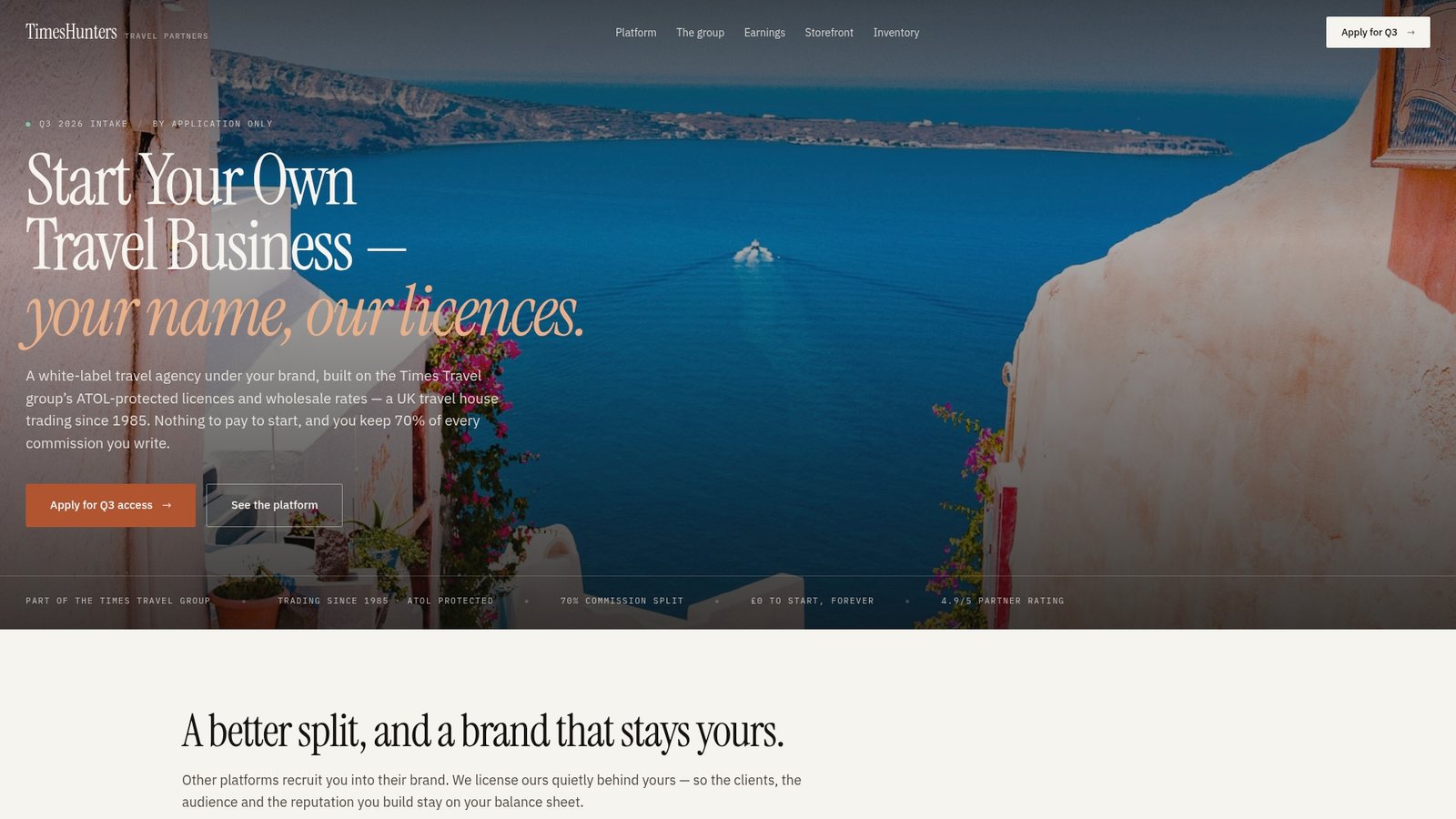
The platform handles the operational side that this article has walked through: automated ATOL certificate workflows at the point of payment, managed payment processing designed around client fund handling, and booking records kept in a way that stands up if a claim ever needs evidencing. Partners keep their own brand and client relationships while selling from wholesale hotel, cruise, and tour inventory, with commission split favouring the partner compared to typical online travel agencies.
If you’re weighing up whether to build your own agency agreements and payment infrastructure from scratch, or start from a structure that already has the protection mapping worked out, visit Timeshunters to see how the platform works and speak to a partner manager about your product range.
Sources
- The Civil Aviation (Air Travel Organisers’ Licensing) Regulations 2012
- Package Travel Regulations 2018 guidance (UK Government)
- Guidance for travel industry on ATOL holder failure — CAA
FAQ
Does every travel booking need ATOL protection?
No, only packages that include a flight need ATOL cover. Non-flight packages and linked travel arrangements are protected instead under the Package Travel Regulations 2018 through bonding, insurance, or a trust account.
When exactly must an ATOL Certificate be issued?
An ATOL Certificate must be issued immediately when the first payment is taken, and accepting card details or a cheque counts as taking payment for this purpose. Delayed or batched issuance is a compliance failure even where cover technically exists.
What are pipeline monies and why do they matter?
Pipeline monies are customer funds sitting between payment and arrival at the protected ATOL holder or trust account, often held briefly by an agent or payment processor. If a principal fails, the CAA requires detailed records of these funds to settle claims quickly.
Does ABTA membership guarantee my money is protected?
No, ABTA is clear that membership alone doesn’t guarantee protection; the specific arrangement sold has to carry the security. Always check which insolvency mechanism, bonding, insurance, or trust, actually applies to the booking.
Does Timeshunters provide ATOL protection for partners?
Timeshunters gives partners access to ATOL-protected licences through its white-label platform, along with a documented agency agreement and managed booking workflows. Full details on how the protection structure applies to your product range are available directly from Timeshunters.
How long does a claim take if my ATOL principal fails?
There’s no single fixed timeline, but the CAA’s guidance shows that agents who supply complete booking records, receipts, and certificate references see claims settle noticeably faster than those with incomplete documentation.