
Turnkey Host Agency Training: Get Booked in Weeks as a New Advisor
Host agency training that gets new travel advisors booked in weeks. Compare onboarding vs IATA/Travel Institute certification and the turnkey white label...

Most host agencies do provide structured training, and yes, it can get a new advisor to their first booking within weeks rather than months. That training usually comes in two layers: a short onboarding programme run by the host itself, and optional external certification through bodies like IATA or The Travel Institute. Which one you need depends on how much hand-holding you want versus how fast you want to start selling.
TL;DR:
- Most host agencies offer training focused on practical skills to get new advisors booking within weeks, usually through onboarding and optional external certifications like IATA.
- External certifications such as IATA’s diploma provide deeper knowledge on fare construction and supplier disputes, complementing the faster, more operational host onboarding process.
- Choosing the right host involves verifying a clear onboarding plan, accessible mentors, transparent fee structures, and proof of actual advisor success in reaching their first booking quickly.
- White-label platforms like Timeshunters can shorten onboarding to days by providing ready-made licensing, branded sites, and high commission splits, making them ideal for fast start-ups.
- The fastest route to a first booking prioritizes hands-on mentorship, automation tools, and a clear support infrastructure over high headline commissions alone.
Table of Contents
- What does host agency training actually cover?
- Which certifications and courses are worth taking?
- How long does training take, and what does it cost?
- How do you choose the right training programme?
- How does Timeshunters approach training and partner results?
- Which route actually gets you to a first booking fastest?
- Timeshunters: a turnkey route worth exploring
- Where to check course details and host listings
- Sources
- FAQ
What does host agency training actually cover?
Host agency training is built around getting you booking trips quickly, not passing an exam. Most programmes cover four practical areas, though the depth varies enormously between hosts.
- Operational systems — booking flows, supplier portals, payment processing, and how to handle refunds or date changes without losing a client’s trust.
- Industry mechanics — how commission splits work, what financial protection like ATOL actually covers, and basic BSP awareness for agents who touch airline ticketing.
- Selling and client management — writing proposals, handling enquiries, building itineraries, and knowing when to upsell a suite upgrade versus when to leave it alone.
- Marketing and technology — branded booking sites, CRM habits, email and social templates, and automated proposal tools that save hours per client.
Many hosts fold onboarding help around branding and website setup into the first few weeks, precisely because a new advisor without a professional-looking front end struggles to win trust from a first client. The gap between hosts is rarely in what topics they cover. It’s in how much practice and follow-up support sits behind each module.
Which certifications and courses are worth taking?
If you want a credential that means something outside your host agency, three names dominate the conversation: IATA, The Travel Institute, and, for finding a vetted host in the first place, industry bodies like Advantage Travel Partnership.
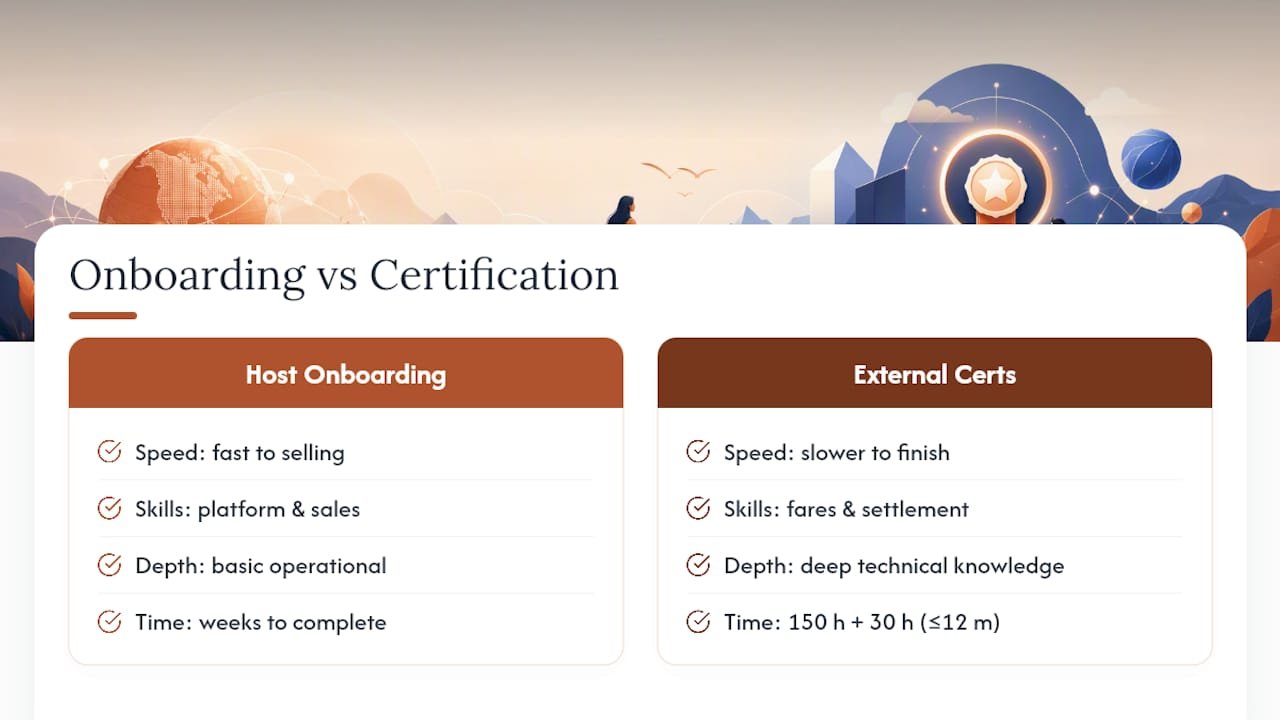
IATA’s Travel and Tourism Consultant diploma is the heavyweight option. It runs to roughly 150 hours of self-study plus an additional 30 hours for management modules, with an online exam and up to 12 months to finish. It’s a genuinely internationally recognised qualification, useful if you want fare construction and settlement knowledge that most host onboarding never touches.
The Travel Institute sits at a different altitude. Its Certified Travel Associate programme and related continuing-education tracks focus on sales skills, business planning, and professional credibility rather than technical ticketing depth.
Pro Tip: Treat host onboarding and external certification as complementary, not competing. Onboarding gets you selling; a diploma gives you the depth to handle complex fares and awkward supplier disputes later.
The practical difference: host onboarding gets you selling fast. External certification builds the deeper knowledge that protects you when a booking goes wrong.
How long does training take, and what does it cost?
Timelines split cleanly into two tracks.
- Host onboarding: anywhere from a few hours of video modules to a few weeks of guided sessions, depending on how hands-on the host is.
- External certification: multi-week to multi-month commitments. IATA’s diploma alone runs to 150 hours plus additional modules, spread across up to a year.
- Combined path: many advisors start selling through host onboarding within their first month, then work toward a formal certification alongside live bookings.
Cost follows a similarly split pattern. Host onboarding is frequently free or bundled into the commission arrangement, since the host earns from your future bookings anyway. External certification carries its own course fee, and some hosts add ongoing platform or subscription charges on top. The fastest routes to a first booking tend to share three things: a mentor who answers questions same day, ready-made marketing templates, and, where possible, an existing client list to work from rather than a cold start.
How do you choose the right training programme?
Choosing a host isn’t just about commission percentages. It’s about whether their training actually gets you to a paying client.
Run through this checklist before signing anything:
- Does the host show a clear onboarding schedule, not just a vague promise of “support”?
- Is there a named mentor or account manager, and can you reach them within a working day?
- What does the tech stack look like — branded website, automated proposals, CRM, or manual spreadsheets?
- How is money protection structured, and is it explained in plain terms?
- Is the commission split stated clearly, with no vague “up to X%” language?
Ask hosts directly for a sample onboarding module, a list of mentor availability hours, and (where relevant) a redacted contract clause on commission and exit terms. Vetted host directories often review exactly these factors before listing a host, which is worth checking before you rely on marketing copy alone.
Pro Tip: If a host can’t produce a single example of a new advisor reaching their first booking within a stated timeframe, treat that as a warning sign rather than an oversight.
Red flags worth walking away from: no demonstrable onboarding plan, opaque or shifting fee structures, and an absence of any real advisor outcome to point to.
How does Timeshunters approach training and partner results?
Timeshunters runs a white-label platform that lets new advisors trade under their own brand while operating on ATOL-protected licences borrowed from an established travel group. That structure matters for training because it removes the compliance burden that usually eats weeks of a new advisor’s onboarding time.
Timeshunters states that partners keep 70% of commission on bookings, against the roughly 4% typical of standard online travel agency arrangements, a claim the company makes about its own commission split. One partner testimonial cited by the company describes an increase in income per booking after switching to this model, illustrating the kind of shift a higher commission split and better-supported onboarding can produce.
Which route actually gets you to a first booking fastest?
Prioritise a host with hands-on mentor support and a tech stack that automates proposals over one offering the highest headline commission. Shortlist two hosts, ask each for a sample onboarding week and a genuine reference from a current partner, then compare. A high commission split means little if you’re left without support the first time a booking goes wrong.
— Sam
Timeshunters: a turnkey route worth exploring
Building your own booking site, chasing supplier contracts, and sorting financial protection from scratch can eat months before you take a single enquiry. Timeshunters offers a different starting point: a white-label travel agency platform where you keep your own brand and client list, while operating under ATOL-protected licences already in place.
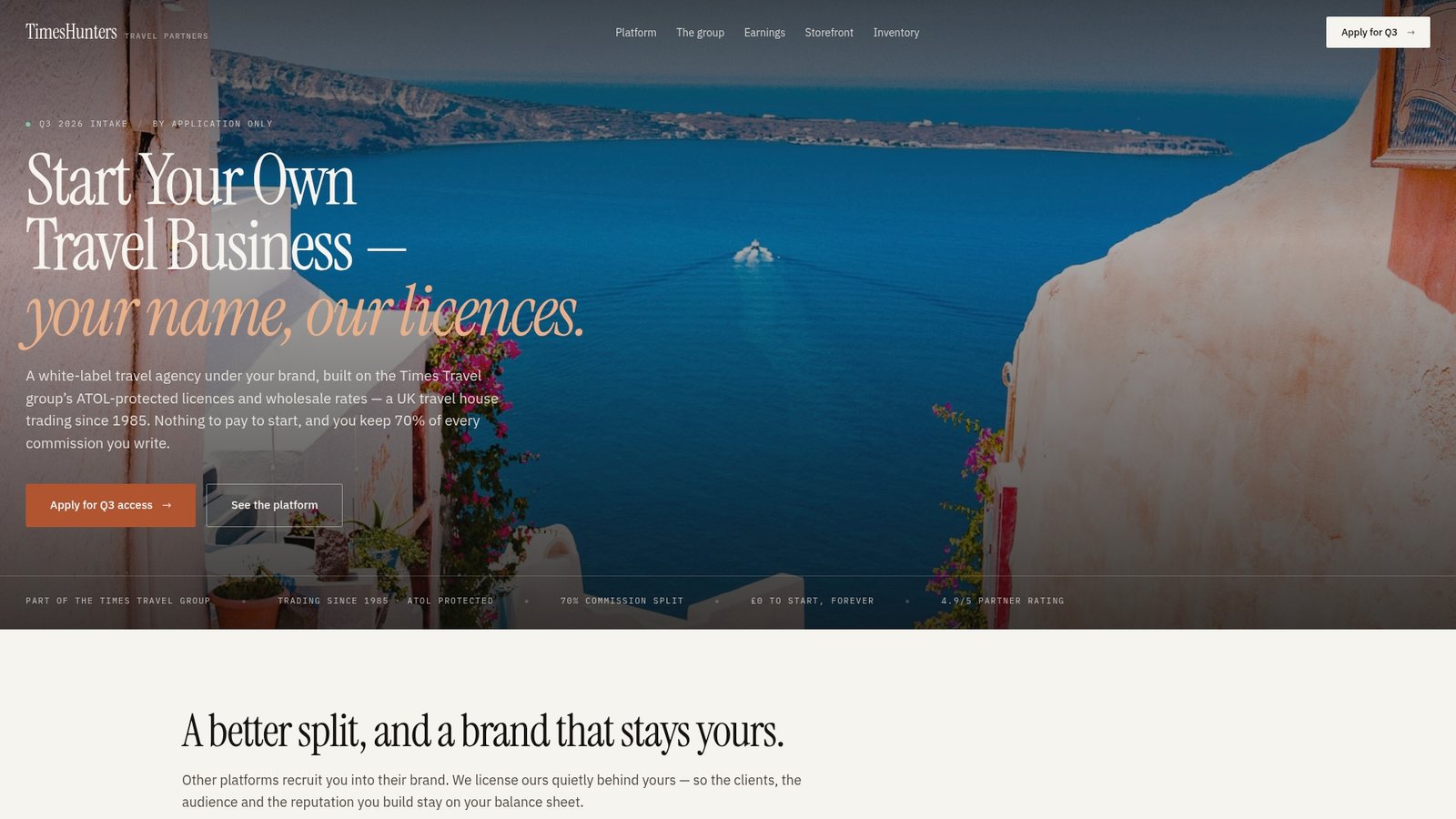
Partners get a branded booking site, wholesale hotel, cruise and tour access, automated proposal tools, and a stated 70% commission split on bookings, all without the upfront cost of building agency infrastructure yourself. It maps directly onto the checklist above: onboarding support, technology, and money protection sorted before you take your first enquiry. If that fits the fast, guided route you’re looking for, visit the white-label travel agency page to see how partner sign-up works.
Where to check course details and host listings
For exact course structure and exam details, check IATA’s training pages directly. For certification options, see The Travel Institute, and for vetted host listings, Advantage Travel Partnership.
Sources
- IATA – Travel and Tourism Consultant Diploma for the Leadership & Management Training Program
- The Travel Institute
- Host Agency Programme | Advantage Travel Partnership
FAQ
How do I become a host travel agency?
Becoming a host agency yourself means building the supplier relationships, financial protection, and technology that other advisors will operate under, which typically requires significant industry experience first. Most new advisors instead join an existing host agency rather than becoming one, using its infrastructure and training to start selling immediately.
How much does it cost to train to be a travel agent?
Host agency onboarding is often free or bundled into your future commission, while formal certification carries its own course fee. IATA’s Travel and Tourism Consultant diploma, for example, runs to roughly 150 hours of study plus additional modules, priced separately from any host’s own onboarding.
What is the best host agency for beginners?
The right host depends on how much structure you need, but look for one offering mentor-led onboarding, clear commission terms, and proven money protection. Platforms like Timeshunters pair ATOL-protected licences with a stated 70% commission split, which suits advisors wanting infrastructure and training bundled together from day one.
What does a host agency do?
A host agency gives independent advisors access to supplier contracts, financial protection, booking technology, and commission arrangements they couldn’t easily secure alone. In return, it typically takes a share of each booking’s commission while the advisor builds their own client base under their own brand.