
Before Launch: UK ATOL Licence Requirements for White Label Agencies
UK prelaunch checklist for white label ATOL licence compliance. Run a test booking, secure the full agency agreement, confirm certificate issuance and...

Operating under a white‑label ATOL means you carry real legal duties even though you never apply for the licence yourself. Before you take a single payment, secure the full written agency agreement with its Schedule of Terms, confirm your trading name appears correctly on every ATOL Certificate, and test the certificate and receipt workflow end to end. Skip any of these three and you risk breaching the ATOL Regulations regardless of what your platform promises.
TL;DR:
- You must verify the full agency agreement, including the Schedule of Terms, before spending on marketing or launching to ensure legal compliance.
- Testing the ATOL certificate issuance process with a real or simulated payment is essential to confirm immediate delivery and correct issuer information before accepting customer payments.
- All consumer-facing wording, receipts, and confirmations must clearly distinguish protected funds from fees and include the ATOL holder’s name and licence number to avoid breaches.
- Operating under a white‑label ATOL means you rely on the holder’s financial security and licensing, so understanding and confirming the provider’s documentation and support is critical before launch.
- Changes to your business or the platform’s ownership require prompt notification to maintain ATOL coverage and avoid invalidating the protection.
Table of Contents
- Agency agreement: what to read, record and insist on
- ATOL certificate: timing, issuer rules and what to test
- Consumer‑facing wording, receipts and confirmations to audit
- Operational pre‑launch checklist before you accept payments
- What to ask a white‑label platform before you sign anything
- Who actually qualifies to hold an ATOL licence
- Financial security and insurance an ATOL holder must maintain
- How the CAA licence application actually works
- Ongoing reporting duties once you’re trading
- Penalties for non‑compliance or misuse of an ATOL licence
- What happens to your ATOL cover if the business changes
- Publisher perspective: how Timeshunters approaches onboarding and compliance
- How Timeshunters helps you launch a compliant branded agency
- Sources
- FAQ
Agency agreement: what to read, record and insist on
The Civil Aviation Authority requires every white‑label agent to operate under a dated written agency agreement that includes the CAA Schedule of Terms. This is not paperwork you glance at once and file away. It is the legal document that determines whether you and your ATOL holder are both trading lawfully, and without it, both parties can end up in breach of the ATOL Regulations before a single booking is made.
Ask for the complete agreement, not a summary email or an onboarding slide deck. A proper Schedule of Terms sets out exactly what you are and are not permitted to do under someone else’s licence.
Before signing, check the agreement covers:
- Branding permissions: what your booking site, invoices and marketing are allowed to say about your own brand versus the protecting ATOL holder
- Payment authority: whether you or the ATOL holder actually processes and holds customer money
- Certificate issuance: who generates the ATOL Certificate and how your trading name is displayed on it
- Audit cooperation: what happens if the CAA or a customer requests records from your business
- Termination terms: how existing bookings and customer relationships are handled if the partnership ends
Pro Tip: Request the agreement before you spend a penny on marketing. If a platform hesitates to hand over the full Schedule of Terms rather than a plain-English summary, treat that as your answer.
Once you have it, store it alongside your launch records. If a customer claim or CAA enquiry ever lands on your desk, this document is what proves you were trading correctly from day one.
ATOL certificate: timing, issuer rules and what to test
An ATOL Certificate must be issued immediately the moment a customer pays for a flight‑inclusive or otherwise licensable booking. There is no grace period. “Immediate” means sending it by email straight after payment clears, whether the sale happened online, over the phone, or face to face, and a business must not take payment at all until it can actually supply that certificate.

Here is the detail that catches new agents out: the certificate’s “Issuer” field should show the business dealing directly with the consumer, which is you, even though your platform’s system generates the file behind the scenes. Your trading name needs to sit in that field correctly, every time.
Run this sequence before you go live:
- Make a small test payment through your booking site exactly as a real customer would
- Confirm the certificate arrives without delay and check the timestamp against the payment time
- Open the certificate and verify your trading name appears as the issuer, not the platform’s name
- Check the ATOL number displayed matches the one on your agency agreement
- Retain screenshots, email headers and the certificate file as evidence
Pro Tip: A delayed certificate cannot be fixed by sending it later. If your test booking reveals any lag, that gap needs closing before you accept a single genuine payment, not after.
Consumer‑facing wording, receipts and confirmations to audit
CAA Standard Term 1 governs everything your customer actually sees: your website, your booking terms, your invoices and your receipts. None of it can present the protection as if it were your own personal licence rather than the principal’s.
Your receipts carry a specific technical duty too. They must distinguish which part of any payment is protected under the ATOL and which part, such as a service fee, is not. The receipt also needs to show the ATOL holder’s name and licence number clearly, not buried in small print.
Before launch, audit:
- Your website footer and booking pages for accurate wording about who provides the financial protection
- Invoice and receipt templates for correctly split protected and unprotected amounts
- Package sale confirmations, which the CAA requires within three days of payment, complete with lead passenger name, flight details, carrier and the unique ATOL Certificate reference
- Any mixed catalogue of licensable and non‑licensable products, so ATOL wording never gets applied to items it doesn’t cover
Build approved templates for each of these and get the principal’s written sign‑off. Rewriting their documentation without approval is one of the fastest routes to a compliance breach.
Operational pre‑launch checklist before you accept payments
Compliance on paper means nothing until you have proven it works in practice. Before your booking site goes live to real customers, work through this sequence:
- Run a genuine or sandbox test booking and capture evidence: screenshots, email timestamps, and the resulting ATOL Certificate showing immediate issue and correct issuer naming
- Build a product matrix listing every item you sell and flagging which ones are ATOL‑licensable (flight‑inclusive packages) versus which are not (accommodation‑only stays, some cruise products)
- Check every email template, invoice and booking confirmation against the CAA’s required wording and get written approval from your principal before using them
- File copies of your signed agency agreement, test booking records and certificate emails somewhere retrievable, ready for a CAA enquiry or a customer claim
ABTA’s guidance on agency trading is useful here, because it confirms that an agent brings the customer contract into existence with the principal, and recommends exactly this kind of product‑by‑product distinction between licensable and non‑licensable sales.
Pro Tip: Treat your product matrix as a living document. New suppliers and new package types get added constantly, and a stale matrix is how ATOL wording ends up on a booking it was never meant to cover.
What to ask a white‑label platform before you sign anything
A short negotiation checklist saves you from discovering problems after launch, when customers are already booking through your brand.
Ask the platform to:
- Show you the full written agency agreement, not a summary, and confirm it includes the CAA Schedule of Terms
- Produce a sample ATOL Certificate demonstrating your trading name in the issuer field
- Explain exactly who accepts customer payments and how receipts will separate protected money from fees
- Hand over their approved consumer‑facing wording templates, with confirmation you’re permitted to use them
- Commit in writing to supporting you if the CAA or a customer ever requests audit records
Treat hesitation on any of these as a red flag. A platform that cannot produce a sample certificate, cannot show immediate issuance in a demo, or gives vague answers about receipt wording is not ready for you to launch on, whatever its marketing promises.
Who actually qualifies to hold an ATOL licence
The obligations above sit on top of a licence that the CAA does not hand out lightly. An ATOL holder has to demonstrate sound financial standing, usually through audited accounts and a bond or guarantee sized to their projected turnover, before the CAA will grant or renew a licence.
Experience matters too. Applicants need to show their business has the operational capability to run bookings, handle customer money correctly and cooperate with CAA reporting, not just a business plan. Directors and key management also go through a “fit and proper person” assessment, checking for relevant convictions, previous licence revocations, or a history of insolvency connected to travel businesses.
This is exactly why the white‑label route exists for most new entrants. Meeting these standards from scratch takes capital and track record that a first‑time entrepreneur rarely has on day one, which is the practical reason operating under an established holder’s licence, correctly, is the realistic path into this market.
Financial security and insurance an ATOL holder must maintain
Every ATOL holder has to maintain financial security proportionate to the value of bookings they take, typically structured as a bond held with the CAA or an equivalent guarantee arrangement. This security exists to fund repatriation and refunds if the holder collapses mid‑season, which is the entire point of ATOL protection for the travelling public.
Alongside the bond, holders need working capital sufficient to survive the gap between taking customer payments and paying suppliers, a gap that can stretch to months on package holidays booked well in advance. The CAA reviews this financial position annually through audited accounts, and a holder whose numbers slip below the required threshold faces licence conditions or revocation.
None of this financial burden falls on you as a white‑label agent. It sits with the ATOL holder whose licence you trade under, which is the trade‑off worth understanding clearly: you get financial protection for your customers without carrying the bond and reserve requirements yourself, in exchange for operating strictly within the agency terms that holder sets.
How the CAA licence application actually works
Applying for an ATOL licence directly involves submitting detailed financial forecasts, audited or certified accounts, and evidence of the bond or guarantee arrangement to the CAA, followed by an assessment period that commonly runs several months before a decision. Renewal happens annually, with the CAA reviewing updated accounts each time.
For a first‑time applicant with no trading history, this process is slower and more demanding, since the CAA has no track record to assess and will typically require a larger proportionate bond as a result. Any material change flagged during assessment, such as a funding gap or unclear ownership structure, extends the timeline further.
This is the practical reason most people reading this are not applying to the CAA directly. The white‑label travel agency model bypasses this entire application and bonding process by letting you trade under an existing holder’s licence instead, provided you meet the agency‑level obligations covered earlier.
Ongoing reporting duties once you’re trading
Holding, or trading under, an ATOL licence is not a one‑time compliance exercise. ATOL holders submit regular financial and booking data to the CAA, and as a white‑label agent your own record‑keeping duties feed directly into that reporting chain.
Your agency agreement will typically specify what data you need to supply the principal: booking volumes, certificate issuance records, and confirmation of correct consumer‑facing wording. The CAA can request evidence of compliance with Standard Term 1 at any point, not just at renewal time, so the audit trail you build during launch needs to keep growing as you trade.
Retain every test booking record, every agency agreement update and every approved template revision. If the platform changes its wording or its certificate format, get written confirmation of the update and file it alongside the original documents.
Penalties for non‑compliance or misuse of an ATOL licence
Misusing an ATOL, whether by issuing certificates late, misrepresenting protection in marketing, or presenting a principal’s licence as your own, exposes both you and the ATOL holder to enforcement action. The CAA can suspend or revoke a licence, which for a white‑label agent means an abrupt loss of the ability to trade at all.
Beyond regulatory action, incorrect ATOL wording or a missing certificate weakens a customer’s position if they need to claim after a supplier failure, since the certificate is the primary evidence of protection. That exposes your business to complaints, chargebacks and reputational damage that can outlast any CAA penalty.
The safest position is treating every compliance point in this article as non‑negotiable operational practice, not a checkbox exercise completed once at launch and then forgotten.
What happens to your ATOL cover if the business changes
Mergers, relocations, ownership changes and even a change of trading name can all affect the validity of the arrangement you rely on. The ATOL holder’s own licence conditions typically require them to notify the CAA of material changes to their business, and your agency agreement will usually require you to notify them of equivalent changes on your side.
If you relocate your business, change your company structure, or bring in new directors, tell your platform immediately rather than assuming the existing agreement still covers the new arrangement automatically. A change that looks administrative to you, such as switching from sole trader to limited company, can affect who is legally the contracting party under the agency agreement.
The same caution applies if your platform itself merges or changes ownership. Ask directly whether the underlying ATOL licence and your Schedule of Terms remain unchanged, and get that confirmation in writing rather than relying on a general reassurance.
Publisher perspective: how Timeshunters approaches onboarding and compliance
Marketing copy claiming “ATOL protected” means nothing without the paperwork behind it. That is the uncomfortable truth most white‑label platforms would rather you didn’t dwell on, and it is why the compliance tasks in this article, the agreement request, the certificate test, the wording audit, matter more than any badge on a landing page.
Timeshunters builds its partner model around Times Travel group’s ATOL‑protected licences, giving partners access to wholesale rates and a 70% commission on bookings against the roughly 4% typical of online travel agencies. That commission structure only means something if the compliance foundation underneath it is solid, which is exactly why documentation and test evidence, not promotional claims, should be your yardstick before you launch under anyone’s licence.
— Sam
How Timeshunters helps you launch a compliant branded agency
Timeshunters gives you a genuine alternative to building this compliance infrastructure from nothing: a white‑label platform where the ATOL protection, the Schedule of Terms and the certificate workflow already exist, so your job is verifying them rather than constructing them.
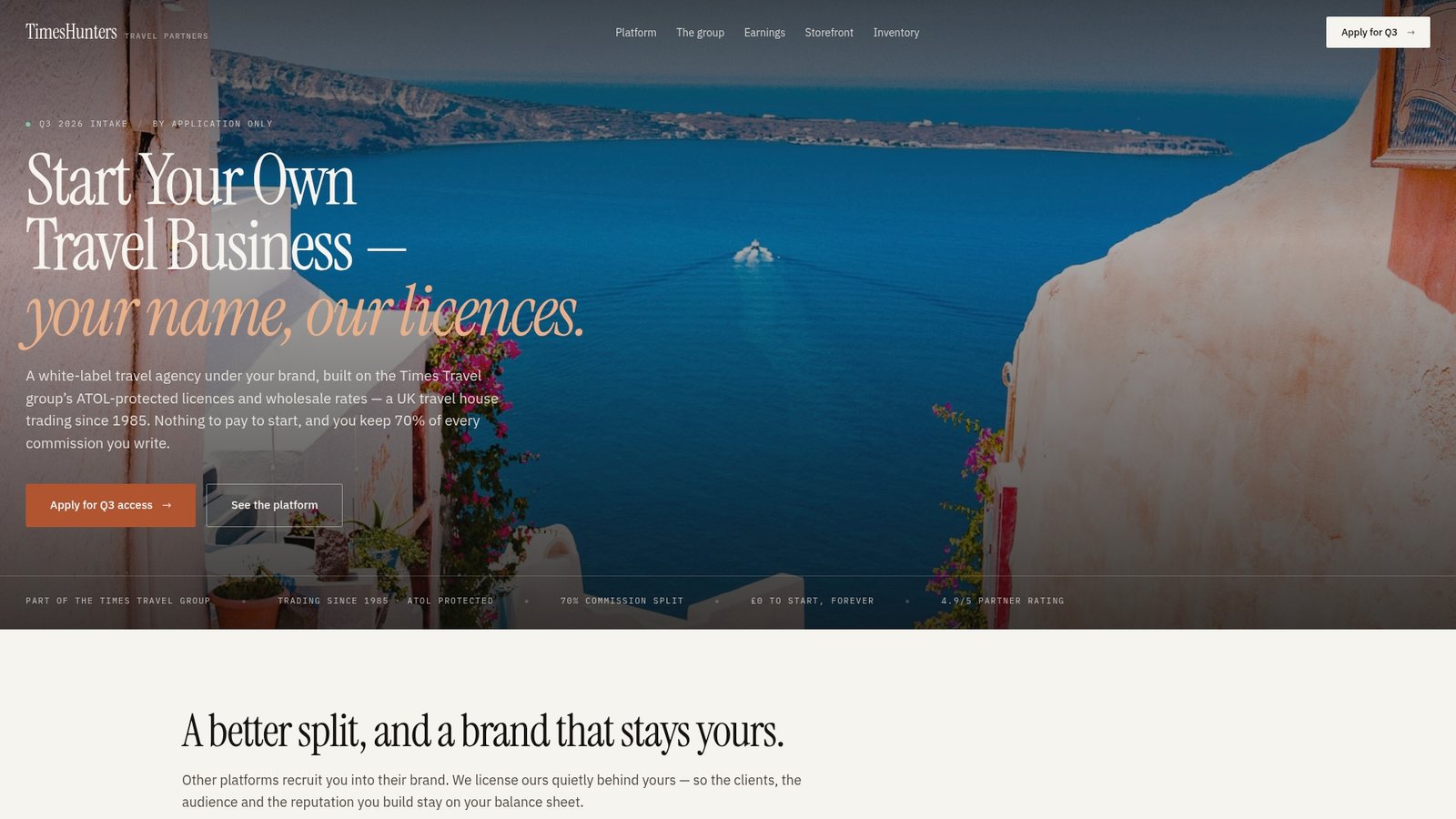
The platform gives partners a branded booking site, wholesale access to hotels, cruises, tours, villas, safari camps and rail, automated booking management, and training and support built around the onboarding steps this article covers. Partners keep their own brand and client relationships while trading under ATOL‑protected licences, earning a 70% commission split on bookings rather than the low single-digit rates typical of standard online travel agency arrangements.
Before you commit, request the full agency agreement, ask for a sample ATOL Certificate showing your trading name as issuer, and run a test booking to see the workflow in action, exactly as this article recommends. If you are ready to look closer, visit the Timeshunters landing page or explore the white‑label travel agency product page for full details on wholesale access and partner onboarding. If your launch also involves airport transfers for clients, Zont’s B2B transfer service is worth checking against your confirmation and booking templates too.
Sources
FAQ
Do I need my own ATOL licence to run a branded travel agency?
No. Under a white‑label arrangement like Timeshunters’s, you trade under the platform’s ATOL‑protected licence rather than applying for your own, provided your agency agreement and consumer‑facing documentation meet CAA requirements.
How quickly must an ATOL Certificate be issued after payment?
Immediately, meaning straight after the first payment clears for any flight‑inclusive or licensable booking. A business should not take payment at all until it can supply the certificate at that moment.
What should appear on my ATOL Certificate as the issuer?
Your own trading name should appear in the issuer field, since the CAA specifies the issuer as the business dealing directly with the consumer, even though the platform’s system generates the certificate file behind the scenes.
What is the commission structure with Timeshunters?
Timeshunters partners earn a high commission on bookings made through their branded site, significantly more than the typical standard online travel agency models, alongside access to wholesale rates across hotels, cruises, tours and more.
What happens if my receipts don’t distinguish protected money?
That breaches CAA Standard Term 1, which requires receipts to separately identify protected and unprotected amounts along with the ATOL holder’s name and licence number, and it can weaken a customer’s claim after a supplier failure.