
How to Launch a Travel Brand in the UK in 2026
How to launch your own travel brand in the UK: pick a niche, choose a licensing route, understand ATOL and package rules, and start earning 70% commission.

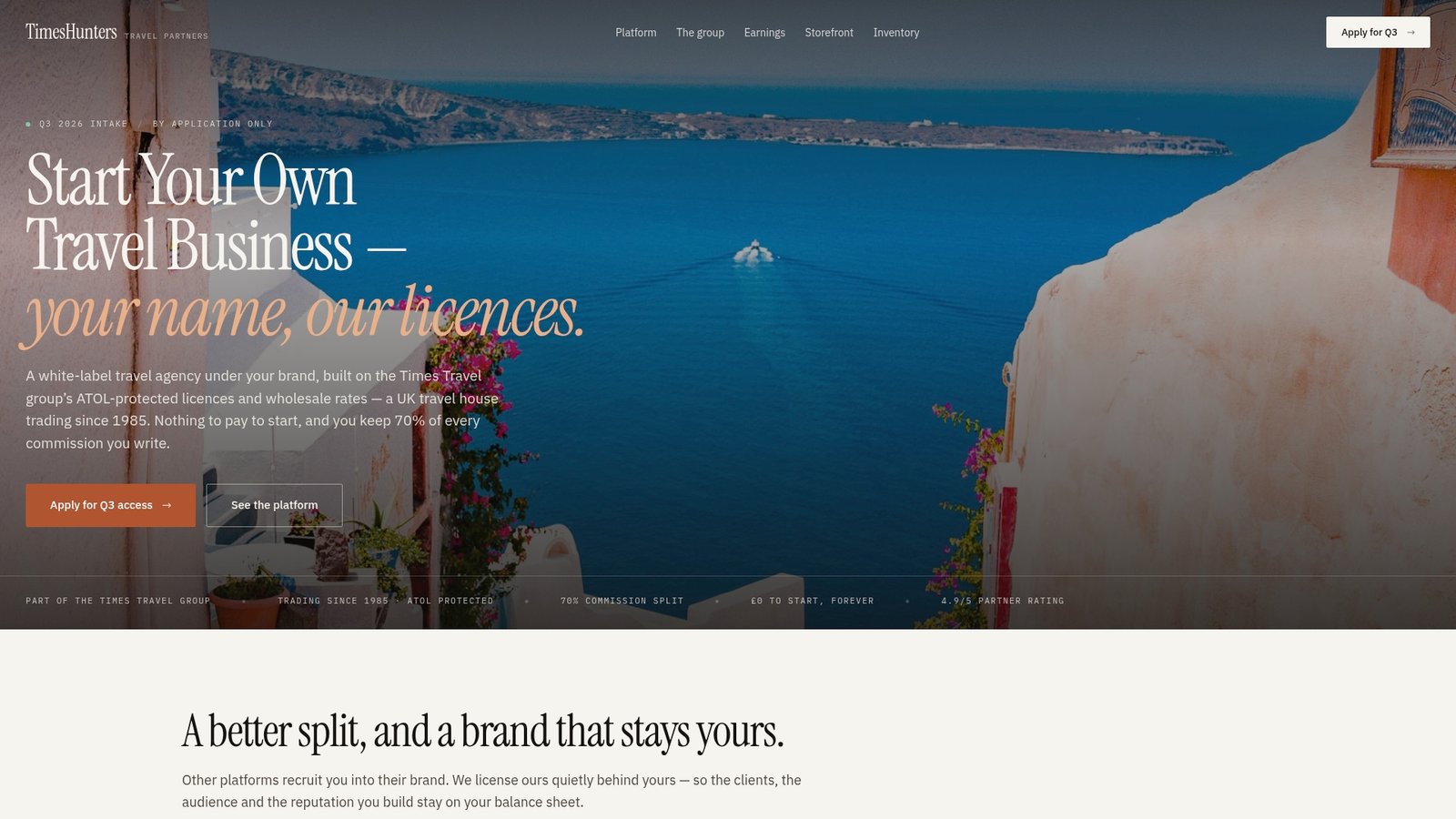
The fastest way to launch a travel brand in the UK is to put your own name on a business that already holds the licences, rather than building the regulatory structure yourself. With TimesHunters you sell under your own brand using Times Travel group’s ATOL-protected licences, keep 70% of the commission (our commission split is 30%), and there is no cost to start. Below: the steps, what each costs and where each one goes wrong.
TL;DR
- A travel brand is a niche, a name and an audience. The licensing and protection behind it can be supplied for you.
- Going fully independent means a CAA licence, a bond and share capital. A white-label route removes that barrier.
- Our partners keep 70% commission and their own client list, and the licence branding is invisible to clients.
- UK package travel rules change on 6 April 2027, so build your offer with them in mind.
- Start with one niche and one audience you can already reach.
Table of Contents
- Step 1: choose a niche you can reach
- Step 2: pick your business model
- Step 3: understand the rules your brand sells under
- Step 4: work out how you will earn
- Step 5: build the brand and the first customers
- Step 6: set up the systems
- What to do in your first 30 days
- Start under your own name
- Our perspective
- FAQ
- Sources
Step 1: choose a niche you can reach
A brand that tries to sell everything competes with every high-street agent. A narrow brand is easier to remember and to market.
A UK agent profiled by Travel Weekly in 2026 builds her business around women over 55 who want walking, cycling, cooking and yoga trips. She has grown a 14,500-member Facebook group for solo travellers, and it feeds her bookings. The lesson is the audience came first and the brand followed.
Other signals of demand:
- Solo travel: Mintel’s 2024 UK report says 16% of people cite single supplement fees as a barrier. A brand that tackles supplements has a clear pitch.
- Adventure: at an Abta conference in 2024, a leading adventure operator’s chief said adventure travel is close to becoming mass market, with under-35s with money the most important sector.
- Destinations: Flash Pack’s 2026 trend data shows Albania bookings up 300% in 2025, and over-50s trips now make up 10% of its audience.
- Groups: families, reunions and corporate retreats book several rooms or homes at once. Group stays show how a single destination can host a coordinated trip, and our guide to branded group travel explains how to fill 8 to 15 seats.
Test your niche with one question: can you name 100 people who fit it and reach them this month? If you are a creator, hotelier or professional with an existing client list, you probably can.
Step 2: pick your business model
There are three routes in the UK, and they differ on control, cost and risk.
| Route | Upfront cost (published estimates) | Licences | Commission kept |
|---|---|---|---|
| Fully independent | £70,000–£100,000 including a £50,000+ bond, per Countingup’s 2026 guide | Your own ATOL | 100% of supplier commission |
| Franchise | £10,000–£35,000 in the same guide | Franchisor’s | Varies |
| White label | No cost to start with us | Times Travel group’s ATOL-protected licences | 70% |
The independent route has real hurdles. The CAA says start-ups must submit a certified opening balance sheet plus 12 months of financial projections and normally attend a formal meeting. A Standard ATOL needs a bond of 15% of licensable revenue (minimum £50,000), a £2,606 application fee and at least £30,000 paid-up share capital for limited companies. A Small Business ATOL is capped at 500 passengers and £1,000,000 licensable revenue a year, costs £1,538 to apply for and carries a £1,250 annual contribution, on the same CAA page.
That is a lot of capital and paperwork before your first booking. With a white-label platform you skip it: you keep your brand, client relationships and autonomy, and the infrastructure sits behind you. Our pages on ATOL licence requirements and tour operator bonding show what you avoid carrying yourself.
Step 3: understand the rules your brand sells under
You do not need to be a lawyer, but you need to know the shape of the rules.
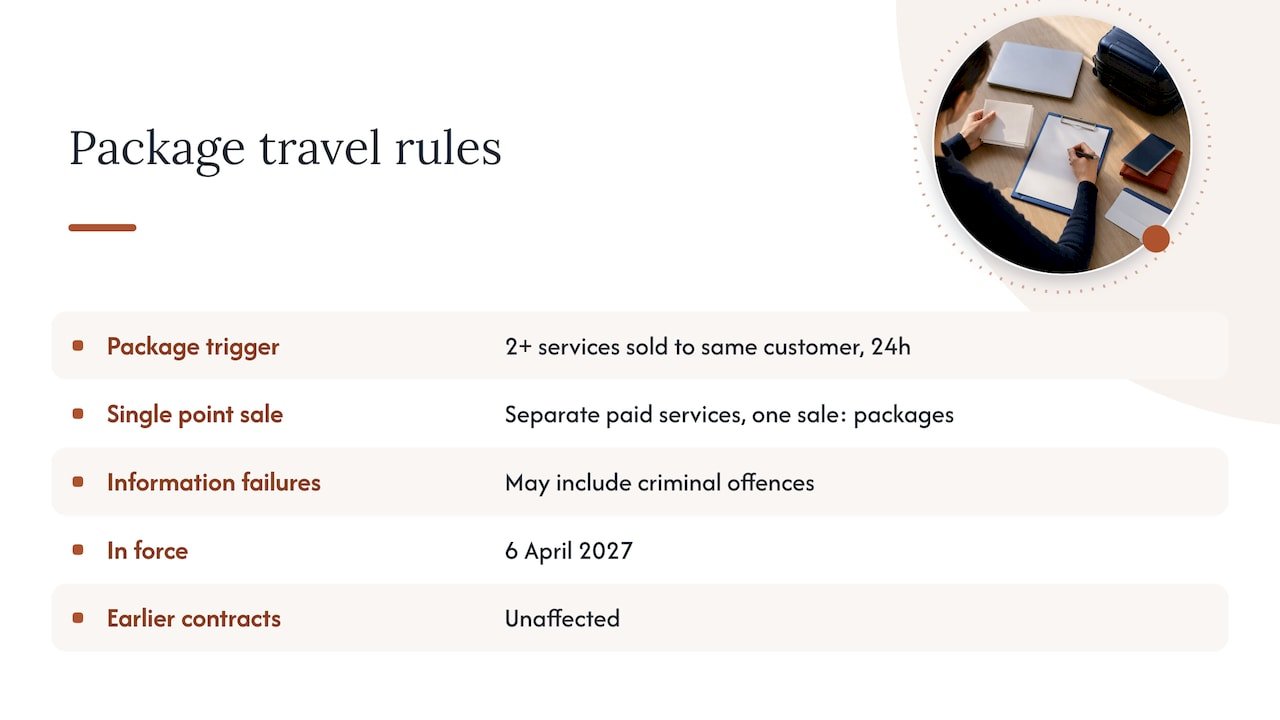
The Package Travel Regulations apply where at least two of transport, accommodation, vehicle hire or other significant services are sold to the same customer within 24 hours. The Chartered Trading Standards Institute notes the regulations include criminal offences if the information requirements are not followed.
The change to plan for: the Package Travel and Linked Travel Arrangements (Amendment) Regulations 2026 come into force on 6 April 2027. They treat separately selected and paid-for services at a single point of sale as packages, and repeal the rule on linked travel arrangement insolvency protection. They do not affect contracts made before that date. Travel Weekly reports that government guidance removes the 24-hour add-on category. Our page on the Package Travel Regulations sets out what sellers should do.
The practical point: how you assemble and present a trip decides how it is classed. Build your product pages and proposals with that in mind from day one.
Step 4: work out how you will earn
Supplier commission varies by product. Countingup’s guide gives typical figures of 10–15% for hotels, 10–20% for tours and 1–3% for airlines, plus service fees of £150–£500 per booking. Under the Tour Operators’ Margin Scheme, VAT is due on the margin, not the turnover: on a £2,000 package with £1,700 of supplier costs, VAT falls on the £300 margin. Plan your cash flow on margin.
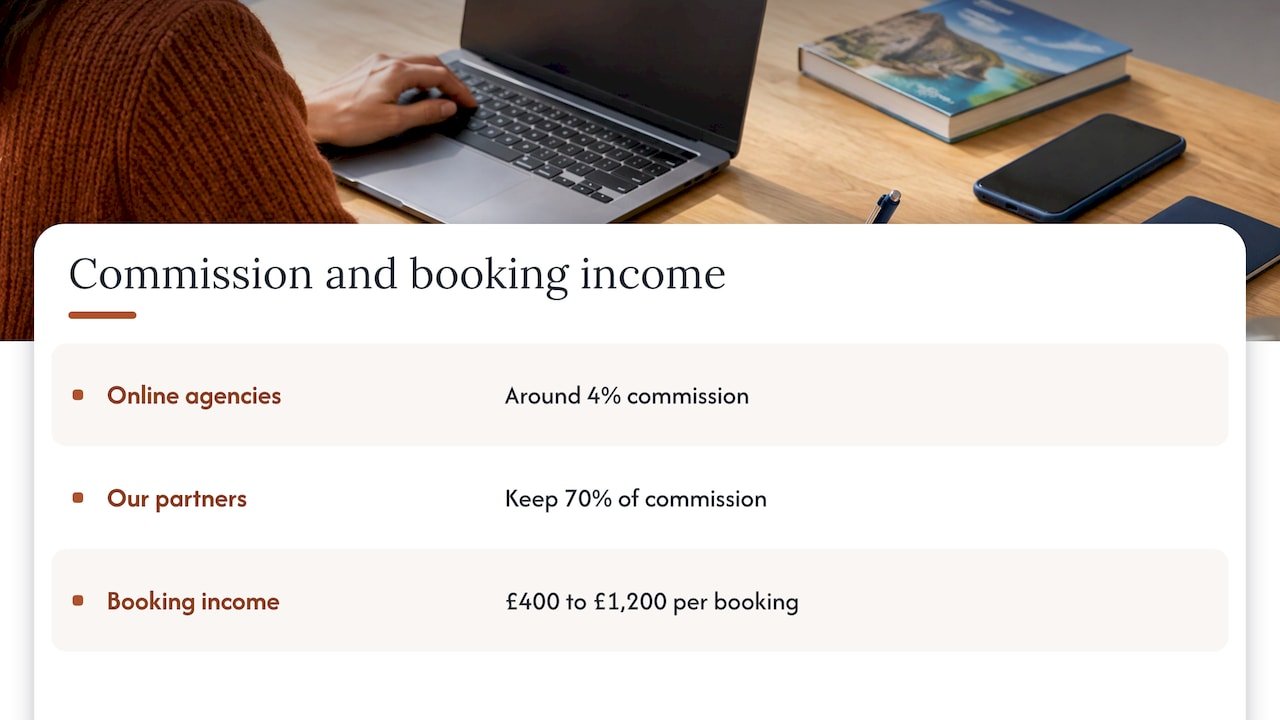
The commission split matters more than most newcomers expect. Online agencies are often cited at around 4%, while our partners keep 70% of commission on bookings. One partner reports moving from £400 to £1,200 per booking. Wholesale access to hotels, cruises, tours, villas, safari camps and rail gives you inventory to build trips from. See our guides on cruise agent commissions, tour operator commissions and upselling travel extras for worked numbers.
Step 5: build the brand and the first customers
Your brand is a promise to a specific person. Write it in one sentence: who you help, where, and what is different about how you do it. Then:
- Name and visuals. Pick a name that signals the niche, not just “travel”. Your clients will see your brand on the booking site, not ours, since the licence branding is invisible to them.
- Start with people you already have. A client list, a hotel’s past guests or a social following converts faster than cold advertising. Direct customer acquisition can be unpredictable: a search algorithm change or higher ad costs can wreck the economics overnight. An owned community is steadier.
- Create one signature offer. A group departure, a themed itinerary or a destination specialism gives followers something to share. Creators can see how in our guide to selling travel as an influencer.
- Respond fast with a clear proposal. Instant pricing proposals and automated client follow-up are built into our platform, so enquiries do not stall while you work out prices.
Step 6: set up the systems
A new brand is judged on admin as much as on itineraries. You need one place to take enquiries, quote, confirm, collect payment and follow up. Our platform includes a branded booking site, instant proposals, managed payments with financial protection, and automated booking management, so you spend your time with clients. Training and support are included, and our 4-week launch training and onboarding checklist walk you through the compliance steps.
What to do in your first 30 days
- Week 1: pick the niche and write the one-sentence promise.
- Week 2: list the people you can reach directly and what they have asked you about travel.
- Week 3: complete onboarding and build your first two trip ideas.
- Week 4: send proposals to your first warm contacts and ask for referrals.
For a fuller plan, use our travel agency business plan template.
Start under your own name
If you want the brand without the bond, the share capital and the CAA process, our white-label travel agency lets you start under your own name with ATOL-protected licences, wholesale rates and 70% commission. See the white-label travel agency offer, or read how to become a travel agent in the UK.
Our perspective
Most people who want a travel brand already have the hard part: an audience that trusts them. What they lack is the licence structure and the commission that makes the effort worthwhile.
We built TimesHunters so that you keep your name, your clients and 70% of the commission, while the ATOL-protected infrastructure runs behind you. You are not renting a logo. You are running your own business.
Begin small, with one niche and the people who already listen to you. Grow from the bookings that come back.
Sam
FAQ
Do I need my own ATOL to launch a travel brand?
Not with our model. You sell under Times Travel group’s ATOL-protected licences. Going independent requires your own CAA licence, a bond and share capital, as the CAA’s licence types page sets out.
How much does it cost to start?
There is no cost to start with us. Published estimates for other routes range from £500 to £5,000 under a host agency to £70,000–£100,000 for a fully independent agency.
What commission can I earn?
Our partners keep 70% of commission on bookings. Our fee is a 30% commission split. Your net per booking depends on the supplier and product, so use our guides on cruise and tour commissions to model it.
Which niche should I choose?
Choose the one where you already have an audience or credibility. Solo travel, adventure, groups and over-50s trips all show demand in UK trade reporting, but your own contacts matter most.
Sources
- Standard ATOL, UK Civil Aviation Authority
- Types of ATOL, UK Civil Aviation Authority
- Travel Weekly: selling adventure holidays to solo travellers
- Mintel UK Solo Holidays Market Report 2024
- Travel Weekly: adventure travel close to becoming mass market
- Selling Travel: Flash Pack 2026 list
- Countingup: start a travel business online
- VisitBritain: UK package travel regulations guidance
- Practical holiday law, Chartered Trading Standards Institute
- Package Travel and Linked Travel Arrangements (Amendment) Regulations 2026
- Travel Weekly: government guidance on PTRs
- LAS Accounting: business plan for travel agents
- TravelSalesIQ: D2C vs trade distribution