
How to Protect Client Money When You Sell Travel in the UK
What UK law requires when you take money for travel: ATOL, trust accounts, bonds, insurance and the 2027 changes, and how a white-label licence covers it.

If you sell holidays in the UK and a flight is part of the trip, your clients’ money must sit under an ATOL, the Civil Aviation Authority’s insolvency scheme, before you take a payment. For trips without flights, the law requires a bond, insurance or a trust account. You can build that protection yourself, or start under a licence that already carries it. We built TimesHunters around the second route: partners sell under their own brand on Times Travel group’s ATOL-protected licences, with managed payments and financial protection included.
This guide is for people starting a travel business: freelancers, influencers, hospitality owners and professionals with an existing client list. It explains which bookings need protection, what the main options are, how money should be handled day to day, and what changes from April 2027.
TL;DR
- Flight-inclusive packages and flight-only sales in the UK need an ATOL holder, or an exemption, behind them. The CAA states this and it applies even to businesses based abroad that sell to UK consumers.
- Packages without flights need one of three arrangements: a bond, insurance or a trust account.
- Clients must receive an ATOL Certificate immediately on first payment, and you cannot accept money before you can issue one.
- From 6 April 2027 the package definition widens, so more of what independent sellers do will count as a package.
- Selling under a white-label ATOL-protected licence means the protection is already in place when you take your first booking.
Table of Contents
- Why client money protection decides whether you can trade
- Which bookings need protection
- When you need an ATOL
- The three protection arrangements for non-flight packages
- How client money should be handled day to day
- What clients must be told and shown
- What changes from 6 April 2027
- Starting under a licence that already protects client money
- Our view on client money
- FAQ
- Sources
Why client money protection decides whether you can trade
A client who pays you £3,000 for a trip is trusting that the money survives if something goes wrong with you or a supplier. The law turns that trust into a requirement. Under Regulation 19 of the Package Travel and Linked Travel Arrangements Regulations 2018 (the PTRs), a UK-established package organiser must provide effective security to cover the reasonably foreseeable cost of refunding payments for services not performed. Where carriage of passengers is included, the security must also cover repatriation and accommodation before it.
Non-compliance is not a paperwork issue. The same regulation makes it a criminal offence, punishable by a fine.
The stakes are real for consumers too. The CAA’s 2026 ATIPAC annual report notes that, according to the National Audit Office, the Department for Transport paid £83 million towards repatriating stranded passengers who were not covered by ATOL after the Thomas Cook group failure. Protection works only when it sits behind the right bookings.
Which bookings need protection
The PTRs apply to packages and linked travel arrangements sold on or after their commencement date. Regulation 3 excludes arrangements lasting under 24 hours unless they include overnight accommodation, occasional not-for-profit arrangements for a limited group, and arrangements bought under a general agreement (typically business travel).
In plain terms:
- A package combines at least two kinds of travel service, such as flights and a hotel, sold together for one trip. Protection is mandatory. Our guide to the package holiday definition shows where the line falls.
- A linked travel arrangement is a looser set of separately contracted services. ABTA explains that protection here only covers the arranger failing and the service not being provided as a result. It does not cover cases where the services can still be delivered, or where a supplier fails instead. More on this in our page on linked travel arrangements.
- A standalone service, such as a hotel only or a flight booked directly with an airline. ABTA states that flights booked direct with airlines are not protected by any financial protection scheme.
So a hotel-only sale carries a different obligation from a flight-and-hotel sale. Many new sellers drift into packages by accident: a client asks for a hotel, then wants flights added. Once you arrange both, you are likely selling a package.
When you need an ATOL
The CAA says a business selling a flight-inclusive package or a flight-only product must be the operator of the aircraft, an ATOL holder, or exempt. The rules apply irrespective of the departure point for packages including flights.
ATOL has been run by the CAA since 1973. The scheme’s own page says that if your travel company fails while you are abroad, the CAA will help you stay in your accommodation where possible, reimburse money spent replacing ATOL-protected parts of the trip and arrange flights home depending on the circumstances.
It helps to know what ATOL is not. ATOL states that it protects you if the ATOL holder responsible for your booking stops trading, and that it does not cover cancelled flights, illness, lost luggage, hotel problems or general disruption, and is not travel insurance. When you speak to clients, describe ATOL as insolvency protection and recommend separate travel insurance for everything else.
For a new seller, getting your own ATOL means an application, financial scrutiny and a protection arrangement of your own. We cover that route in our ATOL licence guide.
The three protection arrangements for non-flight packages
For packages without flights, the October 2026 amended PTR guidance lists three permitted options: bonding under regulations 20 and 21, insurance under regulation 22 and a trust account under regulation 23. Bonding requires membership of a Department for Business, Innovation, Science and Trade approved body, and bonds may not exceed 18 months.
| Arrangement | How it works | What it asks of you |
|---|---|---|
| Bond | An approved body or insurer guarantees refunds if you fail | Membership, financial assessment, renewal at least every 18 months |
| Insurance | A policy covers the cost of refunds and repatriation on insolvency | Premiums, underwriting of your accounts |
| Trust account | Client money is held in a segregated account under a trust deed | A trustee, strict payment rules, regular reconciliation |
Our pages on tour operator bonding and trust accounts versus insurance go deeper on cost and set-up.
The CAA describes a trust account as a segregated account under a trust deed and overseen by a trustee. If an ATOL holder fails, customer money held in it can be made available to fund repatriation and claims. The same document notes that administration varies, that professional trustees charge a fee and carry professional indemnity insurance, and that managing the role internally carries a higher risk of fraud or mistake.
The practical message for a start-up: every option is a regulated system with its own rules, costs and discipline. A solo seller with a few bookings a month carries the same legal duty as a large operator.
How client money should be handled day to day
The habits matter as much as the structure. The ATOL Trust Deed, as summarised by ICAEW, requires consumer funds to be paid into the trust account within 48 hours. Non-flight money, including profit, may not be paid out until the client has returned. Flight money may be paid out before travel only to organisations providing acceptable levels of protection.
A sound routine looks like this:
- Take payment only into the protected route. Never into a personal account or a general business account.
- Issue the ATOL Certificate straight away. The CAA says a certificate must be issued immediately on the first payment, and that a business may not accept payment until it can issue one. If the client is present, that means at the moment of payment.
- Record every payment against a booking. Deposits, balances and refunds should each trace to one client and one trip.
- Hold supplier payments to their due dates. Releasing money early is where trust-account rules are most often breached.
- Reconcile regularly. Bank balance against bookings still to travel, every week while you are small.
Our checklist of client money protection checks and trust account checks turns this into something you can run through each week.
The workload is why many independent sellers find the admin heavier than the selling. On our platform, payments are managed and booking management is automated, so the routine above is part of how a booking flows through the system rather than a spreadsheet you maintain after hours.
What clients must be told and shown
Your clients need to know what protects them, and the rules on this have just tightened. ATOL Standard Term 1.3, in force since 1 April 2026, requires ATOL holders advertising ATOL-protected services to UK consumers to make reference to ATOL protection in the advert, unless the CAA agrees an equivalent approach.
For social media, where space is tight, the CAA says tags such as #ATOLProtected or pinned comments that point to fuller information may be more appropriate. If you plan to sell through Instagram or TikTok, build that into your posts from the first one. Our page on selling travel as a creator shows how that audience-led model works.
A client booking an ATOL-protected flight receives an ATOL Certificate after paying but will not receive a valid e-ticket in exchange for payment. If they hold a valid e-ticket from an airline, ATOL does not cover that flight. Teach clients to read their documents with this in mind.
What changes from 6 April 2027
The Package Travel and Linked Travel Arrangements (Amendment) Regulations 2026 commence on 6 April 2027. The explanatory material says they remove the linked travel arrangement category by absorbing type A into the definition of a package and removing type B completely. They also set a 14-day period for refunds of cancelled services.

ABTA’s August 2026 update spells out the effect for sellers: when a customer books one service and then selects and books another in separate transactions during a single visit or contact with the point of sale, the seller will be selling packages and must meet all package obligations, including financial protection and liability for the services.
In practice, a seller who today treats a hotel and a transfer as separate sales may, from April 2027, be selling a protected package. If you handle group trips with several separately booked parts, a guide to managing travel bookings for groups can help you see how those bookings stack up across one customer contact.
One more change touches suppliers: under Regulation 29A, when a third party cancels or fails to perform part of a package, it must refund the organiser or retailer within 14 days. Check our full explainer on the Package Travel Regulations changes for the sequence.
The longer-running ATOL Reform project is still open. The CAA’s ATIPAC report says a consultation with preferred options was expected in 2025 but has not yet happened, so plan around the rules as they stand and check the CAA for updates.
Starting under a licence that already protects client money
The case for a white-label route is simple. You take on the selling, the brand and the client relationships. The protected infrastructure sits underneath you from day one, instead of being something you assemble, fund and audit before you can earn.
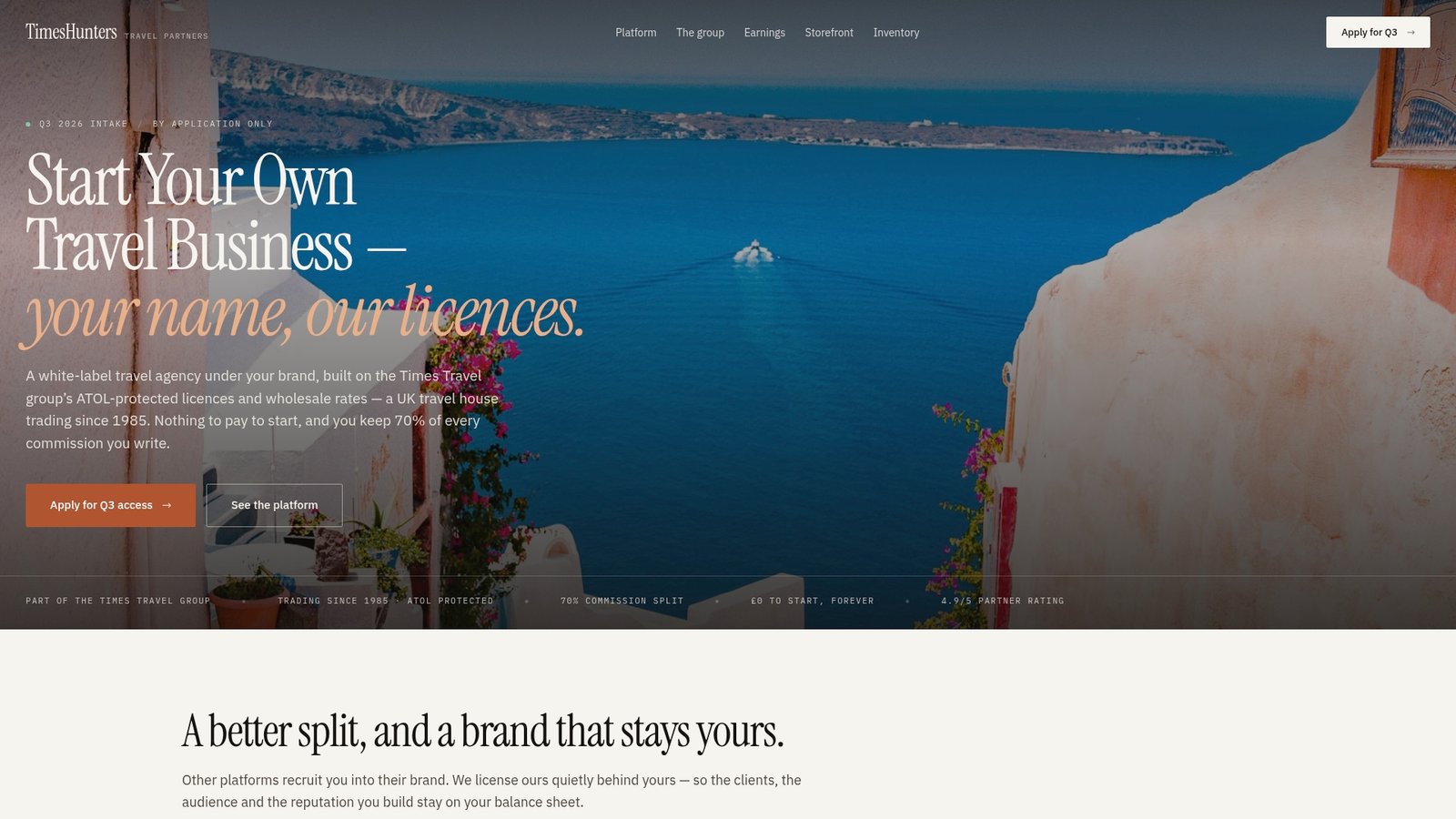
With TimesHunters, you sell under your own name using Times Travel group’s ATOL-protected licences. The licence’s branding is invisible to your end clients, there is no cost to start, and you keep 70% commission on your bookings. Wholesale hotel, cruise and tour inventory, a branded booking site, instant pricing proposals, managed payments and financial protection, and automated client follow-up are part of the platform, with training and support behind them.
For sellers moving from a hobby to a business, that changes the order of events. You can build an audience and a client list first, and take bookings with protection already in place. If you sell tailor-made trips, our guide on selling tailor-made holidays legally shows how this sits with the package rules, and the overview of travel accreditation in the UK covers what else a new agent should line up.
If you are ready to see the model in full, start with our white-label travel agency page.
Our view on client money
Most new sellers ask how much commission they can earn. The better first question is whose name sits on the protection when a client pays you.
We built TimesHunters because the usual routes force a choice. Join a platform and keep around 4%, or go alone and spend months on licences, bonds and trust deeds before the first booking. Our answer is to let you keep your brand, your clients and 70% commission, while the ATOL-protected licence and managed payments do the heavy lifting underneath.
Protection is not an extra. It is what lets a client send you a deposit for a honeymoon, and what lets you promote that trip on a public feed without worry. Treat it as the foundation of your brand, not as admin.
Sam
FAQ
Do I need an ATOL to sell holidays from home?
If the trips include flights as part of a package, or you sell flight-only products, you must be an ATOL holder, operate the aircraft or be exempt. The CAA applies this to anyone selling to UK consumers. Selling under a licence holder is how many new sellers meet the requirement from the start.
Is a deposit protected if I only book a hotel?
A hotel-only booking is a standalone service, so package insolvency rules do not apply to it in the same way. Once you combine it with another travel service, the sale may become a package or linked arrangement. From 6 April 2027 more combinations will count as packages.
Does ATOL cover cancelled flights or illness?
No. ATOL protects clients if the ATOL holder responsible for the booking stops trading. It does not cover cancellations, illness, lost luggage or hotel problems, and it is not travel insurance, so clients should hold separate cover for those risks.
What must a client receive when they pay?
For ATOL-protected bookings, an ATOL Certificate must be issued immediately on the first payment. You cannot accept money until you can issue it. Clients should also be told clearly what protection applies to their trip.
Sources
- Do I need an ATOL, UK Civil Aviation Authority
- ATOL Certificates, UK Civil Aviation Authority
- What is ATOL protection? ATOL
- What does ATOL protection cover? ATOL
- Package Travel and Linked Travel Arrangements Regulations 2018, Regulation 3
- Package Travel and Linked Travel Arrangements Regulations 2018, Regulation 19
- Guidance on the Package Travel and Linked Travel Arrangements Regulations 2018 (amended 2026)
- ATOL Reform consultation document, April 2021, CAA
- ATOL Reform and Standard Term 1.3, CAA
- ATIPAC 2026 annual report, CAA
- The advantage of Trust ATOLs over Bonds, ICAEW
- Is my money protected? ABTA
- Upcoming changes to the Package Travel Regulations, ABTA
- Package Travel and Linked Travel Arrangements (Amendment) Regulations 2026, explanatory memorandum
- Package Travel and Linked Travel Arrangements (Amendment) Regulations 2026