
Booking Pipeline Dashboard: What to Track and Why
What a booking pipeline dashboard should show a new travel business: the stages, the numbers that matter, and how to spot stalled enquiries and forecast commission.

A booking pipeline dashboard is a single view of every enquiry you have, the stage it has reached, what it is worth and what you must do next. For a new travel business it answers one question each morning: which conversations will turn into commission, and which are quietly going cold? Below we set out the stages, the numbers and the weekly routine. We also show why a branded agency on a white-label platform, where bookings, payments and follow-up are managed for you, gives the dashboard cleaner data and more commission per sale to look at.
TL;DR
- Build the dashboard around stages named as actions (“Proposal sent”), with one dated next step on every open enquiry.
- Track six numbers weekly: new enquiries, reply time, quote-to-booking rate, average booking value, pipeline value and commission expected versus received.
- Keep booking value, cash collected and your commission as separate figures. They tell you different things.
- Stalled quotes are where most revenue leaks, so review them twice a week and automate the first follow-ups.
- Under our white-label model you keep 70% commission, and automated booking management and client follow-up are part of the platform, so there is less to chase by hand.
Table of Contents
- Why a pipeline view matters when you are starting out
- The stages: from first message to post-trip follow-up
- The numbers a booking pipeline dashboard should show
- A worked example: reading a week of pipeline
- Spotting stalled enquiries before they cost you
- Forecasting commission from the pipeline
- Keeping the data accurate
- What a pipeline cannot do on its own
- Build your pipeline on your own brand
- Our perspective
- FAQ
- Sources
Why a pipeline view matters when you are starting out
Most new agents begin the way a lot of established ones did. In Travel Weekly’s 2021 report on four UK independent agents adopting a CRM, one agency owner described running “completely manually” and hoped a system would let the team follow things up without so much effort. Another wanted booking history visible the moment a customer rings, so repeat clients deal with someone who knows them.
That is the real job of a pipeline dashboard. It is not a reporting exercise. It stops enquiries sitting in your inbox, tells you when a deposit is due, and shows whether your week’s work will pay your bills.
If you are a freelancer, a creator with an audience or a hospitality owner adding travel as a new revenue stream, you will usually be the only person in the business. A pipeline view is your substitute for a team that remembers things.
The stages: from first message to post-trip follow-up
Start simple. A UK travel-agent community guide describes a workable booking flow as customer brief, research, checked quote, customer decision, approved payment and confirmation, pre-travel documents and ongoing care, with the next action and the person responsible recorded at each stage. That maps neatly to a pipeline you can keep in your head:
| Stage | What has to be true to move on | Your next action |
|---|---|---|
| Enquiry received | Dates, budget, party size and destination captured | Reply the same day |
| Proposal sent | Priced options with a clear total are with the client | Follow up within 24 hours, then again at around 72 hours |
| Deposit paid | Money received and booking made with the supplier | Send confirmation |
| Balance due | Final payment date known and diarised | Reminder a week before the due date |
| Documents sent | Itinerary, vouchers and travel details with the client | Check-in message before departure |
| Travelled | Client is home | Ask for a review and a referral |
| Rebooking | Review in, relationship warm | Ask about next year’s trip |
Two habits make this table work.
Name stages as actions, not statuses. “Proposal sent” tells you what to check. “Pending” tells you nothing. Add a column for the next dated action and refuse to leave an open enquiry without one.
Keep trip types apart. A cruise can run six to twelve months from enquiry to sailing, while a short hotel stay may be settled in days. Put them in one stage list and your conversion figures turn to noise. If you sell cruises, hotels and tours, give each its own lane or at least its own filter.
The numbers a booking pipeline dashboard should show
A dashboard with twenty widgets is a dashboard nobody reads. Begin with the numbers that change what you do on Monday.
Volume and speed
- New enquiries per week, split by source (Instagram, email list, referral, website). This tells you where to spend your time.
- First-response time. The faster you reply, the more enquiries you keep. Measure it in working minutes, not days.
- Days in “proposal sent”. This is where quotes go to die. If the average climbs, your follow-up is slipping.
Conversion
- Enquiry-to-proposal and proposal-to-booking rates. The second is your headline. Track it by source and by trip type.
- Average booking value. Travel Sales IQ’s UK benchmarks put average leisure bookings at £1,800 to £3,200 and short-haul at £600 to £1,400, reported weekly. Use them as a rough yardstick for your own mix, not a target.
Money
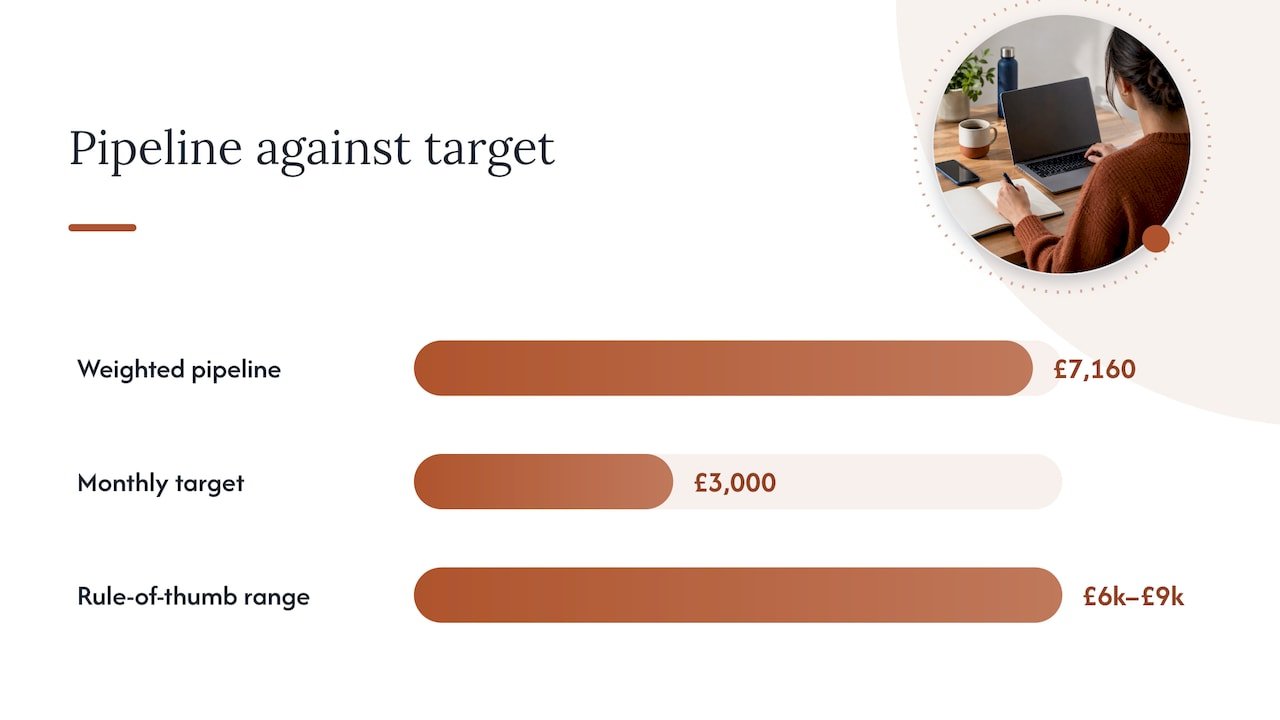
- Pipeline value. Add up each open quote multiplied by its realistic chance of booking. The same source says healthy pipeline value is typically two to three times your monthly revenue target.
- Commission expected versus received. The gap between the two is cash you are owed or that has not yet been earned.
Keep four money figures apart
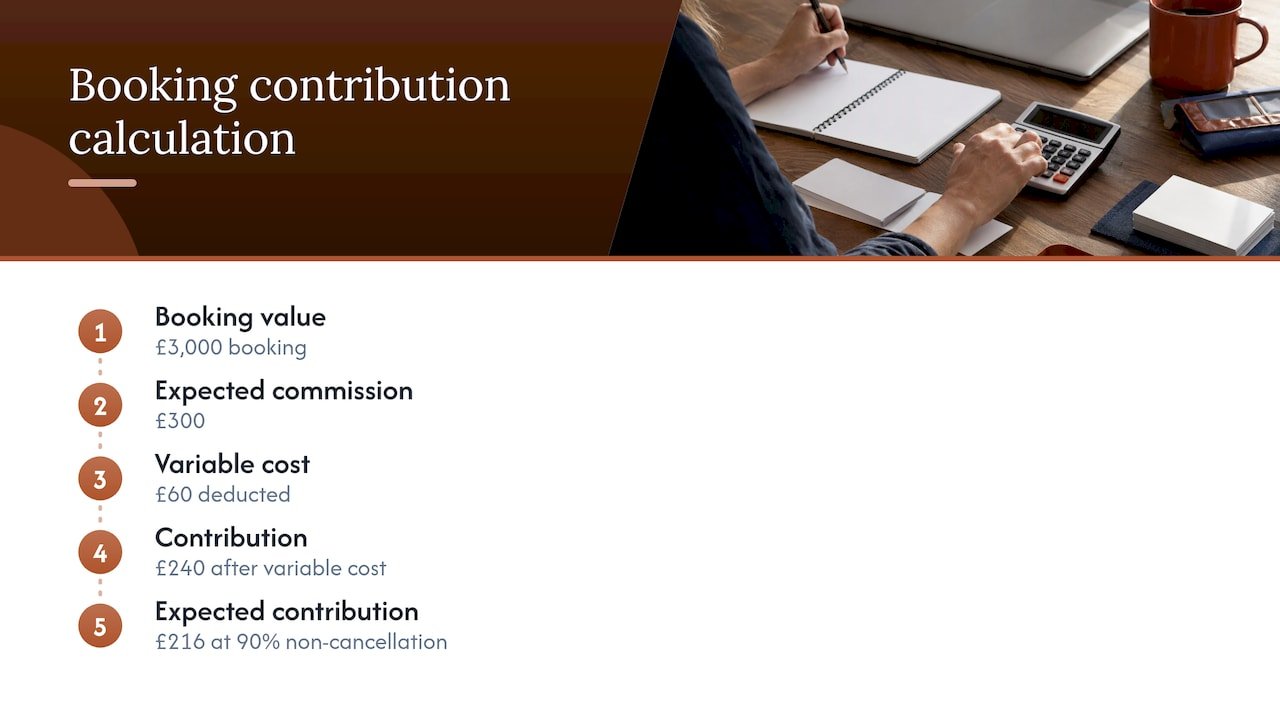
One of the most useful distinctions comes from a UK marketing agency’s guide to travel data: booking value, cash collected, recognised revenue and contribution are different things. Booking value is the total the customer pays. Cash collected is what has actually arrived. Contribution is your commission or margin less variable costs.
Their worked example is a £3,000 booking with £300 expected commission and £60 of variable cost. Multiply the £240 difference by a 90% chance the booking is not cancelled and you get £216 of expected contribution. A big headline booking can be worth less to you than a smaller, better-paying one, so the dashboard should lead with what you keep.
A worked example: reading a week of pipeline
Take a hypothetical new agent with six open proposals. This is an illustration, not a client result.
| Proposal | Quote value | Chance of booking | Weighted value |
|---|---|---|---|
| Family beach week | £3,600 | 50% | £1,800 |
| Anniversary city break | £1,400 | 60% | £840 |
| Cruise for four | £5,200 | 30% | £1,560 |
| Safari enquiry | £7,000 | 20% | £1,400 |
| Weekend away | £800 | 70% | £560 |
| Group tour | £4,000 | 25% | £1,000 |
The weighted pipeline is £7,160. If your monthly revenue target is £3,000, the two-to-three-times rule of thumb would call for £6,000 to £9,000, so you are in a sensible range. Now look at the other columns. If the safari and cruise quotes have both sat untouched for ten days, a third of your pipeline value is at risk, and the dashboard has just told you who to ring first.
Only use probabilities you can justify from your own conversion history. In your first weeks, treat them as rough and tighten them as data builds up.
Spotting stalled enquiries before they cost you
Three rules keep a pipeline honest.
- Every open enquiry has a dated next action. No date, no enquiry on the board.
- Flag anything with no update in 14 days. Reporting tools in the travel software market commonly use a similar stale-lead threshold. Either move it on or close it as lost.
- Review the board twice a week. Look at deals and weighted value by stage, what is stalled and which messages are unanswered.
The cause of most stalls is silence after the proposal. Travel Engine, a travel software company, claims agencies without automated follow-ups lose 40 to 60 per cent of quoted enquiries to silence. Whatever the exact figure for your business, the fix is the same: a message within 24 hours of the proposal, a second touch around 72 hours, and a deposit reminder a week before it falls due.
We have written up the message sequence in our guide to automated client follow-up, and our travel agent email templates cover the wording for each stage.
Forecasting commission from the pipeline
A forward view turns the dashboard from a to-do list into a planning tool. Three questions to answer each month:
- What is confirmed for the next twelve months? Bookings by travel month show when commission will actually be paid, which is often later than when the client booked.
- Is booking pace ahead of or behind the same period last year? Once you have a year of data, this tells you whether to spend more on content and ads or slow down.
- What is the gap between expected and received commission? Anything overdue should be chased.
As your client list grows, repeat business becomes the cheapest source of bookings. Date-based triggers work well: a check-in before departure, a review request after return and a “same dates next year?” nudge months later. Our client retention playbook goes into the detail, and a direct booking retention plan shows the same idea applied to rental stays: use forward-booking visibility to decide where to spend your marketing effort.
Keeping the data accurate
A dashboard is only as good as what feeds it. The common failure is splitting one booking across a spreadsheet, an email thread and a supplier portal, so a voucher goes unattached or a second payment goes unlogged. The cure is one record per booking holding the itinerary version, supplier confirmation, payment milestones and tasks.
A few habits help whatever you use:
- Make key fields compulsory at each stage: travel dates, party size, total price, your commission and the payment due dates.
- Update the stage the moment something happens, not at the end of the week.
- Reconcile expected commission against what lands in your account every month.
- Add automation gradually. Start with the 24-hour follow-up and the deposit reminder, run them on new enquiries only, and review after a month or two.
This is where a platform does more of the work than a self-built set of tools. Our white-label platform includes automated booking management, managed payments with financial protection and automated client follow-up, so the status of a booking is not something you reassemble from separate places. For the confirmation step, see how booking confirmation automation can be set up in weeks.
What a pipeline cannot do on its own
A dashboard shows you the problem. It does not make the commission bigger. A beautifully tracked pipeline at a 4% commission rate is still a small business, because a £2,000 holiday leaves you with far less to reinvest. That is why the first question for an aspiring agent is not which charts to build, but what each completed booking pays you.
Our tour operator commissions guide shows how to work out net earnings per booking, and our guide to cruise agent commissions does the same for cruises. Run those numbers first, then judge your dashboard by whether it moves the right ones.
Build your pipeline on your own brand
TimesHunters lets you start a travel business under your own name using Times Travel group’s ATOL-protected licences. You keep 70% commission on bookings, and our commission split is 30%. The licence’s branding is invisible to your clients, so the brand and the client list you build are yours, and there is no cost to start.
The platform gives you a branded booking site, wholesale hotel, cruise and tour inventory, instant pricing proposals, managed payments and financial protection, automated client follow-up, and training and support. That means the stages in your pipeline, from proposal to confirmation to follow-up, are largely handled inside one system. You can see how it works on the white-label travel agency page, or start from our UK training programme for agents.
Our perspective
Most people ask us about dashboards after they have already lost a few enquiries. The charts are never the real issue. The issue is that a new agent is doing sales, research, payment chasing and aftercare alone, and the one thing that always gets dropped is the follow-up.
We built TimesHunters around the idea that your time should go on clients, not on stitching systems together. That is why booking management, payments and client follow-up sit inside the platform, and why you keep 70% of commission rather than the 4% typical of online travel agencies. A pipeline you can trust, a brand that is yours and a commission that justifies the effort: that is the combination that makes a travel business sustainable.
Start with a short list of stages, a dated next step on every enquiry and a weekly look at what you expect to earn. Everything else can wait.
Sam
FAQ
What is a booking pipeline dashboard?
It is a live view of every active enquiry, showing the stage it has reached, its potential value, who is responsible and what happens next. It also shows conversion and expected commission, so you can see where enquiries drop out and what you are likely to earn.
How many stages should a travel pipeline have?
Six or seven is enough to start: enquiry, proposal sent, deposit paid, balance due, documents sent, travelled and rebooking. Keep separate lists for trip types with very different timescales, such as cruises and short breaks, so your conversion figures stay meaningful.
Which metric matters most for a new travel business?
Watch proposal-to-booking rate alongside reply time, because together they show whether you are winning the enquiries you generate. Then track commission expected against commission received, since that is the money you actually keep.
How often should I review the pipeline?
Twice a week is a good rhythm. Check what is stalled, what is due to be followed up and what weighted value sits at each stage. Do a fuller monthly review of forward bookings, booking pace and commission received.
Sources
- Special report: Four Inspiring Agents get technology update, Travel Weekly
- Travel Agent Booking Workflow, Unlocked Travel
- Travel Sales KPIs, Dashboards and Benchmarks, Travel Sales IQ
- Travel Agency and Tour Operator Marketing, Space Ads
- How to Build a Travel Booking Pipeline That Doesn’t Leak, Travel Engine