What are typical travel agent commission rates?
Discover the varying travel agent commission rates across hotels, tours, cruises, and flights. Learn how to maximize your earnings with expert strategies.

Commission depends entirely on what you’re selling. Hotels typically pay 10% to 25%, tours and attractions run 15% to 35%, cruises sit around 10% to 16%, and flights pay next to nothing, which is why most agents now charge a service fee instead. The gap between those figures comes down to who controls the price: fixed supplier commissions leave you with whatever rate you’re given, while wholesale net rates let you set your own markup. The worked examples and tactics below show exactly what that difference is worth per booking.
TL;DR:
- Most profitable bookings come from tours and attractions, which offer margins of 15% to 35%, especially when booked through net rate platforms.
- Moving to a markup model on net rates generally outperforms fixed retail commissions and allows better control over profit margins.
- Building volume, joining consortia, and packaging multiple services are key negotiation levers for higher commission tiers and better rates.
- Transparent disclosure of commissions and fees fosters trust and can enhance client retention, especially when recommending products that genuinely meet their needs.
Table of Contents
- Typical commission and markup ranges by product
- How commission structures work: commission, markup and service fees
- What affects commission rates and negotiation levers
- Worked examples: calculate take‑home per booking
- Strategies to increase per-booking profitability
- TimesHunters proof points and partner outcome
- Legal and ethical considerations for commission disclosure
- Author perspective and next steps
- How Timeshunters can help you keep more of each booking
- Sources
Typical commission and markup ranges by product
Every product category pays differently, and the spread inside each category is often as wide as the spread between categories. The same room, sold through a consortia relationship with negotiated rates, can pay 15% to 20%. That five-point difference sounds small until you’re booking £2,000 rooms in volume.
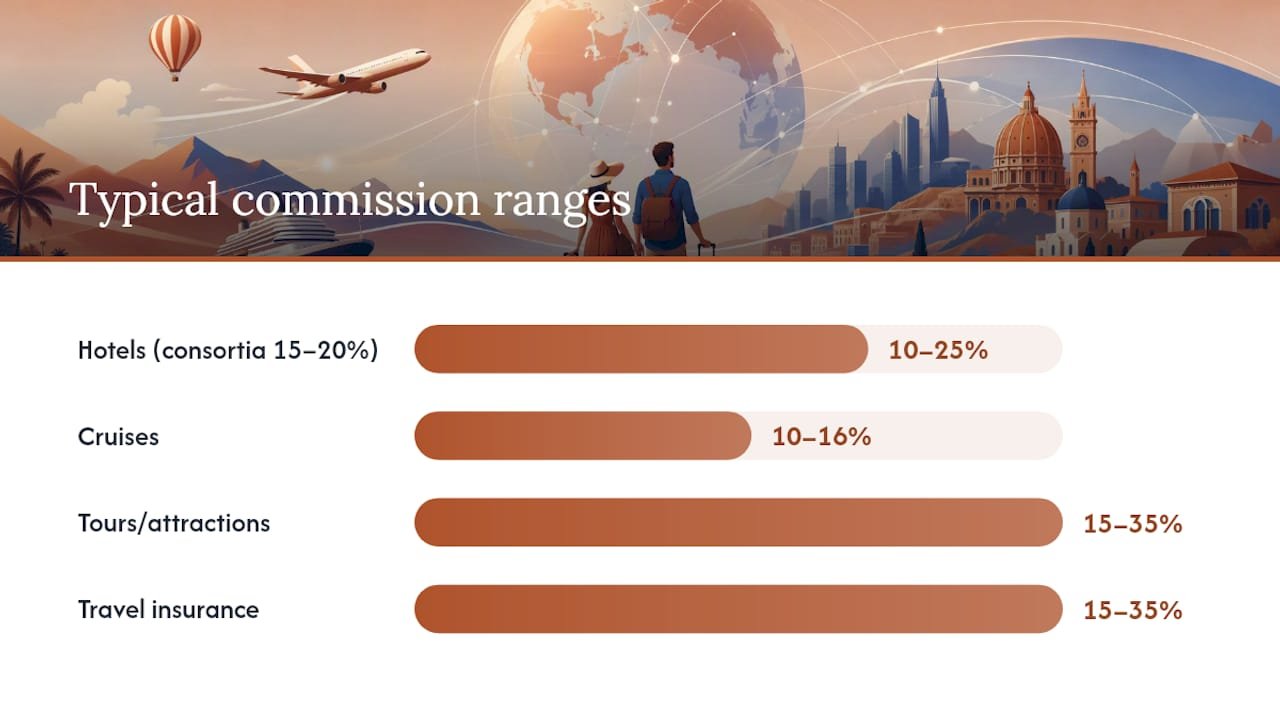
Cruises are the most consistent earner on the list. Rates cluster around 10% to 16% regardless of cabin category, and because cruise bookings tend to carry higher price tags than a single hotel night, the absolute commission per sale is usually stronger even at a lower percentage.
Tours and attractions are where the real upside sits. Margins of 15% to 35% are common, particularly when an agent books through a B2B platform on net rates rather than accepting a fixed retail commission. Flights, by contrast, have paid close to nothing since airlines stripped commissions out decades ago. Most agents now charge a flat service fee instead, commonly £20 to £75 per ticket depending on complexity.
| Product | Typical rate | Notes |
|---|---|---|
| Hotels | 10–25% | Retail 10–15%, consortia/negotiated 15–20% |
| Cruises | 10–16% | Higher absolute value due to booking size |
| Tours/attractions | 15–35% | Highest when booked via net rate B2B access |
| Flights | next to nothing | Service fee of £20–£75 typically applied instead |
| Transfers | Varies by supplier | Often bundled into package markup rather than sold standalone |
| Car hire | Low single digits to ~10% | Rarely a primary income source |
| Travel insurance | 15% to 35% | High margin, low absolute value per policy |
A few things worth keeping in mind when you’re benchmarking your own numbers:
- Package and tour operator commissions often beat the sum of booking each element separately.
- Insurance carries a strong percentage but a small pound value, so it rarely moves the needle alone.
- Regional and market variance is real: a hotel chain’s UK contracted rate can differ from its rate in another market, so don’t assume a figure quoted for one region travels everywhere.
- The highest absolute earnings usually come from high-value, high-percentage combinations, not high percentages on cheap products.
How commission structures work: commission, markup and service fees
These three terms get used interchangeably, and that’s where a lot of confusion starts. Supplier commission is a percentage the hotel, cruise line, or tour operator pays you for selling their inventory at their set retail price. Agent markup is different: you buy at a net wholesale rate and decide your own selling price, keeping the difference. Service fees are a flat charge for your time and expertise, most common on flights where commission has disappeared.
Here’s how the maths plays out on a markup model:
- Net wholesale cost from supplier: £800
- Agent sets retail price: £950
- Agent margin: £150 (roughly 18.75% of the sale)
That £150 is yours in full, unless you’re operating under a host agency. Host agencies commonly take a 10% to 30% share of whatever commission or margin you generate, in exchange for the ATOL protection, back-office support, and supplier access they provide.
- Gross commission: the full amount before any split.
- Net take-home: what actually lands in your account after the host’s cut.
- The gap between the two can be the single biggest factor in whether commission-based selling is worth your time.
What affects commission rates and negotiation levers
Rates aren’t fixed in stone, and the agents earning well above the average tend to be working levers most part-timers ignore. Volume is the obvious one: suppliers reward agents who consistently push bookings their way with better tiers, sometimes called preferred-partner or override arrangements.
Consortia membership matters too. Joining a buying group pools your sales volume with hundreds of other agents, which often unlocks rates individual agents could never negotiate alone. Packaging multiple elements together (flight, hotel, transfers, insurance) into one sale frequently pays better than selling each piece separately, because the supplier is getting a bigger, stickier booking.
- Sales history and volume with a specific supplier
- Preferred-partner or consortia status
- Group and packaged bookings versus single-element sales
- Access to B2B wholesale platforms offering net rates
- Seasonality and destination demand, which shift what suppliers are willing to pay to fill inventory
Pro Tip: Before chasing a better commission tier, check whether a B2B wholesale platform would get you a better margin on the same booking without needing the volume threshold at all.
Worked examples: calculate take‑home per booking

Numbers make this concrete faster than percentages alone. That’s £180 in gross commission. If you’re operating through a host agency taking a 20% split, your take-home drops to £144.
A cruise booking tells a different story. Compare that with buying the same cabin on a net rate of £2,550 and marking it up to £3,000: you’d keep £450, and none of it is subject to a host split unless your agreement says otherwise.
A bespoke tour package shows how add-ons compound. Add a transfer package worth £150 in margin and travel insurance worth £60, and the same client now generates £650 in total earnings from one transaction, demonstrating how corporate travel solutions in Austin, Texas can optimize transfer and ground-transport margins.
| Scenario | Booking value | Rate/margin | Gross earnings |
|---|---|---|---|
| Hotel (retail commission) | £950 | 10% | £180 |
| Hotel after 20% host split | £950 | 10% | £144 |
| Cruise (commission) | £3,000 | 16% | £450 |
| Cruise (net rate markup) | £3,000 (net £2,550) | Markup to £3,000 | £450 |
| Tour + transfers + insurance | £2,550 net wholesale cost | 20% + add-ons | £650 |
- Start with the booking value.
- Apply the relevant commission or markup percentage.
- Subtract any host or platform split to find genuine take-home pay.
Two or three percentage points either way, or one well-placed add-on, routinely swings earnings by £100 or more on a single sale.
Strategies to increase per-booking profitability
The agents doing well aren’t necessarily working with better base rates. They’re structuring each sale to capture more of it. Bundling high-margin extras onto a core booking is the simplest lever available: travel insurance, airport transfers, and excursions all carry stronger percentage margins than the headline hotel or flight sale that brought the client in.
Markup on net rates, where you have access to it, tends to outperform fixed retail commission over time because you control the number rather than accepting whatever the supplier offers. Consortia membership and host-agency overrides can lift your baseline further if you’re not ready to go fully independent.
- Bundle insurance, transfers and excursions onto every core booking as standard, not an afterthought.
- Quote net-rate products with your own markup instead of relying on fixed commission where the option exists.
- Consider whether a host agency’s split is still worth it once you’re generating consistent volume.
- Explore a white-label model if you want to retain a materially larger share of each sale.
Pro Tip: When upselling, frame add-ons around what the client avoids (“this transfer means no queuing for a taxi at 2am”) rather than what you earn. It protects perceived value and still lifts your margin.
TimesHunters proof points and partner outcome
Timeshunters runs a white-label platform: partners launch a travel business under their own brand, backed by ATOL-protected licences through the Times Travel group, with access to wholesale hotel, cruise and tour inventory.
One partner reported increasing income from £400 to £1,200 per booking after moving to this model, simply by capturing a far larger share of the same sale.
This model tends to suit a specific reader best: someone with an existing audience, whether that’s a client list built over years of independent selling or a following built through content and influence, who wants to convert that trust into bookings without giving away most of the margin to a host agency or platform.
Legal and ethical considerations for commission disclosure
Commission itself isn’t something you need to hide, but how you handle it determines whether a client trusts you with repeat business. Clients are increasingly aware that agents earn a percentage of what they book, and being upfront about that, rather than letting them discover it, builds the kind of relationship that generates referrals.
Disclosure practice varies by market and by whether you’re recommending a product because it’s genuinely the best fit or because it pays better. The ethical line is straightforward even if it’s easy to blur under pressure: if a higher-commission product isn’t the best option for the client’s actual needs, recommending it anyway is a conflict of interest, not a sales technique.
Transparency around service fees matters just as much. A flat booking fee on a flight should be stated clearly before the client commits, not buried in the final invoice. The same goes for markup on net rates: you’re not obliged to itemise your exact margin, but you are expected to be honest that a markup exists rather than presenting a net rate as if it were the supplier’s own retail price.
Good practice here isn’t just about avoiding complaints. Clients who understand how you’re paid tend to value the relationship more, not less, because it makes your recommendations feel like advice rather than a sales pitch.
Author perspective and next steps
Commission-based selling still works fine for occasional bookings and low-volume side income. Once you’re consistently moving five-figure annual sales, the arithmetic shifts hard towards markup and higher-share models. Audit your average booking value first. Then pick two high-margin add-ons to push on every sale. Finally, weigh whether a platform or host model is worth investigating. Give it two to three months to see real movement in take-home pay.
— Sam
How Timeshunters can help you keep more of each booking
Partners get a branded booking site, ATOL-protected licences through the Times Travel group, wholesale hotel, cruise and tour inventory, and automated booking management handling the admin most independent agents do manually.
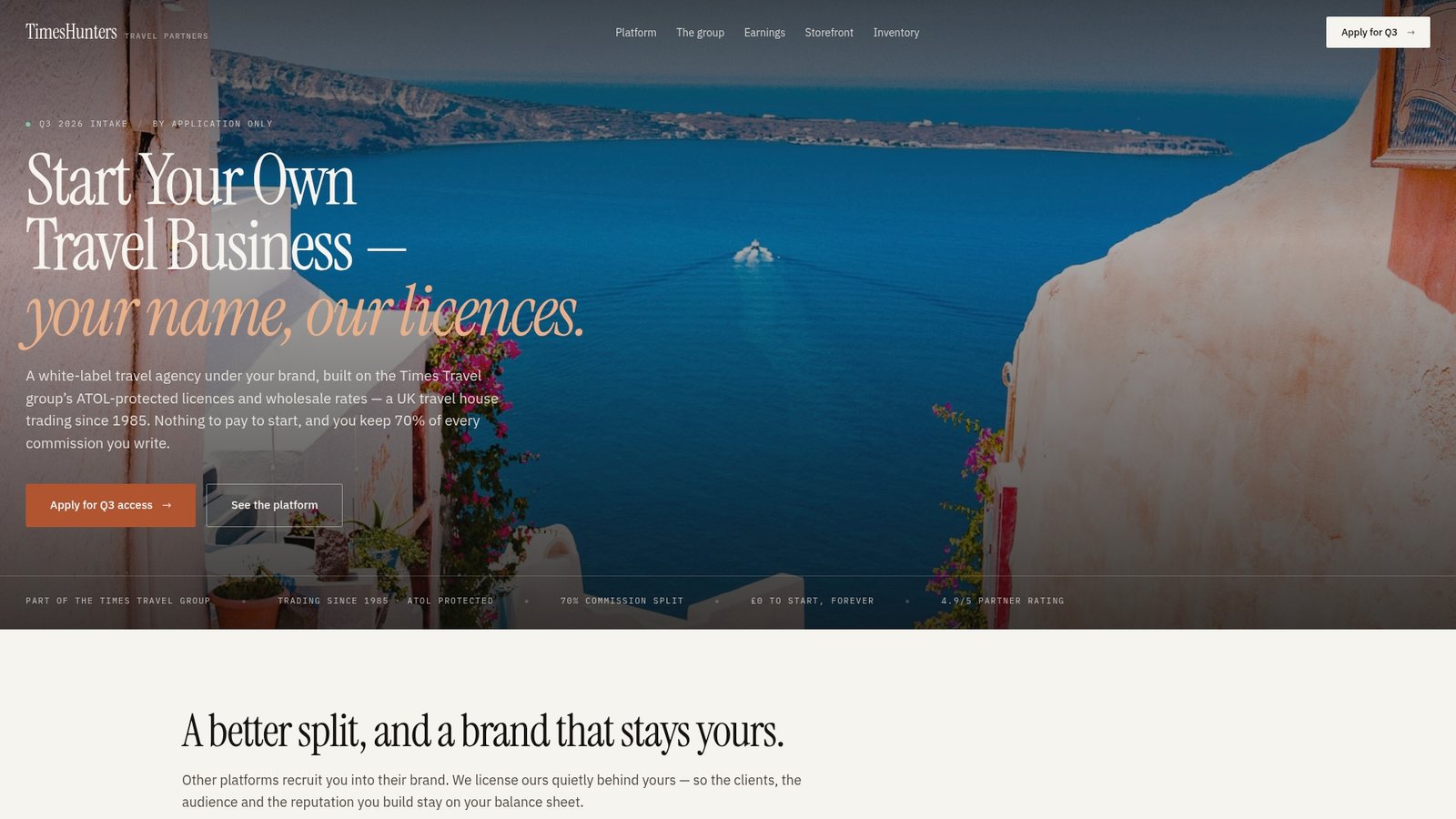
It suits aspiring travel entrepreneurs and independents with an existing client base or following who want that audience converted into bookings without most of the margin disappearing before it reaches them. If that’s your situation, explore the Timeshunters platform and see how the partner model applies to your own booking volume.
Sources
- Travel Agent Commission Rates 2026: 10-25% Hotels, 15-35% Tours
- A complete guide to travel agency commission rates · Approved Experiences
- How Much Do Travel Agents Make in 2026? Salaries, Commissions — TravelBuzzy