Travel Agency SEO: 10 Fixes That Turn Visits Into Bookings
Turn travel website traffic into bookings. Start with Search Console, fix the inquiry flow, add FAQ schema, and run the ten priority tasks.

Rankings mean nothing if the enquiry form breaks. The single most important focus for travel agency SEO right now is targeting business-fit, long-tail trip queries while stripping friction from the booking path itself. Start with Google Search Console, add FAQPage schema to your top pages, and audit your enquiry flow this week. Local wins can land within weeks; competitive destination terms take months.
TL;DR:
- Prioritize completing your Google Business Profile, auditing the booking path, and optimizing high-traffic pages to see local and conversion improvements within weeks.
- Fix technical SEO issues by ensuring crawlability, mobile speed, and booking widget accessibility, and run regular speed and integrity checks.
- Focus on long-tail, experience-specific keywords that match actual booking intent and structure your site with pillar and cluster pages for better authority.
- Enhance local search visibility through comprehensive GBP optimization, consistent NAP data, and encouraging reviews that mention specific destinations.
- Use schema markup and AI-focused content patterns like FAQPage and review schema to increase your chances of being cited in AI-generated answers.
Table of Contents
- What makes travel agency SEO different from other industries?
- Technical SEO and site speed: the checklist that removes ranking blockers
- Which keywords and page structure actually drive bookings?
- How do you win local search and the map pack?
- What schema and content patterns help you get cited by AI?
- What link-building actually works for a travel agency?
- How do you turn organic traffic into qualified bookings?
- Does a white-label route make SEO easier to convert into bookings?
- What tools and timeline should you use to measure this?
- Which ten tasks should you start this week?
- How should mobile and voice search shape your priorities?
- What changes when your travel agency site serves multiple countries or languages?
- Does social media actually help travel agency SEO?
- Where can you validate this yourself?
- A realistic view on where to spend your effort
- Another route: building your agency on TimesHunters instead of from scratch
- Sources
What makes travel agency SEO different from other industries?
Online travel agencies own the generic terms. Type “Rome hotels” or “Bali packages” into Google and you’re fighting Booking.com, Expedia, and a wall of AI Overviews before you even see an organic result. That’s the first constraint: broad destination keywords are largely a losing battle for independent agencies, because long-tail, experience-specific keywords typically convert better than broad destination terms precisely because OTAs can’t replicate a bespoke, advisor-led itinerary.
Seasonality compounds the problem. A ski-trip page that ranks brilliantly in November is dead weight in June, so your content calendar has to work against the calendar tourists actually book on, not the one you’d prefer.
Three fixes deliver disproportionate return this week:
- Complete your Google Business Profile fully, including services, booking links, and photos. Expect visible local movement within two to four weeks.
- Audit the booking path end to end. A broken handoff between your landing page and enquiry form quietly cancels out every ranking gain.
- Optimise three high-intent pages you already have traffic on. Rewrite the title tag, tighten the opening paragraph, add a direct answer block.
Pro Tip: Search behaviour is shifting fast. Travel queries showed a marked jump in AI Overview appearances during 2025, which means visibility without a click is becoming normal, not rare.
Technical SEO and site speed: the checklist that removes ranking blockers
Most travel sites lose visibility to problems nobody’s looking at because the homepage looks fine. A structured audit approach, working through pass and fail checks, assigning severity, and revalidating after each fix, catches what a casual glance misses.
Work through this order:
- Check crawlability first. Confirm your XML sitemap is submitted in Search Console, robots.txt isn’t accidentally blocking booking or destination folders, and canonical tags point to the version you actually want indexed. It’s common to find seasonal campaign pages canonicalised to nowhere.
- Fix mobile page speed. Compress hero images (most travel sites run unnecessarily heavy destination photography), enable lazy loading below the fold, and use server hints for critical assets. Aim for a Largest Contentful Paint under 2.5 seconds on mobile.
- Test every booking widget and iframe. Search engines frequently can’t read content inside embedded booking tools, which means the page around the widget carries the entire SEO weight. Make sure the surrounding text describes the trip in full, not just “book now.”
- Confirm the enquiry handoff works. Submit a test enquiry monthly. Booking widget failures are a quiet revenue leak; reducing booking errors at the handoff point often recovers more revenue than a new blog post ever will.
- Prioritise by business impact, not ease. A slow-loading page that converts at 8% deserves attention before a fast page nobody books from.
Run a monthly crawl with a tool like Screaming Frog or Sitebug, check Core Web Vitals in Google Search Console, and validate speed fixes with Lighthouse. A 22-point structured checklist covering technical, content, and local issues is a useful baseline if you want something more exhaustive than a quick scan.
Pro Tip: Test your own booking flow from a mobile connection with throttled speed, not your office Wi-Fi. What looks instant on fibre can time out on 4G in an airport lounge, exactly where a lot of your traffic is coming from.
Which keywords and page structure actually drive bookings?
Volume is the wrong metric. Score each keyword on three things instead: fit (does it match a trip you actually sell), intent (is the searcher close to booking or just browsing), and effort (can you realistically outrank what’s there now). A phrase like “10-day family safari Kenya with toddlers” will never show huge search volume, but it converts at a rate generic terms never will.
Structure your site as a hub and spoke: a destination pillar page (“Kenya Safaris”) links out to cluster pages covering trip types, family safaris, honeymoon safaris, budget safaris, each linking back to the hub and sideways to advisor profiles. Pillar and cluster architecture with relevant schema builds topical authority faster than a flat pile of unconnected pages, and it gives you somewhere natural to send internal links from high-traffic blog content toward commercial booking pages.
Keep answers near the top of each page short and direct, this helps both human scanners and AI systems extracting content for citation.
Useful page types worth building:
- Itinerary pages with day-by-day detail and pricing ranges
- Advisor profile pages that put a real name and face against the booking
- Trip brief pages answering “who this is for” and “what’s included” before the fold
How do you win local search and the map pack?
Local SEO is often the fastest return you’ll see. Google Business Profile completion, citation consistency, and location-specific pages tend to move faster than competitive national rankings because fewer agencies bother getting the basics right.
Choose your GBP categories carefully, “Travel Agency” as primary, with secondary categories matching your actual specialism (cruise, honeymoon, corporate travel). Keep your name, address, and phone number identical across your website, GBP, and every directory listing, inconsistent NAP data confuses Google about which business it’s actually ranking. Build a dedicated location page only if you have a genuine physical presence or serve a clearly bounded region; a page with no real local signal just dilutes your site.
- Respond to every review within 48 hours, mentioning the destination or trip type where relevant.
- Ask satisfied clients for a review immediately after final payment clears, not months later.
- Track which reviews mention specific trip types; that’s free keyword research.
Pro Tip: Ask happy clients to name the destination in their review. “Best Vietnam trip we’ve ever booked” does more for local rankings than five stars with no text.
What schema and content patterns help you get cited by AI?
Structured data is no longer optional if you want to show up in AI-generated answers. Concise, direct answers paired with FAQPage schema measurably increase the odds an AI system quotes your page rather than a competitor’s.
- Add TouristTrip and TouristAttraction schema to itinerary and destination pages using JSON-LD.
- Mark up reviews with Review schema, and LocalBusiness schema on your contact and location pages.
- Write the first paragraph under each heading as a self-contained answer, two or three sentences an AI system could lift whole.
- Validate every markup change with Google’s Rich Results Test before publishing, missing required fields is the most common error.
What link-building actually works for a travel agency?
Forget generic outreach templates. The links that move a travel site are ones tied to something real: supplier relationships, local press, or original data.
- Supplier links from tour operators, hotels, and DMOs you work with directly, ask for a partner listing when you renew a contract.
- Local press coverage when you sponsor an event or a client has a genuinely unusual story worth covering.
- Original survey data, even something small like “we asked 200 clients what nearly stopped them booking”, gives journalists a reason to link.
- Guest contributions to travel publications, written by your actual advisors, not outsourced content mills.
Expect authority gains to show up gradually over three to six months, not overnight. Track referring domains in Ahrefs or a similar crawler monthly rather than checking daily.
How do you turn organic traffic into qualified bookings?
Map the full “inquiry-to-itinerary” flow: landing page, enquiry form, advisor response, quote, booking. Auditing this path end to end matters because traffic without conversion is just a vanity metric, and most agencies never look past the analytics dashboard.
- Connect the chain: Search Console shows what ranks, Analytics shows what converts, and your CRM shows what actually becomes revenue.
- Track drop-off at each step, form abandonment often spikes when there are more than four fields.
- Cut friction fast: shorten forms, show a real advisor’s photo near the submit button, set routing rules so enquiries reach the right specialist within minutes, and send an automated confirmation immediately.
Pro Tip: A four-field enquiry form (name, email, destination, travel dates) consistently outperforms a ten-field “tell us everything” version. Ask the rest during the phone call.
Does a white-label route make SEO easier to convert into bookings?
Some agency owners solve the supplier-relationship problem entirely differently. Timeshunters runs a white-label platform giving partners their own branded travel business under Times Travel Group’s ATOL-protected licences, with 70% commission on bookings rather than the roughly 4% typical of standard online travel agency arrangements. One partner reported per-booking income rising from £400 to £1,200 after switching models.
The relevance to SEO is direct: your organic traffic still needs somewhere credible to land. A branded booking site with automated booking management means enquiries generated by your long-tail content and local search work route straight into a working sales process, rather than stalling at a generic contact form with no backend behind it.
What tools and timeline should you use to measure this?
Set up a simple monitoring stack: Google Search Console for rankings and indexing, Analytics for behaviour, Lighthouse for speed, a crawler like Screaming Frog for technical health, and your CRM for actual bookings.
- Month 0 to 1: fix technical blockers and complete GBP.
- Month 1 to 3: publish long-tail cluster content and schema.
- Month 3 to 6: build links, review conversion data, iterate.
Present stakeholders with enquiry volume and booking value tied to organic sessions, not raw traffic. That’s the number that justifies the budget next quarter.
Which ten tasks should you start this week?
Ordered by impact versus effort:
- Submit and check your sitemap in Search Console (SEO lead, 1 hour)
- Complete Google Business Profile fully (marketing, 2 hours)
- Test the enquiry form on mobile (operations, 30 minutes)
- Compress hero images site-wide (developer, half day)
- Add FAQPage schema to top five pages (SEO lead, half day)
- Write three long-tail trip briefs (content, 2 days)
- Fix NAP consistency across directories (marketing, half day)
- Add advisor photos near enquiry forms (developer, 2 hours)
- Request reviews from last month’s clients (operations, ongoing)
- Connect Search Console, Analytics and CRM reporting (SEO lead, 1 day)
How should mobile and voice search shape your priorities?
Most trip research now happens on a phone, often while a traveller is sitting on a sofa, or increasingly, asking a voice assistant directly. That shifts what “optimised” means. A destination page that reads brilliantly on a laptop but forces pinch-to-zoom on a phone is losing bookings before anyone reaches your enquiry form.

Voice queries tend to be longer and more conversational than typed ones: “what’s the best time to visit Portugal with kids” rather than “Portugal family holiday”. Structure your content to answer that exact phrasing near the top of the page, in plain sentences, because voice assistants pull from short, direct passages rather than dense paragraphs.
Three mobile priorities matter more than anything cosmetic: tap targets large enough for a thumb, forms that autofill correctly, and click-to-call buttons that actually dial rather than opening a new tab. Google’s mobile-first indexing means the mobile version of your page is the one being evaluated for ranking, so a desktop-only redesign fixes nothing.
Test your own site on a real phone, not a browser’s device emulator. Emulators miss things like a sticky header eating half the screen or a booking widget that requires horizontal scrolling. If your enquiry form takes more than three taps to reach from a destination page, that’s the fix to make before writing another blog post.
What changes when your travel agency site serves multiple countries or languages?
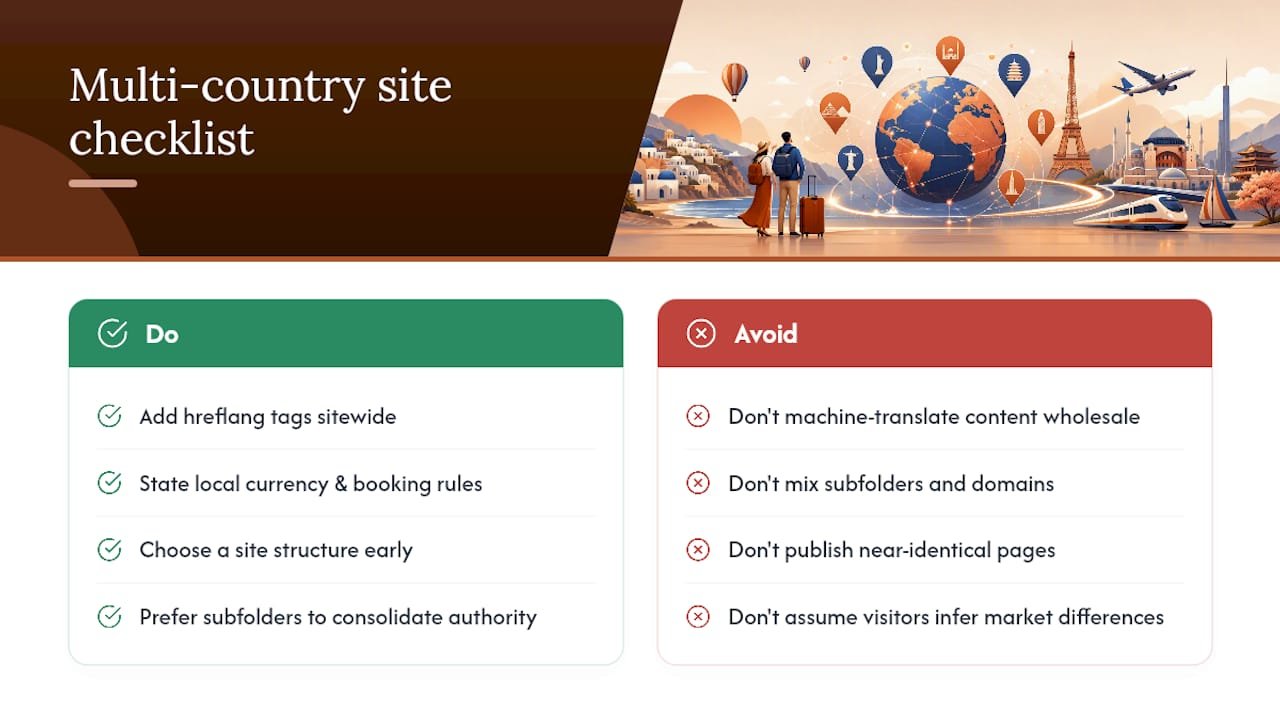
A site trying to rank in the UK, Ireland, and Australia simultaneously with one set of English pages usually confuses search engines about which audience each page targets. The fix is hreflang tags, which tell Google exactly which country and language version of a page to show which searcher, applied consistently across every translated or region-specific page.
Avoid machine-translating destination content wholesale. A literal translation of “hidden gems” rarely lands the same way in French or German, and search engines increasingly reward content that reads as genuinely native rather than converted. If you serve a market with different currency or booking regulations, say so explicitly on that market’s page rather than assuming visitors will infer it.
Decide early whether you need country-specific subfolders (yoursite.com/fr/) or separate domains altogether; subfolders are usually easier to maintain and consolidate authority under one root domain. Whichever structure you choose, keep it consistent so you’re not mixing approaches across different markets on the same site.
Duplicate content across near-identical language versions is a common trap. Two English pages, one for the UK and one for Australia, need distinct signals (currency, spelling, relevant seasons) or search engines may treat one as redundant and simply stop showing it.
Does social media actually help travel agency SEO?
Social posts don’t carry direct ranking weight the way backlinks do, but the relationship between social activity and search visibility in travel is stronger than in most industries because of how much research happens visually first. A striking Instagram carousel of a client’s trip often drives the branded search (“[Agency Name] Maldives”) that eventually lands on your website through organic results.
Embedding real client trip photos and short video content on destination pages, sourced from your own social channels, keeps pages fresh and gives visitors proof beyond stock photography. That matters for dwell time, which correlates with how search engines assess page quality even without a formal ranking signal attached to “likes.”
Consistent branding across your website, Google Business Profile, and social profiles reinforces the entity signals search engines use to understand who you are, useful when a searcher types your agency name directly rather than a generic query. Link your social profiles from your GBP listing and website footer so all three reinforce the same business identity.
Treat social platforms as a distribution channel for the same long-tail content you’re building for search, a trip brief written for SEO can become three Instagram captions and a short video script with almost no extra work.
Where can you validate this yourself?
- Google Search Console for indexing, crawl errors, and query data
- Google’s Rich Results Test to confirm schema markup renders correctly
- Ahrefs or a comparable crawler for backlink and technical monitoring
- The travel-SEO guides cited throughout this article for deeper tactical detail
A realistic view on where to spend your effort
Most agencies over-invest in content volume and under-invest in fixing the enquiry form. Hire a specialist when technical work exceeds your team’s comfort, schema, Core Web Vitals, migrations. Keep local SEO, review requests, and content ideas in-house; nobody understands your clients’ trips better than you do. The biggest trap is chasing rankings on terms you can’t realistically convert, while the booking path quietly bleeds enquiries nobody notices.
— Sam
Another route: building your agency on TimesHunters instead of from scratch
Everything above assumes you’re building supplier relationships, ATOL protection, and booking infrastructure yourself, which is a real path, but not the only one. Timeshunters offers a different starting point: a white-label platform that hands you a branded booking site, wholesale hotel, cruise, and tour inventory, and Times Travel Group’s ATOL-protected licences, without the years it normally takes to negotiate supplier access.
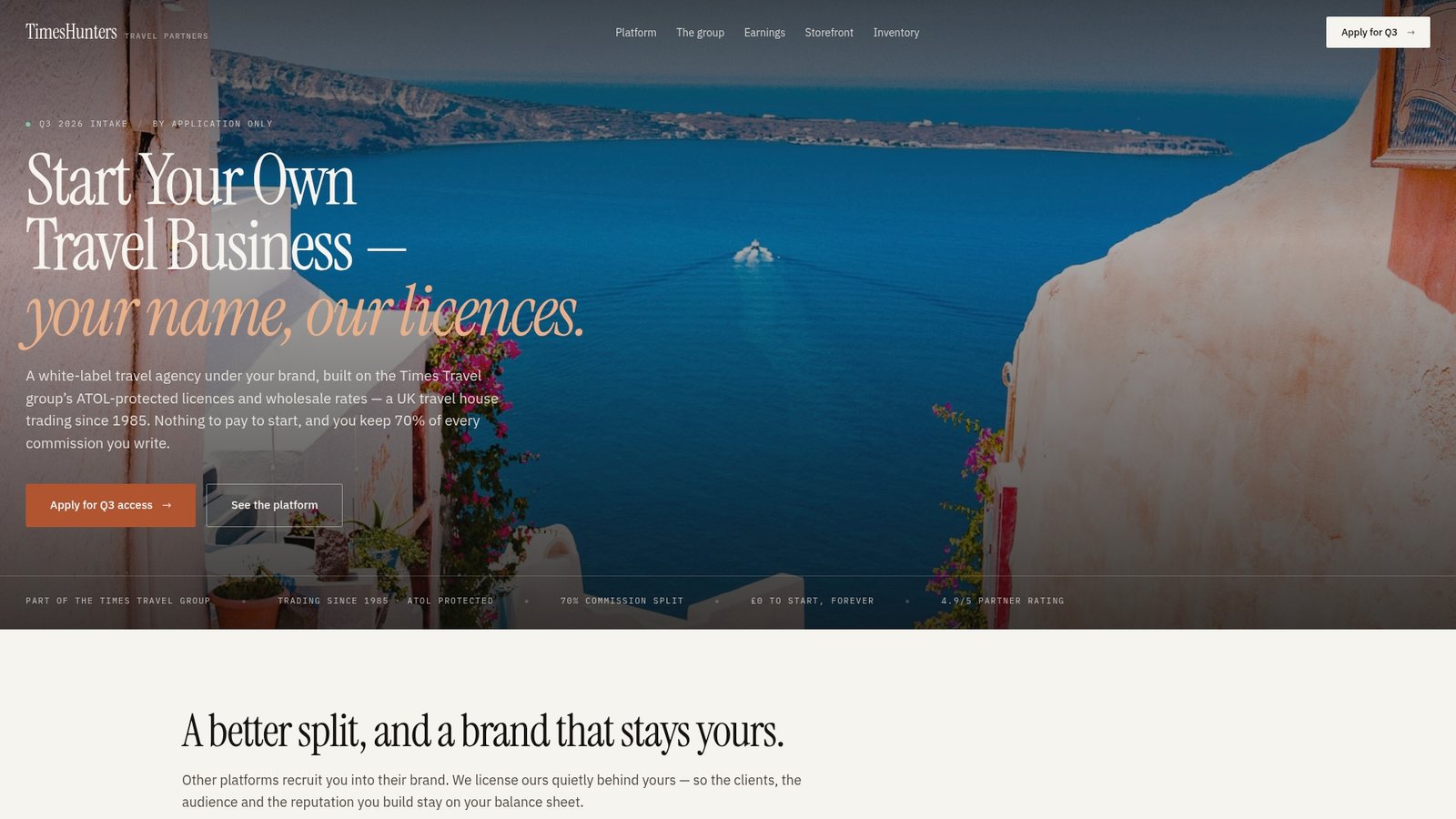
Instant pricing proposals and automated booking management mean the long-tail traffic and local visibility you’re building through the tactics above has somewhere functional to land, a branded enquiry flow that converts, rather than a form that quietly disappears into an inbox. If launching a branded agency without building booking infrastructure from zero sounds like the faster route, see how the platform works and check whether it fits your market.