
Monetise Your Travel Expertise: 5 Ways That Pay in the UK
Turn what you know about travel into income: planning calls, affiliate links, tours and your own branded agency, with UK rules and real commission figures.

The most direct way to monetise travel expertise in the UK is to sell the trips you already recommend, under your own name, and keep most of the commission. Affiliate links, paid planning calls, tours and writing all work as supporting income. A branded agency running on a licensed, ATOL-protected platform turns your knowledge and your audience into bookings you control, with 70% of the commission coming to you.
This guide is for people who already have the knowledge or the audience: freelancers, creators, hospitality owners and professionals with clients who ask them where to go. It covers each route, what it realistically earns, the UK rules that apply and how to put the routes together.
TL;DR
- Travel expertise earns in five ways: paid advice, affiliate links, tours and workshops, writing and content, and selling bookings through your own agency.
- Selling bookings has the highest ceiling, because commission is a percentage of the trip value. Typical supplier rates run from 10% to 20% for hotels, cruises and tours, and the split you keep matters as much as the rate.
- Under UK law, selling flight-inclusive packages needs an ATOL or exempt status. Sharing opinions does not, but arranging and taking payment for trips does.
- We give partners 70% of commission, a branded booking site and ATOL-protected licences, with no cost to start.
- Stack the routes in order of speed: advice and affiliate first, then your own bookings as the core.
Table of Contents
- The five ways travel knowledge turns into income
- Sell the bookings: your own branded travel agency
- The UK rules: what you can do with and without an ATOL
- Paid planning calls: the fastest first pound
- Affiliate links: income that follows intent
- Tours, workshops and group trips
- Writing and content
- What the money looks like
- Stack the routes in the right order
- Our view
- Start your own branded agency
- FAQ
- Sources
The five ways travel knowledge turns into income
Every route below sells one of three things: your time, your attention, or your recommendation at the moment someone books. They differ in how fast they pay and how far they scale.
| Route | What you sell | Speed to first income | Ceiling |
|---|---|---|---|
| Paid planning calls | Your time | Days | Limited by hours |
| Affiliate links | Your recommendation | Weeks to months | Grows with traffic and intent |
| Tours and workshops | Your presence | Weeks | Limited by group size and dates |
| Writing and content | Your words and images | Weeks | Limited by commissions and rates |
| Your own travel agency | Bookings under your brand | Weeks to launch, then per booking | Grows with client list and trip value |
The last row is where we focus, because it is the only one where the client relationship, the brand and the repeat business all belong to you.
Sell the bookings: your own branded travel agency
An agent earns when a client travels. Suppliers pay the agent a percentage of the booking value. One industry guide puts typical ranges at 10–15% for hotels, 10–16% for cruises, 10–20% for tours and packages and 20–30% for travel insurance, with rates moving with supplier volume, agreements and bonus tiers. The client pays the same as booking direct, so you are not adding a cost to the trip. For a closer look at how these rates behave, see typical travel agent commission rates.
The same guide notes that most suppliers pay once the client has travelled, not when they book. That shapes your cash flow: a trip sold in January may pay out after a summer holiday. It also means the share you keep is the number that decides whether the work is worth doing.
Why the split matters more than the rate
Take a £4,000 hotel-led holiday at a 10% supplier commission. That is £400 in commission. Where an agent keeps 70%, £280 is theirs; at a much lower share the same trip pays a fraction of that. Hosted-advisor models in the market commonly start advisors at 70% of commission, with the host retaining the remainder. The pattern across the industry is that you trade a share for the licence, the supplier access and the back office.
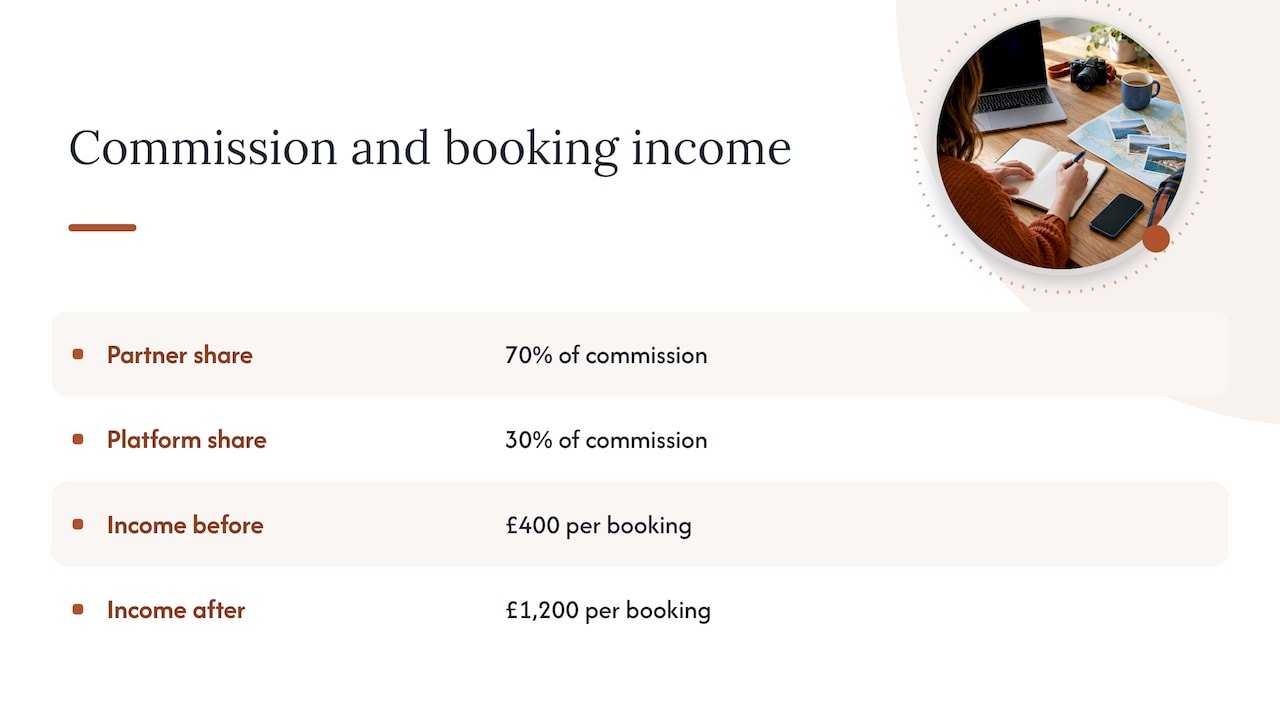
Our model follows that logic. Partners keep 70% of commission and we keep 30%. We offer this because the usual online travel agency route pays creators and small sellers about 4%, which we think is not enough for the work of recommending and selling a trip. One partner told us their income per booking went from £400 to £1,200 after moving to their own branded agency with us.
What you need to start
To sell trips without building everything yourself you need five things:
- A licence to sell flight-inclusive travel. In the UK this means ATOL protection, covered below.
- Supplier access at good rates. We give partners access to wholesale hotel, cruise and tour inventory, plus villas, safari camps and rail.
- A way to quote and book. Partners get a branded booking site and instant pricing proposals.
- Payment handling and protection. Client payments are managed with financial protection built in.
- Admin that does not eat your week. Booking management and client follow-up are automated.
Partners trade under their own name and their client relationships stay theirs: the licence’s branding is invisible to end clients. There is no cost to start. Our travel agent support and onboarding page explains how the first weeks run, and UK travel agent training covers the launch itself.
The UK rules: what you can do with and without an ATOL
This is where many creators stall, so it is worth being precise. There are two different activities.
Sharing what you know. A paid conversation about where to stay in Lisbon is advice. A guide explaining that licensing distinction says ABTA and ATOL rules apply to businesses that sell or arrange package travel and hold client money, not to creators sharing personal destination knowledge.
Arranging and selling travel. The Civil Aviation Authority states that a business selling a flight-inclusive package or flight-only travel to UK consumers must be an airline, an ATOL holder or an exempt person. Exempt persons include an agent for an ATOL holder. The CAA lists several ATOL types, among them a Small Business ATOL and an Accredited Body Member arrangement, and says an agent of an ATOL holder must tell the holder about each booking straight away and issue a certificate naming the holder.
In practice, the quickest legal route for most individuals is to act as an agent under an existing holder’s licence, which is what our model provides. We handle the ATOL side so you can concentrate on clients. Our guide to monetising a travel audience through a compliant agent goes into the detail for creators.
Two further points for your planning:
- Package rules are changing. The Package Travel and Linked Travel Arrangements (Amendment) Regulations 2026 are due to commence on 6 April 2027, bringing one type of linked travel arrangement into the package definition and adding a 14-day refund period for cancelled services. Selling under a licensed structure means the paperwork follows the holder’s compliance, but you should understand the direction of travel.
- Receipts and agreements. ABTA’s guidance requires members selling through agents to have a written agency agreement stating who is principal and who is agent, and ATOL-protected receipts must name the holder and its number.
Paid planning calls: the fastest first pound
If you already answer “where should we stay?” in your messages, you can charge for it. A UK-focused guide says creators can add a paid planning-call option with no minimum following and no travel-agent qualification. It fits the way Britons plan: short-haul city breaks, package comparisons and the occasional long-haul bucket-list trip.
The same publisher suggests building income in order, with paid planning calls first because they need no traffic, affiliate income as a passive layer on content you already have, and sponsorships once there is a track record.
Planning calls teach you what clients actually ask for, which is the best preparation for selling the trip itself. A client who has paid for a plan is also well placed to book it through you. If you move from advising to taking bookings, the ATOL points above apply from that moment.
Affiliate links: income that follows intent
Affiliate links pay when a reader books through your link. The appeal for smaller creators is that they depend on intent, not follower count. One trade report says affiliate marketing has become creators’ top monetisation method because results are trackable, and cites a hotel affiliate post that drove about $30,000 in sales over 60 days at roughly 5% commission.
The UK mechanics are worth knowing:
- Commission is usually paid only after the booking is confirmed and the cancellation window closes, so a cancelled trip removes the payment.
- Many UK creators run two or three programmes at once, because rates and booking values differ by sector.
- Affiliate commission is taxable trading income and counts towards VAT turnover. The same guide notes the VAT registration threshold rose to £90,000 in April 2024, so check the current figure with HMRC as you grow.
Affiliate rates are typically single-digit percentages, as the 5% example shows. That is why creators with an engaged audience often add their own bookings: the same reader, the same trust, a larger share of the same trip. Our page for creators selling travel sets out how that works.
You do not need a huge audience
Focus beats size. One specialist writer argues that a niche site with 3,000 loyal readers can be worth more to a specialist tour operator than a generic blog with 50,000 passive followers. The same writer puts tour and experience bookings at £50 to £500 or more per person with commission of 6–8%, so a single group booking from one recommendation can be meaningful. A hospitality owner with a loyal guest list or a professional with a contacts book is in the same position.
Tours, workshops and group trips
If you enjoy being on the ground, you can sell your presence. A London photographer featured by Side Hustle School charges £75 per person for half-day urban photo tours, reached his first £1,000 after five tours and now runs four to five tours a week in peak season, listing on experience marketplaces and paying referral commission to hotels and agents.
Three lessons transfer to any niche:
- Pick something specific. A narrow theme is easier to price and to recommend than a general tour.
- Price per person with a minimum group size so a quiet week does not cost you.
- Tours generate repeat clients. Those clients are also buyers for flights, hotels and cruises, which brings you back to selling bookings. If you plan to run packages yourself, our guides on tour operator commissions and tour operator versus travel agent show what changes legally and financially.
Writing and content
Writing pays per word and is a good way to build credibility. JRNY magazine pays £0.20 per word, so a typical 2,000-word article is about £400, with photo rates from £2.50 to £40 and payment usually within 14 days of invoice. A professional features outlet pays in the range of £0.30 to £1 per word depending on scope. It is steady, but it is paid by the piece, so it works best as a way to build a name that feeds the rest of your income.
What the money looks like
It helps to set expectations against a salary. Employed UK travel agents typically earn around £22,000 starting and up to £34,000 with experience, according to the National Careers Service figures cited there. Independent agents have no salary: they keep a share of commission, so income ranges from a part-time top-up to a full-time living depending on bookings, commission rates and the split.
The arithmetic of a branded agency is simple enough to model yourself:
- Bookings per month × average trip value × supplier commission rate × your share.
- Ten £3,000 bookings a month at 12% average commission produces £3,600 in commission. At a 70% share, £2,520 is yours.
That is an illustration, not a forecast. Results depend on your audience, your niche and how often clients rebook. The most reliable growth lever is repeat business: a returning client books faster and often spends more, and a referred client arrives already trusting you. Read more in our guides to recurring revenue in travel and building a personal travel brand.
Stack the routes in the right order
A sensible sequence for most people:
- Start with advice. Offer planning calls or answer questions publicly, and learn what people want.
- Add affiliate links to content you already publish, to see which posts convert.
- Launch your branded agency so that the recommendations that convert become your own bookings at 70% commission.
- Add tours or a niche specialism such as cruises, safari or luxury, which raises the value per booking. See our guides to selling cruises from home and the luxury travel niche.
- Build repeat revenue with follow-up, rebooking and referrals.
Our view
Most people who ask us how to monetise travel expertise are already doing the hardest part: people trust their recommendations. What is missing is a way to be paid properly when that trust turns into a booking.
We built the platform for exactly that moment. You keep your own brand and your own clients, and the licence behind you is invisible to the people you serve. You sell hotels, cruises, tours, villas, safari camps and rail, with wholesale access and the booking admin automated, and you keep 70% of the commission.
Our advice is to treat everything else, the calls, the links, the tours, as the way you find and warm up clients, and to make your own bookings the centre of the business. A recommendation that earns a few per cent for someone else could earn most of the commission for you.
Sam
Start your own branded agency
If you want to move from recommending trips to selling them, our white-label travel agency lets you launch under your own name using Times Travel group’s ATOL-protected licences. You get a branded booking site, wholesale hotel, cruise and tour inventory, instant pricing proposals, managed payments with financial protection and automated client follow-up. There is no cost to start, and you keep 70% of every commission.
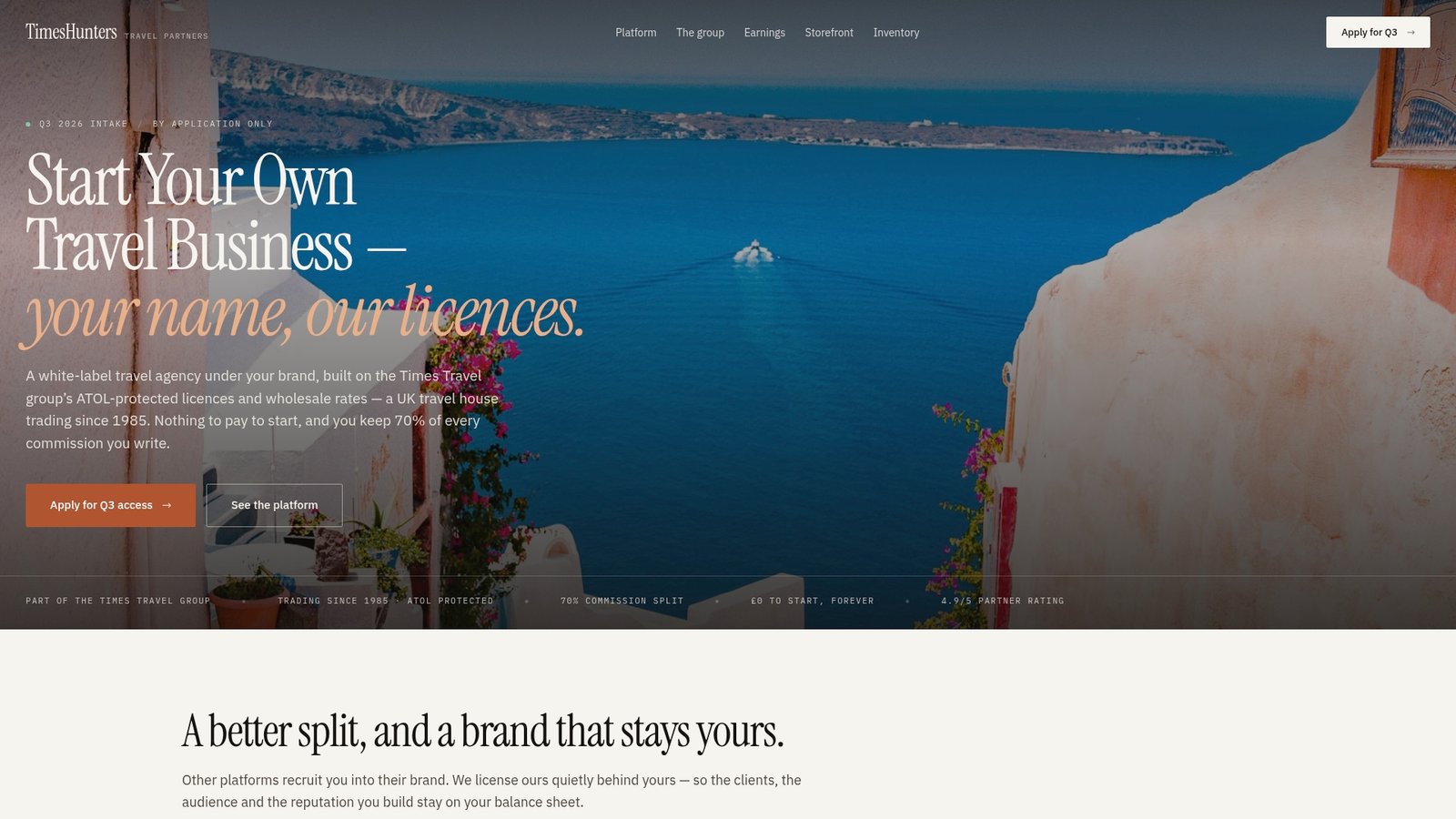
See how the white-label agency works or start from the Timeshunters home page.
FAQ
Do I need to be a qualified travel agent to earn from travel?
No. Paid planning calls, affiliate links, tours and writing have no qualification requirement. Selling flight-inclusive travel to UK consumers does need an ATOL or exempt status, such as acting as an agent for an ATOL holder. Our platform provides that structure through ATOL-protected licences.
How many followers do I need?
There is no fixed number. Affiliate income is driven by intent, and a small, focused audience that trusts you can be worth more to a specialist supplier than a large, passive one. A client list or a loyal guest base counts as much as social following.
How much commission can I realistically earn?
Suppliers commonly pay between about 10% and 20% on hotels, cruises and tours, and your share of that depends on your agency arrangement. With us you keep 70%. A £4,000 booking at 10% commission gives £400, of which £280 is yours.
When do I get paid?
Most suppliers pay commission after the client has travelled, and affiliate programmes pay after the cancellation window closes. Plan your cash flow around that gap, particularly for trips booked far ahead.
Do I have to pay tax on travel commission?
Yes. Commission is trading income, and VAT may apply once your turnover passes the registration threshold. Ask an accountant or check HMRC’s guidance for your situation.
Sources
- Travel agent commission rates and tracking
- How Much Do Travel Agents Make? | HowStuffWorks
- Do I need an ATOL | UK Civil Aviation Authority
- Information note about the ATOL | CAA
- Package Travel and Linked Travel Arrangements (Amendment) Regulations 2026 | legislation.gov.uk
- Guidance on the application of the Code of Conduct | ABTA
- How UK travel creators are turning DMs into paid planning calls
- The travel creator income stack
- Travel’s creator economy doesn’t need a million followers | Skift
- How do travel creators use affiliate marketing in the UK?
- Tour and experience collaborations | Travel Creator Guide
- London Underground photo safaris | Side Hustle School
- Contribute to JRNY Magazine
- 70 publications paying for travel writing
- How much do travel agents earn in the UK?