
Launch a white label ATOL agency in 4 weeks: UK travel agent training
Launch a white label ATOL protected travel agency in the UK. Practical onboarding, training modules, ATOL checklist, commission guidance and a four week...

Yes, you can launch a branded, ATOL‑protected travel agency without vocational qualifications or years in the trade. Platform onboarding through Timeshunters covers the booking workflows, compliance documentation and commission tracking you need, backed by ATOL protection via the Times Travel group. Partners keep a significantly higher commission rate compared to the low typical percentage of many online travel agency affiliate schemes. The next step is booking a demo and starting onboarding.
TL;DR:
- Completing dummy bookings on your busiest routes ensures ATOL certificates generate correctly before going live, reducing costly errors.
- A proper written agency agreement and correct ATOL certificate issuance are vital to avoid customer claim refusals and safeguard your earnings.
- Your branded portal launch depends on sequencing DNS, SSL, testing bookings, and configuring agent permissions, with each step crucial to prevent delays or errors.
- The 70% commission split on marked-up bookings can significantly boost income compared to traditional affiliate schemes, especially with proper pricing and documentation.
- Achieving quick launch within weeks is possible by preparing branding assets and scope in advance, with personalized onboarding support ensuring compliance and setup accuracy.
Table of Contents
- Training essentials: the modules you must complete to operate a white‑label agency
- ATOL compliance and the written agency agreement you must know
- Technical setup and launch checklist for your branded portal
- How the earnings model works: commission maths, reporting and a realistic example
- Onboarding customers and winning your first bookings: a four‑week practical plan
- Legal and regulatory requirements for travel agents in the UK
- Key skills and competencies required for travel agents
- Overview of relevant travel industry certifications and how to obtain them in the UK
- Training on using popular travel booking software platforms relevant in the UK market
- Best practices for handling customer inquiries, complaints, and cancellations
- Impact of Brexit on travel agent operations and compliance in the UK
- Author perspective: what we teach partners and how we support them through launch
- How to get started with Timeshunters: demo, documents and typical timeline
- Sources
Training essentials: the modules you must complete to operate a white‑label agency
Nobody should take a live booking on day one. Timeshunters structures onboarding into modules that build real competence before you handle customer payments, each focused on essential skills used regularly in trading.
- Booking workflows. You learn to search live inventory, apply the correct pricing, confirm a booking and generate the ATOL Certificate for flights, hotels and packages. This is the module you will repeat most, so speed and accuracy matter more than memorising every screen.
- Admin and commission rules. You set up agent profiles, understand how commission tiers apply to different suppliers, and read the reporting dashboard that tracks every payout.
- Payments and documentation. You practise raising invoices, distinguishing protected sums from non‑protected extras such as travel insurance, and issuing the Passenger Ticket Receipt or ATOL Certificate that proves financial protection.
- Practical drills. Dummy bookings across your likely top routes, test ATOL document generation, and a short checklist you tick off before Timeshunters clears you for live sales.
The drills matter more than they sound. A booking that looks fine on screen can still generate the wrong certificate type if a package is priced incorrectly, and catching that in a dummy run costs nothing. Catching it after a customer has paid costs you a refund and a difficult phone call.
Pro Tip: Run at least three dummy bookings on your busiest expected route before going live, and print the resulting ATOL Certificate to check every field against a real one your onboarding specialist provides.
ATOL compliance and the written agency agreement you must know
You do not need your own ATOL to trade under Timeshunters’ platform. What you do need is a written agency agreement, and the Civil Aviation (Air Travel Organisers’ Licensing) Regulations 2012 sets out exactly what that agreement must contain, including a Schedule of Terms binding you to the ATOL holder’s obligations.
The consumer‑facing side matters just as much. Under ATOL Standard Term 1, you must issue an ATOL Certificate the moment a customer pays, and your paperwork has to state the ATOL holder’s name, the ATOL number and a clear statement of financial protection.
Before you sell a single booking, your agency agreement checklist should confirm:
- Both parties are named correctly, with the ATOL holder identified.
- The Schedule of Terms is attached in full, not summarised.
- It states clearly who issues the ATOL Certificate and when.
- Receipts identify which sums are protected and which are not, such as add‑on insurance or service fees.
CAA guidance on selling through agents is blunt about the consequence of getting this wrong: a customer’s claim can be refused if protected money was not clearly identified on the receipt. If you ever consider applying for your own licence later, the CAA’s ATOL application guidance lists the fees and the mandatory accountable persons course, but most partners never need to go that route while trading under an existing ATOL holder.
Technical setup and launch checklist for your branded portal
Getting your branded site live is mostly a sequencing problem, not a technical one. Miss a step and you either delay launch or, worse, go live with something broken.
- Domain and DNS. Submit the DNS changes Timeshunters requires and then wait. DNS propagation typically takes 24 to 48 hours, so build that buffer into your launch date rather than treating it as a same‑day task.
- SSL and security. Confirm your certificate is issued before any payment page goes live. This isn’t optional under UK GDPR once you are handling customer payment data.
- Staging tests. Run full test bookings for flights, hotels and packages, checking that ATOL certificates generate correctly and that pricing and markups match what you configured.
- Agent configuration. Import your team’s accounts if you have any, set role permissions, define your commission and markup rules, and pull a test report to confirm figures reconcile.
Pro Tip: Test your top departure routes specifically, not just a random sample. If most of your bookings will go through Gatwick or Manchester, verify pricing on those routes before launch rather than on whichever route happens to be cheapest to test.
How the earnings model works: commission maths, reporting and a realistic example
The 70% commission split is the headline, but understanding how it actually flows matters more than the number itself. A supplier sets a net rate for a hotel, cruise or package. Timeshunters’ platform marks that up to the customer‑facing price, and the difference between net and gross is the commission pool. You keep 70% of that pool; the platform retains the remainder to cover ATOL protection, technology and supplier relationships.
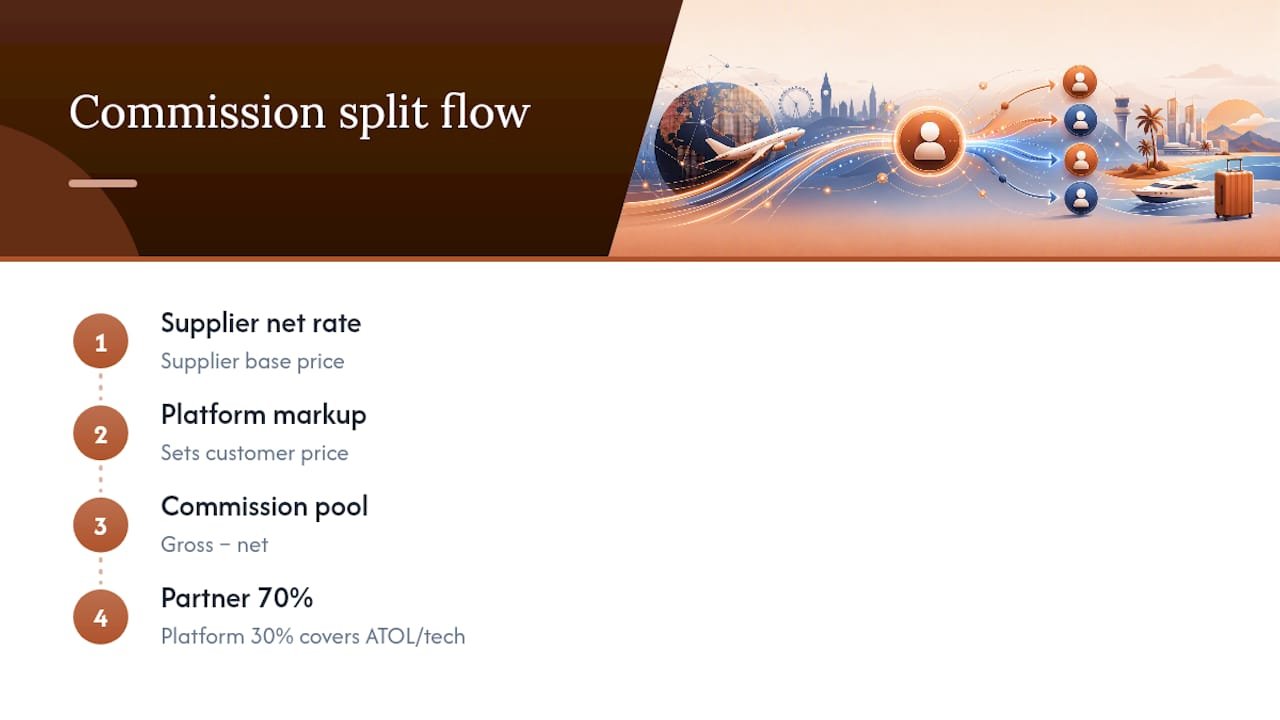
One partner reported income rising from £400 to £1,200 per booking after switching from a standard online travel agency affiliate arrangement to this model, largely because 70% of a properly marked‑up commission dwarfs the 4% typical of affiliate schemes.
Correct ATOL documentation isn’t just a compliance box to tick. It protects your earnings too, because a badly issued certificate or an unclear receipt is exactly the kind of error that triggers refund requests and chargebacks, eating into commission you have already earned. On pricing, resist the urge to undercut every online competitor. A modest, transparent service fee on complex bookings, like multi‑stop itineraries or group travel, often adds more margin than shaving the headline price ever will.
Onboarding customers and winning your first bookings: a four‑week practical plan
Launching the site is the easy part. Getting your first paying customers takes a plan, and four weeks is realistic if you work it consistently.
- Week one: build your launch assets. A short quick‑start guide for customers, a two‑minute demo video showing how to book, and a set of branded emails ready to send.
- Week two: soft launch to a small group, friends, family, or an existing audience if you have one. Ask directly for feedback and, if they’re happy, a short testimonial you can use later.
- Week three: push into low‑cost channels. Your own email list, relevant community groups (a school parents’ group planning a trip, a local sports club touring abroad), and a simple referral offer for anyone who sends you a booking.
- Week four: lean on the platform’s automated follow‑up sequences to nudge quote recipients who haven’t booked yet, and check your reporting dashboard weekly to see which channel is actually converting.
Momentum in month one usually decides whether month three feels like a business or a hobby.
Legal and regulatory requirements for travel agents in the UK
Beyond the ATOL agency agreement already covered, a handful of other legal basics apply whether you trade through a white‑label platform or independently. You need public liability and professional indemnity insurance appropriate to advising clients on travel arrangements, since a booking error that costs a customer money can expose you to a claim.
Data protection is not optional either. Handling customer names, passport details and payment information means complying with UK GDPR, which requires you to state clearly what data you collect, how long you keep it, and how customers can request its deletion.
If you plan to sell package holidays as defined under the Package Travel and Linked Travel Arrangements Regulations 2018, you fall under additional consumer protection rules around cancellation rights and pre‑contract information, regardless of whether you hold your own ATOL. Trading under an established ATOL holder through a platform like Timeshunters removes the burden of holding a licence yourself, but it does not remove your responsibility to trade honestly, keep accurate records and issue correct documentation on every sale. Basic business registration with HMRC, whether as a sole trader or limited company, also applies from the moment you start earning, and getting that structure right early avoids an awkward tax conversation later.
Key skills and competencies required for travel agents
Destination knowledge matters, but it is teachable on the job in a way that customer service and sales instinct rarely are. You can look up visa requirements for Thailand in ninety seconds; you cannot fake genuine interest in a customer’s honeymoon plans.
Strong travel agents tend to share three things. First, listening skills that surface what a client actually wants rather than what they first ask for, someone requesting “somewhere hot” might really want somewhere quiet, and the difference decides whether they book with you again. Second, comfort with numbers: reading a commission report, spotting a pricing error, understanding markup without a calculator. Third, resilience around complaints, because even a well‑run agency will occasionally deal with a delayed flight or a cancelled hotel, and how calmly you handle that call determines whether the customer stays loyal or leaves a bad review.

Sales technique, in this context, is less about pressure and more about framing options clearly: showing a customer three package tiers rather than one, and explaining the trade‑offs plainly, tends to close more bookings than pushing the most expensive option.
Overview of relevant travel industry certifications and how to obtain them in the UK
Formal certification is not a requirement to trade under a white‑label ATOL arrangement, which is precisely what makes this route accessible to people without an industry background. That said, a few voluntary credentials can add polish to your branding.
ABTA membership, available to agencies rather than individuals, signals consumer trust but comes with its own membership criteria and costs, and most partners trading under an established ATOL holder do not need it in the early stages. Destination‑specific training offered by national tourist boards, such as familiarisation courses run by boards for countries like Australia or the Maldives, is free or low‑cost and genuinely useful for building credible expertise in a niche you want to specialise in.
If you later decide to apply for your own ATOL rather than trading under a host, the CAA’s accountable persons online course becomes mandatory during that application. For most people starting out through platform onboarding, the practical training modules covering booking, compliance and admin matter far more day to day than any external certificate.
Training on using popular travel booking software platforms relevant in the UK market
The software skill that actually matters is not mastering every system in the industry. It’s mastering the one your business runs on. Timeshunters’ platform consolidates search, pricing, booking confirmation and ATOL certificate generation into a single branded interface, which means you are not toggling between five different supplier portals to build one itinerary.
That said, understanding the broader landscape helps. UK agents commonly encounter Global Distribution Systems for flight inventory, dedicated bed banks for hotel wholesale rates, and separate cruise booking platforms, each with its own quirks around cancellation policies and payment timing. A white‑label platform’s value is largely in abstracting that complexity away, so your training time goes into learning one consistent workflow rather than several incompatible ones.
Reporting software is the other piece worth taking seriously. Your dashboard should tell you, at a glance, which bookings are pending, which commissions have cleared, and where a refund is in progress. Spending an hour a week actually reading that report, rather than glancing at the total, catches pricing errors and slow‑paying suppliers before they become a pattern.
Best practices for handling customer inquiries, complaints, and cancellations
Every inquiry deserves a response within hours, not days. Customers researching a package holiday are often comparing three or four agents simultaneously, and the one who replies fastest with a clear, personalised quote usually wins the booking.
Complaints need a different rhythm: slower, more careful, and always in writing once resolved. Acknowledge the issue immediately, even if you cannot fix it that day, and set a realistic timeframe for a proper answer. Most complaints in this business trace back to expectation mismatches, a hotel room that looked bigger in photos, a transfer time that felt too tight, rather than genuine agent error, and a calm explanation resolves far more of these than a defensive one.
Cancellations require you to know your supplier terms cold. Some bookings are fully refundable up to a cut‑off date; others are non‑refundable the moment payment clears. Never guess when a customer asks about cancellation terms. Check the specific booking, quote the exact policy, and put it in writing. This is also where correct ATOL documentation earns its keep: a customer with a properly issued ATOL Certificate has clear grounds for protection if a supplier fails, and you have proof you met your obligations if a dispute ever escalates.
Impact of Brexit on travel agent operations and compliance in the UK
Brexit changed the operating environment for UK travel agents in ways that are easy to overlook until a customer asks a question you cannot answer. UK travellers now face different passport validity rules for EU travel: a passport must generally have at least six months’ validity remaining and must have been issued within the last ten years, a detail worth checking on every European booking rather than assuming a customer already knows.
Currency exposure is another practical shift. Suppliers pricing in euros mean your margins can move with exchange rate swings between the point of booking and the point of payment, particularly on package holidays booked months in advance. This does not typically show up in ATOL compliance rules directly, but it affects how you price and when you lock in supplier costs.
On the regulatory side, UK ATOL protection continues to operate under domestic law rather than EU‑wide schemes, so the compliance framework covered earlier in this guide, the agency agreement, the Schedule of Terms, correct certificate issuance, remains the primary thing you need to get right. Brexit has not simplified UK travel regulation, but it has made destination‑specific knowledge (visa rules, health documentation, duty‑free allowances) a bigger part of the value you offer customers than it was a decade ago.
Author perspective: what we teach partners and how we support them through launch
Every partner gets a dedicated setup specialist, not a help desk queue. You get templates for your agency agreement paperwork, live walkthroughs of the booking flow, and someone who has watched dozens of partners make the same early mistakes and can flag them before you repeat them.
The 70% commission figure gets attention because it’s dramatic against the 4% norm, but the more telling detail is the partner who went from £400 to £1,200 per booking. That jump came from combining the commission structure with correct pricing and documentation, not from the split alone. Compliance questions come up constantly in onboarding, and that’s exactly what the specialist is there for: not to lecture you on regulation, but to make sure your paperwork protects you and your customers from day one.
— Sam
How to get started with Timeshunters: demo, documents and typical timeline
Timeshunters gives you a fully branded booking site, ATOL protection through the Times Travel group, and 70% commission on every booking, without the years of industry apprenticeship that route would normally demand. Onboarding walks you through compliance, technical setup and your first live bookings step by step.
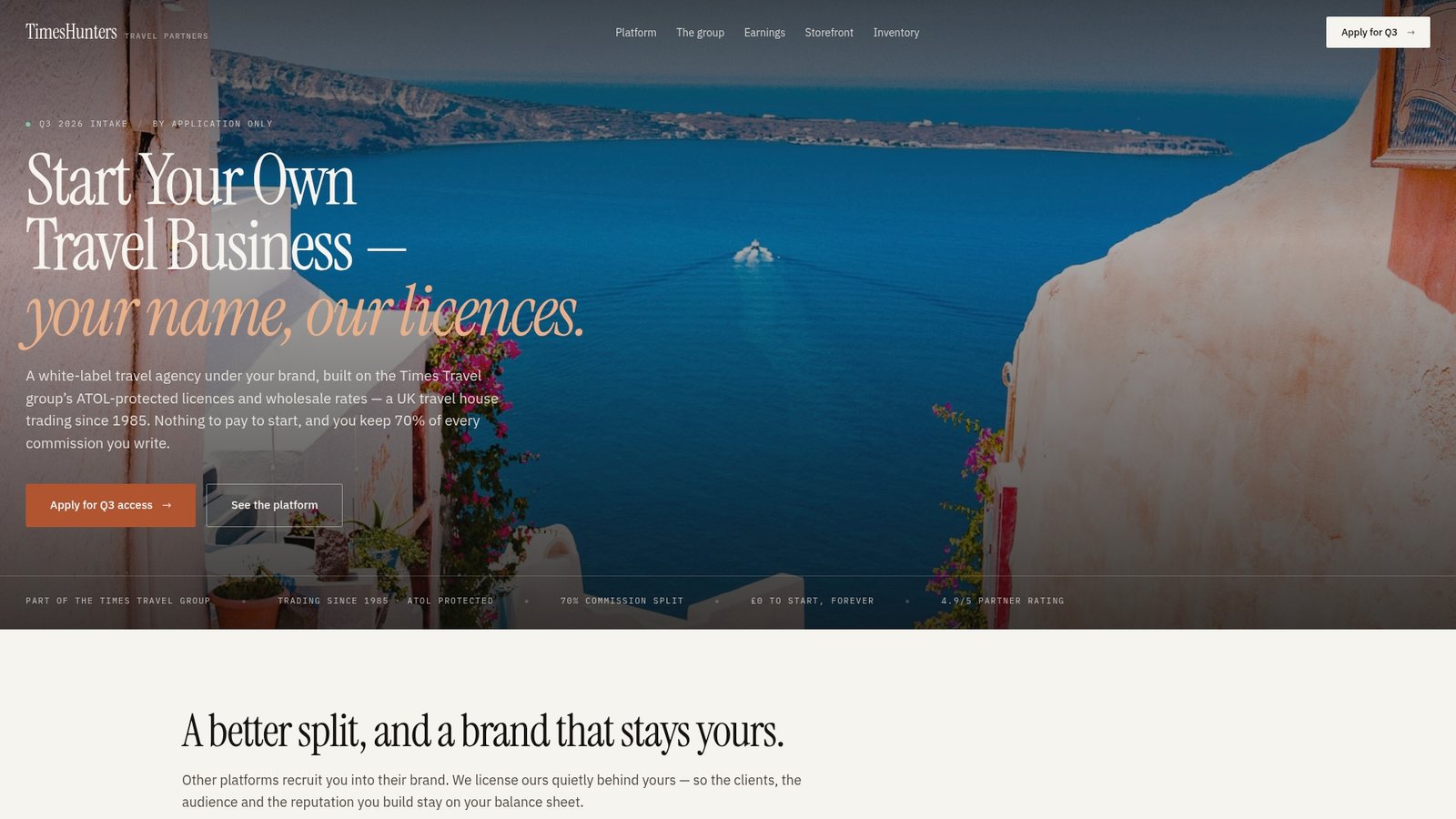
Before booking a demo, gather your branding assets (logo, colour palette, business name), confirm your business structure (sole trader or limited company), and think through the product mix you want to lead with, honeymoons, group tours, cruises, or a broad general offer. With scope and assets ready in advance, a standard deployment can go live within weeks rather than months, and preparing documentation ahead of your contract signature typically shaves real time off configuration.
Book a demo on the Timeshunters platform to see the booking flow, ask about your specific product mix, and get a realistic go‑live date for your branded agency.