
Travel Agency Business Model for Founders: Keep 6–7% of Gross Bookings
A founder's guide to choosing a travel agency business model that models retained revenue and cash timing. Learn when to launch under a host or white-label.

Six models dominate travel retail: independent agency, merchant model, hybrid, host/hosted agent, online travel agency, and tour operator. Most new entrepreneurs should start under a host agency or a white-label platform, because both cut the capital and regulatory load of going fully independent. The trade-off is simple: more control and margin the further you move toward operating as merchant of record, but more complexity and risk alongside it.
TL;DR:
- Working under a host or white-label platform reduces initial capital and regulation burdens, but limits control and margins compared to independent models.
- Agency revenue primarily relies on commissions, but supplementing with fees and overrides stabilizes cash flow and accelerates income realization.
- Retained revenue is typically only 6 to 7 percent of gross bookings with typical commission splits, indicating the need for higher-margin product focus.
- Building a robust system with booking engines, CRM, and accounting software before the first sale prevents cash-flow issues later.
- Focusing on niche markets and high-margin products, while controlling costs and cash reserves, ensures a sustainable travel agency business.
Table of Contents
- Travel agency business model types: agency, merchant, hybrid, OTA, host and tour operator
- How do travel agencies make money?
- What systems and distribution channels does an agency need?
- How do you build a financial model for a travel agency?
- Which travel agency business model is right for you?
- What do you need to start a travel agency?
- What does a white-label platform change about the numbers?
- Prioritise retained revenue over vanity bookings
- Launch under Timeshunters and keep more of every booking
- Sources
Travel agency business model types: agency, merchant, hybrid, OTA, host and tour operator
Every travel agency business model boils down to one question: who takes the money, and who carries the liability if a booking goes wrong? Get that answer right and the rest of the structure follows.
In the agency model, you act purely as an intermediary. The supplier, whether that’s an airline, hotel or tour operator, remains the merchant of record. They invoice the customer (or authorise you to invoice on their behalf), they hold the liability for delivery, and you earn a commission for making the introduction and handling the booking. This is the arrangement most people picture when they hear “travel agent,” and it’s the most common structure explained in payment-flow terms: lower risk, lower capital requirement, but you don’t control pricing and your margin is whatever the supplier decides to pay.
The merchant model flips that. You become the merchant of record, buying inventory at a net rate and reselling it at your own price. You collect the customer’s payment, hold the funds, and take on chargeback and refund risk directly. Margins can be considerably fatter here because you set your own markup, but you also need proper financial protection arrangements, a merchant payment account, and the operational muscle to handle disputes.
Most established agencies actually run a hybrid model: agency terms for flights and package deals booked through a GDS, merchant terms for negotiated hotel or tour rates bought in bulk. It’s messier to account for but it reflects how supplier relationships actually work in practice.
Beyond those two core mechanics, you’ll also come across:
- Online travel agencies (OTAs) — high-volume, low-touch platforms operating on commission rates that can be as thin as 4% per booking, competing purely on price and search visibility.
- Host and hosted-agent arrangements — an established agency (the host) lets you sell under its accreditation and licences in exchange for a commission split, which removes the need to secure your own regulatory approvals from day one.
- Tour operators — businesses that package and sell their own itineraries, taking on far more liability (and margin) than a pure agency, often requiring bonding and insurance well beyond what a retail agent needs.
- Independent accredited agencies — full ownership of licensing, supplier contracts and financial protection, offering maximum control but demanding the most capital and administrative overhead.
Corporate travel management companies tend to run agency or merchant hybrids depending on client contracts. Luxury and bespoke advisors often favour merchant or host arrangements because service fees justify the extra admin. Group and event travel frequently sits with tour operators because the liability of packaging flights, accommodation and transport together is too complex to handle as a pure intermediary.
How do travel agencies make money?
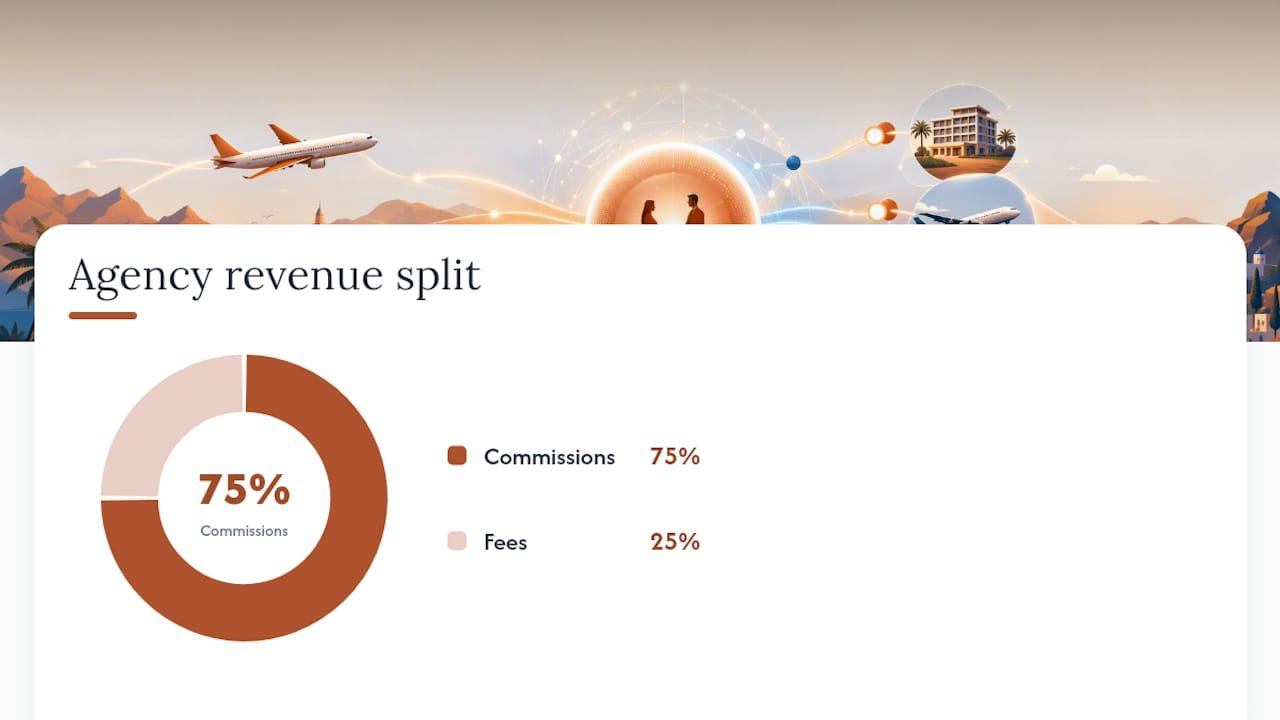
Commissions are still the backbone of agency income, but relying on them alone is a fragile way to build a business. The historical revenue split for agencies leans roughly three-quarters commission and one-quarter fees, though that ratio has been shifting as suppliers squeeze commission rates and advisors push back with their own charges.
A realistic income stack usually includes:
- Supplier commissions — a percentage paid by airlines, hotels, cruise lines and tour operators for each booking, typically ranging from a few percent on flights to 10 to 20% on cruises and packages.
- Planning and consultation fees — a flat or hourly charge for research, itinerary building and advice, increasingly common as a way to get paid for the intellectual work regardless of whether a booking closes.
- Booking and service fees — smaller administrative charges for ticketing, amendments, or complex multi-supplier bookings.
- Insurance commissions — travel insurance often carries a healthier margin than the trip itself, and it’s one of the easiest ancillary sales to attach.
- Overrides and group bonuses — additional commission tiers paid once you hit volume thresholds with a preferred supplier, or a per-head margin on group bookings.
Statistic Callout: Commissions on cruises and escorted tours can run 10 to 20%, compared with roughly 4% on many OTA-style flight bookings, which is exactly why niche and full-service advisors gravitate toward higher-margin product categories rather than competing on flight sales alone.
Timing matters as much as the mix. Commissions are frequently paid only after the traveller completes their trip, or after a final payment milestone has cleared, not when the booking is confirmed. That creates a lag of weeks or months between doing the work and seeing the cash, which catches out a lot of new agency owners who plan cash flow around gross sales rather than actual receipts.
This is why planning fees change the game for a young agency. A £50 to £150 consultation fee charged upfront doesn’t just add revenue, it pulls income forward to the moment the work happens, smoothing out the gap while commission cheques are still working their way through the pipeline. An agency earning purely on commission might see £20,000 in bookings this month and £0 in actual cash. An agency charging fees on top sees a trickle of income arriving continuously, even in months when nothing has travelled yet.
That split shifts over time, usually toward fees and overrides as the client book matures and repeat business reduces the amount of unpaid discovery work per booking.
What systems and distribution channels does an agency need?
The back end of a travel agency is where most first-time founders underestimate the effort. Booking the trip is the easy part; reconciling who owes what, and when, is where things get complicated.
Global Distribution Systems (GDS) like Amadeus, Sabre and Travelport remain the standard route for flights, some hotel inventory and car hire, particularly for corporate and complex itineraries. They’re powerful but carry training overhead and, often, subscription or transaction fees that only make sense once booking volume justifies them.
Bed banks and wholesalers give independent agencies access to negotiated hotel and package rates that individual advisors could never secure alone. This is usually where the merchant model’s margin advantage comes from: buy net, sell at your own price.
Booking engines split into two camps. White-label platforms let you launch under your own brand almost immediately, using someone else’s accreditation, supplier contracts and back-end automation. Bespoke integrations, by contrast, mean building or licensing your own connections to GDS and wholesale feeds, which offers more flexibility but demands significant upfront development cost and ongoing maintenance.
Your systems checklist should cover:
- A booking platform or engine that connects to your chosen suppliers and GDS access points.
- CRM software to track client history, follow-ups and repeat business, since referrals and rebooking are where agency profit actually compounds.
- Accounting software capable of reconciling commissions, refunds and chargebacks against separate booking and payment dates, not just a single sales figure.
- A payment processing setup suited to your model, whether that’s a standard merchant account or virtual cards.
Virtual cards (VCCs) are increasingly common for agencies operating under merchant terms, because they simplify reconciliation against individual bookings and reduce exposure to fraud compared with handling raw customer card details. If you’re taking payments directly rather than passing them to a supplier, PCI compliance obligations follow, and that’s not a paperwork exercise you want to discover after launch.
Pro Tip: Set up your CRM and accounting reconciliation process before you take your first booking, not after. Retrofitting a system to match six months of messy commission and refund data is far more painful than building the habit from day one.
How do you build a financial model for a travel agency?
Gross bookings feel good to talk about. £250,000 in bookings sounds like a real business. But gross bookings measure volume, not income, and confusing the two is the single most common reason new agencies misjudge how much runway they actually have.
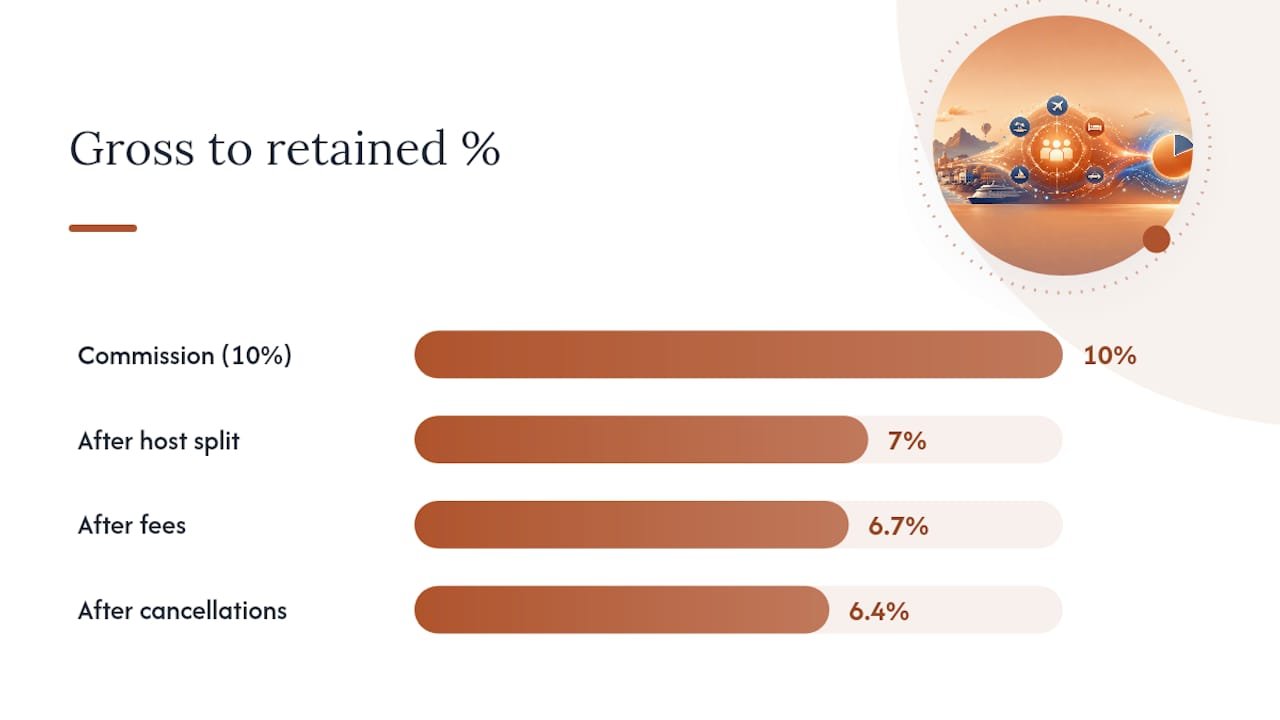
The more useful modelling approach converts gross bookings into retained revenue: the commission percentage you actually keep, minus any host agency split, minus card processing fees, minus a realistic allowance for cancellations and chargebacks. That retained figure, not the headline sales number, is what pays your rent, your software subscriptions and your own salary.
Here’s a worked example. Say you book £30,000 worth of travel in a month at an average 10% commission. That’s £3,000 gross commission. If you’re operating under a host agency on a 70/30 split in your favour, you keep £2,100. Strip out card processing and platform fees, call it 3%, and you’re at roughly £2,010. Hold back 5% as a cancellation reserve and you’re looking at closer to £1,910 in genuinely retained revenue on £30,000 of gross bookings, a retention rate of just over 6%.
Statistic Callout: On a typical 10% average commission with a 70/30 host split and modest processing costs, retained revenue often lands between 6% and 7% of gross bookings, meaning a founder targeting £3,000 a month in take-home income may need to originate £45,000 to £50,000 in gross travel sales.
A working financial model needs more than a single spreadsheet tab with a sales total. The practical structure includes separate tabs for the bookings pipeline, confirmed booking dates, commission recognition dates, actual cash receipt dates, operating expenses and owner drawings. Splitting booking date from cash receipt date is the part most first-timers skip, and it’s exactly the gap that causes cash crunches three months after a strong sales month.
The KPIs worth tracking monthly:
- Retained revenue percentage — the share of gross bookings you actually keep after splits, fees and reserves.
- Break-even retained revenue — the minimum retained revenue needed to cover fixed costs (software, marketing, any staff or contractor time) before you draw a personal wage.
- Pipeline-to-booking conversion rate — how many enquiries or consultations turn into confirmed, paid bookings, which tells you whether your marketing or your closing process needs attention.
- Average commission lag — the typical number of days between booking confirmation and cash actually landing in your account.
The commission lag deserves particular attention because it’s the single most underestimated cash-flow risk in this business. Commissions often only arrive once the client has completed travel, or once a final balance payment has cleared with the supplier. For a cruise booked eight months ahead of departure, that can mean a lag of nearly a year between doing the work and getting paid. Model this explicitly rather than assuming money arrives when a booking is made.
That’s also why reserves matter more here than in most small businesses. Hold back a portion of every commission cheque, realistically 5 to 10%, against future cancellations, chargebacks or client disputes. Cancellations happen for reasons entirely outside your control, from airline schedule changes to family emergencies, and a reserve is the difference between a manageable hiccup and a cash-flow emergency in a month when three bookings fall through at once.
Run the maths backwards from your income target, not forwards from optimism. Knowing that figure before you launch tells you immediately whether your niche, your network and your marketing plan can realistically support the business you’re picturing.
Which travel agency business model is right for you?
Choosing a model is less about ambition and more about an honest inventory of what you can afford to risk right now.
- How much capital can you commit before your first commission cheque lands? If the answer is “not much,” a host agency or white-label arrangement removes the accreditation and bonding costs of going fully independent, letting you trade almost immediately.
- How much control over pricing and supplier relationships do you actually need? If you want to negotiate your own net rates and set your own markup, you’re heading toward a merchant model eventually, but that can wait until you have volume and cash reserves to support it.
- What’s your appetite for regulatory and compliance work? Financial protection, licensing and consumer protection obligations sit with whoever is legally accredited. Operating under a host or white-label licence shifts that burden away from you in the early stages.
- Do you already have a sales channel? An existing audience, whether a social following, a hospitality client base, or a professional network, changes the calculation entirely, because customer acquisition cost is usually the biggest hidden expense in this industry.
- What margin do you need to hit your income target? Revisit the retained-revenue maths from the previous section before committing to a model that structurally caps your commission share.
Watch for red flags in any host or supplier agreement before signing: vague or unstated commission split percentages, no clear timeline for when commissions are paid out, exclusivity clauses that lock you to a single supplier list, and marketing promises about “guaranteed income” that no legitimate host can actually back. A host agency that won’t put its commission split in writing is not one worth trading under.
If you’re testing the water part-time alongside another job, start under a host with the lowest possible fixed costs and focus on one or two supplier relationships you can serve well. If you’re serious about scale and already have an audience or referral pipeline, a white-label platform gets you trading under your own brand fast, while still handing off the accreditation headache. If you’ve got capital and want maximum long-term margin, plan your path toward merchant status, but only once booking volume justifies the operational overhead.
What do you need to start a travel agency?
Sequencing matters here. Do these roughly in order and you avoid the classic mistake of building a beautiful brand with nowhere to actually sell anything.
- Check current legal and regulatory obligations first. UK travel selling carries consumer protection and financial protection requirements that you should verify directly against current statutory guidance rather than relying on secondhand summaries, since rules and thresholds do get updated.
- Decide your accreditation route. A host agency arrangement typically costs the least upfront, often a modest joining fee plus an ongoing commission split, and gets you trading within days. A white-label platform sits similarly, adding branded infrastructure to the accreditation shortcut. Fully independent accreditation demands the most time and capital, often stretching into thousands of pounds once bonding, insurance and licensing are accounted for.
- Set up your core systems before your first client conversation: booking platform access, a CRM, payment processing suited to your model, and accounting software configured to separate booking dates from cash receipt dates.
- Build a supplier onboarding checklist, confirming commission rates, payment timelines and any minimum volume requirements before you commit marketing effort to a particular supplier’s product.
- Price your services transparently. Decide upfront whether you’re charging planning fees, and if so, state them clearly before any consultation begins. Clients respect clarity far more than they resent a fee.
- Launch marketing around a specific niche, not “travel in general.” Agencies that specialise (luxury safari, multi-generational family trips, solo female travel, adventure cruising) convert enquiries far more efficiently than generalists competing purely on price against OTAs.
Pro Tip: Confirm your insurance and financial protection cover is active before you take a single deposit, not before your launch party. A gap of even a few days between “open for business” and “properly covered” is the kind of risk that ends agencies before they start.
What does a white-label platform change about the numbers?
Timeshunters runs a white-label model that removes two of the biggest early barriers: securing your own accreditation and building booking infrastructure from scratch. Partners trade under their own brand using ATOL-protected licences, with access to wholesale hotel, cruise and tour inventory, automated booking management and a branded booking site already built.
The commission structure is where the model most directly changes the retained-revenue maths worked through earlier. One reported case saw a partner’s income per booking rise from £400 to £1,200.
Prioritise retained revenue over vanity bookings
Chasing gross booking volume is the fastest way to build a travel agency that looks busy and pays badly. Retained revenue, and how quickly it turns into actual cash, is the only number that keeps the lights on.
Charge for your expertise. A planning fee isn’t a barrier to clients, it’s a filter for the ones who value your time. Stage your growth deliberately: prove one supplier relationship and one niche works before spreading thin across ten. Read every host or supplier contract for commission timing and split clarity before signing, and hold a cash reserve against cancellations from month one, not after the first bad one hits.
The founders who last in this industry treat cash discipline as a core skill, not an afterthought bolted on once the bookings start rolling in.
— Sam
Launch under Timeshunters and keep more of every booking
Timeshunters gives you a direct route to the model this article recommends for most new founders: accredited, branded, and built to retain far more of your commission than a standard OTA arrangement.
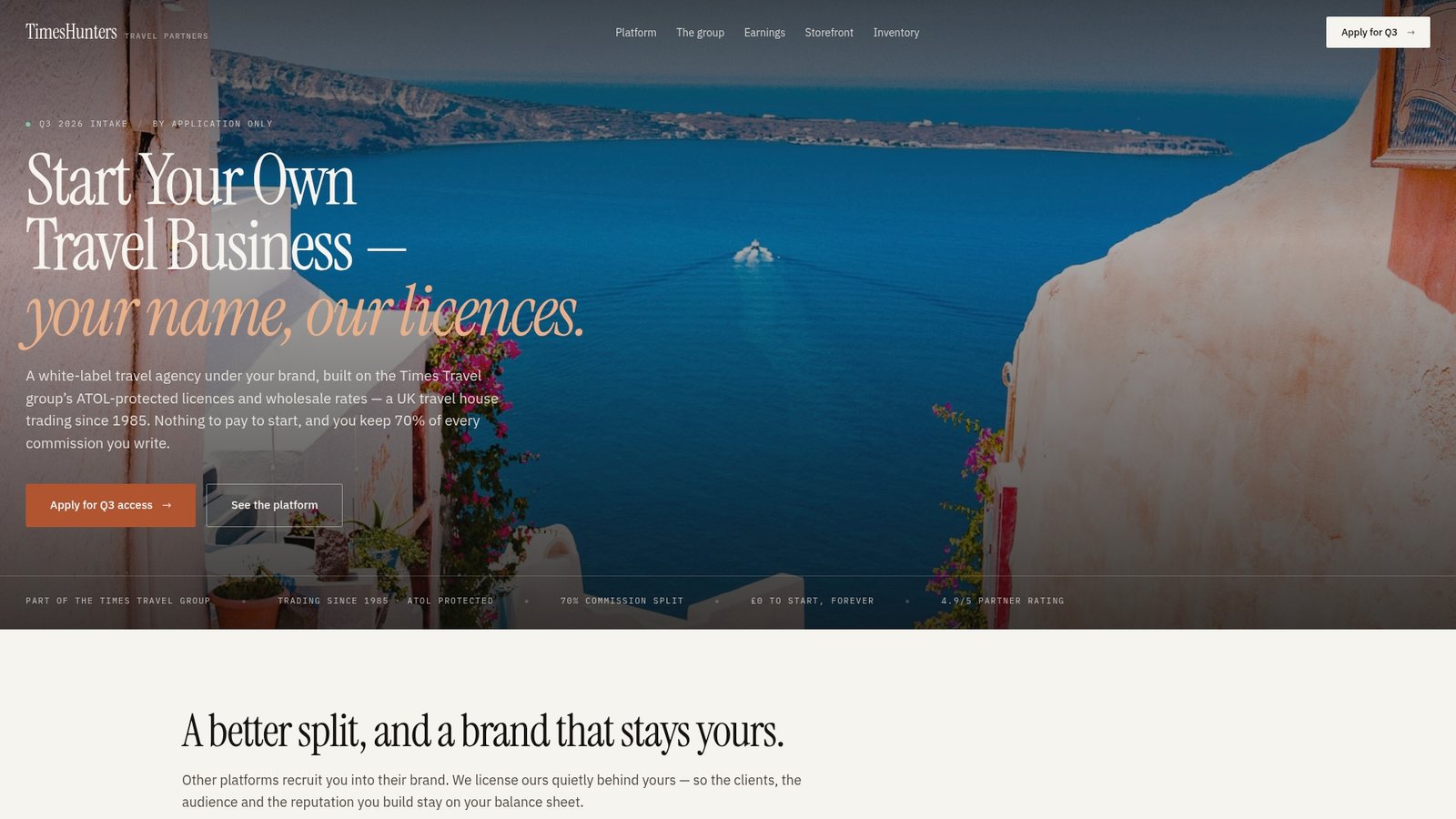
This suits anyone who already has a sales channel, an audience, a hospitality client base, a professional network, and wants to convert it into travel income without building booking infrastructure or chasing accreditation from scratch. Wholesale hotel, cruise and tour access, automated booking management, and instant pricing proposals come built into the platform, so the first booking can happen in weeks rather than months.
If the retained-revenue maths in this guide has you rethinking which model actually pays, explore the Timeshunters partner platform and see what a first branded booking site could look like under your own name.
Sources
For a deeper technical breakdown of how payment flows and merchant-of-record responsibilities differ, AltexSoft’s explainer on the agency model is a solid starting point. Wikipedia’s overview of travel agency business models covers the historical commission-to-fee revenue split in more detail. For financial modelling specifics, including tab structures and retained-revenue calculations, FinancialModelsLab’s guidance is worth working through line by line. UK founders should check current statutory guidance on legislation.gov.uk directly before finalising any licensing decision. Those exploring alternative commission structures outside travel may also find this piece on royalty-based revenue models a useful cross-industry comparison.