
Five Step Onboarding for UK Travel Agencies: ATOL, ABTA & White-Label
A five step onboarding playbook for UK travel agencies to automate confirmations, satisfy ATOL and ABTA rules, and keep clients prepared.

Run this exact sequence the moment a booking lands: confirmation, welcome email, intake questionnaire, service agreement, pre-travel reminder. It compresses admin, cuts avoidable client queries, and gets ATOL and ABTA obligations handled before they become a problem. Skip a step and you’re the agency chasing a client for passport details three days before departure.
TL;DR:
- Implementing a five-step onboarding process ensures clients receive timely confirmation, clear communication, and all necessary travel documents before departure.
- Including passport expiry, visa status, health needs, and supplier preferences in intake questionnaires helps prevent last-minute surprises and compliance issues.
- ATOL certificates must be issued immediately upon receiving the first payment, with agency agreements and proper fund separation aligned with regulatory standards.
- Automating routine steps like confirmation emails, reminders, and document checks improves efficiency while maintaining a personalized client experience.
- Tracking key metrics such as questionnaire completion rates and early satisfaction scores helps maintain onboarding effectiveness and encourages client retention.
Table of Contents
- What is client onboarding for a travel agency, exactly?
- Building the client welcome pack and intake questionnaire
- Getting ATOL, agency agreements and ABTA rules right
- Automating onboarding without losing the personal touch
- Tracking onboarding success and staying in touch afterwards
- Why onboarding is a revenue lever, not paperwork
- Three lessons from scaling this properly
- Run this sequence without building it yourself
- Sources
- FAQ
What is client onboarding for a travel agency, exactly?
Client onboarding is the sequence of communications and documents that take a traveller from “booking confirmed” to “fully prepared and reassured” before they set off. Get it wrong and you inherit a stream of late-stage phone calls asking questions you should have answered in week one. Get it right, and the client onboarding process becomes the moment that actually earns repeat business and referrals, not just a box you tick after taking payment.
Most agencies treat onboarding as an afterthought to the sale. That’s backwards. The booking confirmation is the start of the relationship, not the end of the transaction, and the five steps below turn that relationship into something structured rather than reactive.
The five-step sequence in detail
- Booking and payment confirmation (immediate). Send this the moment payment clears. Include travel dates, a clear payment receipt showing exactly what’s been paid and what’s outstanding, and the client’s next actions. If the booking is a flight-inclusive or licensable package, this is also the trigger point for your ATOL certificate obligation, which cannot wait.
- Welcome email within one day. This sets tone and expectations. State what happens next, roughly when documents will arrive, and link directly to your intake questionnaire. Vague reassurance (“we’ll be in touch”) does more harm than a specific commitment (“your travel documents arrive within five working days”).
- Intake questionnaire. Sent alongside or immediately after the welcome email, this is where you collect the operational detail that prevents last-minute scrambling.
- Service agreement or terms for bespoke or ongoing work. Required whenever you’re doing more than a straightforward package sale, such as multi-stop itineraries, ongoing account management, or corporate travel.
- Pre-travel reminders, timed at 7 to 14 days out and again at 48 to 72 hours before departure.
Fields that belong on every intake questionnaire include passport details and expiry dates, visa requirements for the destination, health or accessibility needs, an emergency contact, dietary requirements, and any supplier preferences (airline seating, cabin category, hotel room type). Miss the passport expiry field and you’ll find out about it at check-in, which is the worst possible moment.
Your service agreement, where one applies, should cover scope of work, fee structure, cancellation terms, and a clear complaints route. Clients rarely read a wall of text, so keep it to the sections that actually protect both parties.
Pre-travel reminders do double duty: reconfirming logistics and reducing your own support burden. A 7 to 14 day reminder should reconfirm passport validity, any outstanding balance, and visa status. The 48 to 72 hour message should include supplier contact details (hotel front desk, transfer company, tour operator), so the client isn’t calling you from an airport queue.
Pro Tip: Build your welcome email as a template with variable fields for destination, dates and supplier names, rather than writing it fresh each time. Consistency here matters more than creativity; clients remember clarity, not flourish.
A well-run onboarding checklist doesn’t need to feel like paperwork. Sequencing these five steps with defined ownership, who sends what, and by when, is what separates a travel agency onboarding checklist that actually gets followed from one that lives in a folder nobody opens.

Building the client welcome pack and intake questionnaire
A welcome pack that just says “thanks for booking with us” wastes an opportunity. The version that works reads like a short reference document the client will actually keep open on their phone during the trip.
Welcome pack contents:
- Itinerary summary with dates, confirmation numbers and supplier names
- A short note on financial protection, including ATOL status where applicable
- Emergency contact details, including your after-hours line if you offer one
- Supplier names and a summary of relevant booking conditions
- A prompt to arrange or confirm travel insurance
The intake questionnaire deserves the same structure. Group fields logically so the client isn’t jumping between unrelated topics:
- Personal details: full legal name (matching passport), date of birth, nationality
- Travel documents: passport number and expiry, visa status for the destination
- Health and accessibility: mobility needs, allergies, medical conditions relevant to travel
- Special requests: celebrations, dietary needs, seating or room preferences
- Loyalty programmes: frequent-flyer and hotel loyalty numbers
- Payment preferences: preferred method and billing contact if different from traveller
Health and accessibility fields need careful handling. ICO guidance for small organisations is specific about this: agencies must explain why data is being collected, who it will be shared with, and how long it’s retained, and sensitive categories like health information warrant narrower consent and shorter retention than general contact details.
Pro Tip: Add a one-line consent statement directly above the health and accessibility section of your questionnaire, separate from your general privacy notice. Clients are far more likely to disclose relevant conditions when they can see exactly why you’re asking.
Keep retention periods proportionate. There’s no defensible reason to hold a client’s passport number two years after a completed trip if there’s no ongoing relationship. A simple retention rule, delete or archive sensitive fields 12 months after travel unless the client remains active, keeps you compliant without needing a data-protection officer on staff.
Getting ATOL, agency agreements and ABTA rules right
This is the section that separates a professional operation from one that’s one complaint away from a regulatory headache. None of it is optional, and none of it is complicated once it’s built into your sequence rather than remembered on an ad hoc basis.
ATOL certificates, where the booking is flight-inclusive or otherwise licensable, must be issued the moment you take the first payment, not the final balance, the first payment. The CAA’s standard terms require the certificate to include:
- Lead passenger name
- Total price of the booking
- A unique reference number
- Issuer name and ATOL number
Delivery can be by email or post, and this applies even when payment is taken by card over the phone with no client physically present, the certificate rules make clear that “immediate” means immediate, not “when convenient”.
If you’re selling on behalf of an ATOL holder rather than holding the licence yourself, you need a written agency agreement that spells out how certificates get issued and, critically, your receipts must clearly separate protected funds from non-protected money. The CAA’s guidance on agents treats this as a core legal obligation, and any booking fee you charge on top must be itemised separately, not folded into the headline price.
A missing schedule of terms in an agency agreement, or a receipt that doesn’t distinguish protected from non-protected funds, is one of the most common compliance gaps regulators flag in agent arrangements.
ABTA members carry their own communication standards that should shape your onboarding timelines regardless of whether a client has complained about anything yet. The ABTA Code of Conduct requires acknowledgement of correspondence within 14 days and a detailed reply within 28 days, alongside clear pre-booking information covering visa advice, health requirements and insurance suitability.
Build these deadlines into your CRM as hard triggers, not something a team member remembers to check. And where a booking issue looks like it might escalate, engage your insurer or broker early rather than waiting for a formal complaint; most policies expect early notification, and brokers can help draft the response before things go legal.
Automating onboarding without losing the personal touch
The tension every growing agency runs into: manual onboarding feels personal but doesn’t scale, and automated onboarding scales but risks feeling generic. The fix isn’t choosing one over the other, it’s automating the repetitive mechanics while keeping human judgement on anything that touches the client relationship directly.
Workflows worth automating:
- Instant booking confirmation paired with automatic document dispatch (ATOL certificate, receipt, itinerary)
- Scheduled reminders when an intake questionnaire hasn’t been completed within 48 hours
- Supplier-document checks that flag missing visa or health requirements before departure
- Pre-travel briefing emails triggered by date, not manual calendar-watching
- Internal task creation the moment a special request (accessibility, dietary, celebration) appears on an intake form
The tool categories behind this are familiar to anyone who’s run a small service business: a CRM to hold client records and trigger sequences, a booking engine to manage inventory and confirmations, a form or consent tool for intake and privacy notices, a document generator for certificates and itineraries, e-signature for service agreements, and payment processing that produces clean, itemised receipts.
A simple data flow looks like this: booking lands in the CRM, the system auto-generates the ATOL certificate and confirmation, the intake form goes out on a timer, and any flagged special requirement (accessibility need, complex visa situation) automatically creates a task for a human to review, rather than getting buried in an inbox.
| Automated step | Trigger | Manual oversight needed |
|---|---|---|
| Booking confirmation + ATOL certificate | Payment received | Verify certificate fields before first use of template |
| Intake questionnaire dispatch | Booking confirmed | None, unless form incomplete after 48 hours |
| Supplier-document check | Data submitted | Review flagged visa/health items |
| Pre-travel briefing | 7 to 14 days before travel | Confirm supplier details are current |
| Special-request task | Form field completed | Human follow-up required |
None of this removes the need for a proper privacy notice. Passport numbers and health data sitting in an automated pipeline still fall under the same ICO obligations around purpose, sharing and retention, automation just means those rules need to be built into the system design rather than remembered case by case.
Tracking onboarding success and staying in touch afterwards
Four numbers tell you whether onboarding is actually working: time-to-first-confirmation, questionnaire completion rate, ATOL-issue lag, and an early satisfaction score gathered shortly after the welcome sequence completes.
- Time-to-first-confirmation: aim for same-day. Anything slower and clients start wondering if the payment went through.
- Questionnaire completion rate: if it’s consistently under 70%, the form is too long or asked at the wrong moment, shorten it or move it earlier.
- ATOL-issue lag: this should be zero. Any delay here is a compliance risk, not just a service one.
- Early satisfaction score: a single follow-up question (“How confident do you feel about your trip so far?”) sent a few days after intake, low scores flag clients who need a proactive call before small doubts become cancellation requests.
For ongoing retention, a simple cadence works well: a check-in at 30 days for anything with a longer lead time, and a follow-up within a week of return asking for feedback and, where the trip went well, a referral. Keep the ask specific, “Do you know anyone travelling somewhere similar this year?” performs better than a generic review request.
Why onboarding is a revenue lever, not paperwork
Onboarding done properly is a premium advisory moment, not admin. Clients pay for confidence, and a structured welcome sequence justifies planning fees while cutting the scope creep that eats margins. A white-label platform can automate the mechanical parts, ATOL handling, branded welcome packs, scheduled reminders, while the agency keeps full ownership of the client relationship and brand.
Three lessons from scaling this properly
Automate the highest-friction touchpoint first, usually document dispatch, not the last one. Treat onboarding as both compliance and monetisation: a well-timed reminder sequence sells add-ons as often as it prevents complaints. And test small: changing one line in a welcome email’s subject or timing is enough to move completion rates, so measure before assuming your current sequence is optimal.
— Sam
Run this sequence without building it yourself
There are other ways to get this right: hire an ops person to manage the admin manually, or piece together separate tools for confirmations, e-signatures and reminders yourself. Both work, but both cost time you could spend on client relationships instead. Timeshunters gives you a white-label travel agency platform built around exactly this sequence, automated booking confirmations, ATOL certificate support, branded welcome packs and scheduled pre-travel reminders, all running under your own name.
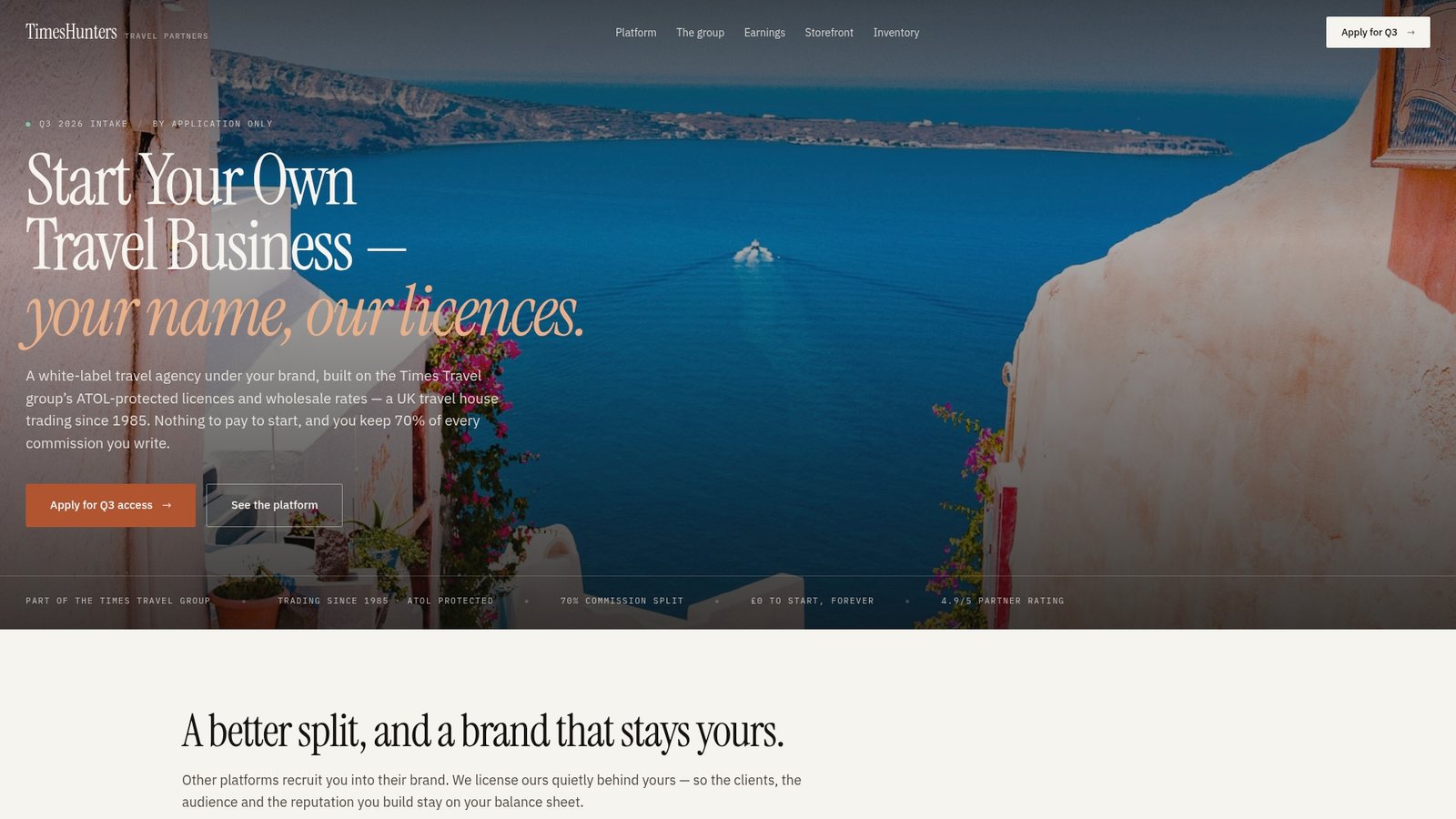
You keep the client list, the brand and the relationship. Compliance and document mechanics are handled behind the scenes, typically backed by ATOL-protected licensing and wholesale rates across hotels, cruises, tours, villas, safari camps and rail. Visit the Timeshunters platform to see how the onboarding sequence in this article runs automatically from your first booking.
Sources
- ATOL compliance: complying with the ATOL standard terms
- ABTA Code of Conduct (July 2024)
- ICO guidance: getting started with data protection
FAQ
What is meant by client onboarding?
Client onboarding is the structured sequence of communications, documents and confirmations that take a customer from booking to being fully prepared for their trip. For a travel agency, that means confirmation, a welcome email, an intake questionnaire, any required service agreement, and pre-travel reminders, done with regulatory obligations like ATOL certificates built in rather than bolted on afterwards.
How do I get clients for my travel agency?
Referrals from well-onboarded existing clients are consistently one of the strongest sources for independent agencies, which is exactly why a smooth onboarding experience matters beyond the first booking. Building a personal brand and niche focus, paired with a platform that handles the back-end compliance and document work, lets you spend the time you’d otherwise lose to admin on the relationships that generate repeat bookings and referrals.
What are some good questions for travel agents to ask clients?
Beyond passport and visa details, ask about health or accessibility needs, dietary requirements, loyalty programme numbers, and specific preferences around seating, room type or pace of travel. Asking about past trip experiences, what worked and what didn’t, often surfaces preferences a standard form field would miss entirely.
How do I market myself as a travel agent?
Consistent, specific communication during onboarding, rather than vague reassurance, is one of the more overlooked marketing tools available to independent agents, because a client who felt genuinely looked after during booking is far more likely to recommend you by name. Platforms like Timeshunters also let you build and market under your own brand while operating on ATOL-protected infrastructure, so your marketing effort builds equity in your name rather than someone else’s.
Do I need a written agreement to sell as an agent for an ATOL holder?
Yes. Anyone selling on behalf of an ATOL holder needs a written agency agreement covering how ATOL certificates are issued and how protected funds are identified on receipts. This isn’t optional paperwork, it’s a core legal requirement of the agent relationship.