
Recurring Revenue in Travel: How Independent Agents Build It
How to build recurring revenue in a travel business: repeat clients, retainers, memberships and the UK rules to follow, with a model built on 70% commission.

Recurring revenue in travel means income you can predict because customers come back or pay on a schedule, instead of income that restarts at zero after every holiday. For an independent agent, the most practical route is to keep your own client list, earn a high share of each booking, and add repeat trips, planning fees or a membership on top. Below, we set out how each option works, what UK rules apply and what to get right before you launch.
TL;DR
- Recurring revenue in travel comes from three places: repeat bookings from clients you own, fixed fees or retainers for services, and memberships or subscriptions.
- Most independent agents start with the first: a branded business, a client list and a high commission share on every booking.
- Subscription-style offers in the UK fall under consumer subscription duties in the Digital Markets, Competition and Consumers Act 2024, including cooling-off rights.
- Profit depends on unit economics (acquisition cost, lifetime value, retention and cost to serve), not on the headline monthly figure.
- Define exactly what a member gets before you sell it, and automate billing, reminders and follow-up from day one.
Table of Contents
- What recurring revenue means in a travel business
- Why commission alone leaves money on the table
- Ways to build recurring revenue, compared
- Subscription travel services: what members get
- Does the market want it?
- Working out whether it pays
- Our perspective
- UK rules to know before you charge on a schedule
- Operational pitfalls to plan for
- Attracting and keeping members
- A sensible order of play
- Start your own branded agency
- FAQ
- Sources
What recurring revenue means in a travel business
A typical agent earns commission on a booking, then starts again looking for the next customer. Recurring revenue changes that pattern. It is income that repeats without you having to win the customer again from scratch.
In travel it takes three forms:
- Repeat commission. The same client books a summer holiday, a winter city break and a cruise over several years. Each booking is still a separate sale, but the relationship is yours, so the flow is dependable.
- Fees and retainers. The client pays for your time or access: a planning fee, an annual concierge arrangement, or a fixed monthly retainer for a business that needs travel handled. Corporate travel management companies already use subscription fees as a retainer model, likened to a contract with fixed regular pricing in exchange for agreed service levels.
- Memberships and subscriptions. A customer pays monthly or annually for ongoing benefits: curated deals, priority service, trip planning, perks.
The difference from one-off commission is predictability. You can forecast next quarter from clients you already have, rather than from leads you hope to convert.
Why commission alone leaves money on the table
The 2025 industry debate in the trade press is that commission on its own can be fragile. Travel Weekly’s in-depth piece argues that supplier commission margins can shrink and that service work often carries on during disruption, so agencies may add planning fees, retainers, loyalty programmes and premium services.
The answer is not to abandon commission. It is to make sure each booking earns as much as possible and that every client becomes a long-term relationship. Two levers matter most:
- The share you keep. On a white-label model like ours, partners receive 70% of commission on bookings, against the 4% that online travel agencies typically offer. A larger share per booking makes every repeat client worth much more.
- The list you own. Your clients know your name, not a platform’s. When your brand is on the relationship, rebooking is far easier.
If you are working out how the numbers fit together, our guide to the travel agency business model and the cost playbook for UK home agents show the arithmetic.
Ways to build recurring revenue, compared
| Approach | How you earn | What the client pays for | Best suited to |
|---|---|---|---|
| Repeat bookings | Commission on each trip | Holidays, cruises, tours, villas | Anyone starting out with a personal audience |
| Planning or retainer fee | Fixed fee, monthly or per trip | Your time and expertise | Agents with complex or high-value clients |
| Membership or subscription | Monthly or annual dues | Ongoing perks, access, service | Agents with a loyal, engaged community |
| Corporate or group accounts | Retainer plus bookings | Managed travel for a business | Agents with business contacts |
| Referral and loyalty | Commission from referred clients | Rewards for introductions | Agents with strong word of mouth |
Most agents combine two or three. Vibe Systems, a travel-technology firm, notes that subscription models may earn from fees, exclusive offers, concierge services, commissions or margins, and sometimes a mix. The commercial answer depends on what the membership includes and whether you still earn on bookings.
Subscription travel services: what members get
When readers search for subscription travel services, they usually mean one of three things: a club that unlocks discounted rates, a concierge-style service, or a prepaid scheme for future trips. At the premium end, some memberships fold nightly rates, taxes and fees into monthly dues, giving a predictable all-inclusive cost.
For an independent agent, the sensible version is smaller and more personal. A membership might include:
- A yearly trip-planning session and a shortlist of options matched to the member’s preferences
- Early sight of offers on hotels, cruises or tours before they are widely promoted
- Priority contact when plans change
- Practical extras that make a trip smoother, such as advice on connectivity, for example a SIM card in Kraków for a city break
Note the keyword is included. The more clearly you list what a member receives, the fewer disputes you face later. Altexsoft’s analysis of travel subscriptions warns that “unlimited” promises are rarely truly unlimited, and that restrictive booking conditions can damage trust. Say what is in and what is out, in plain words.
Does the market want it?
There is encouraging evidence on demand. UK data reported in 2023 indicated that 90% of travel subscribers planned to increase or maintain their subscription levels, and travel was the product category most likely to gain new subscribers.
Skift Research makes a related point: the industry has historically struggled to convert unpaid loyalty tools into paid subscriptions, yet the blending of work and leisure travel makes the current environment favourable for recurring revenue growth. It also finds that businesses attract and keep subscribers by offering personalised value, access to non-public deals and seamless, automated billing, then using ongoing engagement to keep recommendations relevant.
That is a natural fit for a small, personal agency. A large platform cannot know that a client always travels in the first week of June and prefers a balcony. You can.
Working out whether it pays
A monthly figure looks reassuring, but it does not prove profit. UK accountancy guidance says subscription profitability depends on unit economics: customer acquisition cost, lifetime value, payback period, retention and the cost of serving subscribers.
Applied to a travel agent, ask these questions before you launch anything:
- What does it cost to win one member? Include your time, any advertising and content creation.
- How long do members stay? A membership that lasts three years is worth far more than one that lapses after the first trip.
- What does each member cost to serve? Planning calls, amendments and out-of-hours messages all take time.
- Do you still earn commission on bookings? If so, dues are a bonus on top of booking income, not a replacement for it.
A simple worked example, with invented numbers for illustration only: if you spend 10 hours a year serving a member and charge them a fee that works out at less than a sensible hourly rate for that time, the membership loses money however many people join. Price on the hours, not on the hope.
Our perspective
We built TimesHunters around one belief: an independent agent should own the client relationship, and be paid properly for it.
Recurring revenue in travel starts there. Before any membership or retainer, you need a brand people recognise, a client list that belongs to you and a commission share that makes every repeat booking worth the effort. Partners on our platform receive 70% commission, and the licence’s branding is invisible to end clients, so your clients see you.
We would add the practical point most guides skip: recurring income is mostly a service problem. Automated booking management, instant pricing proposals and automated client follow-up are what let one person look after a growing list without it taking over their week. That is the infrastructure we provide, alongside ATOL-protected licences and wholesale access to hotels, cruises, tours and more.
Start with repeat clients. Layer on fees or a membership once you know what your best clients value.
Sam
UK rules to know before you charge on a schedule
This is where small businesses most often go wrong. Selling anything that renews automatically brings legal duties, so check the current text and take advice from a solicitor or trading standards adviser before you launch.
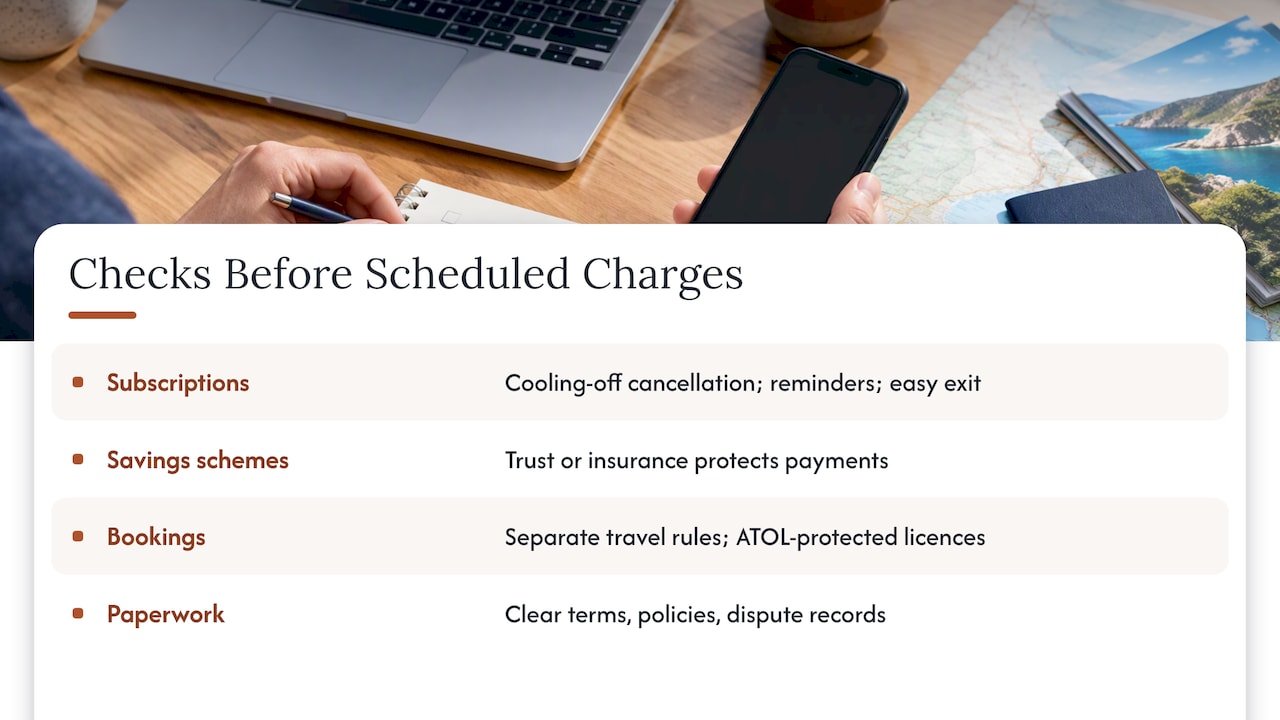
Subscription contracts. The Digital Markets, Competition and Consumers Act 2024 puts duties on traders in relation to subscription contracts and gives consumers rights if those duties are breached, including the right to cancel during cooling-off periods. The government’s reform proposals pointed in the same direction: clearer pre-contract information, renewal reminders and an easy exit. Build these into your sign-up flow now, rather than retrofitting them.
Savings schemes. If you take regular payments from a customer towards a future holiday, the same Act requires traders entering a consumer savings scheme contract to protect those payments through a trust or insurance against the trader’s insolvency. Do not run a pay-as-you-go holiday fund without confirming how it must be protected.
Booking protection. Bookings themselves sit under separate travel rules. Our platform provides ATOL-protected licences, managed payments and financial protection for the bookings you make. Anything you add on top, such as a membership, needs its own terms.
Your own paperwork. Clear terms are part of the job. Our guides to a travel agency cancellation policy and to winning travel chargebacks cover the policies and records that protect you when a client disputes a charge.
Operational pitfalls to plan for
The British business travel trade body’s baseline guidance gives a useful discipline for small businesses: define the included services, set realistic commitments and tolerances, and review them regularly. Underestimate usage and you may be stuck renegotiating, with no refunds or reconciliation. It also stresses that scope matters: whether 24-hour support or account management is included should be settled in writing.
A short checklist:
- Write the scope. Name every service in the membership and what falls outside it.
- Set limits you can honour. If you offer unlimited planning advice, define what counts as a reasonable request.
- Automate billing and reminders. Missed renewal notices are the commonest way to fall foul of subscription rules and annoy customers.
- Track retention. Vibe Systems makes the point that moving to subscription economics does not change booking technology much; the real change is showing members their value and measuring who stays.
- Keep service levels steady. The business travel body’s experts observe that subscription models are harder to sell than transactional fees, but they can work well when structured clearly. The same applies to consumers: a clear promise is easier to sell and to keep.
Attracting and keeping members
Acquisition is easier when you already have an audience. Our guides on selling travel to clients and on monetising a travel audience through a compliant agent explain how to turn followers and contacts into paying clients.
Retention comes from relevance. Practical habits that help:
- Send timely suggestions. If a client always cruises in autumn, send options in spring, not after they have booked elsewhere.
- Use booking history. Note preferences, anniversaries and travelling companions, then reflect them in every proposal.
- Offer something they cannot get easily elsewhere. Access to wholesale rates and a person who knows their taste is hard for a comparison site to copy.
- Follow up after every trip. A short message asking how it went is the cheapest rebooking tool there is.
Caravelo argues that subscriptions help agencies remove the need for customers to go searching, creating a passive, recurring purchase habit. You do not need a formal subscription to get part of that effect: if clients know that you will come to them with the right option, they stop shopping around.
A sensible order of play
- Launch your brand and win your first clients. Focus on bookings where you earn a strong commission share.
- Collect data. Note what each client books, when and why.
- Build the follow-up habit. Automated reminders and proposals keep you in front of past clients.
- Test a small paid offer. An annual planning session is easier to price and deliver than a full membership.
- Formalise. Once clients ask for more, write the terms, check the legal duties and move to monthly or annual dues.
Setup time matters here. Our onboarding and support programme is designed to take you from sign-up to launch in a structured way, so you spend less time on admin and more time with clients.
Start your own branded agency
If your goal is income that builds over time, the foundation is a business you own. TimesHunters gives you a white-label travel agency under your own name, run on ATOL-protected licences, with a branded booking site, instant pricing proposals, automated client follow-up and managed payments. Partners receive 70% commission, we keep a 30% split, and there is no cost to start.
See how it works on our white-label travel agency page, or begin at timeshunters.com.
FAQ
Can a small travel agent really earn recurring revenue?
Yes, usually in stages. Start with repeat bookings from clients you own, then add a planning fee or a membership once you know what your clients value. Treat dues as an addition to commission, not a replacement for it.
What do subscription travel services usually include?
They range from discounted-rate clubs to concierge-style services and all-inclusive premium memberships. For a small agent, a clear bundle of planning time, early access to offers and priority support is the realistic version. List every inclusion and exclusion in writing.
Do UK subscription rules apply to a travel membership?
If customers pay on a recurring basis, the subscription duties in the Digital Markets, Competition and Consumers Act 2024 are likely to be relevant, including cooling-off rights. Regular payments towards a future holiday may count as a savings scheme needing insolvency protection. Take professional advice before launching.
Is recurring revenue better than commission?
They work together. Commission pays for each booking, and recurring income gives you a more predictable base. A high commission share, such as the 70% our partners receive, makes each repeat booking more valuable.
Sources
- Digital Markets, Competition and Consumers Act 2024
- Consumer subscriptions regulatory reform proposals
- Time for Change, Business Travel Association
- Guidance on baseline standards, Business Travel Association
- Is the commission-only model obsolete?, Travel Weekly
- Subscriptions and Memberships in Travel 2022, Skift Research
- Travel subscription services and whether they save money, Condé Nast Traveler
- Subscription shopping services survey, Marketing Tech News
- The Complete Guide to Subscription Business Profitability, Double Point