
Launch Compliantly: UK Travel Agency Onboarding With a White Label Host
A practical UK playbook for travel agency onboarding under a white label ATOL host. Step-by-step compliance checks, test bookings, payment setup, and a...

Travel agency onboarding, in the sense that matters once you’ve decided to launch, means getting your account, compliance paperwork and booking systems live under an ATOL host before you take a single payment. The single most important first move is securing a signed, compliant agency agreement and proving your ATOL certificate issuance works end to end. Platforms such as TimesHunters package this setup so you can reach that point quickly, but the checks below are yours to run regardless of which host you choose.
TL;DR:
- Ensuring certification flow, compliance paperwork, and payment reconciliation are thoroughly tested before accepting real client payments is crucial to avoid regulatory issues.
- A signed, signed, and fully checked agency agreement, along with an immediate ATOL certificate issuance for each payment, are mandatory legal requirements.
- Clarifying commission rates, VAT schemes, and payment flows before the first booking prevents accounting errors and client disputes later on.
- Platforms should automatically generate correct ATOL certificates and receipts, with comprehensive back-office processes for refunds and amendments in place.
- Maintaining compliance through regular internal audits, document retention, and clear dispute procedures reduces the risk of breaches and enhances client trust.
Table of Contents
- Your onboarding checklist from sign-up to first booking
- The legal obligations you cannot skip during onboarding
- Commission, payments and the VAT questions you need answered early
- Setting up your booking site, systems and certificate flow
- Finding your first clients without breaking data protection rules
- Testing, training and a realistic go-live timeline
- What a white-label host adds to onboarding, and TimesHunters’ own figures
- Contract termination and renewal: what to check before you sign
- Keeping your compliance tight once you’re live
- Connecting to global distribution systems
- Setting customer service standards from day one
- Managing risk and understanding where liability sits
- How to start with TimesHunters
- Common pitfalls new partner agents overlook
- FAQ
- Sources
Your onboarding checklist from sign-up to first booking
Onboarding has a fixed order. Skip a step and you risk taking client money before your compliance paperwork can back it up.
- Confirm your business identity: trading name, proof of identity and VAT status if you’re registered.
- Receive the written agency agreement, check the Schedule of Terms is attached, then sign and date it.
- Set up your branded booking site, including the disclosures and receipt layout your agreement requires.
- Agree payment handling and trust account protocols with your host, then test a payment and reconciliation cycle.
- Complete booking management training and test your ATOL certificate templates before going live.
- Run a simulated first booking against your full checklist to confirm everything works before accepting real payments.
Each step produces a document or a test result you can point to later if a client, your host or the regulator asks how a booking was handled. Treat the simulated booking as non-negotiable: it’s the only way to catch a broken certificate flow before a paying customer does.
The legal obligations you cannot skip during onboarding
ATOL compliance isn’t a box you tick once. It governs how you’re allowed to sell, what your receipts must say and who answers for a booking if something goes wrong.
- You need a written agency agreement with your ATOL holder that includes the CAA Schedule of Terms, dated and signed before you sell anything.
- An ATOL Certificate must be issued immediately when a consumer makes their first payment, and the certificate should name the business the consumer is actually dealing with as the issuer.
- Receipts must clearly separate ATOL-protected money from money that isn’t protected, with any booking fee shown as its own line.
- Your ATOL holder carries primary liability for licensable bookings, but your agency agreement defines your own authority and your exposure if a consumer complaint lands on your desk.
None of this is paperwork for its own sake. A delayed certificate or a receipt that doesn’t distinguish protected funds is the kind of failure that turns into a CAA enquiry, not just an awkward email. Agents who review their agreement properly, rather than skimming the signature page, usually understand these obligations before they matter rather than after.
Commission, payments and the VAT questions you need answered early
Your commercial terms shape your accounting from day one, so get them in writing before you sell.
- Work out whether the tour operators’ margin scheme applies to how you sell, since TOMS changes how VAT is accounted for versus standard commission VAT.
- If you’re unsure which treatment applies, contact HMRC’s VAT helpline with your contracts and booking terms rather than guessing.
- Agree practical payment flows: who takes the card payment, how protected funds are logged, and what reconciliation documentation you’ll produce.
- Collect the paperwork you’ll need ongoing: bank details, any self-billing or invoicing agreement, and a template for commission statements.
Getting this settled before your first booking avoids a scramble later when a client payment lands and nobody’s sure which account it belongs in.
Setting up your booking site, systems and certificate flow
Your technical setup has to produce the right paperwork automatically, every time, not just when someone remembers to check.
- Your branded booking site needs to show clearly who the consumer is dealing with, since that business is usually the one recorded as the ATOL certificate issuer.
- Enable booking management features that matter from day one: automated confirmations, booking reference capture, and exportable reports for reconciliation.
- Test every ATOL certificate path your host offers, whether you issue it yourself, your host issues it on your behalf, or it runs through an integration, before a real client pays.
- Set up back-office processes for refunds, amendments and record retention so a cancelled booking doesn’t fall through a gap.
A platform that automates certificate delivery at the point of payment removes most of the risk here, but the test run is still yours to run.
Finding your first clients without breaking data protection rules
New agents often buy or license contact lists to get moving faster, and that’s where most early compliance mistakes happen.
- Check provenance, consent and suppression records on any list you buy or license, in line with ICO guidance on lead sourcing.
- Keep your privacy notice and marketing consent wording current across every channel you use, since PECR rules cover email, SMS and calls differently.
- Build early demand through referral partnerships, content aimed at a niche audience, and visible social proof rather than relying only on bought lists.
- Log what due diligence you did on any external marketing service, so you can show your working if a complaint arrives.
Testing, training and a realistic go-live timeline
Most new agents underestimate how much testing sits between a signed contract and a safe first sale.
- Expect roughly this sequence: agreement signed, booking site live, a round of test bookings, then your first live booking.
- Before go-live, issue a test ATOL certificate at the point of payment, check your receipt layout separates protected and non-protected funds correctly, and simulate a refund and a chargeback.
- Know in advance who to contact at your host and, if needed, at the CAA, and keep a written escalation route for consumer claims.
Treat this timeline as a gate, not a guideline. An agent who rushes past the test-booking stage is the one who discovers a broken certificate flow from an angry client rather than a dry run.
What a white-label host adds to onboarding, and TimesHunters’ own figures
A white-label host exists to take the infrastructure problem off your plate: ATOL access, wholesale rates across hotels, cruises, tours, villas, safari camps and rail, and automated booking management rather than a spreadsheet you built yourself.
TimesHunters states a 70% commission split on partner bookings, well above the roughly 4% typical of online travel agency affiliate schemes, and cites one partner reporting income rising from £400 to £1,200 per booking. These are the host’s own figures, offered as a benchmark for what a well-run white-label setup can produce rather than a guarantee. Managed certificate flows, training and automated reconciliation are the operational pieces that let a new agent reach that kind of outcome without building compliance infrastructure from scratch.
Contract termination and renewal: what to check before you sign
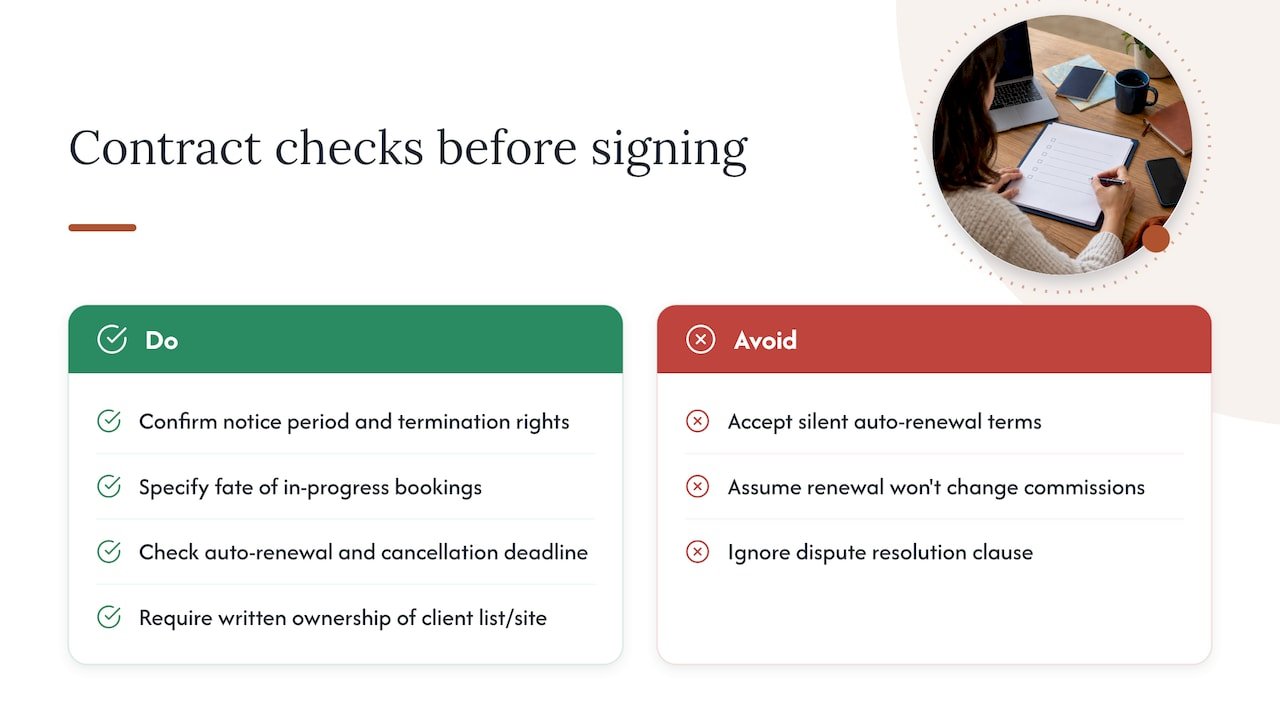
Every agency agreement should spell out how it ends, not just how it starts. Look for the notice period required to terminate, whether either side needs cause or can walk away without one, and what happens to client bookings already in progress if the relationship ends mid-contract.
Renewal terms matter just as much. Some agreements auto-renew unless you cancel by a set date, which can trap you in terms you’d rather renegotiate. Check whether commission rates, trust account arrangements or certificate issuance responsibilities can change at renewal, and whether you’d be notified in time to respond.
Ask specifically what happens to your client list and branded booking site if you leave. A host that treats your client relationships as yours to keep is a different proposition from one that treats them as platform assets, and that distinction should be in writing before you sign anything, not discovered later.
Finally, check the dispute process. A clause naming arbitration or a specific jurisdiction tells you how a disagreement over commission or liability would actually be resolved, rather than leaving it to guesswork if a dispute arises.
Keeping your compliance tight once you’re live
Onboarding gets you compliant on day one. Staying compliant is a separate, ongoing job.
Build a simple internal audit habit: check a sample of receipts each month to confirm protected and non-protected funds are still clearly separated, and that ATOL certificates were issued at the point of payment rather than days later. Most hosts, including those run on the Advantage Travel Partnership’s host agency model, expect agents to maintain their own records alongside whatever the host tracks centrally.
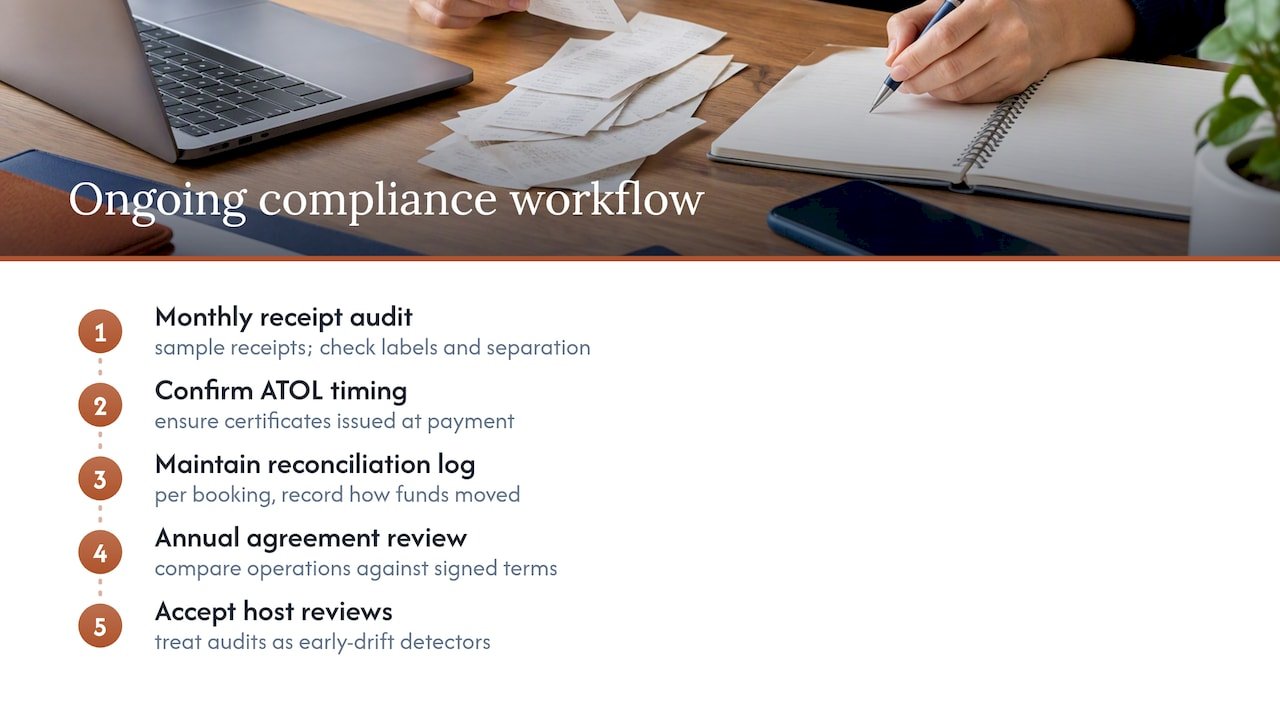
Keep a reconciliation log per booking showing how funds moved, since this is often the exact document the CAA requests when handling a consumer claim. Review your agency agreement annually against how you’re actually operating, since a process that drifted from the signed terms is a compliance gap waiting to surface.
If your host offers periodic reviews or audits of partner accounts, treat them as useful rather than intrusive. They catch the small drift, a mislabelled receipt here, a delayed certificate there, before it becomes a pattern serious enough to trigger a CAA enquiry.
Connecting to global distribution systems
Global distribution systems (GDS) give agents access to live flight, hotel and car hire inventory across multiple suppliers through a single interface, rather than booking each supplier separately. For a new partner agent, the practical question isn’t whether a GDS exists but whether your host’s platform connects to one on your behalf.
A white-label platform that includes GDS access removes a significant technical barrier: you’re not negotiating supplier contracts or building your own integration, you’re working through a booking interface your host has already connected. What you do need to check during onboarding is what inventory that connection actually covers, how pricing and availability refresh, and whether booking confirmations flow automatically into your reporting and reconciliation exports.
If your platform doesn’t offer direct GDS access, ask how it sources live inventory instead, since wholesale rates and real-time availability are only useful if they reach your branded booking site reliably.
Setting customer service standards from day one
Clients booking through a new, branded travel business expect the same responsiveness they’d get from an established agency, regardless of how new your operation is. Set clear internal standards before you take your first booking: a response time for enquiries, a process for handling amendments, and a defined escalation path for complaints that goes beyond “email the host and wait.”
Make sure every client-facing document, your booking confirmations, your ATOL certificates, your receipts, carries consistent branding and contact details so the client always knows who to approach. A tour operator’s cooperation and documentation page is a useful example of how clearly laid out customer documentation and privacy information can reduce confusion before it becomes a complaint.
Protocols matter most when something goes wrong: a cancelled flight, a hotel overbooking, a refund dispute. Decide in advance who handles each scenario, you or your host’s support team, so a client never gets conflicting answers from two parts of the same booking chain.
Managing risk and understanding where liability sits
Risk in this business concentrates around three points: client money, certificate issuance, and the gap between what your agency agreement says and what actually happens day to day.
Your ATOL holder carries primary liability for licensable bookings, but that doesn’t remove your own exposure. If you mishandle client funds, issue a certificate late, or misrepresent what’s protected on a receipt, you can still face a consumer claim or a compliance breach tied directly to your conduct, as the CAA’s guidance for agents makes clear.
Mitigate this with documentation, not hope. Keep every signed agreement, every test result from your onboarding checks, and every reconciliation log somewhere you can retrieve quickly. If a client dispute escalates, the agent who can show a clean paper trail is in a far stronger position than one relying on memory.
How to start with TimesHunters
TimesHunters gives you a route to ATOL-backed onboarding without building the compliance infrastructure yourself: a branded booking site, access to wholesale hotel, cruise, tour, villa, safari camp and rail inventory, managed payments, and automated certificate and booking management from the outset.
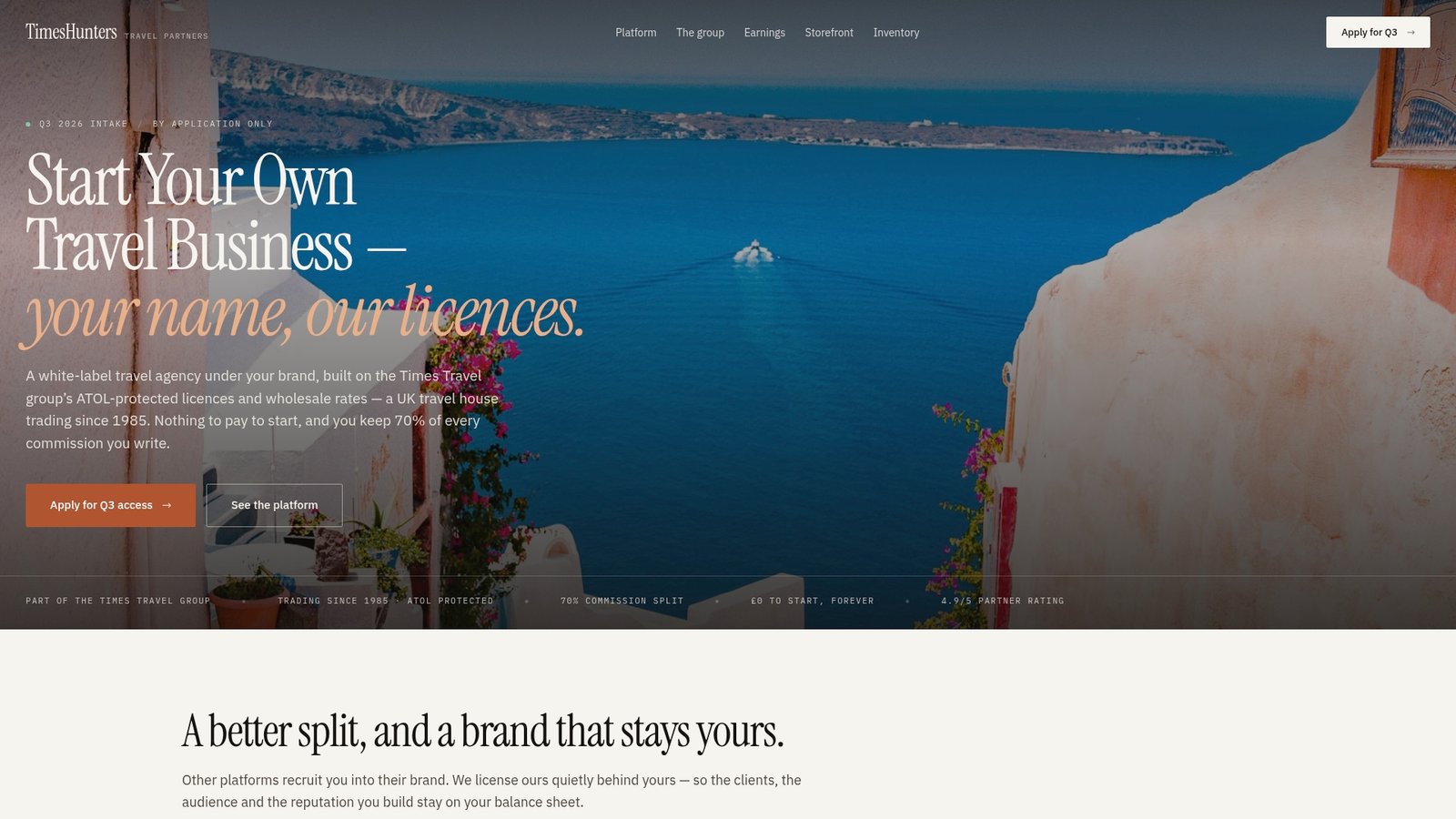
Before you enquire, have your business identity details and VAT status ready, since these shape your agency agreement from the first conversation. Visit the TimesHunters white-label platform to see the partner model and start the sign-up conversation. Legal and VAT questions specific to your situation are still worth independent advice, even though the host assists with the compliance groundwork.
Common pitfalls new partner agents overlook
Get the agency agreement and a tested ATOL certificate flow sorted before you touch marketing or take a single payment. Clear receipts and disciplined money handling prevent most consumer claims before they start. Treat your host as a compliance partner, and put every operational agreement in writing.
— Sam
FAQ
What does onboarding actually involve for a new travel agent?
It means setting up your account, business identity and payment flows under an ATOL host, signing a written agency agreement, and testing your branded booking site and certificate issuance before taking real client payments. The process typically runs from contract signature through test bookings to your first live sale.
Do I need my own ATOL licence to start a travel agency?
No, most new partner agents operate under a host’s existing ATOL licence through a signed agency agreement rather than obtaining their own licence. The CAA’s guidance for agents explains how that agreement allocates responsibility between the agent and the ATOL holder.
How much commission can I expect as a new partner agent?
Commission splits vary by host, and TimesHunters states a 70% commission on bookings compared with roughly 4% typical of online travel agency affiliate models. Your actual earnings depend on booking volume and the inventory you sell.
When do I need to worry about VAT and TOMS?
If you’re reselling travel as a principal or undisclosed agent, the tour operators’ margin scheme may apply and changes how VAT is accounted for. If you’re unsure which treatment fits your bookings, contact HMRC’s VAT helpline with your contracts before you finalise your pricing.
Is it legal to buy a contact list to find my first clients?
You can use bought or licensed contact lists, but you must check provenance, consent and suppression records first under ICO guidance on direct marketing. Skipping that due diligence risks a data protection breach before you’ve made a single sale.