
How to Increase Booking Margins in Your Travel Business
Learn how UK travel sellers increase booking margins: measure true margin, win better supplier terms, price fees openly, add extras and keep more commission.

You increase booking margins in travel by doing four things in order: measure the margin you really earn on each booking, raise the commission or discount you get from suppliers, add fees and extras that are priced openly, and keep a bigger share of what is earned. Most agents only work on the first sales step. The biggest gains usually sit in the commission split and the cost of running each booking.
This guide is for UK agents, homeworkers and would-be travel entrepreneurs. It shows the arithmetic, the levers and the rules you must stay inside.
TL;DR
- Margin is profit divided by selling price, not by cost. Work it out after fees, payment costs and your own time.
- Supplier terms move margin fastest: ask for a precise uplift, offer volume, and look at override and preferred supplier schemes.
- Fees and extras can lift earnings per booking, but the headline price must include everything the customer has to pay.
- Your share of the commission matters as much as the rate: we pay partners 70% of the commission, with a 30% split to us.
- Check ATOL and package rules before you change your product mix.
Table of Contents
- What booking margin actually measures
- Five ways to lift your margin
- Check the rules before you change your product mix
- Start your own branded agency
- FAQ
- Sources
What booking margin actually measures
Margin and markup are not the same number. One practitioner guide defines margin as selling price minus total cost, divided by selling price. Markup divides the same profit by cost, so it always looks bigger. If you quote on markup and report on margin, your figures will never agree.
Commission is a different thing again. VisitBritain describes commission as a cost of distribution that suppliers pay to agents, wholesalers and tour operators to market and sell their product. For you, it is revenue. Margin is what is left once you take away everything that the booking cost you.
That cost should include:
- the supplier’s net rate;
- payment processing and booking fees;
- any split with a host agency or partner;
- currency conversion costs;
- a realistic value for your time.
The same guide separates gross margin (after supplier costs) from net margin (after all expenses, staff time included). Track net margin. A booking that looks healthy at gross level can be thin once you count the hours you spent on it.
A worked example
This is an illustration with round numbers, not a client result.
| Line | Amount |
|---|---|
| Selling price | £2,000 |
| Supplier cost | £1,800 |
| Gross profit | £200 |
| Gross margin (£200 ÷ £2,000) | 10% |
| Markup (£200 ÷ £1,800) | 11.1% |
| Payment and admin costs | £20 |
| Your time (two hours at £20) | £40 |
| Net profit | £140 |
| Net margin (£140 ÷ £2,000) | 7% |
The same booking is 11.1% or 7% depending on how you count. The honest figure is 7%, and that is the one to improve.
Extra costs can also hide in the supply chain. A short guide on itemised cleaning fee receipts shows why every line should be visible when you work out the net margin per accommodation booking.
Margins differ by product
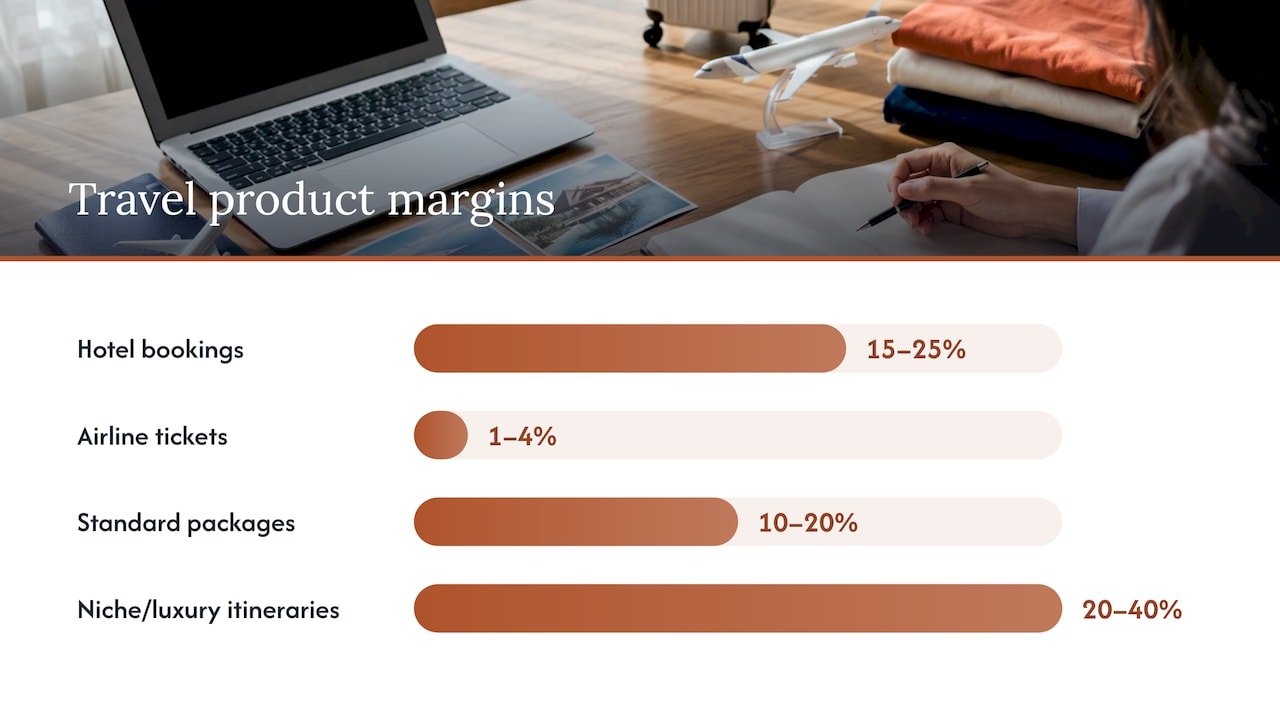
Do not compare a flight with a hotel. One industry glossary puts OTA hotel margins at roughly 15% to 25%, against 1% to 4% for airline tickets, which is why flight-only selling rarely pays. A UK business guide cites typical profit margins of 10% to 20% for standard packages and 20% to 40% for niche or luxury itineraries. Those are broad ranges, so use them as direction, not as a promise.
If you want a fuller look at what agents are paid, see our guide to typical travel agent commission rates.
Five ways to lift your margin
Negotiate better supplier terms
Suppliers pay for volume, reliability and control of the customer. A practical negotiation guide advises you to show past and projected bookings, explain how you steer clients to book through you, and make a precise ask, such as a two-point commission increase. Vague requests for “a better deal” go nowhere.
Three things to bring to the table:
- Your booking history by product, average value and typical travel month.
- A volume commitment you can really meet.
- A willingness to fill low-season dates.
If a lower rate is not possible, ask for added value. A hotel-rates guide lists complimentary upgrades, transfers, meals, late checkout or a commission bump as alternatives, which still help the client’s perceived value and your margin.
Watch for changes that give you more without negotiating. Norwegian Cruise Line removed non-commissionable fares from UK pricing, which Travel Weekly reported as an extra 1.5% to 2% commission on new bookings, depending on booking value. Reading supplier trade bulletins is margin work.
Incentives work the same way. Override commissions pay extra once you hit agreed sales targets, and preferred supplier programmes bundle higher rates with marketing support in return for a minimum volume, as the same negotiation guide explains. Our page on preferred supplier programmes covers how a white-label set-up gives you control here.
Bundled products give you another angle. Attraction packages, such as combo tickets that pair a river cruise with major sights, are the kind of supplier arrangement where agreed rates and incentives can add to what you earn per client.
Understand net and commissionable rates
There are two main rate structures. ETAG’s guide explains that commissionable trade rates pay an agreed percentage of the Best Available Rate, typically 10% to 30%, while net rates are fixed in advance and must stay confidential from the consumer. It also gives a worked example: a provider needing £100 would offer the trade a commissionable rate of around £115, so the partner can claim commission.
Net rates give you room to set the selling price, but they carry contract risk. Before you sign, read our five contract checks for net rates. If you sell hotels, static versus dynamic hotel rates explains how each affects what you can charge.
Keep a bigger share of the commission
The rate you are quoted is not the rate you take home. Host agencies and consortia take a split, and some apply fees or clawbacks. Our host agency commissions guide shows what to deduct before you call a number your pay.
The split is a margin lever in its own right. Within one UK group, self-generated leads earned agents 65% commission according to Travel Weekly, which shows that homeworkers who build their own client base are paid more. Our own model follows the same logic: you build your brand and client list, and you keep 70% of the commission, while we keep 30%. Compare that with the 4% that online travel agencies typically offer, and the difference on every booking is plain.
Price fees and extras openly
Fees are a growing source of margin. The WTAAA’s 2025 white paper reports that 66% of European travel consultancies charge professional fees, and 60% of fee-charging agencies noted higher profitability because they relied less on volatile commissions. In the UK, though, most leisure advisors do not expect a direct payment from the client. TTG’s example of a Surrey advisor shows it can work when you explain it: a clear document up front on why the fee reflects research time and service.
The rule is full transparency. ABTA’s guidance says everything the client must pay has to be in the basic price, and the CMA treats drip pricing as generally not permitted. In February 2026, TTG reported that ABTA reminded agents that prices must include unavoidable taxes and fees payable at hotels, ports or airports. For flights, the CAA says the headline price must include all unavoidable charges, with optional extras offered on an opt-in basis.
Extras sit in the same space: transfers, excursions, insurance and luggage as affiliate or add-on products. Our UK playbook on upselling travel extras shows how to add them without giving away the commission.
Convert more enquiries and win repeat business
Margin per booking is one thing. Margin per hour is another. Travel Sales IQ’s benchmark report says inbound phone enquiries convert at 30% to 45%, against 10% to 18% for web forms, and names slow responses, weak quote follow-up and missed upsells as common losses. These are one company’s benchmarks, so measure your own funnel, but the lesson holds: fast replies and follow-up lift earnings without touching a supplier rate.
Past clients are the cheapest source of sales. A lead generation guide, citing Ruler Analytics, puts referral and past-client channels at a 9.5% average conversion rate for travel brands, compared with 5.83% for paid Google Ads. A client list that is yours, in your name, is therefore a margin asset. Automated follow-up and booking confirmation automation save the hours that otherwise eat your net margin.
Check the rules before you change your product mix
A higher-margin product can bring higher obligations. ABTA explains that an agent who combines travel services itself is responsible for financial protection and liable to customers under the Package Travel Regulations. ATOL covers flight-inclusive packages and flight-only sales, while cruises and accommodation-only are non-licensable.
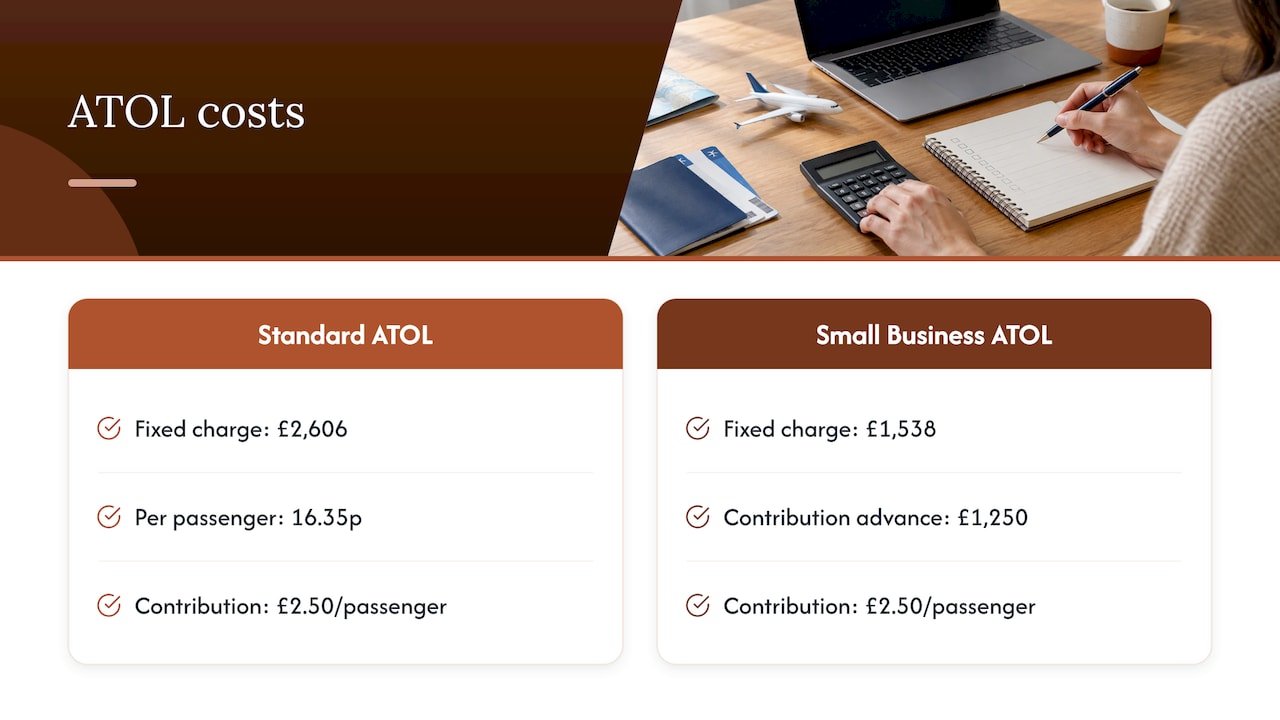
The ATOL cost is real. The CAA lists a Standard ATOL fixed charge of £2,606 plus 16.35 pence per passenger, and £1,538 for a Small Business ATOL, plus a £1,250 advance payment on the contribution. The contribution is £2.50 per licensable passenger. Where an ATOL holder sells through agents, the CAA requires a written agency agreement and any booking fees shown separately on receipts. Check the current figures on the CAA pages, as they are reviewed.
Selling under a licensed host’s ATOL means you do not need your own. Our model works that way, and you can see the costs in our guide to break-even for UK home agents.
Our view: the split is the biggest margin lever
Agents spend years haggling for an extra point from suppliers, then hand a large slice of the commission to whoever holds the licence. We think that is the wrong way round.
That is why we built TimesHunters around a 70% partner share. You trade under your own name, the licence branding is invisible to your clients, and the client relationships stay yours. Add wholesale hotel, cruise and tour inventory, instant pricing proposals and automated client follow-up, and the margin gain comes from both sides: more per booking, fewer hours per booking.
There is no cost to start, so the first booking you make is the first test of the model on your own terms.
Sam
Start your own branded agency
If you want to keep 70% of the commission under your own brand, TimesHunters gives you ATOL-protected licences, wholesale hotels, cruises and tours, a branded booking site and managed payments, with training and support.
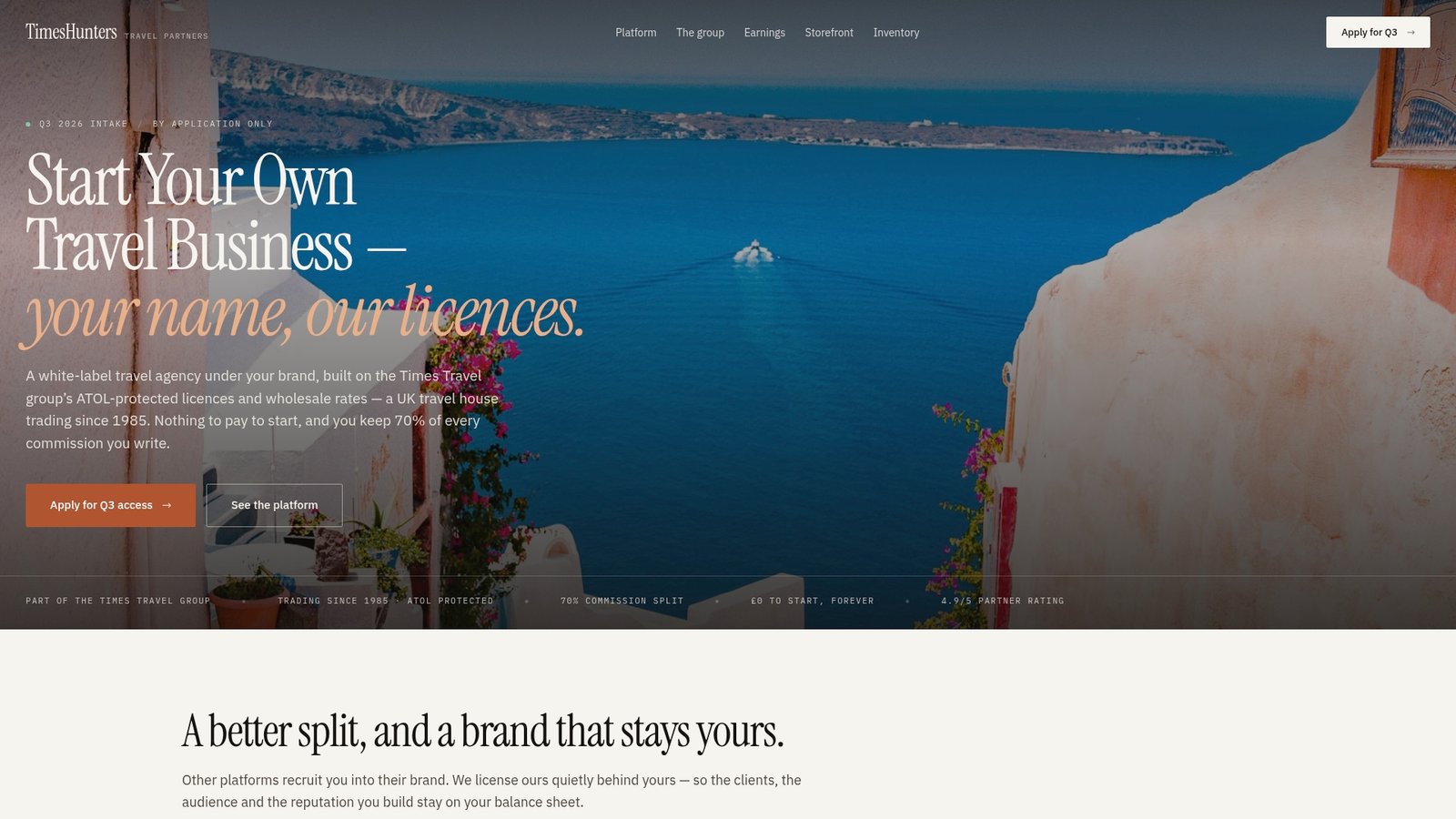
One partner reports moving from £400 to £1,200 per booking. See how it works on our white-label travel agency page, or read about the four-week launch training.
FAQ
What is a good booking margin in travel?
It depends on the product. Airline tickets are famously thin, at 1% to 4%, while hotels sold through OTAs sit nearer 15% to 25%, according to an industry glossary. Calculate your own net margin after fees and time, then compare it with the product type.
Is margin the same as markup?
No. Margin divides profit by the selling price, while markup divides it by cost. Markup is always the larger figure for the same sale, so quote and report on margin to avoid overstating your results.
Can I charge a booking fee on top of commission?
Yes, but it must be clear. The price you advertise must include everything the customer must pay, and fees on ATOL bookings must be separately identified on receipts, per the CAA. Explain what the fee covers from the first conversation.
Do I need my own ATOL to sell holidays with flights?
Not if you sell through an ATOL-licensed host agency, as one UK guide explains. Accommodation-only and tours without flights do not need ATOL. Confirm your set-up before you change your product mix.
Sources
- Travel Margin Calculation: Count Staff Time and Fees per Booking
- Pricing: it’s all about balance (VisitBritain)
- What Is Margin in Travel
- How Anna Money describes starting a UK travel agency
- Itemised apartment cleaning fees
- How to negotiate better commission rates with travel suppliers
- Negotiate Better Hotel Rates
- Travel Weekly: NCL to remove non-commissionable fares for UK agents
- Paris combo tickets
- ETAG Rates and Pricing 2022
- Travel Weekly: PTCs target 20% sales hike in 2026
- WTAAA Professional Fees White Paper
- TTG: How travel advisors can charge fees
- ABTA Code of Conduct Guidance, November 2025
- TTG: ABTA urges agents on pricing guidance
- CAA CAP 1014 Quick Reference Guide
- Travel Sales Conversion Benchmarks
- Lead Generation for Travel Agents
- ABTA: How your business trades
- CAA: Small business ATOL
- CAA: ATOL protection contribution
- CAA: Travel trade selling through agents