How to Sell Corporate Travel from Home in the UK
Learn how to sell corporate travel from home in the UK: what the work involves, the ATOL and package rules, how to win business clients and how you get paid.

You can sell corporate travel from home in the UK with a laptop, a phone, a business bank account and a legal route to take payment. That route is the part most people get wrong. The clients are the easier part. Small and mid-sized firms want someone who handles bookings, changes and paperwork for them, and one person working from a spare room can do that well. Whether you can legally sell flight-inclusive trips depends on how you are licensed, so settle that before you pitch anyone.
TL;DR
- Corporate travel means handling a company’s trips: booking, changes, policy checks, invoicing and help when plans go wrong.
- In the UK, selling flight-inclusive packages or flights to consumers needs an ATOL, either your own or one you trade under. The CAA sets the rules.
- Target firms with frequent travellers that are too small for a big management company. Approach the person who owns the admin, not just the traveller.
- Your income depends on the commission or fee structure you work under. Compare it before you commit.
- A white-label model lets you start under your own brand without waiting for your own licence.
Table of Contents
- What selling corporate travel from home involves
- Get the legal footing right first
- Three ways to operate from home
- Finding corporate clients
- What business clients expect from you
- How you earn, and what eats into it
- Using a white-label platform for corporate-style bookings
- Start selling under your own brand
- A simple first-month checklist
- FAQ
- Sources
What selling corporate travel from home involves
A corporate travel agent looks after a company’s business trips: flights, hotels, rail, ground transport, and the admin that surrounds them. One industry write-up on home-based business agents describes services such as round-the-clock support, arranging visas and negotiating corporate hotel rates, plus rebooking clients across several flights during a disruption.
So the product is not a cheap fare. It is a company not having to think about travel. A typical example of corporate travel looks like this:
- a sales team travelling to client meetings every month;
- a consultancy sending staff to a site for a week at a time;
- a firm organising a two-day leadership offsite for 20 people;
- a conference trip where five colleagues need matching hotel and rail bookings.
From home, you can run all of this with a booking platform, a clear process and fast replies. Clients rarely mind where you work. They mind whether you answer at 7am when a train is cancelled.
Get the legal footing right first
This is the section to read twice. What you must hold depends on what you sell and how you sell it.
ATOL: when you need it
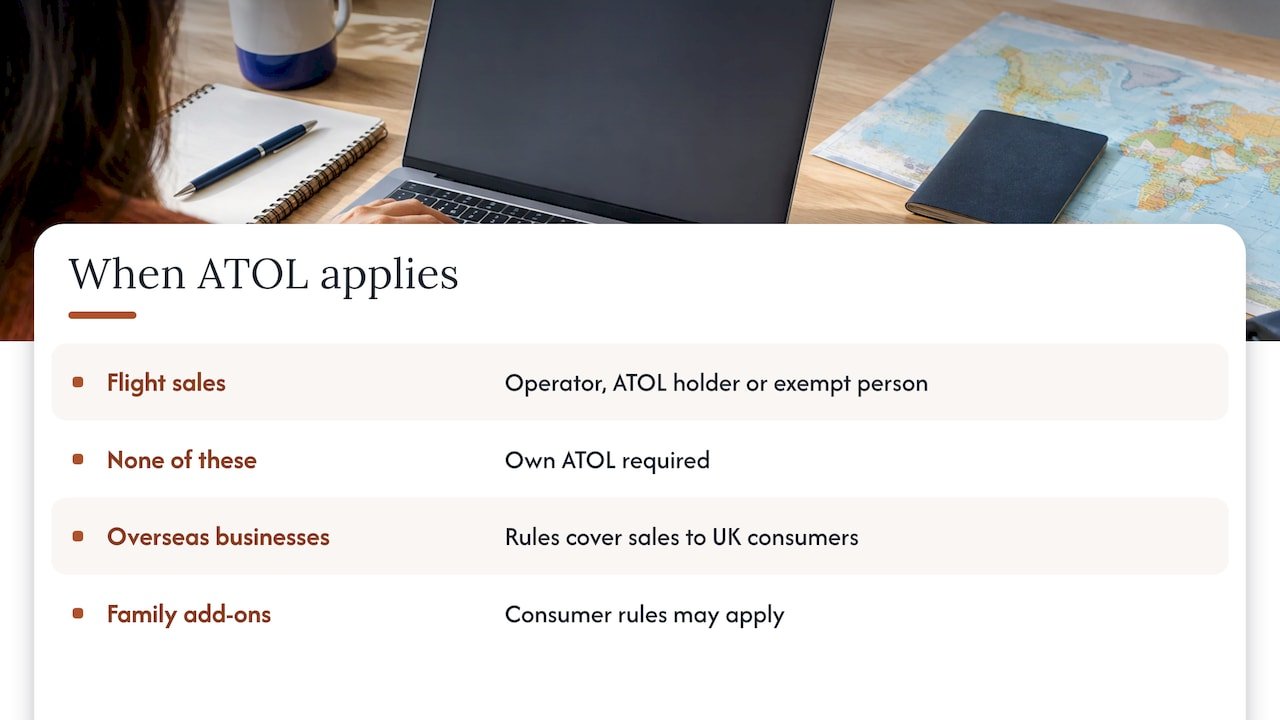
The CAA says that for flight-inclusive packages or flight-only sales to UK consumers, a business must be an aircraft operator selling its own services, an ATOL holder or an exempt person. If it is none of those, it needs its own ATOL. The same page says the rules also reach businesses established outside the UK that advertise and sell to UK consumers.
The ATOL Regulations exist so that consumers are refunded or brought home if an ATOL-holding organiser stops trading. Corporate work is mostly business-to-business, so check with the CAA how your own mix of clients and products is treated. If you also sell trips to individuals, such as an employee’s family add-on, the consumer rules matter.
Homeworkers and who holds the licence
The CAA’s guidance on homeworking schemes uses “homeworker” for a self-employed homeworking travel agent. It states that such a person does not count as a worker of an ATOL holder and is subject to the ATOL Regulations. Read that page before you sign anything with any scheme, and make sure the arrangement you join fits it.
Package travel rules
If what you sell counts as a package or a linked travel arrangement, heavier duties apply. VisitBritain’s summary lists pre-contractual information, standard information forms, contractual information and insolvency protection as the main features. UK Government guidance explains that the organiser is liable for the travel services in the package and that insolvency protection and detailed information requirements apply. The guidance notes that amendments commence on 6 April 2027. We cover what changes in our guide to the UK Package Travel Regulations from April 2027, and what counts as a package in our package holiday definition.
Protecting client money
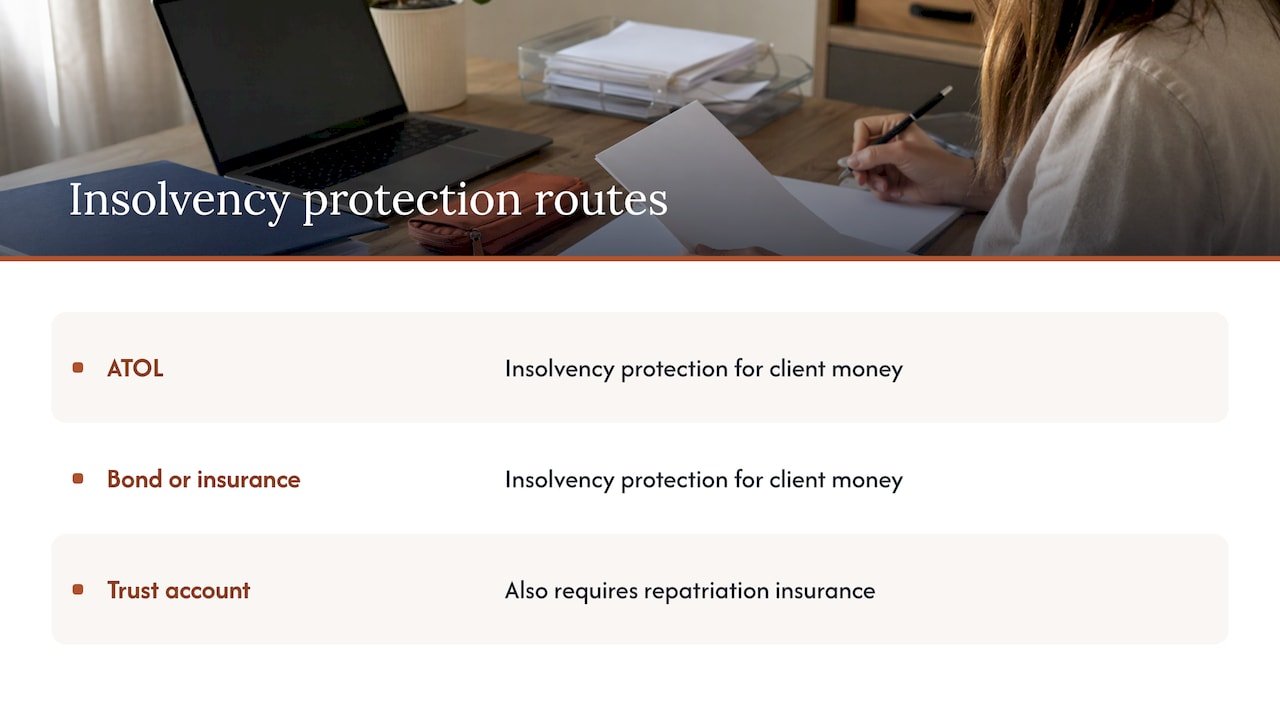
The Chartered Trading Standards Institute’s holiday law guidance for travel agents says agents who sell their own packages need insolvency protection for the money they take. The options are an ATOL, a bond or insurance policy, or a trust account. An organiser using a trust account must also arrange insurance for repatriation if they collapse. The same paper says it is an offence to tell an independent trustee that travellers have returned when they have not, in order to release money early. For a plain-English comparison of the routes, see our page on trust accounts versus insurance.
Setting up the business
Most people trade through a limited company. You register with Companies House after choosing a name, a registered office address, directors and shareholders and suitable SIC codes, as this UK incorporation guide sets out. The same guide recommends a dedicated business account instead of mixing personal and company money, which matters when clients pay large sums before a trip. Our overview of how to become an independent travel agent in the UK walks through the wider picture.
Three ways to operate from home
| Route | What it means | Main trade-off |
|---|---|---|
| Your own ATOL | You hold the licence and carry the compliance load | Time to obtain it, plus ongoing obligations |
| Homeworker under a host | You sell under someone else’s licence and scheme | Terms vary, so read the CAA guidance and the contract |
| White-label platform | You trade under your own brand on licensed infrastructure | Commission split with the platform |
| Non-flight only | You sell hotels, rail and tours without flights | Still check whether package or linked arrangement rules apply |
Our page on the ATOL licence for UK sellers explains the white-label alternative to waiting for your own, and accreditation for UK travel suppliers covers the wider supplier side.
Finding corporate clients
Corporate buyers are not like holidaymakers. The person choosing an agent is often an office manager, an HR lead, a finance manager or an executive assistant, not the traveller. Guides on winning business accounts consistently say this group values professionalism, reliability, speed and reporting, and that LinkedIn outreach and B2B email reach them best. One practical guide also suggests companies whose staff travel often but which are too small for a global management company, which fits a home-based agent well.
A workable plan for your first 90 days:
- Make a target list. Pick 50 firms within a sector you know: architects, recruitment agencies, engineering consultancies, software teams.
- Find the right contact. Look for the office manager, finance manager or PA, not the managing director.
- Send a short, specific message. Say who you help, what you take off their plate and offer a 15-minute call.
- Bring a one-page proposal. Explain how booking and approval work, your response times, how you invoice and what your service fee covers.
- Offer a trial. Ask to handle one trip or one team’s bookings, not a full switch on day one.
- Ask for referrals. Corporate travel spreads by word of mouth between office managers.
If you already have a network from a previous job, that is your fastest route. Former colleagues and suppliers know your reliability already.
What business clients expect from you
Whoever you sell to will judge you on a short list of things:
- Policy-aware bookings. You know the company’s rules on cabin class, hotel caps and approval, and you apply them.
- Fast quotes. Trips are often arranged within a day or two, so a quick proposal wins.
- Clean invoices. Finance teams want a clear breakdown with VAT shown and data that drops into their accounts.
- Help when plans change. Cancellations and delays are where an agent proves their worth.
- Reporting. A simple monthly summary of spend per team or trip is often enough for a small firm.
You can do this from home with a booking platform and a solid routine. Agents commonly use booking systems and CRM tools, and agents working from home use white-labelled support and integrated tools to manage changes and emergencies around the clock. Plan your own out-of-hours cover honestly: tell clients when you are reachable and what the emergency route is.
How you earn, and what eats into it
Corporate agents are paid in different ways. CAPA’s analysis of money flows in aviation says agents earn through GDS payments, airline incentives and booking-service fees, and that distribution changes can push up technology costs because agents may need several technology partners to reach the full range of fares. Some management companies instead charge a flat monthly fee for basic booking and reporting.
For a home-based seller, three levers matter:
- Your service fee. Charge for the work you do: planning, changes, reporting. A modest per-booking fee or a monthly retainer keeps income steady.
- Commission on what you resell. Hotels, rail, tours and villas can pay commission, depending on the supplier or platform.
- Repeat business. One account that travels every month is worth more than ten one-off enquiries. Our guide to recurring revenue for independent agents shows how to build that.
A quick worked example. Suppose a firm books £3,000 of hotel and rail in a month. Your take depends entirely on your split. At a 70% share of the commission earned, you keep the larger part of what the booking generates, and the platform keeps 30%. Check our travel agency business model page for how gross bookings translate into income, and work out your own figures before you set fees.
Our view: your brand, your clients, our infrastructure
Most people who want to sell corporate travel from home get stuck at the same point: they have the contacts but not the licence, the supplier access or the booking tools. We built TimesHunters for exactly that gap.
Our model is that you keep your own brand and your own client relationships. You trade under Times Travel group’s ATOL-protected licences, and the licence branding is invisible to your end clients. There is no cost to start. Partners receive 70% of commission on bookings, against the 4% typically offered by online travel agencies.
That changes the maths of a small corporate account. When a firm sends you a handful of trips every month, a higher share of commission on each one adds up. You also get a branded booking site, instant pricing proposals and automated booking management, which is what lets one person look as organised as a much larger agency.
Our advice: pick one niche, win three clients, and let the process do the repetitive work while you do the relationship work.
Sam
Using a white-label platform for corporate-style bookings
If you want to start without applying for your own licence, a white-label route lets you launch under your name using licensed infrastructure. TimesHunters gives partners access to wholesale hotel, cruise and tour inventory, plus villas, safari camps and rail. It also provides a branded booking site, instant pricing proposals, managed payments with financial protection, automated client follow-up and training and support.
For corporate work, the pieces that help most are the proposal tool, the follow-up automation and the managed payments. They cover the quote-to-confirmation cycle that office managers care about. Our page on static versus dynamic hotel rates explains how hotel pricing behaves, which is useful when you quote a team stay, and our guide to booking confirmation automation shows how confirmations are handled. If you plan to add extras to trips, upselling travel extras covers how to do it without losing commission.
If you want to launch, our travel agent training and onboarding support set out how a launch runs in the first weeks.
Start selling under your own brand
If you have contacts in companies that travel and want a licensed, ready-built way to serve them, our partner programme is built for you. You keep the client relationship, work under your own name and keep 70% of commission. Start with the white-label travel agency page to see what inventory you can sell, or look at the referral programme for UK agents.
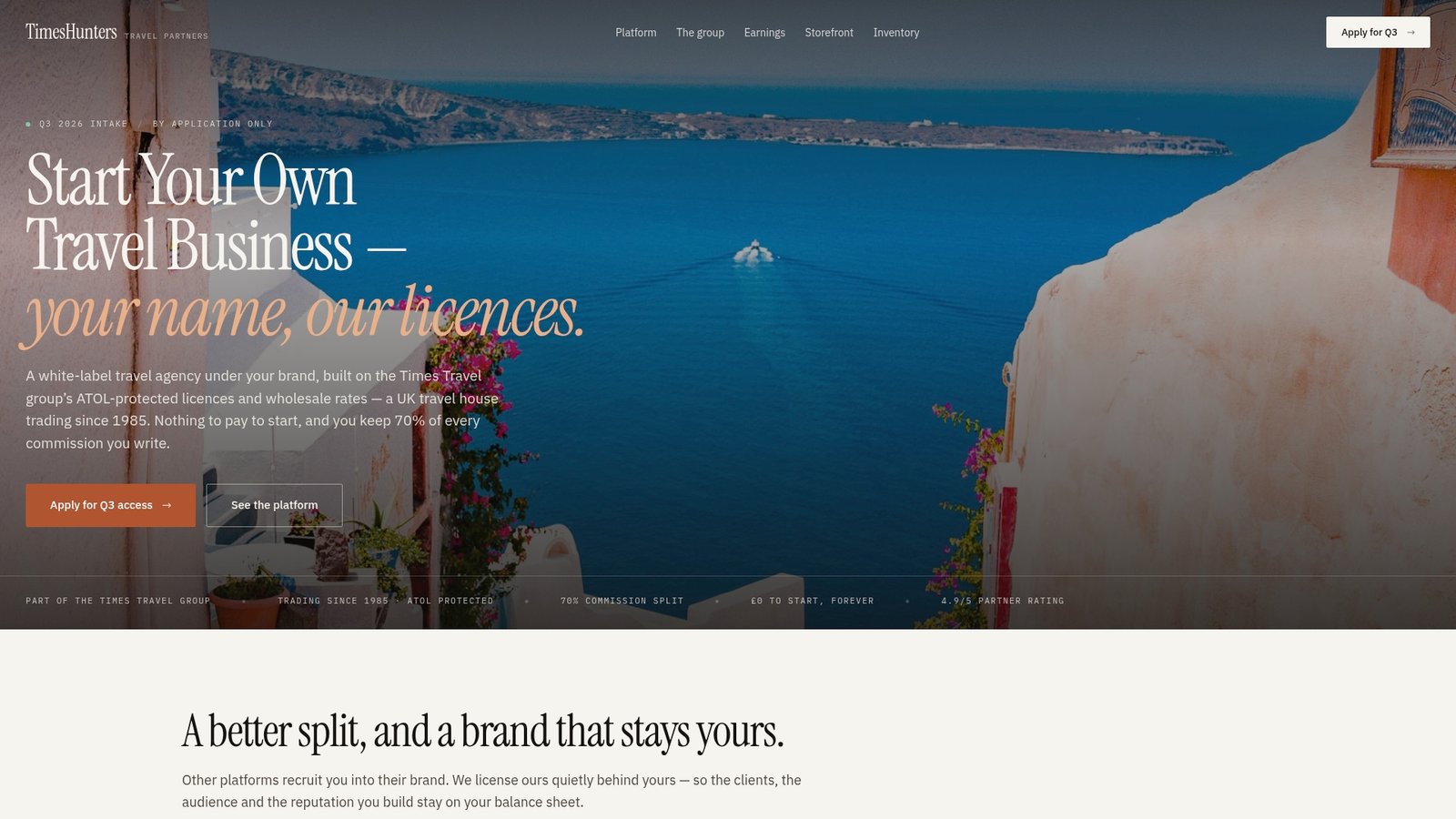
There is no cost to start, so you can set up your brand and your first proposal before you approach a single client.
A simple first-month checklist
- Choose your niche and name, and register your company with Companies House.
- Open a separate business bank account.
- Decide your licensing route and read the CAA’s guidance on it.
- Set up your branded booking site and proposal template.
- Write your one-page proposal: process, response times, invoicing, fees.
- Build your target list of 50 firms and contact ten a week.
- Offer a trial trip to the first three interested.
- Set your out-of-hours routine and tell clients clearly.
Keep a record of every question a client asks. After a month, those questions become your FAQ, your proposal and your pitch.
FAQ
What is a home-based travel agent?
A home-based travel agent is a self-employed travel seller who works from home, usually under a host agency, a licensed platform or their own licence. In the UK, the CAA treats a homeworking agent as subject to the ATOL Regulations, so check the licensing arrangement carefully.
How do I get corporate travel clients?
Target firms whose staff travel often but are too small for a large management company. Reach the office manager, finance lead or PA through LinkedIn and email. Offer a short call, a one-page proposal and a trial trip rather than asking for the whole account at once.
Do I need an ATOL to sell corporate travel?
If you sell flight-inclusive packages or flights to UK consumers, the CAA says you must be an exempt person, an aircraft operator or an ATOL holder. Many home-based sellers trade under a licensed arrangement instead of their own. Confirm with the CAA how your mix of products and clients is treated.
Is it cheaper to book through a travel agent or on your own?
Not always cheaper on the headline price, but an agent saves time, applies the company’s policy and helps when plans change. For a business, that saved admin and support is usually the real value, and it is how you should position your service.
Sources
- For Home-Based Biz Agent, Fees + Service = Success
- Do I need an ATOL, UK Civil Aviation Authority
- Homeworking schemes, UK Civil Aviation Authority
- UK Package Travel Regulations Guidance, VisitBritain
- Guidance on the Package Travel and Linked Travel Arrangements Regulations, UK Government
- Holiday law for travel agents, Chartered Trading Standards Institute
- How to Open a UK Company for Travel Agencies
- How to Get Corporate Travel Clients: A Practical Guide
- Money Flows in the Aviation Industry, CAPA
- Pros and cons of the subscription fee model, Travel Weekly
- Corporate solutions overview