
3 Core Covers UK Travel Agents Must Hold, and Which Brokers to Call First
Practical UK buying guide to the three essential covers travel agents must hold, Package Travel Regulations compliance, and the specialist brokers to...

Every UK travel agent needs professional indemnity, public liability with a Package Travel Regulations extension, and employers’ liability if you have staff. Supplier failure cover, crisis management support, and cyber liability round out a proper specialist package. The sensible next move is a quote from a broker who actually works in travel, not a generic small-business policy pulled off a comparison site — firms like Gallagher and others named below, checked against Gov and ABTA’s membership standards.
TL;DR:
- Online insurers like PolicyBee and Simply Business offer quick quotes suitable for low-risk agents but may not cover complex packaging or supplier failure adequately.
- Specialist brokers such as AJG, RouteOne, and James Hallam negotiate bespoke policies aligned with actual trading models, providing better coverage for packaging, bonding, and crisis management.
- Clearly detail your turnover, packaging activities, supplier relationships, and staffing plans before calling brokers to ensure accurate quotes and appropriate coverage.
- Emphasize to brokers the need for explicit inclusion of Package Travel Regulations liabilities and supplier failure coverage to avoid gaps in holiday packaging protection.
- Be aware that Brexit mainly affects cross-border EU dealings and supplier contracts, requiring additional scrutiny rather than core policy changes.
Table of Contents
- Shortlist: specialist UK brokers and insurers to contact first
- How these providers differ: underwriting approach and practical trade-offs
- How to choose the right policy and what to prepare before you call
- What each core cover actually protects against
- Typical costs, limits and what drives premium quotes
- How to get a tailored quote and arrange bonding evidence
- Employers’ liability: what changes once you take on staff
- Claims process and how to handle insurance claims
- Impact of Brexit on travel insurance policies for UK agents
- Additional optional covers worth considering
- An adviser’s take: the mistake I see most often
- Timeshunters: a different route into the travel industry
- Sources
- FAQ
Shortlist: specialist UK brokers and insurers to contact first
Several well-known names recur when travel businesses go looking for cover, each recommended for different reasons. Some are built for volume and speed. Others exist because complex packaging risk needs a human who understands what a tour operator actually does all day.
- AJG (Gallagher) places tour operator and travel agent risk with underwriters who understand scheduled airline failure insurance (SAFI), travel bonds, and packaged-holiday liability as standard components, not bolt-ons.
- PolicyBee runs a fast, online-first route aimed squarely at sole traders and small agencies whose main exposure is professional indemnity rather than complex packaging.
- Simply Business offers quick comparison quotes for straightforward public liability and PI modules, which suits low-risk, non-packaging agents who need cover today rather than in a fortnight.
- Howden handles adventure travel and complex itineraries, including sports and activity extensions that a generalist insurer typically won’t touch.
- RouteOne Insurance specialises in travel brokering with bonding options and supplier failure products built specifically for tour operators and agents who package holidays.
- James Hallam is a Lloyd’s broker with decades of travel-sector history, drawing on long-standing underwriter relationships to place risks that don’t fit a standard template.
| Provider | Core covers offered | Travel-specific extensions | Best suited for |
|---|---|---|---|
| AJG (Gallagher) | PI, PL, employers’ liability | SAFI, travel bonds, packaged-holiday liability | Established tour operators with packaging exposure |
| PolicyBee | PI, PL | Limited packaging extensions | Sole traders, small agencies, low packaging risk |
| Simply Business | PI, PL | Minimal specialist extensions | Fast online quotes, straightforward risk profiles |
| Howden | PI, PL, employers’ liability | Adventure/activity sports extensions | Complex or adventure-focused itineraries |
| RouteOne Insurance | PI, PL, supplier failure cover | Bonding, financial failure protection | Agents packaging holidays needing bonding evidence |
| James Hallam | PI, PL, employers’ liability | Lloyd’s-placed bespoke wording | Complex risks needing specialist underwriter access |
Contacting two or three of these in parallel, rather than settling for the first quote, is the single easiest way to spot whether a policy actually covers your packaging activity or just looks like it does on the surface.
How these providers differ: underwriting approach and practical trade-offs
The real split isn’t between “good” and “bad” providers. It’s between two different ways of buying insurance, and knowing which one your business needs saves you from an expensive mismatch later.
Online-first platforms like PolicyBee and Simply Business exist to get you a quote in minutes. That speed comes from standardised policy wording, which works fine if your agency sells travel advice and takes a booking fee without ever acting as the principal organiser of a package. The moment you start bundling flights, hotels, and transfers into a single price under your own brand, you’ve likely stepped into packaging territory, and a standardised policy may not follow you there.
Specialist brokers such as AJG, Howden, RouteOne Insurance, and James Hallam work differently. They negotiate with a panel of travel underwriters, often placing business at Lloyd’s, and they build policies around your actual trading model rather than a generic small-business template. Simply Business itself acknowledges that aggregator quotes suit self-employed agents with low packaging exposure, but that complex packaging usually needs specialist broking to place properly.
- Speed: online platforms typically quote same-day; specialist brokers may take several days to a week for complex risks.
- Depth: specialist brokers can negotiate bespoke wording around supplier contracts and payment flows; aggregators generally can’t.
- Bonding: RouteOne Insurance and similar specialists offer bonding products tied to ATOL and ABTA evidence requirements; most online platforms don’t touch bonding at all.
- Crisis support: brokers with genuine travel-sector credentials, including James Hallam’s ABTA-linked underwriter relationships, tend to bundle 24/7 emergency response as standard rather than as a costly add-on.
Pro Tip: Ask any broker directly whether their policy wording names the Package Travel Regulations explicitly. If they can’t point to the clause, assume it isn’t covered and keep asking.
The trade-off, in short: online platforms win on speed and low cost for simple risk profiles. Specialist brokers win on depth, bonding access, and genuine Package Travel Regulations coverage for anyone acting as an organiser. If you’re not sure which category you fall into, that uncertainty is itself a reason to call a specialist broker rather than click through an aggregator.
How to choose the right policy and what to prepare before you call
Walking into a broker call unprepared wastes everyone’s time and usually gets you a rougher quote. Have these ready before you pick up the phone:
- Annual turnover and projected growth — insurers price supplier failure and PI limits partly against how much money moves through your business each year.
- Your trading model — are you acting purely as an agent selling on commission, or as a principal or packager assembling holidays under your own brand? This single distinction changes which policy you need.
- Staff headcount and roles — anyone employed, even part-time, usually triggers a legal requirement for employers’ liability cover.
- Supplier payment arrangements — how deposits and balances flow between you, your customers, and your suppliers affects your exposure to supplier failure.
- Existing ATOL or ABTA membership evidence — brokers use this to confirm your bonding position and speed up placement.
Once you’re on the call, ask direct questions: does the public liability policy explicitly extend to Package Travel Regulations liability? What’s the supplier failure limit, and does it cover airline insolvency as well as hotel failure? Is crisis management included or a separate add-on? What’s the cyber liability limit if customer payment data is breached?
Watch for red flags. A policy that excludes package travel liability outright, or caps supplier failure cover at a token amount, isn’t fit for anyone packaging holidays. As one specialist insurer puts it, if you sell packaged holidays you should insist on a policy that explicitly covers Package Travel Regulations liabilities and supplier failure — anything less leaves a genuine gap.
What each core cover actually protects against
Professional indemnity (PI) defends you when a client claims you gave negligent advice, made a booking error, or published a misleading brochure description. Picture an agent who books a family into the wrong hotel category, or mistypes a departure date. PI is what pays out and covers legal costs if that client sues for the ruined holiday.
Public liability with a Package Travel Regulations extension covers injury or property damage claims, but the extension matters far more for agents who package holidays. Since 1 July 2018, the Package Travel and Linked Travel Arrangements Regulations extend consumer protection to flight-plus-hotel bookings and similar combinations, meaning agents can be treated as the principal organiser and held directly liable for booking errors, even when a third-party supplier caused the underlying problem. If you’re bundling components into a single price, this extension isn’t optional in practice.
Employers’ liability is a legal requirement the moment you employ anyone, covering claims from staff injured or made ill through their work. It’s separate from PI and PL, and skipping it isn’t a discount, it’s a compliance breach.
Supplier failure and travel bonds protect against financial loss when a hotel, airline, or ground operator goes insolvent mid-booking. Specialist covers here commonly bundle:
- Supplier failure/financial failure insurance for insolvent partners
- Crisis management support, including 24-hour emergency phone lines and PR consultant costs
- Cyber liability for data breaches involving customer payment information
Since Package Travel Regulations expanded consumer protection, agents also face an obligation to assist travellers stranded by supplier failure, which is exactly where crisis management cover earns its cost. RouteOne Insurance frames crisis management and supplier failure cover as standard supplements to core PI/PL packages precisely because holiday disruptions rarely stay contained to one customer.
Cyber liability matters more than most small agents assume. Travel businesses hold passport numbers, payment card details, and full itineraries for every client. A breach doesn’t just cost money to fix; it costs the trust that keeps repeat bookings coming. Cyber cover typically includes incident response and data recovery costs, alongside liability for the breach itself.
Typical costs, limits and what drives premium quotes
Premiums for travel agent insurance vary enormously, and no broker will give you a meaningful figure without knowing your turnover, packaging activity, and claims history. A handful of factors consistently push the price up or down.
- Turnover is the biggest lever. A £200,000-turnover agent selling commission-only bookings pays a fraction of what a £2 million packager pays for the same PI limit.
- Packaging activity matters more than turnover alone. Acting as principal organiser under the Package Travel Regulations increases underwriting risk regardless of business size.
- Claims history affects renewal pricing sharply. One supplier-failure claim can shift your risk profile for several years.
- Staff numbers and overseas representatives add employers’ liability exposure and often push crisis management costs up, since more people on the ground overseas means more potential incidents.
- Add-on modules change the total materially. Supplier failure cover, crisis management, and cyber liability each add a separate premium layer on top of core PI/PL.
PI and PL limits for small agencies commonly sit in the low hundreds of thousands, rising into the millions for larger packagers with significant supplier exposure. Treat any figure a broker quotes verbally as indicative until it’s written into a formal policy schedule.
How to get a tailored quote and arrange bonding evidence
Brokers typically ask for the same core documentation regardless of who you approach, so gathering it upfront speeds everything up:
- Financial records showing turnover, projected growth, and how supplier payments flow through your accounts.
- A list of suppliers you work with regularly, including hotels, airlines, and ground operators, since this shapes supplier failure pricing.
- Your booking process documentation, showing whether you act as agent or principal for each type of sale.
- Existing ATOL or ABTA membership evidence, which specialist brokers use to fast-track bonding arrangements.
Simple PI-only quotes can be turned around in a day or two through online platforms. Bonding arrangements tied to ATOL evidence usually take longer, often a week or more, because insurers may request additional underwriting information or, for larger packagers, a site visit before confirming terms. Specialist brokers with existing underwriter relationships generally move faster through this stage than a generalist would, simply because the paperwork and questions are already familiar to them.
Employers’ liability: what changes once you take on staff
The day you employ your first member of staff, even part-time or on a zero-hours arrangement, employers’ liability insurance stops being optional. It’s a legal requirement, and trading without it when you have employees is a compliance breach that can carry a fine, not just a coverage gap.
This cover pays out when a staff member is injured or made ill because of their work. In a travel agency, that’s rarely dramatic; think repetitive strain from constant screen work, or a slip in the office. But the same policy also covers legal defence costs if a former employee claims stress-related illness from an unmanageable workload, which does happen in an industry known for tight deadlines during peak booking season.
If you send staff overseas for supplier visits, familiarisation trips, or to run resort desks, tell your broker explicitly. Standard employers’ liability wording sometimes limits or excludes overseas work-related injury, and travel businesses are exactly the sort of employer that needs this checked rather than assumed. This is also where the line between employers’ liability and business travel insurance gets blurry: business travel insurance is built for employees working overseas, with higher limits and repatriation cover that employers’ liability doesn’t provide. If your reps travel regularly, you likely need both, not one instead of the other.
Claims process and how to handle insurance claims
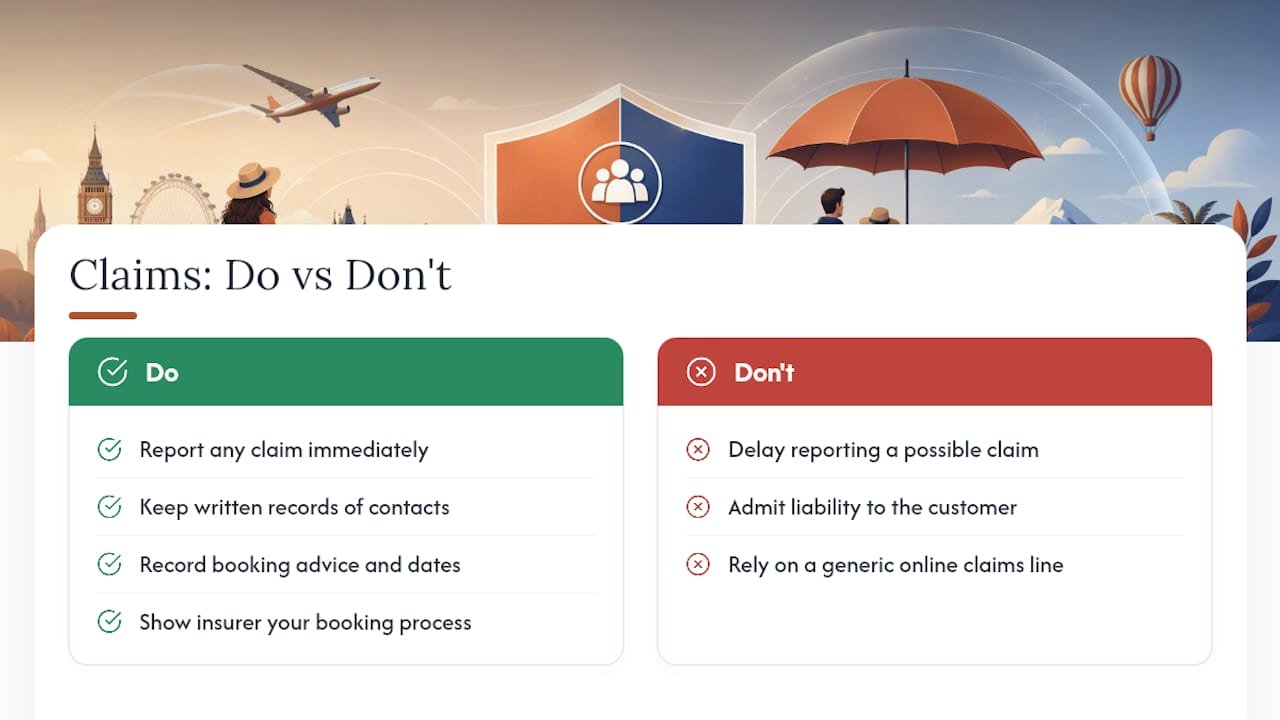
Report a claim, or anything that might become one, as soon as you become aware of it. Most travel policies include a notification clause requiring prompt reporting, and delaying can weaken your position even on a claim that would otherwise have been paid.
Keep a written record from the first contact: the customer’s complaint, dates, correspondence with the supplier involved, and any advice given at the point of booking. If a client claims you mis-sold a package or gave negligent advice, your broker or insurer will want to see exactly what was said and when, which is why good record-keeping at the point of sale matters as much as the policy itself.
Specialist brokers generally handle claims differently to online platforms. A broker with genuine travel-sector relationships, such as James Hallam’s Lloyd’s connections, can often intervene directly with the underwriter on your behalf, particularly on complex packaging claims where the facts aren’t straightforward. An online platform typically hands you off to a generic claims line with no travel-sector context.
Expect the insurer to ask for evidence of your usual booking procedures alongside the specific incident. This is one more reason a documented, consistent booking process matters beyond day-to-day operations. It’s effectively your defence file if something goes wrong. Don’t admit liability to a customer before speaking to your insurer; doing so can complicate or invalidate the claim, even when your instinct is to apologise and smooth things over quickly.
Impact of Brexit on travel insurance policies for UK agents
Brexit hasn’t rewritten the core insurance requirements for UK travel agents. Professional indemnity, public liability, and the Package Travel Regulations extension remain UK domestic law, since the 2018 regulations were transposed into UK legislation before the UK left the EU and have continued to apply since.
Where Brexit has changed things is at the edges of cross-border trading. Agents selling packages that include EU destinations, or working with EU-based suppliers and ground operators, may face additional friction around currency fluctuations, supplier contract terms, and how quickly claims involving an EU-based partner get resolved. None of this removes the need for core UK cover; it simply means supplier contract wording deserves a closer look if a significant share of your bookings route through EU partners.
If your business relies on EU ground transport, transfers, or coach partners, it’s worth reviewing supplier contracts for how liability and payment terms hold up post-Brexit. Partners like Zont’s transport solutions for tourism agencies illustrate the kind of operational relationship worth checking contractually, since transport reliability directly affects your supplier failure exposure. A broker who reviews these contracts can sometimes negotiate bespoke wording that closes gaps a standard policy would miss.
Additional optional covers worth considering
Beyond the core package, a handful of optional extensions are worth asking about depending on how your agency actually operates day to day.
Equipment insurance covers laptops, point-of-sale systems, and mobile devices your team uses for bookings, particularly relevant if staff work from home or travel to trade shows and supplier familiarisation trips. Business interruption cover protects income if an office fire, flood, or system failure stops you trading for weeks. Legal expenses cover helps with the cost of defending contractual disputes with suppliers, which can otherwise run up legal bills fast even when you’re clearly in the right. Directors’ and officers’ liability matters if you run a limited company and want personal protection against claims of mismanagement. And for agencies handling a lot of overseas rep travel, a dedicated business travel insurance policy, distinct from employers’ liability, covers higher limits, repatriation, and security assistance for staff working abroad.
None of these replace the core PI, PL, and employers’ liability trio. They fill specific gaps that only apply to certain business models, so it’s worth mentioning your actual operations to a broker rather than assuming you need every add-on on the list.
An adviser’s take: the mistake I see most often
The most common error isn’t skipping cover, it’s buying the wrong kind. Agents grab a general SME policy because it’s cheap and quick, then discover during a claim that Package Travel Regulations liability was never actually included. A specialist travel placement costs more upfront but closes that gap properly. Timeshunters works alongside travel entrepreneurs who understand this trade-off well, having built businesses on ATOL-protected foundations rather than generic templates.
— Sam
Timeshunters: a different route into the travel industry
If reading all this has you thinking about building a travel business rather than just running one, there’s a route that skips the years of setup most agents go through. Timeshunters is a white-label alternative to building a travel agency from scratch: instead of spending months on ATOL applications and supplier negotiations, you launch under your own brand using Timeshunters’s existing ATOL-protected licences, with access to wholesale hotel, cruise, tour, villa, safari, and rail inventory from day one.
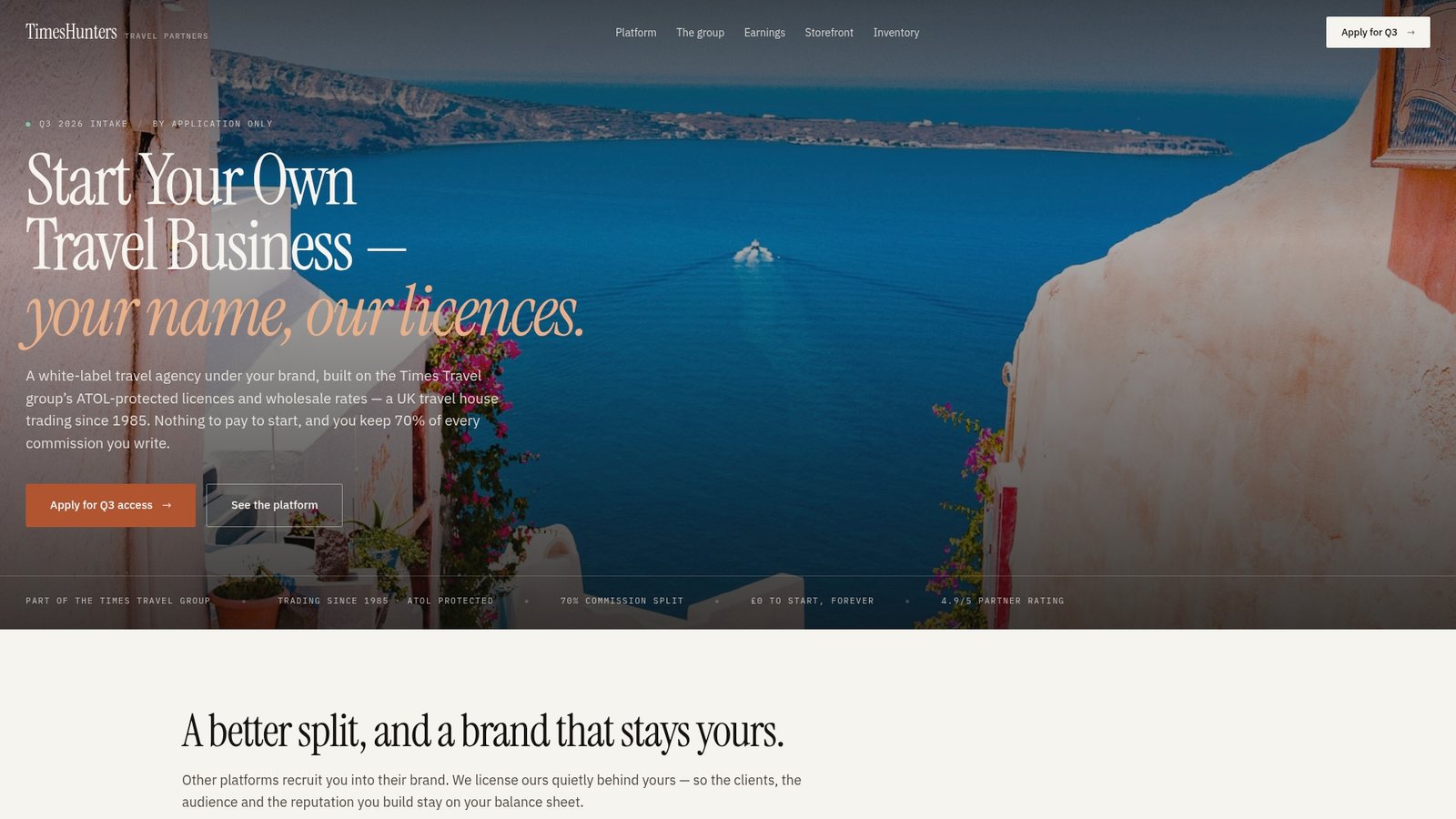
Partners keep their own brand and client relationships while earning a commission split, offering a different structure compared to typical online travel agency margins. Automated booking management and instant pricing proposals handle the admin, freeing you to focus on client relationships instead of back-office logistics. None of this replaces the insurance covered above. Whether you build under Timeshunters or run an existing agency, you still need professional indemnity and public liability with a Package Travel Regulations extension, and a specialist travel broker is still the right call to arrange it. If the white-label model interests you, explore the white-label travel agency platform to see how the commission structure and licensing actually work.
This article is general information, not a substitute for advice from a qualified financial advisor. Consult a qualified financial professional about your own circumstances before acting on anything here.
Sources
- RouteOne Insurance — tour operators & travel agents liability
- James Hallam — Insurance for the travel industry
- AJG (Gallagher) — Travel agents & tour operators insurance
FAQ
Can I get travel insurance from a travel agent?
Travel agents sell consumer travel insurance to customers, but that’s separate from the business insurance the agency itself needs to trade legally. As a UK travel agent, you need your own professional indemnity, public liability, and employers’ liability cover, arranged through a specialist broker rather than a policy you’d sell to a client.
What insurance do I need as a travel agent?
At minimum, you need professional indemnity, public liability with a Package Travel Regulations extension, and employers’ liability if you employ staff. Most specialist policies also bundle supplier failure cover, crisis management, and cyber liability as standard supplements.
What are the top UK travel insurance and broker providers?
Names that consistently come up for specialist travel business cover include AJG (Gallagher), PolicyBee, Simply Business, Howden, RouteOne Insurance, and James Hallam. Each suits a slightly different business profile, from fast online quotes for sole traders to Lloyd’s-placed cover for complex packagers.
Can non-UK residents buy travel insurance?
This depends on the specific insurer’s eligibility rules, since consumer travel insurance policies typically require the policyholder to be a UK resident or meet other residency criteria set by that provider. For business insurance covered in this article, eligibility is based on where the business trades and is registered, not the personal residency of individual customers.
Do I need a different policy if I sell packaged holidays versus acting purely as an agent?
Yes. Acting as principal organiser of a packaged holiday under the Package Travel Regulations creates direct liability that a policy for simple commission-based agents often won’t cover. Always confirm with your broker that the Package Travel Regulations extension is explicitly named in the policy wording if you package holidays in any form.