
UK Travel Agents: Keep 70% Commission on White Label Referral Program
Learn how UK travel agents can launch a white label referral program, keep about 70% commission, meet ATOL requirements, and win clients.

A travel agent referral programme, in its most valuable form, is a white-label partner model that lets you launch a branded travel agency using someone else’s licences, technology and supplier deals. Join one and you earn commission generally starting around 70% on every booking, significantly higher than the small percentages typical of most affiliate schemes. The rest of this guide covers how to join, what you’ll earn, the compliance details you can’t skip, and how to actually win clients once you’re live.
TL;DR:
- White-label programs typically offer commission splits of 70% to 90% of supplier earnings, with higher income potential from markups, service fees, and commissions on upgrades or preferred supplier volume.
- Setting up a white-label portal can be achieved in under six weeks with proper branding and configuration, avoiding months of custom development costs.
- Confirming ATOL or equivalent financial protection and understanding tax reporting obligations are crucial compliance steps before launching a travel agency.
- Building an initial client base relies on leveraging existing networks and offering repeatable, personalized itineraries, with automation tools supporting ongoing relationships.
- Success requires focusing on establishing strong client relationships and business branding, not just choosing the highest commission platform or technology provider.
Table of Contents
- What is a white-label travel agent referral programme?
- Why does the white-label model usually beat building your own or going the affiliate route?
- How does onboarding actually work, step by step?
- How much can you actually earn from commission splits?
- What compliance and operational checks matter before you sign up?
- How do you win your first clients and scale from there?
- What I’d tell someone starting their first branded travel agency
- Start your own branded agency with TimesHunters
- Sources
What is a white-label travel agent referral programme?
Forget the affiliate links and tracking codes you might associate with the phrase “referral programme”. The model worth your attention is white-label partnership: you get your own branded booking site, but the licences, supplier contracts and financial protection sit with an established provider behind the scenes.
The platform typically supplies:
- A branded booking portal carrying your name and colours, not the provider’s
- ATOL-protected licences and supplier access, so you’re not negotiating rates from scratch
- Automated quoting, booking management and payment handling
- Training and onboarding support to get you booking within weeks
This suits solo travel advisors building a client base, influencers with an audience ready to book holidays, and small hospitality businesses wanting a second revenue line. It’s not built for someone chasing a one-off tracked link commission. It’s built for someone who wants to own a client list and a brand.
Why does the white-label model usually beat building your own or going the affiliate route?
Building a booking platform from scratch means engineering costs, supplier negotiations, and months before you take a single booking. Buying in white-label technology skips that entirely: agencies can launch under existing infrastructure rather than build bespoke systems, which cuts both the risk and the timeline.
The practical advantages stack up:
- Speed: you’re taking bookings in weeks, not the year or more custom development would take
- Brand control: your name is on the site and the client relationship, even though someone else runs the plumbing
- Cost predictability: you’re not carrying developer salaries or infrastructure bills
- Freed-up focus: capital goes into marketing and client relationships instead of engineering
Pro Tip: Don’t judge a white-label provider on commission percentage alone. Check what supplier consortium and preferred-partner deals sit behind the platform. Two providers offering the same split can leave you with very different margins once you factor in supplier commission structures.
How does onboarding actually work, step by step?
Joining a white-label programme follows a fairly consistent sequence, whichever provider you choose. Partner programmes commonly ask for documentation and rate-category assignment before you get near a live booking, and most guides describe a similar stepwise process.
- Apply and submit documentation. Expect to provide ID, business registration details (or a plan to register), and basic background on your target market.
- Prepare branding assets. High-resolution logos, hex colour codes, and domain details speed up configuration considerably, since providers need these formats ready before they can build your portal.
- Configure the platform. This covers your branding, agent groups if you’re bringing on sub-agents, markup settings and payment routing.
- Run test bookings. A staged pilot with a handful of test transactions catches configuration errors before real clients see them.
- Go live and start daily operations. Quoting, booking, confirming and following up become your routine tasks.
Done properly, a UK white-label portal can go live in under six weeks when the branding and scoping work happens up front rather than mid-build.
How much can you actually earn from commission splits?
Commission splits in host and white-label arrangements typically fall between 70% and 90% of supplier commission, with the platform keeping the remainder to cover licensing, technology and support.
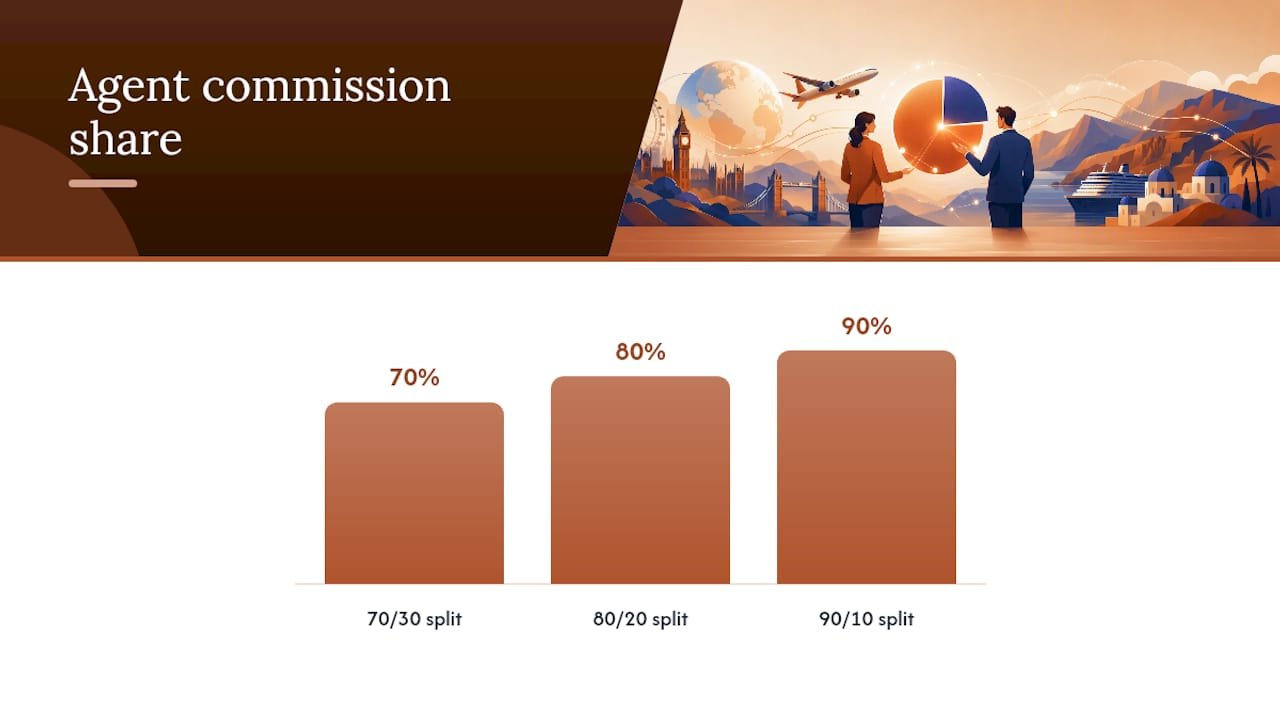
Run the maths on a straightforward example. A package holiday generates supplier commission that, at a typical 70/30 split, results in the agent keeping a large majority. Multiple bookings monthly can thus generate a solid income before markups or fees.
Beyond the base split, several levers push earnings higher:
- Markups on top of wholesale rates, set at your discretion
- Service fees for planning, itinerary building or bespoke research
- Upgrade commissions on room categories, cabin classes or add-on excursions
- Preferred supplier overrides, where certain suppliers pay extra for volume
One partner using the TimesHunters platform reported income rising from around £400 to £1,200 per booking after switching from a low-commission model to a 70% white-label split. That single change in structure, not a change in client volume, drove the jump.
What compliance and operational checks matter before you sign up?
ATOL protection isn’t paperwork you can skip if you’re selling flight-inclusive packages. It protects your customers’ money if a supplier fails, and it protects your business from the reputational damage that follows. Confirm exactly which bookings the provider’s ATOL licence covers before you promote a single package.
The accounting side matters just as much, even though it gets less attention. Whether you’re classed as principal or agent changes how you recognise revenue and report income for tax purposes. As an agent earning commission, you generally report the commission itself as revenue, not the full booking value, which keeps your tax position simpler.
Before joining any programme, ask for:
- Written confirmation of ATOL or equivalent financial protection scope
- A clear breakdown of how commission is calculated and paid
- Documentation on your reporting obligations as principal or agent
- Details of what happens to client bookings if the platform itself ceases trading
How do you win your first clients and scale from there?
Your existing audience is the fastest route to your first bookings, whether that’s a social following, a local community, or former colleagues who trust your judgement on travel. A shareable sample itinerary, built once and reused for similar enquiries, does more selling than a generic sales pitch ever will.
Once bookings start coming in, automation keeps the relationship alive without eating your time:
- Automated post-booking follow-up emails asking about the trip and prompting reviews
- A structured referral incentive for past clients who send you new business
- Platform analytics to track which trip types and destinations convert best
- Recruiting sub-agents once your own booking volume plateaus, sharing commission on the business they bring
Pro Tip: Track revenue per client, not just total bookings. A handful of repeat clients booking annual holidays is worth more long-term than a large list of one-off bookers you never hear from again.
If you’re setting up a formal business entity, particularly one with international ambitions, get the registration paperwork sorted early. Guidance on business registration and documentation requirements for founders working across borders is worth reading before you commit to a structure.
What I’d tell someone starting their first branded travel agency
and both point to the same lesson: the platform gets you licensed and booking fast, but the client relationships still take real graft to build. The partner who moved from £400 to £1,200 per booking didn’t do it by switching software. She did it by treating her branded agency like an actual business from day one. Start there, not with the technology.
— Sam
Start your own branded agency with TimesHunters
Running your own agency without the licensing headache or years of supplier negotiation can be facilitated by a white-label travel agency platform.
These platforms typically provide wholesale hotel, cruise and tour inventory, automated booking management, instant pricing proposals, and onboarding support to help you start trading quickly rather than be stuck in setup for months. If you’ve read this far because you want to stop earning pennies on referral links and start owning a real travel business, visit TimesHunters to see how the partner model works and get your branded portal set up.