Turn Downloads Into Bookings With Travel Lead Magnets for Agents
How travel professionals turn guide downloads into bookings: solve one traveller friction, publish a focused landing page, and use a five email nurture to...

The best-performing travel lead magnets are a niche destination guide, an editable itinerary template and a budget or price estimator, because each one solves a specific planning problem for a clearly defined traveller. The rule that matters more than any format choice: pick one friction point for one traveller segment and answer it precisely. Get that right and the download becomes a booking through a short nurture sequence, not a soft ask on day one.
TL;DR:
- Targeted destination guides, itinerary templates, and budget calculators generate higher quality leads because they address specific traveller pain points.
- Designing mobile-friendly lead magnets with clear visuals, large fonts, and destination-specific imagery boosts engagement and conversion rates.
- Fast, simple creation and launch are possible by clearly defining the traveller’s problem, drafting content quickly, and using accessible tools like Canva and Google Sheets.
- Segmenting leads based on downloaded assets and quiz responses significantly improves email open rates and nurtures prospects more effectively.
- Integrating an automation system that tags and tracks leads from download through booking improves workflow efficiency and enhances personalization.
Table of Contents
- What makes a travel lead magnet actually work
- Top lead magnet ideas that work for travel professionals
- How to build and launch your lead magnet in a weekend
- Where to promote your lead magnet for the best-quality leads
- Measuring what matters and avoiding false signals
- From download to booking: a practical workflow
- Connecting your lead magnet to CRM and email automation
- Legal considerations for travel lead magnets
- Designing lead magnets that look good on a phone
- Segmenting leads by travel interest and demographics
- Where lead magnets are heading next
- A platform route for turning leads into managed bookings
- Sources
- FAQ
What makes a travel lead magnet actually work
Most travel lead magnets fail for a boring reason: they try to help everyone, so they end up helping no one. A generic “10 tips for your next holiday” PDF tells a search engine nothing about who it’s for and tells a reader even less about why they should hand over their email address. Compare that with a guide titled “The Seven-Day Sicily Itinerary for Foodie Couples Over 40” and you can see the difference instantly. One is a brochure. The other is a solution.
The travel professionals who generate consistent enquiries build lead magnets around a single planning bottleneck: seasonality, visa paperwork, budget anxiety, or the sheer overwhelm of building an itinerary from scratch. A destination guide that maps directly to your own signature itinerary produces far more qualified leads than a broad “travel tips” download, because the person downloading it is already halfway to booking the thing you actually sell.
That specificity is also why lead-magnet landing pages built for travel routinely convert at 25 to 40%, against the 1 to 4% you’d expect from a generic homepage. The gap isn’t the design. It’s the message match between what was promised and what gets delivered.
There’s a second reason this works, and it has nothing to do with SEO or funnel mechanics. Human-first content, the kind with real behind-the-scenes detail and a specific case study, consistently outperforms generic AI-style listicles in travel marketing, because clients are about to spend a large sum on trust, not a commodity. A Moz analysis of travel marketing makes the same point: readers can tell the difference between a template and someone who’s actually been there.
Top lead magnet ideas that work for travel professionals
Not every format deserves your time. These are ranked by how directly they solve a planning problem, and how easily they connect to a real booking conversation afterwards.
- Destination planning guide. Scope it tightly, one destination, one traveller type (families, solo women, retirees) and structure it around decisions, not trivia: when to go, where to stay, what it costs, what to skip. Deliver as a PDF designed in Canva; readers expect something they can save and reference on a phone.
- Editable itinerary template. A fill-in-the-blank day-by-day planner with realistic time estimates beats a static guide because it forces the reader to imagine their actual trip. Build it in Google Sheets or as an interactive PDF, and include one or two sample days pre-filled so people see the format before they commit.
- Packing and pre-departure checklists. Visa requirements, vaccination rules, and packing lists sound mundane, but they’re quick wins that build trust fast, because they solve a real anxiety with almost no effort from the reader.
- Budget calculator or price estimator. Budget anxiety is one of the biggest silent objections in travel. A simple spreadsheet or interactive tool that breaks down likely costs by category addresses that fear directly and positions you as the person who has already done the maths.
- Segmenting quizzes. A “What’s Your Ideal Safari Style?” quiz does two jobs at once: it engages the reader and tags them by interest, which drives stronger engagement than a static download and sets up much sharper nurture emails later.
- Exclusive deals and alerts. A subscriber list built around urgency, “flash fares to Southeast Asia” or “cabin release alerts”, works particularly well for return visitors who’ve already travelled with you once.
- Local insider guides and micro-itineraries. For high-value travellers, a 48-hour insider guide to one city, written with specific restaurant names and timing notes, signals expertise that a generic guide can’t match.
Building any of these doesn’t need a design team.
- Use Canva for PDFs and social snippets.
- Use Google Sheets for calculators and editable itineraries.
- Use Typeform or Interact for quizzes.
Pro Tip: Give your destination guide the same title structure as your best-selling package. If your signature trip is “10 Days in Northern Vietnam,” your lead magnet should be “The Complete Northern Vietnam Planning Guide,” not “Southeast Asia Travel Tips.” The tighter the match, the warmer the lead.
How to build and launch your lead magnet in a weekend
You don’t need weeks. A focused lead magnet can go from idea to published asset in a few days if you follow the sequence in order rather than jumping straight to design.
- Define the traveller and the friction. Write one sentence: “This is for [traveller type] who struggles with [specific problem].” If you can’t finish that sentence, the asset isn’t ready to build.
- Create the asset. Aim for 1,500 to 2,500 words for a guide, tighter for a checklist. Practical how-to resources suggest a simple PDF guide can be built in one to three hours once the content is drafted, using Canva for layout, Google Sheets for calculators, or Typeform for quizzes.
- Build a lean landing page. Skip the full navigation menu. You need a headline that states the promise directly, three or four bullets showing what’s inside, a mockup image of the guide, a form asking only for name and email, and a one-line privacy note. Send them to a proper thank-you page, not just a download link.
- Automate delivery and follow-up. Connect the form to your email platform so the asset delivers instantly, then queue a five-email sequence over 10 to 15 days: deliver the asset, add a related tip, share a case study or testimonial, address a common objection, then invite a consultation.
- Run the technical checklist. Host the file somewhere permanent, tag new subscribers by source and interest, confirm your consent wording meets data protection rules, and test the whole flow yourself before sending traffic.
- Landing page: headline, 3 to 4 bullets, one form field pair, mockup image, privacy line
- Email sequence: five emails, roughly days 0, 2, 5, 9, 14
- Test every download link on both desktop and mobile before launch
Where to promote your lead magnet for the best-quality leads
Pick two or three channels that fit your budget and skills rather than spreading thin across all of them.
- Organic search: optimise the landing page for long-tail queries that combine destination and trip type, “family safari Kenya budget,” not just “Kenya safari.”
- Social video: short Instagram Reels or TikToks showing a page of the guide, with a link-in-bio pointing straight to the landing page.
- Paid search: Google Search ads catch people already typing high-intent queries, so they tend to convert faster than social.
- Paid social: Meta lead ads and Reels ads work better for inspiration-stage audiences who aren’t searching yet but respond to a strong visual hook.
- On-site placement: a homepage hero banner, contextual CTAs inside relevant blog posts, and one well-timed exit-intent pop-up.
- Partnerships and email signatures: low-cost, often overlooked, and effective when the partner’s audience genuinely overlaps with yours.
Measuring what matters and avoiding false signals
Track four numbers: landing page conversion rate, email open and click-through rate, the rate at which qualified leads turn into bookings, and cost per lead on any paid channel. Test in this order of priority, because each change has outsized impact on the one before it: headline and offer first, then form length, then hero image, then CTA copy, then email subject lines.
- Landing pages built specifically for one lead magnet often convert at 25 to 40%, a useful benchmark rather than a guarantee.
- Travel bookings involve long decision windows and shifting prices, so BCG’s travel marketing research recommends longer test windows and incrementality-aware measurement rather than judging a campaign after a week.
- Tag leads from the first email so you can trace which channel and asset actually produced a booking, not just a download.
From download to booking: a practical workflow
A subscriber downloads your guide, enters a five-email nurture, then books a consultation call. From there, a booking gets created on a branded page backed by wholesale rates and ATOL protection, with automated follow-up handling the admin.
- Branded booking page with wholesale hotel, cruise, and tour inventory
- Automated client follow-up after the consultation
- ATOL-protected bookings for financial and consumer protection
A managed platform route suits someone building a client list without back-office infrastructure; a fully DIY process suits someone who already has supplier contracts and booking systems in place.
Connecting your lead magnet to CRM and email automation
A lead magnet without automation behind it is just a PDF sitting on a server. The moment someone submits the form, your email platform, whether that’s a dedicated CRM or a straightforward email marketing tool, needs to fire three things automatically: instant delivery of the asset, a tag describing where the lead came from and what they downloaded, and enrolment into the correct nurture sequence.
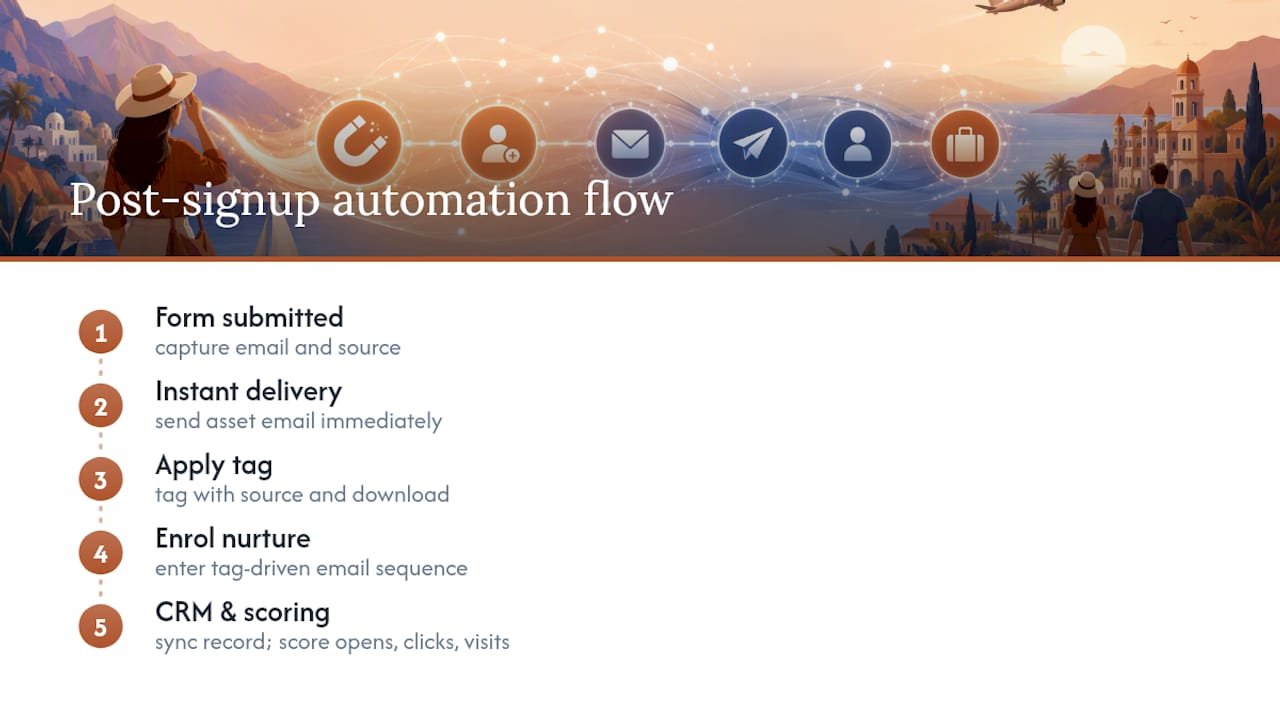
Tagging matters more than most travel professionals realise. If someone downloads your “Family Safari Budget Calculator,” that tag should trigger a nurture sequence built around family safari content, not your general newsletter. Someone who takes your destination quiz and gets tagged “adventure traveller” should never receive the same emails as someone tagged “luxury relaxation.” Most modern email platforms support this kind of conditional tagging without needing custom development.
The CRM side matters once a lead moves from “interested” to “in conversation.” At that point, you want every previous touchpoint, which guide they downloaded, which emails they opened, whether they clicked the deals page, visible in one record so a consultation call starts from context rather than a blank slate. This is also where lead scoring earns its keep: assign points for opens, clicks and page visits, and set a threshold that flags a lead as sales-ready rather than relying on gut feel.
Whichever tools you choose, the integration only works if the tag applied at signup carries through to every later automation. A lead magnet strategy without that connective layer is just a very expensive way to collect email addresses.
Legal considerations for travel lead magnets
Every lead magnet that collects an email address is subject to data protection rules, and travel professionals working with UK and EU travellers need to treat this as a design requirement, not an afterthought. Under GDPR, consent must be specific, informed and freely given, which means a pre-ticked “yes, sign me up for offers” box next to your download button doesn’t meet the standard. Use a clear, unticked checkbox with plain language explaining what the subscriber is opting into.
Your privacy note on the landing page needs to say what you’ll do with the data, how long you’ll keep it, and how someone can withdraw consent. This doesn’t need to be lengthy: a single sentence with a link to a full privacy policy usually satisfies both the regulation and the reader’s patience.
For the email sequence itself, every message needs a working unsubscribe link and a clear sender identity, requirements that sit at the heart of both GDPR and the US CAN-SPAM Act if any of your subscribers are based in the United States. Don’t disguise a promotional email as a personal one, and don’t continue emailing someone who has unsubscribed, even if they later fill in a different form on your site.
One detail travel professionals often miss: if your lead magnet asks for passport details, dates of birth, or health information as part of a “personalised” itinerary tool, that’s sensitive data requiring extra care in storage and handling. Keep data collection at the lead-magnet stage limited to name, email, and basic trip preferences, and gather anything sensitive later, inside a secured booking process.
Designing lead magnets that look good on a phone
Most travel research and lead magnet downloads now happen on a phone, often while someone is scrolling in bed dreaming about a trip they haven’t booked yet. That single fact should shape every design decision you make.
Keep your PDF guides in a single-column layout. A two-column magazine-style spread that looks elegant on a laptop screen becomes an unreadable mess when squeezed onto a phone, forcing readers to pinch and zoom their way through your best content. Use large, legible fonts, generous white space, and images that compress well without losing detail, since a beautiful destination photo means nothing if it takes ten seconds to load on mobile data.
For itinerary templates built in Google Sheets, test the mobile view specifically. Sheets can look cramped on a small screen unless you widen key columns and freeze the header row so travellers can scroll without losing track of which day they’re looking at.
Colour and imagery matter more in travel than in almost any other category, because the emotional pull of a destination is half the sale. Use real photography where you can, ideally your own or licensed images specific to the destination in question, rather than generic stock shots that could belong to any beach in the world. A guide about hiking in Patagonia should look and feel like Patagonia, not like a template with the location swapped out.
Finally, make the call-to-action button impossible to miss on a small screen. A pale grey “Download Now” button that blends into the background costs you conversions you’ll never see in your analytics, because the person simply gave up scrolling.
Segmenting leads by travel interest and demographics
Not every subscriber wants the same follow-up email, and treating them as one undifferentiated list is one of the fastest ways to kill engagement. Segmentation starts the moment someone downloads a lead magnet, because the asset itself tells you something about intent.

Someone who downloads a luxury honeymoon guide is a different lead from someone who grabs a budget backpacking checklist, even if they both end up on your general list without tagging. Split by trip type first: family, romance, adventure, luxury, solo. Then layer in a second dimension where you can, budget range, travel frequency, or preferred destinations based on quiz answers or which guide they chose.
Demographic segmentation matters too, though it’s easy to overdo. Age bracket and travel-with-kids status change what content resonates: a 60-something couple planning a milestone anniversary trip wants different reassurance than a 28-year-old planning a solo gap year. Where you can capture this naturally, through a quiz question or a simple form field, use it to branch your nurture sequence rather than sending identical emails to both groups.
The practical payoff shows up in your open rates. A segmented list built around actual downloaded content and quiz answers routinely outperforms a single generic newsletter, because every email feels like it was written for the specific person reading it rather than blasted to everyone at once.
Where lead magnets are heading next
AI-driven personalisation and first-party data activation will define the next wave of travel marketing gains. If you do one thing in the next 90 days, test a single segmented lead magnet against a quiz-driven tag sequence and measure the qualified-lead difference yourself.
— Sam
A platform route for turning leads into managed bookings
Once your lead magnet is generating enquiries, the next bottleneck is usually fulfilment: contracts, supplier logins, financial protection, and the admin of turning an enquiry into a paid, protected booking. That’s the specific gap a white-label travel agency platform is built to close.
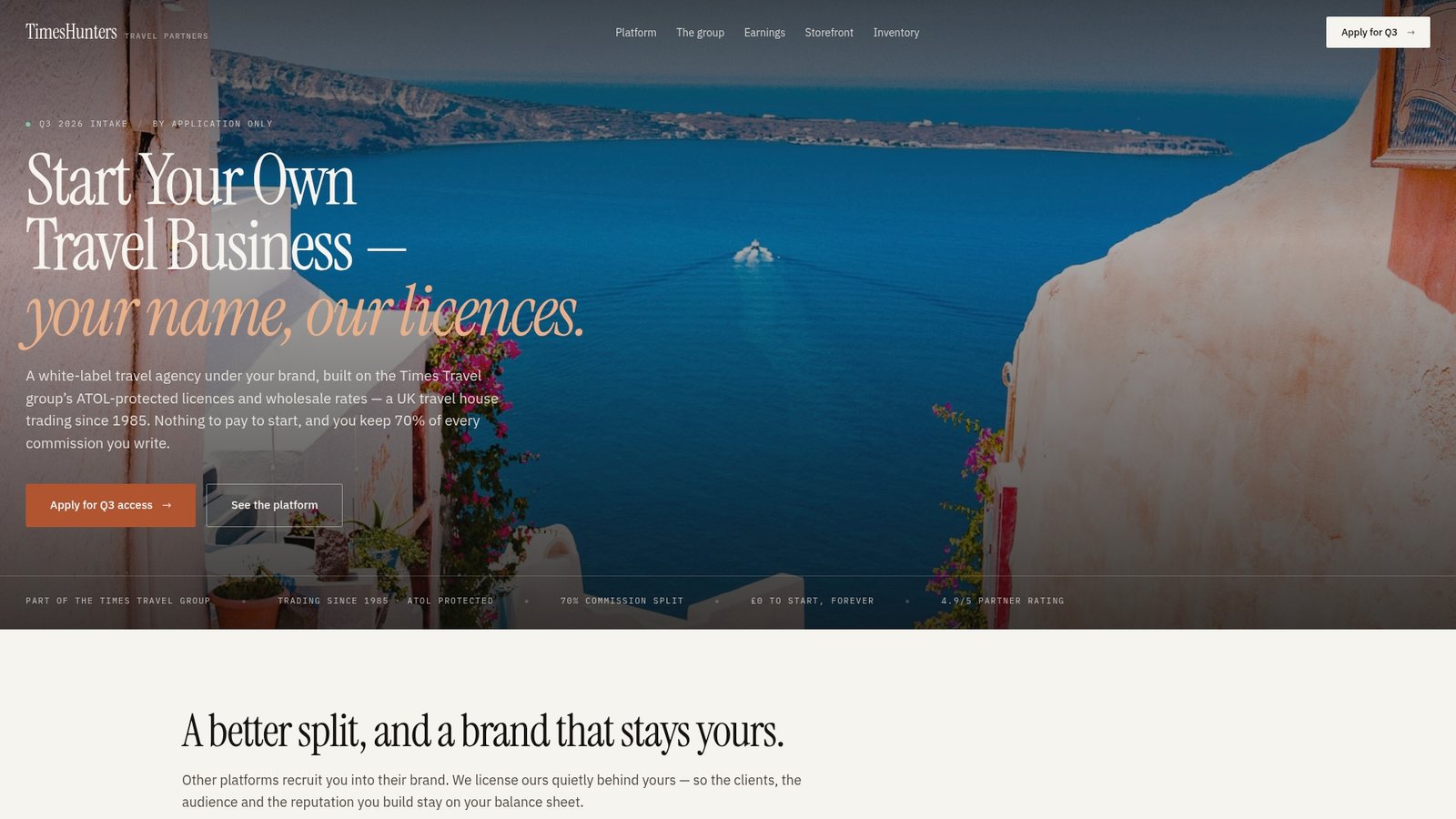
A white-label travel agency platform can offer travel entrepreneurs a branded booking site, access to wholesale hotel, cruise and tour inventory, and ATOL-protected licences, enabling leads generated by your guide, itinerary template or quiz to convert into bookings without needing your own supplier contracts or back-office systems. If you’ve built the lead magnet and the nurture sequence and want a faster route from enquiry to fulfilled, protected booking, see how the Timeshunters platform works.
Sources
- Lead Magnets For Travel Agencies: How To Capture More Enquiries 🧲
- Five ways to boost marketing ROI across travel
- Moz: travel marketing whiteboard/friday
FAQ
Do lead magnets still work for travel businesses?
Yes. Destination guides, itinerary templates and quizzes remain among the highest-converting formats in travel, with dedicated landing pages reported converting at 25 to 40% when the offer matches a specific traveller’s need.
How can I get free leads for a travel agency?
Build one tightly scoped lead magnet, a destination guide or budget calculator, put it behind a simple landing page, and promote it through organic search, social video and partnerships, all channels with no ad spend required.
What are the best lead magnets for travel professionals?
Destination guides, editable itinerary templates, budget calculators and segmenting quizzes perform best because each solves one specific planning problem rather than offering generic advice.
How do I generate leads as a travel agent without a big budget?
Focus on organic promotion and partnerships first: optimise your landing page for long-tail searches, share short video previews of your guide on social media, and swap promotion with a complementary local business.
Do I need a CRM to run travel lead magnets effectively?
Not initially, but tagging leads by which asset they downloaded and connecting that tag to an automated email sequence makes nurture and segmentation far easier to manage as your list grows.