
Static vs dynamic hotel rates: how each works and what it means for agents
Static and dynamic hotel rates explained: how each is set, when each makes sense and what it means when you sell hotels under your own travel brand in the UK.

A static hotel rate is fixed in advance for a long period, usually a season or a set weekday and weekend pattern. A dynamic rate moves, sometimes several times a day, with demand, availability and competitor prices. If you sell hotels to your own clients, you will meet both, and knowing which one sits behind a quote helps you price proposals, time bookings and protect your commission.
This guide explains the difference in plain terms, shows how each model is built, sets out the advantages on both sides and then turns it into practical habits for a travel business.
TL;DR
- Static rates are set ahead for a season or fixed pattern and ignore day-to-day demand. Dynamic rates respond to demand, booking pace and competitors, and can change by day or even hour.
- A predictable weekday-versus-weekend or high-season uplift is not automatically dynamic pricing. The test is whether the price reacts to observed market conditions.
- Static suits contracted, corporate and wholesale business. Dynamic suits fast-moving, price-driven markets such as city centres and airports.
- For an agent, the practical skill is quoting with a clear validity window and a margin that survives a rate move.
- Under your own brand with our platform, you keep 70% of the commission on each booking, so the rate model behind a quote matters to your earnings.
Table of Contents
- What static and dynamic hotel rates actually are
- How hotels set each type of rate
- Advantages and drawbacks for the hotel
- What it means when you sell hotels under your own brand
- Advertising and consumer rules in the UK
- Our perspective
- Start your own branded travel business
- A short checklist before you quote a hotel
- FAQ
- Sources
What static and dynamic hotel rates actually are
A static rate is a price list. The hotel decides what each room type costs, often with a standard weekday rate, a higher weekend rate and uplifts for peak periods, and then leaves it alone. SiteMinder’s guide describes static rates as unaffected by changes in traveller demand or competitor behaviour. Lighthouse gives a simple picture: one fixed rate from November to March and a higher fixed rate from April to October.
A dynamic rate changes as conditions change. The UK Government’s dynamic pricing update of 20 June 2025 defines the practice as prices adjusted rapidly and frequently in response to demand, and names hotels among the sectors that use it. Cvent describes it as changing day to day or hour to hour using real-time supply and demand data.
A seasonal price is not always a dynamic one
This is the point most guides blur. Consumer Scotland’s insight report on dynamic pricing separates prices that respond frequently to specific observed conditions from prices set in advance for general seasonal or time-of-use patterns. A higher August rate published in January is a static, seasonal decision. A rate that rises on Tuesday because a conference has filled the district is dynamic.
| Static rate | Dynamic rate | |
|---|---|---|
| Set | In advance, for a season or fixed pattern | Continuously, as conditions change |
| Reacts to demand | No | Yes |
| Typical change frequency | Once a season or a few times a year | Daily, sometimes several times a day |
| Main strength | Predictability, simple administration | Captures demand peaks, fills quiet dates |
| Main weakness | Under-sells in peaks, over-priced in troughs | Can confuse buyers and needs oversight |
| Typical home | Contracted corporate, wholesale, long stays | City-centre, airport and other fast markets |
How hotels set each type of rate
Static: the rack rate and what hangs off it
Most static structures start from a rack rate. The HSMAI Academy glossary defines it as the standard benchmark price a hotel assigns to a room type for the year or season, with other rates, such as group discounts or premiums, built from it.
A simplified way to arrive at one, as Altexsoft’s rate guide lays out, is annual costs plus target profit, divided by 365 and by the number of rooms you expect to fill each night. Its worked example uses $1,800,000 of costs, $360,000 of target profit and 75 occupied rooms to reach roughly $79. Real hotels use richer models, but the logic shows why a static rate is a planning decision made months before a guest arrives.
The same guide treats a rack rate and discounts taken from it as static, while discounts applied to a best available rate (BAR) are dynamic. That is a useful rule of thumb when you read a rate sheet: ask what the discount is a percentage of.
Dynamic: a loop, not a single price
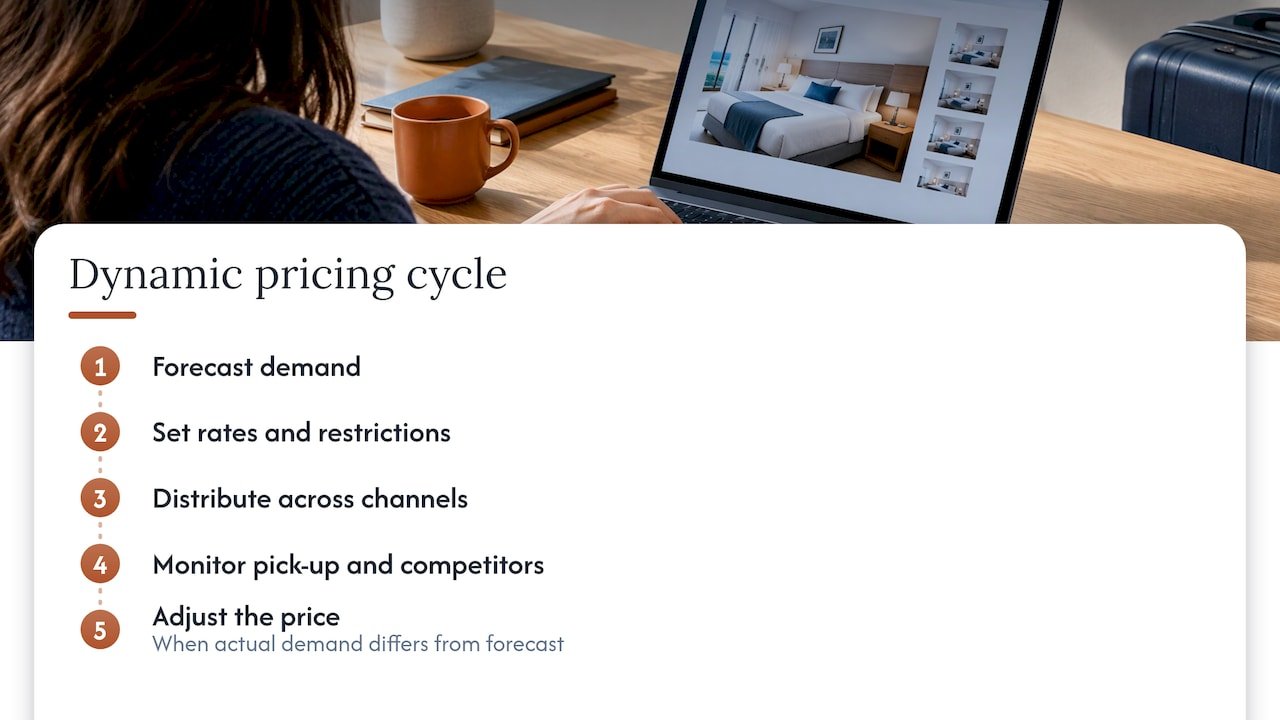
Dynamic pricing is a repeated cycle. Catala Consulting describes it as forecasting demand, setting rates and restrictions, distributing them across channels, monitoring pick-up and competitors, then adjusting when actual demand drifts from the forecast.
The inputs are broad. RoomRaccoon lists booking pace, lead time, seasonality, day of week, local events, weather, traveller behaviour and competitor rates. The government update adds that a dynamic price generally reflects actual demand, including current bookings, remaining capacity and the time left until the stay.
How often the price moves varies. A London boutique hotel reported in a vendor case study that its rates changed three to four times a day after it adopted automated pricing, alongside an 18% revenue increase. That is one company’s account of its own results, so treat it as an illustration of cadence, not proof of what the method delivers. Catala makes a fair point here: how often prices change matters less than whether each change is backed by a forecast.
Software can publish changes straight to booking channels or recommend them for a revenue manager to approve. Smaller properties often sit in between. Beds24’s documentation distinguishes fixed prices covering a date range from daily prices set date by date, and notes the two can be combined: fixed prices for rates set ahead with few seasons, daily prices where frequent adjustment is needed.
Advantages and drawbacks for the hotel
You sell on behalf of hotels, so it helps to see why they choose what they choose.
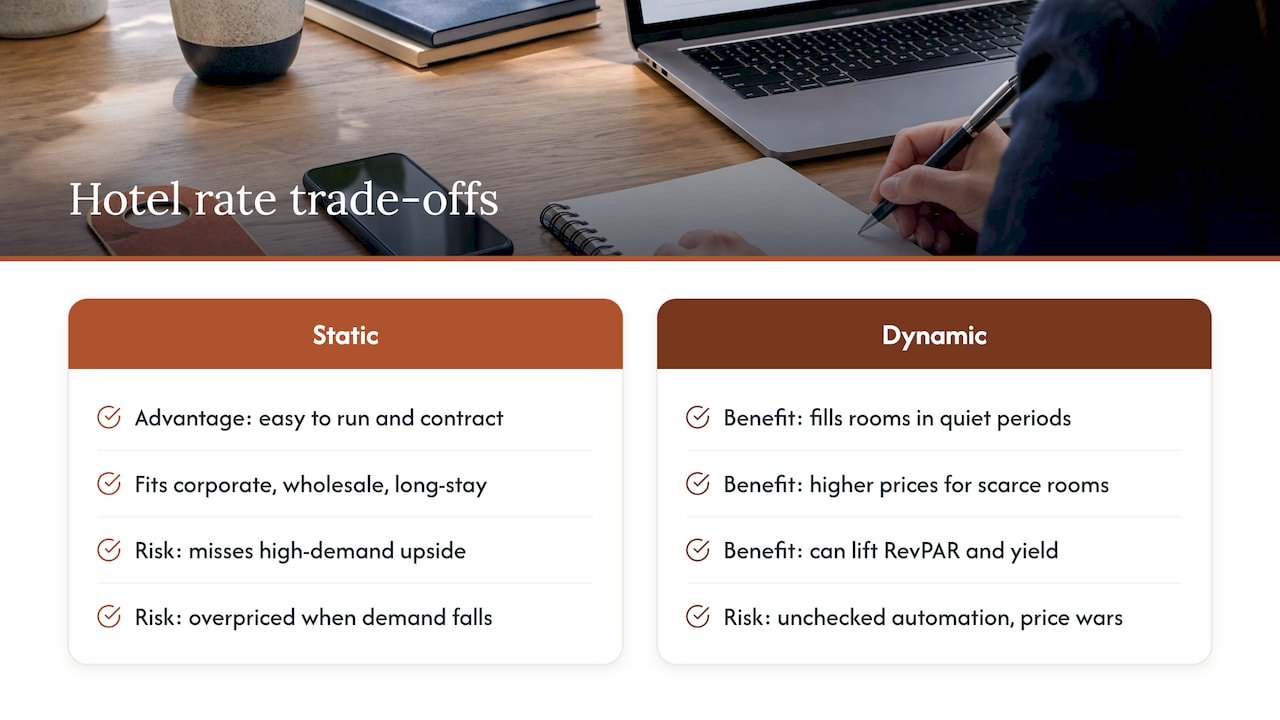
Why hotels use static rates. They are easy to run and easy to contract. Ramsi describes static rates as suited to contracted corporate, wholesale and long-stay business, at the cost of revenue upside in high-demand periods. Lighthouse names the main limitation: a hotel can undersell when demand rises, or sit overpriced when demand falls.
Why hotels use dynamic rates. SiteMinder lists stimulating occupancy in quiet periods, selling scarce remaining rooms at higher prices, better forecasting and faster responses to competitors. The UK government update notes that dynamic rates can help firms use capacity better and maximise profit, while consumer outcomes depend on transparency, alternatives and whether people understand how prices may vary. A critical review of revenue-management research reaches a similar view: dynamic pricing can lift RevPAR and yield, but should be applied carefully with clear booking terms.
What can go wrong with dynamic. Catala flags confusing rate swings, price wars, unchecked automation and conflict between direct and online travel agency channels. UK consultancy Right Revenue warns that an algorithm watching only demand can push a standard room’s price close to, or above, a superior room’s. Catala’s safeguards are rate floors, clear rules and regular review.
Where each model fits best
Right Revenue says dynamic pricing tends to work best for hotels with transient, price-driven guests in fast-moving markets, such as city-centre or airport locations. A countryside inn with repeat guests and long lead times may do perfectly well with seasonal static rates.
The corporate market shows the middle ground. A Business Travel News Europe report from August 2024 quotes UK hotel consultant Jutta Moore saying dynamic rates are easier for hotels to manage and give more certainty about yield, but pass price risk to corporate buyers when demand is strong. Buyers value fixed or last-room-availability rates for certainty. The compromise it reports is static rates staying open in low-demand periods, with dynamic rates taking over in high-demand ones.
What it means when you sell hotels under your own brand
The advice above is written for hoteliers. If you are the agent in the middle, the same mechanics decide how you quote, when you book and what you keep.
Quote with a validity window
A dynamic price you quote on Monday may not exist on Thursday. Build a short validity into every proposal and say so plainly to the client. Static or contracted rates give you more room, since they hold across a season, so you can quote further ahead with confidence. Whichever applies, the clear, early information Consumer Scotland describes as the heart of the issue is also simply good service: clients can compare, decide and book without surprises.
Work out your margin on the rate you will actually book
Your earnings come from the commission on the booking, so a rate move changes your result. Our guides on net rates and cash flow and tour operator commissions show how to calculate what you take home per booking before you promise a price.
Expect price differences between sellers
The same room can show different prices on different sites, because each seller works from its own rate, timing and terms. The same effect occurs in other travel products, as this piece on why prices differ between websites shows for show tickets. Your edge as an independent agent is not to chase the lowest headline number but to give a client a considered, well-explained proposal under a brand they trust.
Match the rate type to the trip
- Fixed-date, long-lead trips such as a wedding or a group stay: ask for rates that hold across the dates, so your quote does not drift.
- Last-minute city breaks: expect movement and book promptly once the client agrees.
- Packages: when you combine hotel, flights and transfers, the hotel element is one input among several. Our piece on dynamic packaging looks at building those offers.
- Cruises and tours: these are usually priced on published fares and departures rather than nightly hotel rates, which is why our wholesale cruise rates guide treats them separately.
Advertising and consumer rules in the UK
Dynamic pricing is not unlawful in itself. Consumer Scotland says transparent dynamic pricing, with clear and correct information given in good time, is acceptable, but hotel marketing and sales remain subject to the Consumer Protection from Unfair Trading Regulations 2008.
The Advertising Standards Authority’s ruling on Hilton Worldwide is a useful marker for anyone who advertises hotel prices. It held that “from” price claims must be substantiated, that a significant proportion of rooms should be available at the advertised price across a range of dates, and that using a dynamic pricing system did not remove the advertiser’s responsibility under the CAP Code. If you publish “from” prices on your own site or social channels, build them on rates you can actually book across a spread of dates.
Our perspective
Most of the writing on static and dynamic rates is aimed at hotel revenue managers. Agents rarely get a say in how a hotel prices, so the useful question for you is different: how do you build a business that is steady whichever model sits behind a quote?
Our view is that the answer is ownership. When you sell under your own brand, the client relationship is yours, and so is the proposal. Rates will move, but your service, your follow-up and your reputation do not. That is why we built our platform around a 70% commission split for partners, with automated booking management, instant pricing proposals and managed payments that take the admin out of moving prices.
We would rather you spend your time advising clients than refreshing rate sheets. Our model is designed to give you access to wholesale inventory across hotels, cruises, tours, villas, safari camps and rail, with ATOL-protected licences behind you and no cost to start.
Sam
Start your own branded travel business
If you already have clients, an audience or a hospitality background, you can turn that into bookings under your own name. With our white-label platform you get a branded booking site, instant pricing proposals, managed payments and financial protection, automated client follow-up and training, and you keep 70% of the commission on each booking.
See how it works on our white-label travel agency page, or read how hoteliers and agents compare bedbanks with white label. If you want the full picture of the numbers first, our UK cost playbook for home agents walks through what it takes to break even.
A short checklist before you quote a hotel
- Identify the rate type. Is it a seasonal static rate, a discount from a rack rate, or a price tied to a best available rate?
- Note the validity. Write the date until which the price holds, then confirm it before the client pays.
- Check the room type. Dynamic systems can narrow the gap between room categories, so be sure you are quoting the room your client wants.
- Calculate your commission on the quoted price, not on last week’s.
- Follow up quickly. Automated reminders help here. See our guides to travel agency automation and booking confirmation automation.
- Record what you told the client, including any “from” wording, so that your marketing matches what you can deliver.
FAQ
What is the main difference between static and dynamic hotel rates?
Static rates are fixed in advance for a season or a standard weekly pattern and do not react to demand. Dynamic rates change frequently, by day or even hour, based on demand, booking pace, availability and competitor prices.
Is a weekend or high-season price dynamic pricing?
Not necessarily. Consumer Scotland distinguishes prices that respond to observed market conditions from prices set in advance for general seasonal or time-of-use patterns. A published weekend uplift is usually static, while a price that shifts because rooms are selling fast is dynamic.
What is a rack rate and is it static?
A rack rate is the standard benchmark price a hotel sets for a room type for a year or season, according to the HSMAI Academy. Other rates are built from it, and it is generally treated as static. It is a reference point, not always what guests pay.
Is dynamic hotel pricing legal in the UK?
Yes, when it is transparent. Consumer Scotland says clear, correct and timely information makes dynamic pricing lawful in itself, but sales and marketing must still comply with the Consumer Protection from Unfair Trading Regulations 2008. The ASA also expects “from” prices to be substantiated.
Which is better for a travel agent selling hotels?
Neither is better in itself. Static or contracted rates give you stability for quoting far ahead, while dynamic rates reward quick, well-judged booking. What matters is a clear validity window and a margin that holds. Our platform is designed to handle the proposal and booking admin so you can focus on clients.
Sources
- Update: dynamic pricing, GOV.UK
- Dynamic Pricing: a Consumer Scotland insight report
- ASA Ruling on Hilton Worldwide Ltd
- Rack rate, HSMAI Academy
- Hotel revenue management: a critical literature review
- RFP 2025: Choosing the right rate type, Business Travel News Europe
- Hotel dynamic pricing: complete guide, SiteMinder
- Static pricing vs dynamic pricing, Lighthouse
- Hotel dynamic pricing complete guide, Cvent
- Hotel dynamic pricing guide, RoomRaccoon
- Hotel dynamic pricing strategies, Catala Consulting
- How to increase your hotel ADR, Right Revenue
- Rack rates, wholesale rates, BAR: guide to hotel prices, Altexsoft
- Dynamic rate vs static rate, Ramsi
- Eccleston Square Hotel customer story, Mews
- Category: Prices, Beds24 Wiki