
Tour Operator Commissions: Calculate Your Net Per Booking Earnings
UK agents: calculate net per booking pay, manage host splits and delayed payouts, and see when a white label partner can boost your commission cut.

Tour operator commissions typically pay agents between 10% and 20% of the commissionable booking value, with cruises averaging around 16%, hotels sitting lower at 10–15%, and travel insurance paying the most at 20–40%. Clients almost never pay extra for using an agent, because suppliers build the commission into the retail price rather than adding it on top.
TL;DR:
- Cruise commissions average around 16%, with higher rates for luxury ships and tiered overrides for high-volume bookings.
- Agents earn 10–20% on tours and land packages, but international operators and wholesalers may offer up to 30%, especially with volume or tiered structures.
- Payment is usually made after travel, with typical split arrangements like 90/10 or 80/20, and delays can impact cash flow significantly.
- Commissions are calculated on the commissionable amount after taxes and non-commissionable fees, often resulting in an average net income of about 10% of the total trip value.
- Controlling staff or client relationships and negotiating better tiered rates or volume overrides can significantly increase an agent’s earnings.
Table of Contents
- How tour operator commissions actually work
- What are typical commission rates by supplier?
- How do host splits and payment timing affect cash flow?
- How to calculate what you actually earn per booking
- Practical ways to increase your commission income
- Contract terms and red flags to watch for
- Why does TimesHunters change the per-booking maths?
- How do commissions affect what your client pays?
- Domestic versus international operator commission differences
- What rules and standards govern commission payments?
- What are the tax implications of commission income?
- How should agents track their commission payments?
- Where commission models are actually heading
- Why consider Timeshunters if you want a bigger share of your bookings
- Sources
- FAQ
How tour operator commissions actually work
A tour operator commission is a percentage of a booking’s value that a supplier pays to the agent who sold it, in exchange for bringing them a paying customer. The catch is that “booking value” rarely means the full price the client pays.
Suppliers pay commission on what’s called the commissionable portion, not the total invoice. Taxes, government fees, and airline seats are usually stripped out before the percentage gets applied. Cruise lines strip out non-commissionable fees, or NCFs, before calculating what’s owed. A £2,000 cruise booking might have only £1,600 of it actually earning commission once port charges and taxes are removed.
Two payment models dominate the industry:
- Percentage commission: the standard model, where the operator pays a fixed percentage of the commissionable fare, typically set in a contract or rate sheet.
- Net rate: the agent buys at a wholesale price and sets their own retail markup, effectively creating their own margin rather than earning a published percentage.
Net rates show up most often with tour wholesalers, ITOs, and destination management companies, where agents who assemble their own packages can build in higher effective margins than a flat percentage would allow.
Suppliers pay commission at all because agents solve a customer acquisition problem for them, and it’s cheaper than paid advertising for a repeat, trust-based sale. Payment usually lands after the client has travelled, not at the point of booking.
What are typical commission rates by supplier?
Rates shift depending on what you’re selling and who you’re selling it through. Cruises commonly pay commissions around the mid-teen percentage range, tours and land packages sit in a wide 10–20% band, and insurance is consistently the best-paying category on the sheet.
| Supplier / product type | Typical commission range | Notes |
|---|---|---|
| Cruises | 10–20% (avg ~16%) | Applied to fare, not port taxes or NCFs |
| Tours and packages | 10–20% | Wholesalers and ITOs can offer 25–30% tiers |
| Hotels | 10–15% | Luxury and boutique properties often pay more |
| All-inclusive resorts | 10–15% | Similar to standard hotel rates |
| Travel insurance | 20–40% | Highest-paying category for most agents |
| Car rentals / transfers | ~10% | Low but consistent |
| Flights | 0–2% | Usually covered by a service fee instead |
Luxury and boutique operators tend to pay above the standard band because their margins are wider and their bookings are harder to replace. Group tours can trigger volume overrides, extra commission points once an agent hits a booking threshold with a particular operator, which is where tiered structures of 25–30% start appearing for wholesalers and destination partners.
One thing that quietly erodes these numbers: booking through a marketplace. Platforms such as Viator commonly take around 20% from the operator’s side, and operators paying for better placement can hand over 25–30%. That cost gets absorbed somewhere, and it’s rarely the marketplace eating it.
How do host splits and payment timing affect cash flow?
Getting paid on time matters as much as the headline rate, and this is where a lot of new agents get caught out. Suppliers typically settle commission after the client has actually travelled, not when they book, and terms of net 30, net 60, or even net 90 days post-departure are standard.
If you’re working under a host agency rather than holding your own supplier contracts directly, your split with the host determines what actually reaches your account:
- 90/10: agent-favourable, usually reserved for agents with an established book of business or high volume.
- 80/20: a common mid-tier arrangement for agents with a steady booking history.
- 70/30: typical for newer agents or those relying heavily on the host’s support and back-office systems.
- 0% plus flat fee: some hosts charge a fixed monthly or per-booking fee instead of taking a percentage, which can favour high-volume agents.
Overrides can shift these splits upward once you hit certain sales thresholds, and some hosts offer early-payment options at a discount, trading a slice of the commission for faster access to cash.
Pro Tip: Map out your expected payout dates against your fixed costs before you commit to a host. A 90/10 split is worthless if the money lands 90 days after you needed it.
How to calculate what you actually earn per booking
The formula is straightforward once you strip out the noise: commissionable amount × supplier rate × your split = your gross commission, minus any platform or host fees taken before the money reaches you.
- Identify the commissionable amount (total price minus taxes, air, and non-commissionable fees).
- Multiply by the supplier’s published commission rate.
- Multiply by your host split, if you work under one.
- Subtract any platform, card processing, or host administration fees.
Here’s how that plays out in practice:
The industry average nets agents around 10% of total trip value once non-commissionable elements are stripped out, though negotiated splits and higher-value products push that up considerably. Before you bank on any figure, check the invoice for these items: what’s genuinely commissionable, whether taxes and fees are itemised separately, the exact rate quoted in your contract, and any platform deduction applied before your split.
Practical ways to increase your commission income
Small, deliberate changes to what and how you sell move the needle far more than chasing a slightly better base rate.
- Prioritise insurance on every booking; it pays 20–40% and takes minutes to add.
- Charge a service fee on air-only bookings, where supplier commission is often 0–2%.
- Negotiate tiered commissions or volume overrides once you’re generating consistent bookings with a supplier.
- Track every commissionable component separately rather than trusting the headline invoice total.
- Join a consortium or a strong host agency if it genuinely improves your split or your access to better-paying suppliers.
Operators themselves use tiered commission as a lever to get their product prioritised over a competitor’s, so don’t be afraid to ask what a higher volume commitment would unlock.
Pro Tip: Build your own custom packages from wholesale components where you can. Controlling the pricing on each element often beats waiting for a supplier to raise your percentage.
Contract terms and red flags to watch for
Read the payment section of any supplier or host contract before the marketing pitch. That’s where the real terms live.
- Check how cancellations and retained deposits are treated. Some contracts pay you nothing if a client cancels, even after final payment.
- Look for payment-withholding clauses that let a supplier delay or reduce commission for vague “compliance” reasons.
- Watch for chargebacks being deducted from your commission rather than the supplier absorbing the loss.
- Confirm who owns the client data. Marketplace-style platforms often keep the customer relationship, which limits your ability to rebook that client directly.
- Insist on written terms covering reporting cadence, override triggers, and a sample payout schedule before you sign anything.
Why does TimesHunters change the per-booking maths?
Timeshunters runs a white-label platform that lets agents launch a branded travel business using ATOL-protected licences through the Times Travel group, rather than working under a standard host split. The headline difference is the partner share: Timeshunters offers partners 70% commission on bookings, compared with the roughly 4% typical of online travel agency arrangements.
How do commissions affect what your client pays?
Clients rarely notice commission on their invoice, because it’s baked into the retail price rather than itemised separately. The supplier sets a retail rate, builds the agent’s commission into it, and the client pays that rate whether they book through an agent or go direct. This is why price-matching a supplier’s own website is usually possible; the commission comes out of the supplier’s margin, not the client’s pocket.
Where it gets more interesting is at the margin edges. Luxury and boutique operators, who pay higher commission rates of 15% or more, often have more pricing headroom to begin with, so a generous commission doesn’t necessarily inflate what the client pays relative to booking direct. Budget and high-volume suppliers, by contrast, tend to run tighter margins, which is part of why flights pay agents next to nothing: there’s little room in the fare to share.
Package pricing complicates things further. When an agent assembles a custom package from wholesale components rather than reselling a fixed operator product, the margin they apply is genuinely their own decision, not a supplier-set percentage. This can mean two agents quoting wildly different prices for what looks like a similar itinerary, because one is working off a published commission and the other is pricing a bespoke assembly. For the client, the practical takeaway is simple: commission structures explain why agents can match direct prices without losing money, but they don’t guarantee that every agent’s price for a comparable trip will be identical.
Domestic versus international operator commission differences
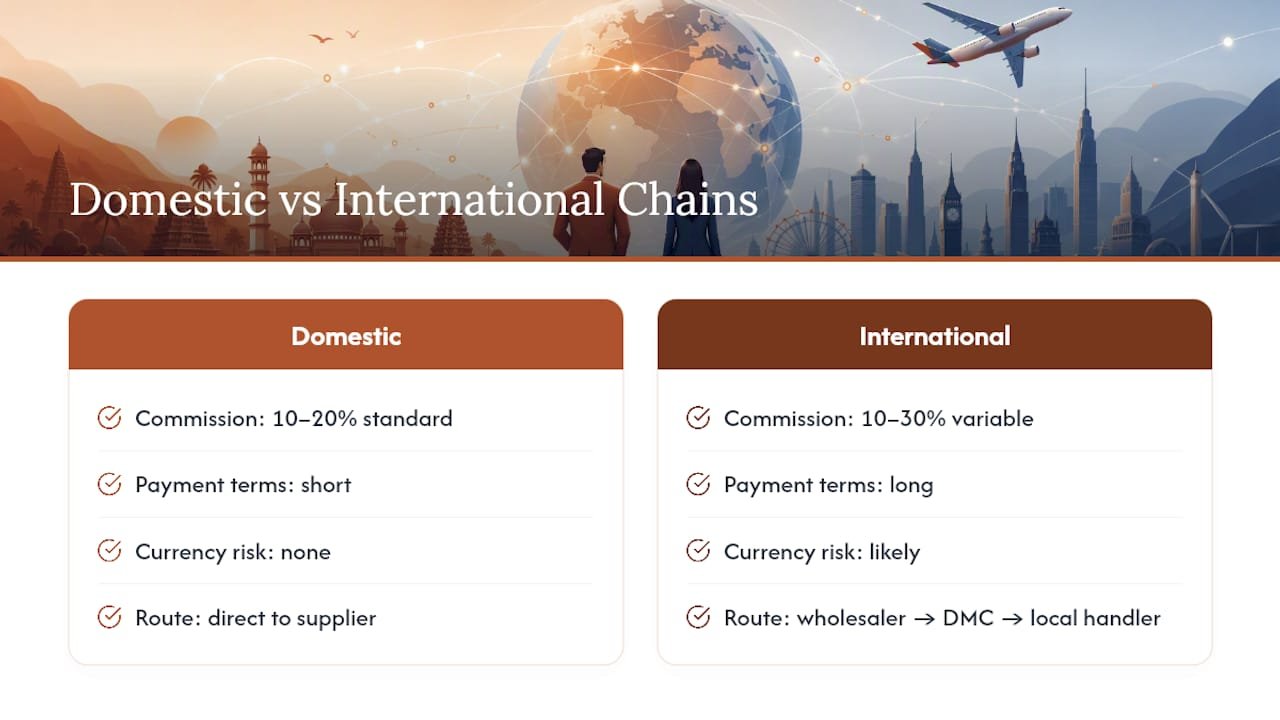
Domestic tour operators, selling trips within the agent’s home market, tend to run simpler, more standardised commission sheets. Rates are usually published upfront, negotiation room is limited unless you’re generating serious volume, and payment terms are shorter because the operational chain between booking and departure is shorter too.
International and cross-border operators, particularly wholesalers, inbound tour operators (ITOs), and destination management companies operating overseas, tend to work with more flexible, negotiated structures. For example, the 10–20% retail band can stretch to 25–30% fixed or tiered rates, depending on the agent’s role in the distribution chain and how much of the ground arrangement they control.
Currency exposure is the other major difference. A domestic booking settles in the agent’s home currency with no conversion risk. An international operator quoting in US dollars, euros, or a local destination currency introduces exchange-rate movement between the time a rate is agreed and when commission is actually paid, particularly on the long payment terms common with overseas suppliers. Agents working heavily with international wholesalers should factor this into their cash-flow planning rather than assuming the quoted rate is the rate they’ll bank.
Distribution layers also multiply internationally. A domestic hotel might pay you direct. An international resort might route through a wholesaler, a destination management company, and a local ground handler before commission reaches you, and each layer can take a cut or add a delay. The headline rate an international operator advertises is not always what lands in your account once the chain between you and the supplier is accounted for.
What rules and standards govern commission payments?
There’s no single statutory rate that sets tour operator commission in the UK; the percentage itself is a commercial negotiation between agent and supplier, not a regulated figure. What is regulated is the framework around who’s liable for the money and the holiday if something goes wrong.
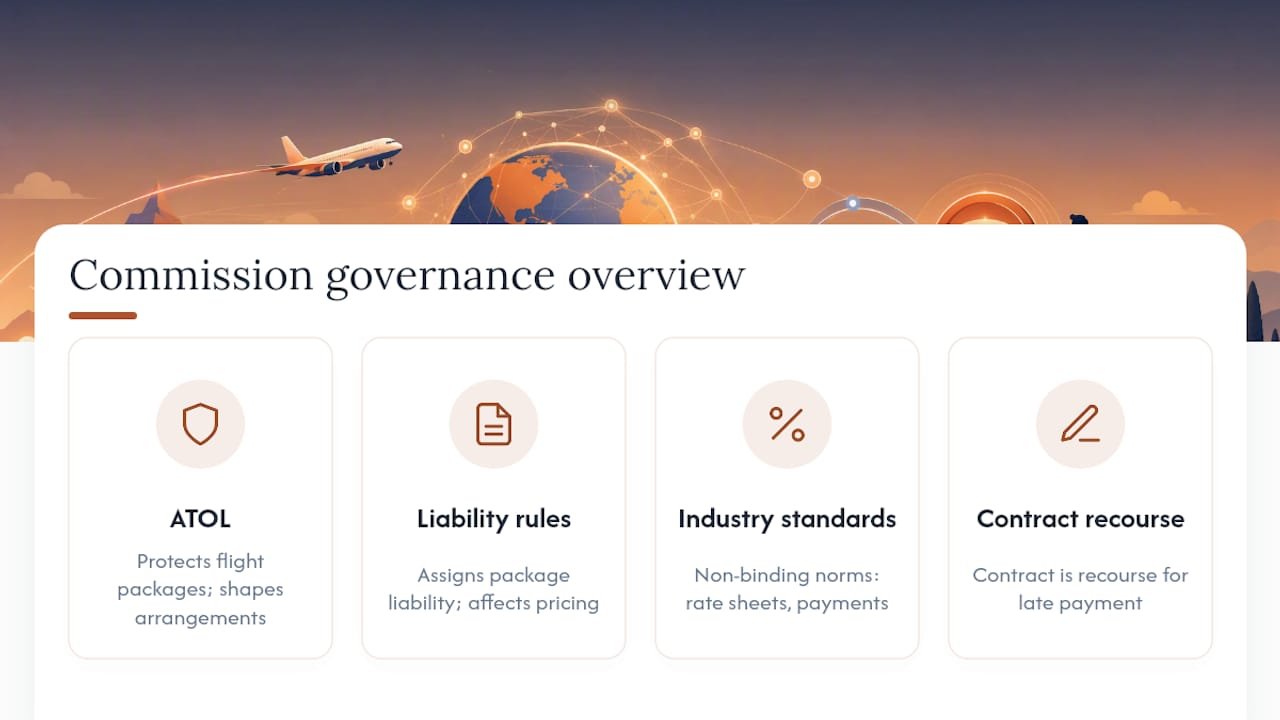
ATOL protection, administered by the UK Civil Aviation Authority, governs financial protection for package holidays that include a flight element, and it shapes how agents and operators structure their commercial relationships. An agent selling under someone else’s ATOL licence, as happens in white-label and host arrangements, is operating under that licence holder’s regulatory umbrella rather than holding their own.
Consumer protection law, particularly the Package Travel and Linked Travel Arrangements Regulations, determines who’s liable when a package falls apart. This indirectly affects commission because operators price liability risk into what they’re willing to pay agents. A supplier bearing full package liability often runs a tighter margin than one where liability sits elsewhere in the chain, and that shows up in the commission on offer.
Industry standards, as opposed to law, come from trade bodies and consortia that set best-practice expectations around transparent rate sheets, timely payment, and clear disclosure of non-commissionable fees. None of this is legally binding, but agents who work with operators and hosts adhering to those norms tend to see fewer disputes over what’s owed and when. There’s no regulator you can appeal to if a supplier simply pays late; your recourse is contractual, which is exactly why the terms in your agreement matter more than any published rate.
What are the tax implications of commission income?
Commission is taxable income, and how it’s taxed depends entirely on how you’re structured, not on the fact that it’s called “commission” rather than a salary or fee.
Self-employed agents and sole traders must declare commission income through Self Assessment, and it’s taxed alongside any other trading income once allowable expenses are deducted. Those operating through a limited company, which is common for higher-earning agents and consortium members, have commission paid to the company and then face separate decisions around salary, dividends, and Corporation Tax rather than personal Income Tax on the gross figure.
VAT registration becomes relevant once turnover crosses the compulsory threshold, and travel commission has its own quirks under the Tour Operators’ Margin Scheme (TOMS) for agents who buy and resell travel as principal rather than acting purely as an agent for the supplier. Whether TOMS applies depends on the legal structure of the transaction, not on what you call yourself, so it’s worth clarifying with an accountant early rather than assuming standard VAT rules apply.
Timing matters too. Because commission often lands 30, 60, or even 90 days after departure, income can arrive in a different tax year from the booking that generated it. Agents who don’t track this carefully sometimes misreport income in the wrong period, which creates avoidable headaches at Self Assessment time. None of this is a substitute for proper advice; a qualified accountant familiar with travel trade income should confirm how it applies to your specific structure.
How should agents track their commission payments?
Commission that isn’t tracked is commission that quietly goes missing, and with net-30 to net-90 payment terms spread across multiple suppliers, it’s easy to lose sight of what’s owed and when.
A practical tracking system logs, for every booking: the commissionable amount, the agreed rate, the expected payment date, and the actual date and amount received. Spreadsheets work for low volume, but they break down fast once you’re juggling dozens of bookings across different suppliers with different payment cycles. This is where automated commission tracking tools reduce administrative leakage and catch discrepancies that a manual process misses, particularly when a supplier underpays against the rate sheet.
Reconciliation should happen monthly at minimum, comparing what you expected against what actually landed in your account. Discrepancies are common enough that treating them as routine, rather than exceptional, saves a lot of frustration. Flag anything unpaid past its expected date immediately rather than waiting for a quarterly review, because chasing a supplier three months late is a far harder conversation than chasing them one week late.
Keeping supplier-by-supplier records also strengthens your negotiating position. When you can show an operator exactly how much volume you’ve sent them and how reliably you’ve been paid, you’re in a far stronger spot to ask for a tiered rate or an override than if you’re working from memory and a rough sense of how things have gone.
Where commission models are actually heading
Platform-driven distribution is squeezing traditional percentage commissions from both ends: marketplaces take a cut and keep the client relationship, while suppliers increasingly favour direct booking to avoid paying anyone at all. The agents doing best aren’t the ones chasing the highest published rate. They’re the ones controlling their own client list and choosing distribution partners who let them keep more of what they sell.
— Sam
Why consider Timeshunters if you want a bigger share of your bookings
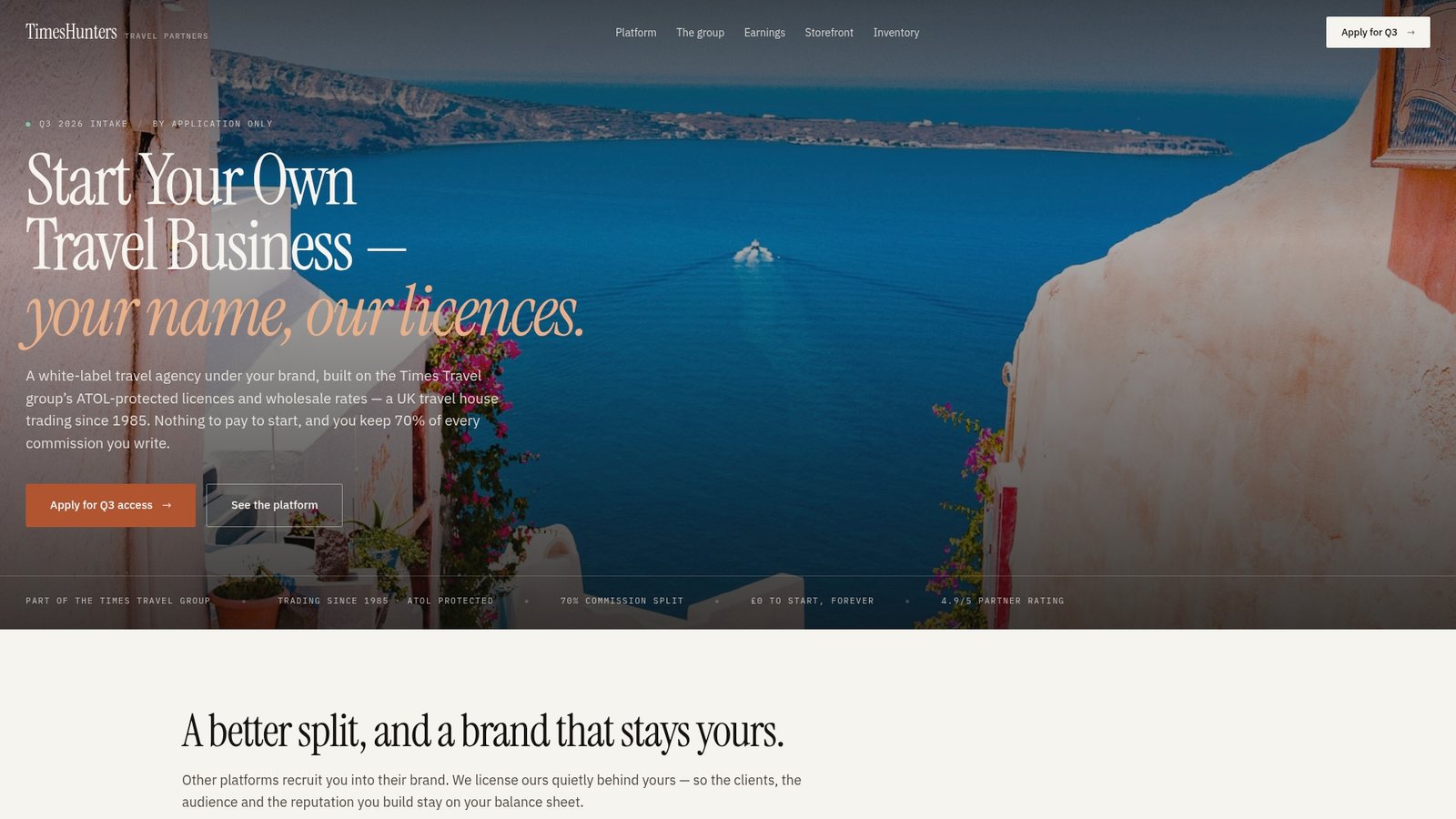
You get your own booking site, access to wholesale rates across hotels, cruises, and tours, automated booking management, and control over your client list. Some partners report increased income per booking after switching to this model. If the per-booking calculations in this article have made you rethink what your current split is actually costing you, visit the Timeshunters website to see how the partner model works and what it would take to get started.
This article is general information, not a substitute for advice from a qualified financial advisor. Consult a qualified financial professional about your own circumstances before acting on anything here.
Sources
- Travel Agency Commission: 7 Rates That Maximise Your Profit · TravelBoost
- How Much Commission Should You Give Travel Agents? · Rezdy
- Travel Agent Commission Structures: Rates & Terms (2026) · DMCQuote
- Commission & margin management in travel sales – 2025 guide · Rework Resources
FAQ
Do travel agents get 70% off?
Not typically as a discount.
How much commission do Hays Travel agents make?
Specific commission rates for individual agencies aren’t publicly listed, and they vary by supplier, product type, and internal arrangement, much like other UK travel agencies.
How much extra do you pay to use a travel agent?
Clients generally pay nothing extra. Suppliers build the agent’s commission into the retail price, so the price is typically the same whether you book direct or through an agent.