
Protect Cash Flow: 5 Contract Checks for Travel Agent Net Rates
Protect cash flow when selling net rates: pricing examples, reconciliation steps, a 5 point contract checklist, and a white label option.

A net rate is the confidential price a supplier gives you before you add your own markup on top. That single fact reshapes everything about how you price and bank a booking: you receive the full gross payment from the client, but only the markup you added is actually yours. The rest belongs to the supplier and has to be paid out. Confuse the two and you’ll spend money that was never your income to begin with.
TL;DR:
- Net rates are best suited for bespoke, group, and corporate travel where volume and negotiation allow for higher margins above the supplier’s confidential cost.
- Managing net-rate bookings requires strict bookkeeping practices, including separate accounts for supplier funds and detailed booking ledgers to avoid cash flow issues.
- Before signing private net rate contracts, agents should clarify payment timing, cancellation policies, currency risks, allotment guarantees, and confidentiality clauses.
- Common pitfalls include mistaking gross payments for profit and mixing net and commission bookings in the same account, which can lead to cash shortfalls.
- Using a professional booking platform and infrastructure, like white-label solutions, helps agents sell net-rate inventory efficiently under their own brand.
Table of Contents
- What is the difference between travel agent net rates and commission?
- Which suppliers commonly offer net rates?
- How do you calculate markup and margin on a net rate?
- How do you reconcile net-rate bookings without losing money?
- What should you check before agreeing a net rate contract?
- Common pitfalls to avoid with net rates
- Where net rates deliver the most value for agents
- Selling net-rate inventory under your own brand
- Sources
- FAQ
What is the difference between travel agent net rates and commission?
The two models move money in almost opposite directions. Under a net rate, you’re told a confidential wholesale cost, you set your own retail price on top, and you collect the full amount from the client yourself. The supplier then invoices you for their net cost, and whatever’s left is your margin. Under a commissionable model, you sell at the supplier’s published retail price, the supplier (or their merchant of record) usually collects the client’s payment, and they pay you a commission afterwards, often weeks later.
That timing difference is the whole story for cash flow.
- Net rate: you hold the client’s money first, owe the supplier later, and your margin is whatever’s left after that payment clears.
- Commission: the supplier (or a booking platform) holds the money, and you wait for a cheque or bank transfer that may not land until after departure.
Here’s how identical retail prices produce very different outcomes. Say a hotel room retails at £300 a night. Sold on a net rate of £220, you bank £300 immediately and owe the hotel £220, leaving £80 margin sitting in your account until settlement day. Sold on commission at 15%, you never touch the £300. You simply wait for £45 to arrive from the supplier, usually after the guest has stayed.
Which suppliers commonly offer net rates?
Net rates cluster around products where suppliers want volume, control, or a longer-term relationship rather than one-off retail sales. If you’re deciding where to spend your negotiating energy, this is the shortlist that tends to pay off:
- Destination management companies (DMCs) and ground handlers, particularly for bespoke itineraries and small groups.
- Group and tour operators, where block allotments and negotiated contracts are standard.
- Corporate travel accounts, where volume and repeat business justify a private rate.
- Villas, safari camps, and boutique properties that prefer to protect their public rate card.
Suppliers offer net terms because it lets them keep a clean, consistent published price while quietly rewarding the agents who bring volume or difficult-to-fill inventory. DMC net rates, in particular, often sit 20–40% below public pricing because of allotments and local contracting leverage. This is exactly the gap you convert into margin. Commodity products, meanwhile, mostly stay commissionable. Scheduled flights, mainstream package holidays, and most branded hotel chains sold through GDS or standard distribution still pay a fixed commission because there’s no room, or no appetite, to negotiate a private cost.
How do you calculate markup and margin on a net rate?
The maths is simple once you separate two numbers that too many agents blend together: the net cost and the retail price you charge.
- Get the net cost from the supplier contract or allotment sheet.
- Decide your markup percentage based on product type, competitor pricing, and how much service you’re providing.
- Calculate retail price: net cost × (1 + markup%).
- Margin is retail price minus net cost, before any card fees or overheads.
Three quick examples show how this plays out across product types:
- A hotel room at a £150 net cost marked up 20% retails at £180, leaving £30 margin.
- A day tour at a £60 net cost marked up 30% retails at £78, leaving £18 margin.
- A group package at a £900 net cost per person marked up 18% retails at £1,062, leaving £162 margin per head.
Typical industry ranges put hotel commissions around 10 to 25%, tours and activities commonly between 15 and 35%, and net-rate markups generally landing in the 15 to 30% band. A £150 hotel room at 20% commission pays you £30. The same room bought net at £150 and sold at a 30% markup pays you £45, and you’re holding the cash days or weeks before you settle the supplier invoice. That gap is the entire case for learning net rates properly.
How do you reconcile net-rate bookings without losing money?
The single most damaging mistake in travel bookkeeping is treating the gross amount a client pays as spendable revenue. It isn’t. Most of it is supplier liability sitting in your account temporarily, and only the markup belongs to you.
Good reconciliation practice keeps that distinction visible at every stage:
- Keep a ring-fenced account or clearly labelled “pot” for supplier funds, separate from your operating cash.
- Run a per-booking ledger showing net cost, markup, and outstanding supplier liability, not just a total in and total out.
- Match every supplier invoice against the original booking reference, never against a lump summary payout.
- Provision conservatively for cancellations and refunds, since you may need to return client money before the supplier has repaid you.
Multi-currency bookings add another layer: exchange rate movement between booking and settlement can quietly erode a thin margin, so factor a buffer into your markup on anything invoiced in a foreign currency.
Pro Tip: Reconcile against the booking, not the bank statement. A single lump payout covering four separate bookings will hide a shortfall on one of them until it’s too late to fix cheaply.
What should you check before agreeing a net rate contract?
Before signing anything, work through this checklist with the supplier, and don’t be shy about putting it in writing:
- Payment timing: when exactly does the supplier expect settlement, and does that align with when you receive client funds?
- Cancellation policy: what refund do you get if the client cancels, and by what deadline?
- Invoicing currency: is the net rate quoted and invoiced in the currency you’ll be paid in, or will you carry exchange risk?
- Allotment terms: are rooms or seats guaranteed, or released back to the supplier after a cut-off date?
- Rate parity and confidentiality: are you barred from publishing the net cost, and does the supplier guarantee you won’t be undercut on retail price?
Red flags worth walking away from include vague or unspecified settlement windows, aggressive chargeback clauses that let the supplier claw back funds without notice, and refund provisions so thin they leave you exposed if a client cancels late. A short, direct question during negotiation, such as asking exactly when funds are due and how disputes are resolved, often reveals more about a supplier’s reliability than the headline discount does.
Common pitfalls to avoid with net rates
Two mistakes account for most of the damage agents do to their own margins. First, mistaking the gross payment for profit and spending it before the supplier invoice lands. Second, running net-rate and commission bookings through one undifferentiated account, which makes it almost impossible to know your real cash position at any given moment.
- Keep a dedicated liability column per booking, not just a running total.
- Ring-fence supplier funds the moment they arrive.
- Provision for refunds before you count margin as available cash.
Pro Tip: If you can’t explain your cash position in one sentence, your books are mixing models. Separate them before your next reconciliation.
Where net rates deliver the most value for agents
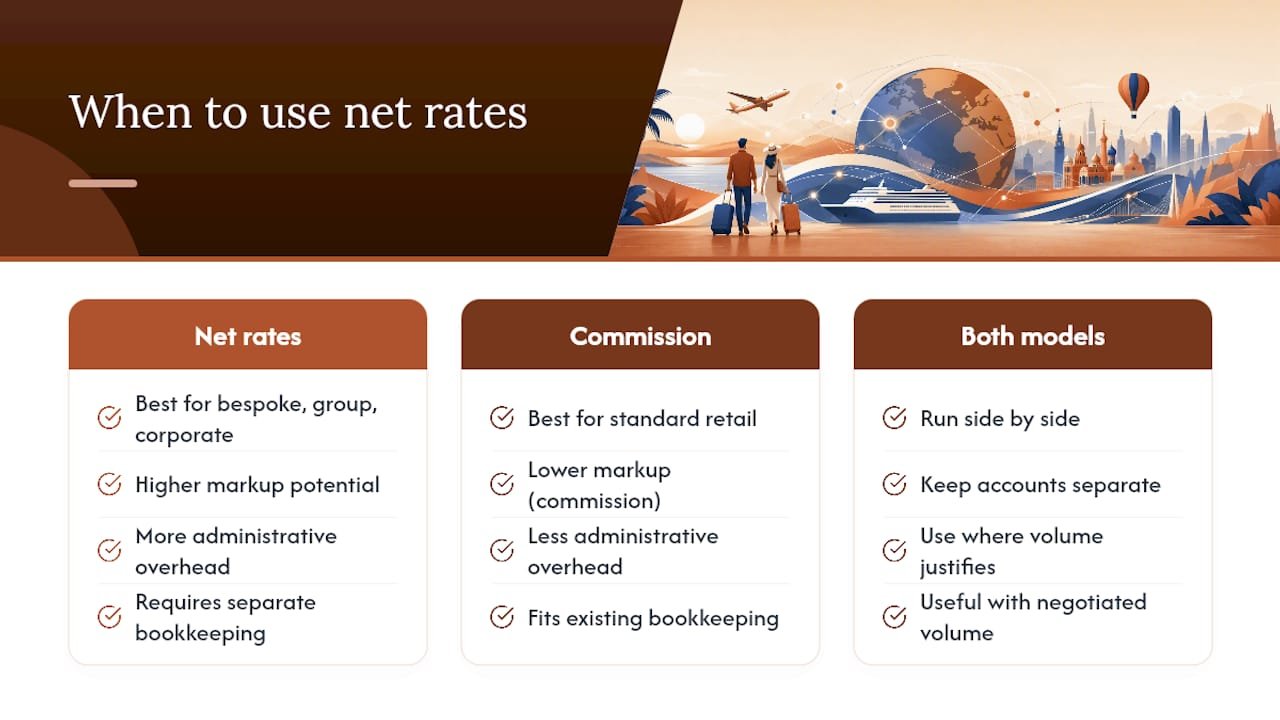
Net rates earn their complexity in bespoke, group, and corporate travel, where volume and negotiation give you real room to build margin above the supplier’s confidential cost. For standard retail products, commission still does the job with far less administrative overhead, and there’s nothing wrong with running both models side by side, provided your books keep them apart.
This isn’t a niche concern. Agents who structure their business around net-rate access to DMCs and group contracts consistently report markup potential well above the commission rates most retail agents settle for, a pattern borne out by the broader labour-market context for the profession. The agents who struggle aren’t the ones choosing net rates. They’re the ones who choose net rates without changing how they do their bookkeeping.
— Sam
Selling net-rate inventory under your own brand
Negotiating good net rates is only half the equation. You also need the infrastructure to sell them properly: a branded booking platform, ATOL protection, managed payments, and someone handling the reconciliation headaches described above. That’s the gap Timeshunters is built to close.
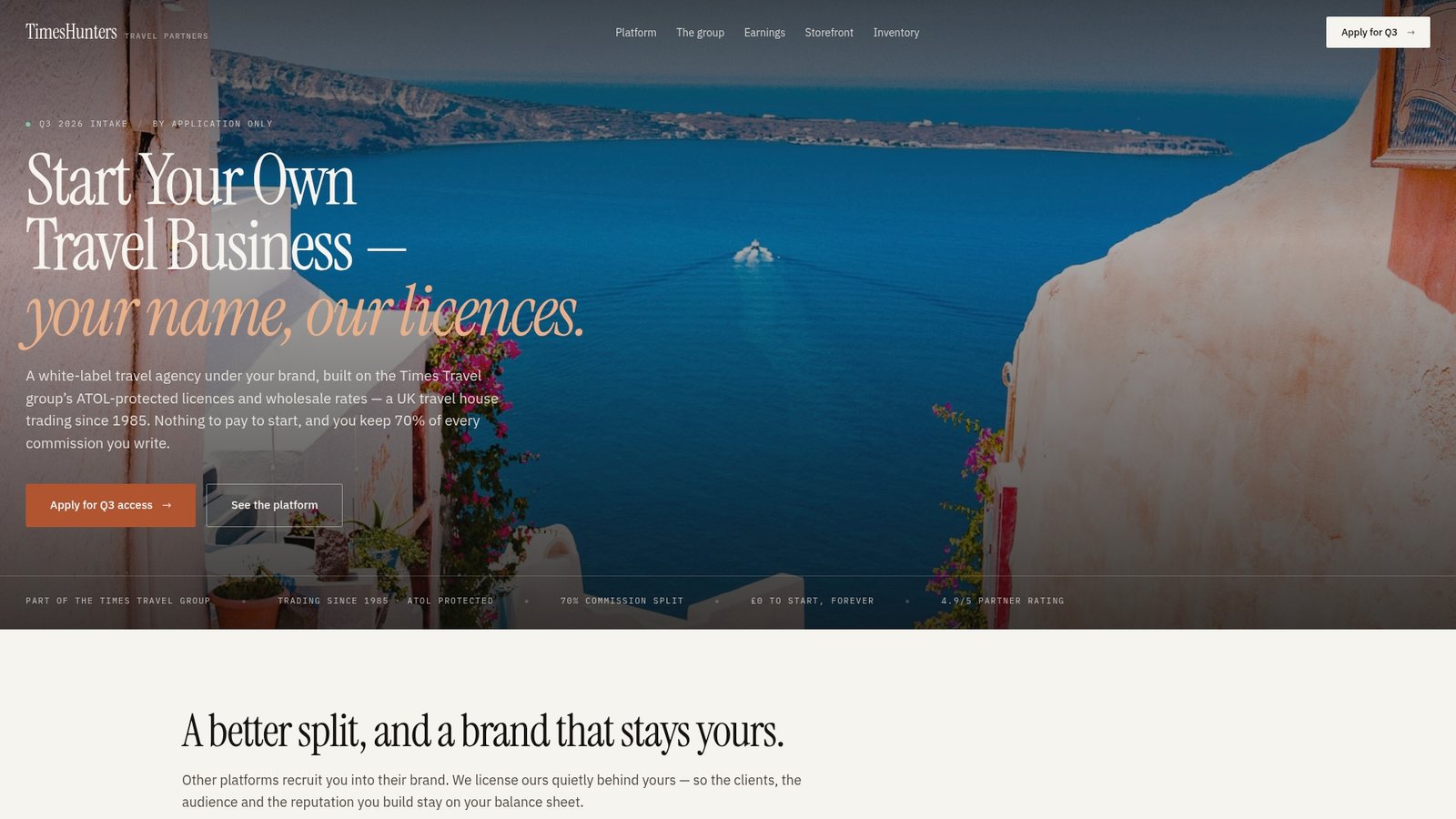
Timeshunters is a white-label travel agency platform: you launch a branded business under your own name, using Times Travel Group’s ATOL-protected licences, with access to wholesale hotel, cruise, tour, villa, safari camp, and rail inventory already negotiated at net rates. Partners receive a commission split on bookings, along with automated booking management and instant pricing proposals, so the arithmetic in this article turns into a working business rather than a spreadsheet exercise. It’s one route among several, and it suits agents who want the client relationship and brand ownership without building supplier contracts and reconciliation systems from scratch. If that’s your situation, explore the white-label travel agency details and see whether your current client list could carry a branded venture of its own.
Sources
- Net rates vs commission for travel – Altery
- Travel Agent Commissions: Rates, Models, and Tracking – SambaHQ
- How DMC net rates work (FIT vs GIT & agent margin) – Travel DMC
- Travel agents – Occupational Outlook Handbook – BLS
FAQ
What percentage do travel agents charge?
Markups on net rates commonly fall between 15 and 30%, while commission on published retail prices tends to sit around 10 to 25% for hotels and 15 to 35% for tours and activities. The exact figure depends on product type, supplier relationship, and how much service the booking involves.
Do travel agents get 70% off?
Discounts that large aren’t typical of standard net rates, which more commonly run 20 to 40% below public pricing for DMC and group contracts. Some white-label models, including Timeshunters, offer partners a 30% commission split on bookings, which is a different structure to a straight supplier discount.
Do travel agents earn good money?
Earnings vary enormously by business model and product mix, with commodity commission work paying far less than net-rate margins on bespoke, group, or corporate travel. Occupational data from the US Bureau of Labor Statistics gives useful broader context on how this profession’s pay compares across markets.
How much extra do travel agents charge?
On top of a net cost, agents typically add a markup in the 15 to 30% range, meaning a £150 net-rate hotel room might retail around £180. The exact figure depends on the product, the competitive landscape, and how much planning or service is bundled into the price.