
Win UK travel chargebacks: 120 day windows and £100–£30,000 rights
Practical UK guide to when to use chargeback, Section 75 or ATOL, what evidence wins, and how to escalate a refused claim to the Financial Ombudsman.

A travel chargeback is a card-scheme process, not a legal right: your bank asks the merchant’s bank to reverse a payment because a service went unpaid, undelivered, or was never authorised. If a booking has gone wrong, contact your card issuer straight away, ask about retrieval or chargeback, and gather every confirmation email, invoice, and refund refusal you have. Section 75 and ATOL cover different situations and are worth checking before you assume chargeback is your only option.
TL;DR:
- Most chargeback claims must be filed within approximately 120 days of purchase or the expected service date, but travel bookings made far in advance can extend this window due to the moving target of the service date.
- Section 75 provides a legal right for credit card purchases between £100 and £30,000, offering a stronger claim against the card provider than a chargeback, which is discretionary and available on both debit cards and small credit card transactions.
- Travelers should gather and submit evidence such as confirmation emails, cancellation notices, and proof of fraud quickly after a dispute arises to increase the chances of winning the chargeback or Section 75 claim.
- Merchants should maintain clear billing descriptors, attach confirmation records automatically, and handle refunds promptly to prevent disputes and reduce chargeback ratios.
- If a chargeback is refused, consumers can escalate to the Financial Ombudsman or pursue legal claims under Section 75, especially on higher-value transactions within the protected range.
Table of Contents
- What is a travel chargeback and why travel disputes work differently
- Chargeback vs Section 75 vs ATOL: which route should you use?
- How to file a travel chargeback: step-by-step
- Time limits, reason codes and the evidence that actually wins
- If a chargeback lands on your business: representment, costs and prevention
- If your chargeback is refused: Section 75, the Ombudsman and court
- Timeshunters’ view on booking hygiene that prevents disputes
- The gap between chargeback theory and what actually happens
- Sources
- FAQ
What is a travel chargeback and why travel disputes work differently
A chargeback moves through four parties: you raise it with your card issuer, the issuer contacts the merchant’s acquiring bank, and the acquirer passes the claim to the merchant, who can accept it or fight back. Visa’s own guidance describes chargebacks as a service issuers provide to reclaim funds for valid disputes, with most scheme windows requiring a claim within roughly 120 days of purchase or the expected service date.
Travel sits awkwardly inside that system because bookings are often made months before the service happens. A flight booked in January for a July holiday leaves a long gap in which prices change, suppliers go quiet, or plans collapse entirely, and cardholders sometimes miss the window because they didn’t realise the clock started at booking, not departure.
Common triggers include:
- A cancelled flight, hotel, or tour where the refund promised never arrives
- Only part of a package being delivered, such as a downgraded room or a cancelled excursion
- Transactions the cardholder never authorised or doesn’t recognise on a statement
- Confusing merchant descriptors that make travellers dispute a legitimate charge by mistake
That last point matters more than most travellers realise. A booking made through a white-label agent or wholesaler can show up under a name that means nothing to the cardholder months later, prompting an unnecessary and avoidable dispute.
Chargeback vs Section 75 vs ATOL: which route should you use?
These three protections overlap in the public imagination but work in completely different ways, and picking the wrong one wastes time you may not have.
Section 75 is a genuine legal right, not a goodwill gesture. Under the Consumer Credit Act 1974, UK Finance confirms that credit card purchases between £100 and £30,000 make your card provider jointly liable alongside the supplier for breach of contract or misrepresentation. This applies specifically to credit cards, not debit cards, and the transaction value (not the amount you paid on the card if you split payment) generally needs to sit within that band.
ATOL protects package holidays that include a flight. It isn’t a dispute mechanism at all; it’s insolvency protection, meaning it activates when your travel organiser collapses financially, covering refunds and repatriation. The Gov confirms ATOL remains the primary safety net for flight-inclusive packages, which is a different problem entirely from a supplier simply failing to deliver what was promised.
Chargeback is your fastest option and the only one available on debit cards, but it’s discretionary. Your issuer decides whether the evidence justifies a reversal.
- Paid by credit card over £100? Section 75 gives you a legal claim against the card provider, not just a scheme favour.
- Paid by debit card, or credit card under £100? Chargeback is usually your only card-based route.
- Booked a flight-inclusive package that collapsed? Check ATOL protection before anything else.
- Split the payment across cards or used a deposit? Only the portion charged to a qualifying card may carry Section 75 rights, so check each transaction separately.
How to file a travel chargeback: step-by-step
Speed and documentation decide most travel disputes. Here’s the order that gives you the best chance:
- Contact the merchant first. Request a refund in writing, note the date and time, and keep every reply (or note the silence if none comes).
- Call your card issuer once the merchant has refused, gone quiet for a reasonable period, or the service clearly hasn’t been delivered. Ask specifically whether they’ll raise a retrieval request or go straight to a formal chargeback.
- Gather your evidence pack before you’re asked for it: booking confirmation, supplier correspondence, refund refusal emails, payment receipts, and a short timeline of your attempts to resolve things directly.
- Submit and wait. Your issuer may issue a temporary credit while they investigate, though this isn’t guaranteed and can be reversed if the merchant successfully disputes your claim.
- Respond to any retrieval request quickly. This is the merchant’s chance to settle before a formal chargeback is even filed, and a fast, clear response here often ends disputes without further escalation.
Pro Tip: Screenshot everything the moment you notice a problem, not weeks later. Booking portals and confirmation pages have a habit of changing or disappearing once a supplier is in financial trouble, and a screenshot with a visible date beats a verbal description of what you remember seeing.
Expect your issuer to move in stages rather than give you an instant answer. Some claims resolve within days if the merchant doesn’t contest them; others take weeks, particularly where the merchant pushes back with a representment.
Time limits, reason codes and the evidence that actually wins
Filing windows and evidence requirements vary by what kind of dispute you’re raising, and mismatching evidence to reason code is one of the most common ways travellers lose winnable cases.
Visa’s guidance points to a typical 120-day window from the purchase date or expected service date for most scheme claims, though travel disputes can run longer depending on the specific reason code and circumstances, since “expected service date” for a holiday booked a year out is a moving target.
| Reason code family | What it covers | Strongest supporting evidence |
|---|---|---|
| Services not provided | Cancelled or undelivered travel service | Itinerary, supplier cancellation confirmation, dated communication timeline |
| Unauthorised / fraud | Transaction the cardholder didn’t make | Lack of successful 3D Secure authentication on the transaction |
| Credit not processed | Merchant promised a refund that never arrived | Refund confirmation emails, transaction or reference IDs |
| Duplicate or incorrect amount | Billed twice, or wrong amount charged | Bank statement showing both charges, original invoice |
For fraud-family disputes, a failed or missing 3D Secure authentication record is often the single most persuasive piece of evidence, because it shows the transaction wasn’t properly verified against the genuine cardholder.
If a chargeback lands on your business: representment, costs and prevention
Travel merchants sit on the receiving end of chargebacks constantly, and the process runs on strict deadlines. A dispute typically moves from retrieval request to formal chargeback, then to representment (your evidence-based rebuttal), and finally to pre-arbitration or arbitration if neither side backs down. IATA’s chargeback guidance notes that merchants often have just 14 to 21 days to assemble and submit evidence once a formal chargeback lands, so an organised evidence trail from the moment of booking isn’t optional.
Prevention beats representment every time. A few operational habits do most of the work:
- Use a billing descriptor that clearly matches your brand name, so a cardholder recognises the charge on their statement months later
- Refund quickly and confirm it in writing the moment a cancellation is genuine
- Attach a confirmation record to every booking automatically, rather than relying on staff to remember
- Apply 3D Secure to card-not-present transactions, which shifts liability away from you in many fraud disputes
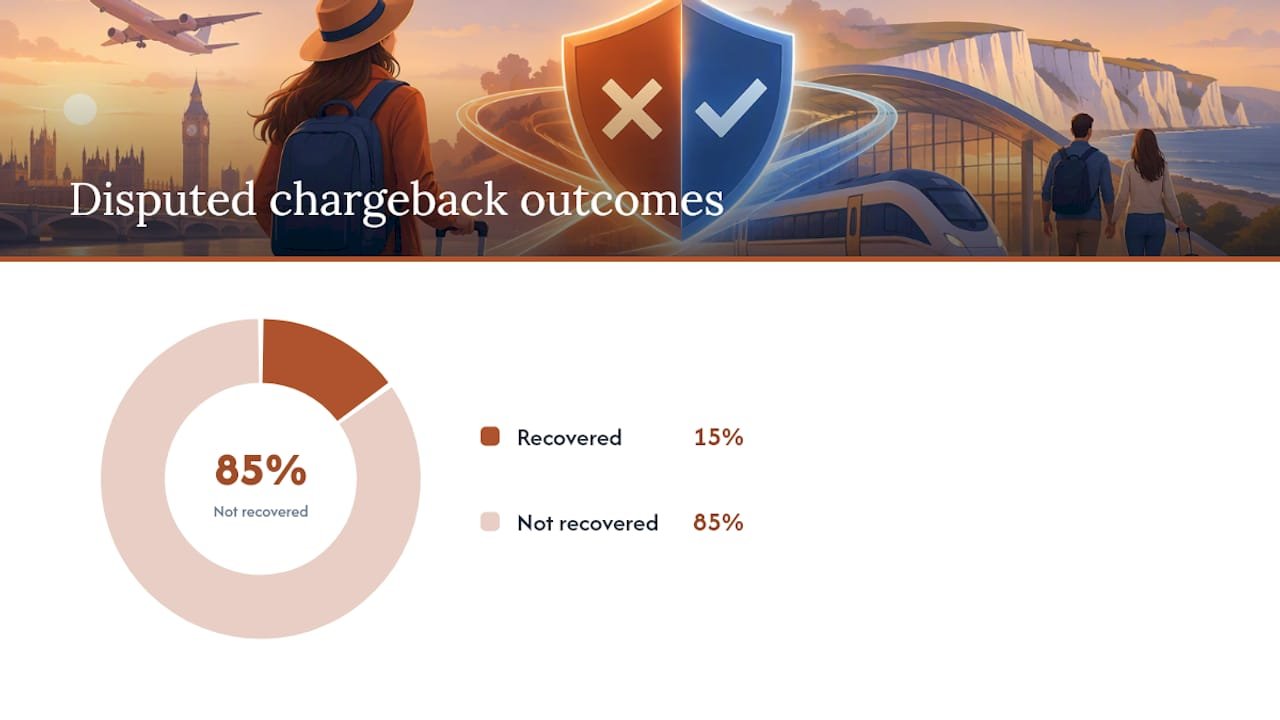
Travel and hospitality businesses recover roughly 15% of disputed chargebacks on average, a low figure that reflects how often travel merchants lose disputes simply because their evidence arrives late, generic, or incomplete rather than because the underlying claim was weak.
A high chargeback ratio doesn’t just cost the disputed amount either. Acquirers respond to persistent ratios by raising your merchant discount rate, holding a larger reserve, or in severe cases withdrawing processing altogether, which is a far bigger financial hit than any single refund.
If your chargeback is refused: Section 75, the Ombudsman and court
A refused chargeback isn’t the end of the road, and treating it as final is one of the most common mistakes travellers make.
- Check Section 75 first if you paid by credit card and the transaction sits between £100 and £30,000. This is a legal claim against your card provider, entirely separate from the chargeback scheme, and a chargeback refusal has no bearing on whether Section 75 applies.
- Escalate to the Financial Ombudsman Service if your card provider rejects a Section 75 claim you believe is valid. Ombudsman case decisions show that banks sometimes decline these claims incorrectly, and the ombudsman will examine the merchant relationship and breach of contract in detail rather than simply accepting the bank’s first answer.
- Consider small claims court only when the sum is significant and you have strong documentary evidence, since court action takes time and carries its own costs even when you’re likely to win.
Complaints to the Ombudsman are free, and a written decision often carries far more weight in future dealings with your bank than a phone call ever will.
Timeshunters’ view on booking hygiene that prevents disputes
Running a travel business under your own brand, as partners do on the Timeshunters platform, means the descriptor on a client’s statement should say something they’ll instantly recognise, not a generic processor name that triggers a needless dispute. That single detail resolves more “friendly fraud” chargebacks than any amount of paperwork after the fact.
Timeshunters partners work from ATOL-protected licences and keep access to wholesale hotel, cruise, and tour inventory alongside automated booking management, which means confirmation records and payment protection are built into the booking flow rather than bolted on afterwards.
A few habits worth building into any travel business, whatever platform you use:
- Attach supplier and payment confirmation to every booking the moment it’s made, not when a dispute arrives
- Confirm your billing descriptor matches the brand name your clients actually recognise
- Handle refund requests within days, not weeks, since delay is what turns a simple request into a formal dispute
The gap between chargeback theory and what actually happens
Most guidance on this topic treats chargebacks as a simple consumer right: something went wrong, so you dispute it, and the money comes back. That’s not what the evidence shows.
The advice that gets underweighted is sequencing. Too many travellers jump straight to chargeback without checking whether Section 75 gives them a stronger, legally enforceable claim, particularly on higher-value package bookings where £100 to £30,000 in Section 75 protection matters far more than a discretionary scheme reversal. Equally, too many small travel businesses treat a retrieval request as a formality rather than their best chance to end a dispute cheaply before it escalates.
If there’s one priority worth acting on immediately, it’s evidence discipline, on both sides of the transaction. Travellers should screenshot and file confirmations the day they’re issued. Merchants should attach evidence to bookings automatically. Waiting until a dispute lands is the single most common reason winnable cases get lost.
— Sam
Sources
- Chargeback: Debit & Credit Card Purchase Disputes — Visa UK
- FAQs – Chargeback rights and Section 75 — UK Finance
- Gov
- Chargebacks in travel — a practical guide | felloh
FAQ
Do airlines fight chargebacks?
Yes, airlines and travel merchants routinely contest chargebacks through representment, particularly where they hold clear evidence such as a completed service, a valid refund policy, or a 3D Secure authentication record. Merchants typically have a short window, often 14 to 21 days, to submit that evidence once a formal chargeback is raised.
What are valid reasons for a chargeback?
Valid reasons generally fall into a few families: services not provided (a cancelled flight or hotel), unauthorised or fraudulent transactions, credit not processed despite a promised refund, and duplicate or incorrect charges. Each reason code needs different supporting evidence, so matching your documentation to the correct category matters more than the strength of any single document.
What if my travel agent is not refunding my money?
Contact your card issuer and ask about a chargeback if the agent has refused or gone silent on a promised refund, keeping every email as evidence. If you paid by credit card and the transaction is between £100 and £30,000, Section 75 may also give you a direct legal claim against your card provider, separate from any chargeback outcome.
Are chargebacks usually successful?
Success varies significantly by reason code and evidence quality rather than being a fixed outcome. Travel and hospitality merchants recover roughly 15% of disputed chargebacks on average, which suggests cardholders with well-documented claims have a reasonable chance, but a chargeback is never guaranteed since issuers retain discretion over the outcome.