
Book More Clients: Travel Sales Scripts for UK Advisors, 3–5 Questions
Modular micro scripts and 3–5 discovery questions to book more clients. UK compliant openers, email templates and exact closes, and a repeatable playbook.

The fastest way to book more clients is a modular micro-script paired with consultative questioning: a short, adaptable opener plus a sequence of discovery questions that position you as an advisor rather than a price quote. Try this opener right now: “Hi, it’s [name] from [agency]. I work with travellers planning [destination type], and I had an idea that might suit your trip, do you have two minutes?” Then ask, listen, and let value lead the close.
TL;DR:
- Tailoring discovery questions to be scattered throughout the conversation increases booking success better than frontloading them at the start.
- Handling objections with clarifying questions or reframes improves trust and reduces cancellations, especially on price and timing concerns.
- Describing outcomes and emphasizing protected services help justify premium fees, leading to higher acceptance of higher-priced packages.
- Using a structured, modular script library and reviewing recordings weekly enhances consistency and confidence in sales calls.
- Scripts should serve as guides, not cages, with honest listening and quick mistake correction forming the foundation of long-term client relationships.
Table of Contents
- Copy-ready scripts for phone, email and follow-up
- How to ask better discovery questions
- Scripts for the common objections that kill bookings
- Language and framing to justify premium fees
- Exact closing lines and next-step CTAs that increase conversion
- Concise booking obligations to mention on calls
- Turning scripts into a repeatable sales playbook
- Why scripts should guide, never grip
- Sources
- FAQ
Copy-ready scripts for phone, email and follow-up
A good script is not a monologue, it is a set of interchangeable parts you assemble on the fly. Keep each piece short enough to say in under thirty seconds.
Phone opener (pattern interrupt plus credibility):
“Hi, it’s [name], I help travellers find [niche, e.g. adults-only Caribbean resorts] without the usual booking headaches. I noticed you’d looked at [destination], can I ask what’s driving the trip?”
Discovery micro-script (three to five questions):
- “What’s the occasion or reason behind this trip?”
- “Who’s travelling, and what matters most to them?”
- “Have you been somewhere similar before, and what did you love or hate about it?”
- “What’s your rough window for travel dates?”
- “Is there a budget range you’re comfortable sharing, or should I work within a few options?”
Presentation script (desire into benefit):
“Based on what you’ve told me, you want somewhere quiet but with enough going on for the evenings. I’d put you in [property], it’s got the adults-only pool you mentioned and it’s a ten-minute walk to the old town, so you get both in one trip.”
Assumptive close:
“I’ll get the booking confirmation sent to you today, does [email] still work?”
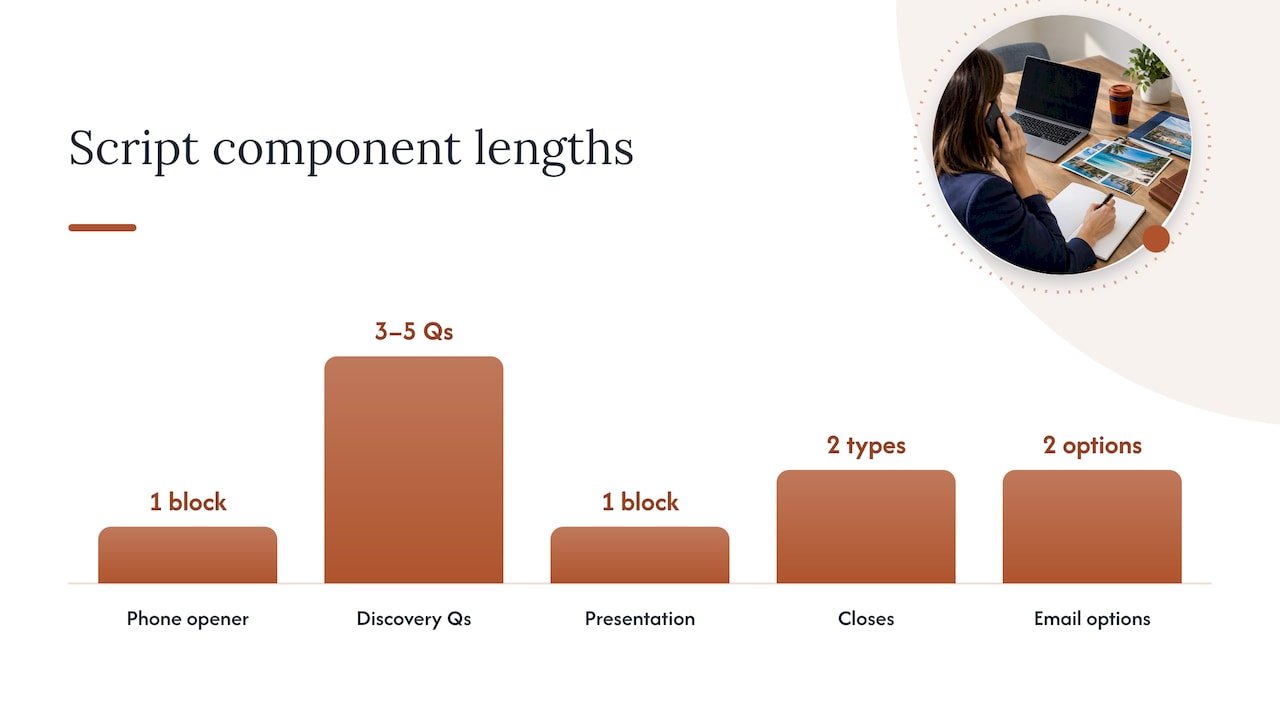
Conditional close:
“If I can hold this rate and confirm availability by tomorrow, are you ready to put down the deposit?”
Email follow-up template:
- Thank them for the call and restate the trip’s purpose in one line.
- Attach the proposal with two options, never more than three.
- Close with a single question: “Shall I hold Option 1 while you decide?”
Short, modular blocks like these travel well. Swap the destination, the client detail and the proof point, and the same skeleton works across niches, a point. Practitioner guidance on modular micro-cards backs up directly.
How to ask better discovery questions
Discovery works best when it is spread across the whole call rather than dumped at the start. Analysis of large-scale sales conversations found that 11 to 14 discovery questions is the optimal range, with performance dropping once agents ask more than that, and that scattering questions throughout the conversation improves conversion compared with frontloading them.
- Open: “What does a perfect trip look like for you?”
- Probing: “You mentioned relaxation matters, what does that mean day to day?”
- Follow-up: “You said you’d want flexibility, is that about dates or about the itinerary?”
Switch from discovery to presentation once you can restate the client’s priority back to them accurately: “So the trip needs to feel effortless and private, that’s the brief I’m working to.” That restatement does double duty, it confirms you listened and it sets up the pitch.
Pro Tip: Aim to speak less than the client does on a discovery call; silence after a question usually produces the most useful answer.
Scripts for the common objections that kill bookings
Objections are rarely final answers, they are requests for more clarity. Handle them with a reframe, not a discount.
- Price: “I hear you, can I ask what you’re comparing it against? Most of our rate includes [protection, transfers, support] that a cheaper quote often leaves out.”
- Timing: “That’s fine, shall I hold this rate for 48 hours so you’re not deciding under pressure?”
- Trust or safety: “Everything we book is financially protected, and you’ll have a direct line to us if anything changes while you’re travelling.”
- DIY instinct: “You can absolutely build this yourself, I just save you the hours of comparing providers and the risk of missing the fine print.”
Offer an extra, such as a room upgrade or late checkout, only after the client has said yes in principle, never as a rescue tactic. Practitioner guidance on agent performance consistently warns against late-stage desperation discounts, recommending a restatement of priorities and protections instead.
Language and framing to justify premium fees
Price objections usually disappear when the client sees the booking as the logical outcome of what they already said mattered.
- Describe outcomes, not features: “You land, bags are at the hotel, and you’re on the terrace with a drink before the kids even unpack.”
- Mention financial protection as part of the value, not a disclaimer tacked on at the end.
- Use a 20-second value summariser before asking for commitment: “This gets you the room type you wanted, protected payments, and someone on call if anything goes wrong, that’s what the rate covers.”
Presentations built around experience and access, rather than discount, tend to perform better. A Cornell Hospitality Quarterly analysis cited by Callin found experience-focused presentations outperformed discount-led ones by around 24% in purchase intent.
Exact closing lines and next-step CTAs that increase conversion
Closing is an admin step dressed up as a conversation. Make the next action obvious and small.
- Vet commitment early: “If I find the right option today, are you ready to book?” If the answer is no, capture details and book a specific follow-up slot rather than doing free research for an undecided lead.
- Use an assumptive close once interest is clear: “I’ll send the confirmation to this email, that still the best one?”
- Take the deposit on the call where possible: “I can hold this rate if I take a small deposit now, shall I run that through?”
- Add one upsell line at the point of close, never before: “For £40 more you’d get the sea-view room, want me to add that?”
Concise booking obligations to mention on calls
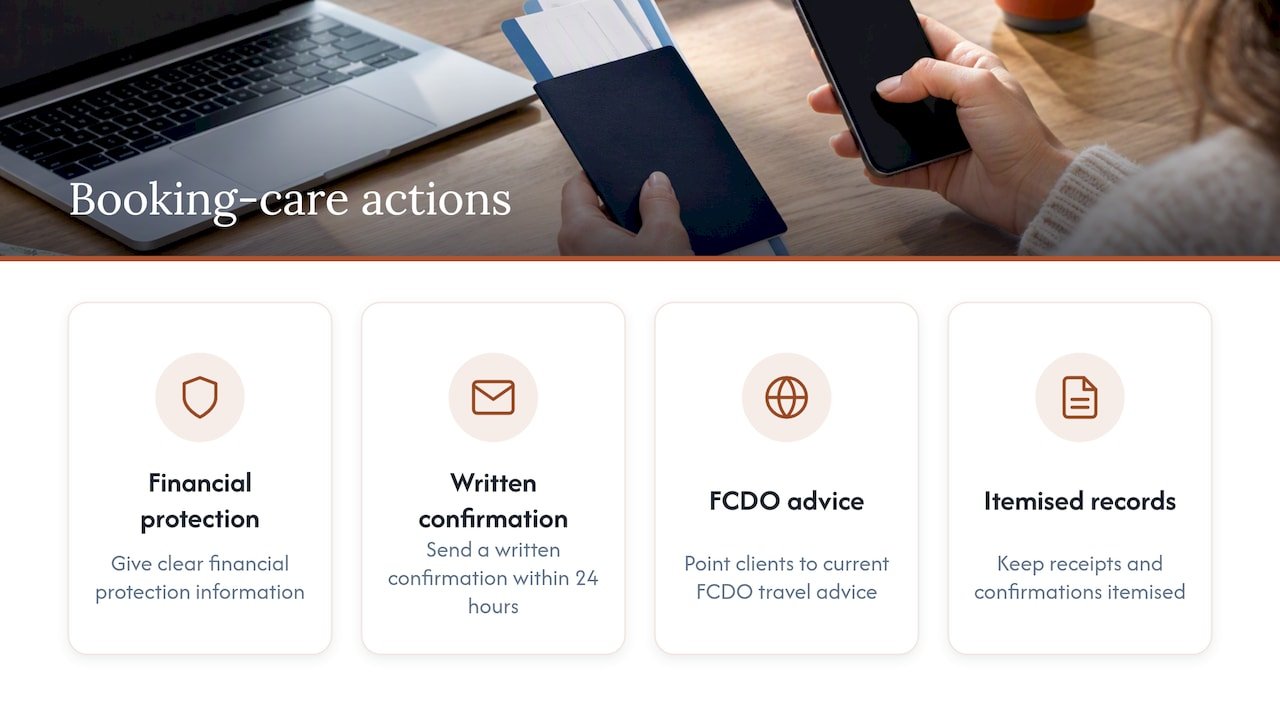
A short compliance line protects both you and the client without derailing the sale. Agents selling packages must give clear financial protection information and issue correct confirmations within the required timeframes, as set out in ABTA’s Code of Conduct guidance and the Package Travel Regulations.
One sentence is usually enough: “Your payment is financially protected, and I’ll send a written confirmation within 24 hours with everything you need.” Point clients to current FCDO travel advice for their destination rather than giving safety opinions yourself, and keep receipts and confirmations itemised so there is no ambiguity later.
Turning scripts into a repeatable sales playbook
Individual scripts become a playbook once you store them as reusable snippets, tag them by objection or destination, and review call recordings weekly against a short checklist.
- Build a CRM snippet library: opener, discovery set, three objection reframes, one close, searchable by niche.
- Automate routine admin, quotes, confirmations and follow-up reminders, so agents spend call time on judgement and empathy rather than paperwork; tools like Nausika’s real maritime data help integrate AI and automation effectively while preserving the human assistance that closes bookings.
- Run short roleplay sessions weekly and review one recorded call per agent against the script checklist.
Some agents move from employed roles into running their own branded book of business using a white-label model such as TimesHunters, where the agent’s own brand stays visible to clients while the underlying booking infrastructure and ATOL protection sit behind the scenes.
Why scripts should guide, never grip
A script is a conversation guide, not a cage. The moment it stops sounding like you, drop it and go back to listening.
The agents who keep clients for years are the ones who own a mistake quickly and fix it without a fight, scripts cannot manufacture that, only honesty can. Two small habits keep scripts sharp: a ten-minute review of your last call each day, and a monthly rewrite of whichever line felt stale.
— Sam
Sources
- Cold calling script for travel agents in 2025 – Callin
- The surprising power of questions (HBR extract / CEBMA copy)
- Guidance on the application of the Code of Conduct – ABTA
FAQ
What are some catchy travel phrases?
Short, benefit-led lines work best, such as “effortless travel, no guesswork” or “the trip you’d plan if you had the time.” Keep phrases tied to a specific client benefit rather than generic adjectives, and test them in real calls to see which ones actually prompt a question back.
What should a good script for a sales meeting include?
A solid script needs an opener with credibility and a reason for the call, three to five discovery questions, a presentation that maps answers to benefits, and a clear close with a next step. Each part should be short enough to say in under thirty seconds and adaptable to different client types.
How to attract customers to a travel agency?
Consistent niche positioning, referrals from past clients and content that answers specific travel questions tend to bring in enquiries more reliably than broad advertising. Personalised outreach alongside digital channels can lift conversion meaningfully, with one 2025 industry report noting up to 27% higher conversion versus digital-only approaches.
How much does a travel agent make on a $10,000 trip?
Commission structures vary widely by agency and booking type, so there is no single industry figure for specific trip prices. Under a white-label model such as TimesHunters, partners keep a 30% commission split on bookings they make, compared with far lower rates typically offered by online travel agencies.