
Start a UK travel franchise with £100 fee and 70% commission
UK cost guide to launching a white label, ATOL protected travel franchise. See why company setup can start at £100 and partners keep a 70% commission split.

Launching a white-label, ATOL-protected travel agency in the UK typically costs between £100 and a few hundred pounds upfront, with first-year running costs usually in the low thousands once you add marketing and admin. Operating as an agent of a principal ATOL holder avoids the large application fees and bonds that come with holding your own licence, while still letting you earn commission on every booking.
TL;DR:
- Operating as an agent of an ATOL holder costs mainly around £100 to a few hundred pounds upfront, with first-year expenses in the low thousands for marketing and admin.
- Choosing to be an agent avoids costly ATOL application fees and bonds, but you must have a written agreement and issue certificates immediately on payment.
- The highest cost decision is whether to operate as an agent or hold your own ATOL license; the latter involves higher capital requirements and regulatory oversight.
- A 70% commission split on bookings significantly increases income potential compared to typical 4% rates, especially on higher-value trips.
- Most start-up costs are self-funded, with government-backed loans and existing networks helping accelerate initial growth and profitability.
Table of Contents
- Concrete one-off costs to budget for in the UK
- How ATOL and agency obligations change cost and operational risk
- How partner commission works in practice and worked examples
- Ordered checklist: from legal setup to your first booking
- Recurring costs and practical ways to keep them low while protecting margin
- Total estimated cost timeline from initial investment to break-even or profitability
- Financing options for starting a travel franchise in the UK
- Market and location factors influencing cost and profitability
- Comparison of different franchise brands and their associated investment ranges
- Legal requirements and compliance costs specific to UK travel franchises
- Who benefits most from this model, and who should think twice
- TimesHunters: how the platform maps to the costs and revenue shown
- FAQ
- Sources
Concrete one-off costs to budget for in the UK
Most of your upfront spending goes on setting up the business itself, not on travel industry licensing, provided you operate as an agent rather than an ATOL holder.
Registering a private limited company through Companies House costs £100 if you file digitally, or £124 for a paper application, following the fee changes that took effect on 1 February 2026 under Companies House’s updated fee schedule. Trading as a sole trader avoids this fee entirely, though it changes your tax and liability position.
If you operate as an agent of an ATOL holder rather than applying for your own licence, you skip the application fees, bonds and minimum paid-up capital tests that come with holding an ATOL, which can otherwise run into thousands of pounds depending on licence type, as set out by the CAA’s types of ATOL guidance.
Beyond registration, plan for:
- A one-off legal review of your agency agreement, to confirm terms before you sign.
- Accountant fees for basic cash flow projections in your first year.
- Branding and website setup costs, which vary depending on how much you do yourself.
- Platform onboarding, which TimesHunters states carries no start-up fee as part of its white-label model.
How ATOL and agency obligations change cost and operational risk
The biggest cost decision in this business model is not how much you spend, but which legal position you take: agent or principal.
- Operating as an agent of an ATOL holder means you need a written agency agreement in place before taking any booking, and you must issue the ATOL Certificate immediately on payment for any licensable transaction, as required by CAA guidance on selling through agents. This avoids the capital outlay of holding your own licence.
- Holding your own ATOL becomes necessary if you want to control pricing, inventory or liability directly rather than sell under a principal’s protection. The CAA’s types of ATOL page lists the Small Business ATOL (SBA) and Standard ATOL, each with different financial tests, bonds and minimum paid-up capital requirements that apply before approval.
- Documentation discipline matters regardless of route. Every receipt and piece of marketing must clearly identify the protecting ATOL holder, and agents must be ready to account for client funds if the principal ever fails.
Pro Tip: Keep a dated copy of every agency agreement and certificate issued; if a claim is ever disputed, the paperwork is what protects you, not memory.
How partner commission works in practice and worked examples
Partners using a white-label travel agency platform can receive a higher commission on bookings compared with the roughly 4% typical of standard online travel agencies.
That distinction matters because commission structures vary between “commissionable” rates, where the supplier sets the headline price and pays a cut, and “net” rates, where you build your own margin on top, a difference the ETAG rates and pricing guidance recommends understanding clearly before setting consumer prices.
On a £1,500 booking the same split works out to around £1,050, and on a £5,000 booking, around £3,500.
- Price consumer-facing packages to cover platform fees, payment processing and marketing before counting margin.
- Separate commissionable elements from net costs so your pricing strategy stays consistent across suppliers.
TimesHunters reports one partner’s income rising from £400 to £1,200 per booking under this commission structure, illustrating the scale of difference the model claims to produce.
Ordered checklist: from legal setup to your first booking
Getting from a standing start to your first live booking follows a fairly predictable sequence.
- Choose your business structure, either registering a limited company through Companies House for £100 digitally or £124 by paper, or trading as a sole trader with no registration fee.
- Request and review the agency agreement with your ATOL principal, checking it includes the CAA Schedule of Terms and clearly names the protecting ATOL holder.
- Complete platform onboarding: set up your branded booking site, confirm your booking flow, and understand exactly how ATOL certificates are issued at point of payment.
- Set up basic accounting, check whether you need to register for VAT based on your turnover, and draft customer terms and conditions covering cancellations, amendments and complaints.
- Take your first booking, issuing the ATOL certificate immediately on payment as required.
Each step builds on the last, and skipping the agency agreement review in particular is the step most likely to cause problems later if your principal’s terms change without clear notice.
Recurring costs and practical ways to keep them low while protecting margin
Once you are live, the ongoing costs are mostly operational rather than regulatory.
- Platform or subscription fees, where applicable, alongside standard payment processing charges on each transaction.
- An Air Passenger Charge or APC-equivalent fee may apply per passenger on certain licensable bookings depending on your principal’s arrangements.
- Marketing and client acquisition spend, which tends to be highest in your first few months as you build a client base.
Automated booking management, where your platform issues certificates and confirmations without manual input, cuts the admin time that otherwise eats into margin on lower-value bookings. Outsourcing tasks such as bookkeeping early on is often cheaper than the hours it takes to learn them yourself.
Pro Tip: Track your cost per booking separately from your cost per client; repeat clients from referrals cost far less to serve than first-time bookings from paid marketing.
Total estimated cost timeline from initial investment to break-even or profitability
Most partners move through three rough phases: setup, early trading, and sustained profitability, though the pace depends heavily on how quickly you can bring in bookings.
The setup phase, covering company registration, agency agreement review and platform onboarding, typically takes a few weeks and accounts for most of your one-off spend. Early trading, where you are building a client list and processing your first handful of bookings, often runs for several months while marketing costs outweigh commission income.
Break-even depends on booking volume and value rather than time alone. Partners who already have an audience, whether through a hospitality business, a social following or a professional network, tend to reach consistent monthly income sooner because they skip the slowest part of early trading: finding the first clients.
Sustained profitability follows once referral and repeat business start outweighing paid acquisition. At that point your main costs become platform fees, payment processing and modest ongoing marketing, while commission income becomes the dominant line rather than a supplement to other work.
Financing options for starting a travel franchise in the UK
Because the one-off costs in this model are modest compared with a traditional retail franchise, most partners self-fund their launch rather than seeking external finance.
Where additional capital is useful, a personal loan or a business loan from a high street bank can cover marketing spend in the early months, particularly if you want to invest in paid advertising or event attendance to build your client list faster. Some partners use savings or income from an existing business, which avoids interest costs entirely.
Government-backed start-up loans, available to new and early-stage UK businesses through the British Business Bank network, are worth researching if you want structured finance with fixed repayment terms rather than relying on a personal overdraft or credit card. Because this model does not require ATOL bonds or large paid-up capital when operating as an agent, the capital intensity that usually drives franchise owners toward investors or franchisor financing schemes simply does not apply in the same way here.
Market and location factors influencing cost and profitability
Where you are based in the UK affects client acquisition cost more than it affects your core setup spend, since the regulatory and platform costs are the same nationally.
Partners based in or near major cities often find it easier to build a local client network through events, referrals and word of mouth, which can reduce reliance on paid marketing. Rural or smaller-market partners may need to lean more on online marketing and niche specialisms, such as a particular destination or type of trip, to stand out without a large local population to draw from.
Your existing audience matters more than geography for this model. A partner with a following built around a specific interest, whether that is weddings, golf trips or luxury cruising, often finds demand regardless of where they are physically based, since bookings and communication happen remotely.
Comparison of different franchise brands and their associated investment ranges
Traditional travel franchises in the UK typically require a significant upfront franchise fee, ongoing royalty payments and a minimum investment that can run into tens of thousands of pounds before you take a single booking, reflecting the cost of buying into an established brand, premises and training package.
A white-label ATOL agent model works differently. Rather than paying a franchise fee for brand rights, you register your own company, pay Companies House’s standard incorporation fee, and operate under a principal’s ATOL protection through an agency agreement, as described earlier. The white-label platform carries no start-up fee, with revenue instead generated through the commission split on bookings made by partners.
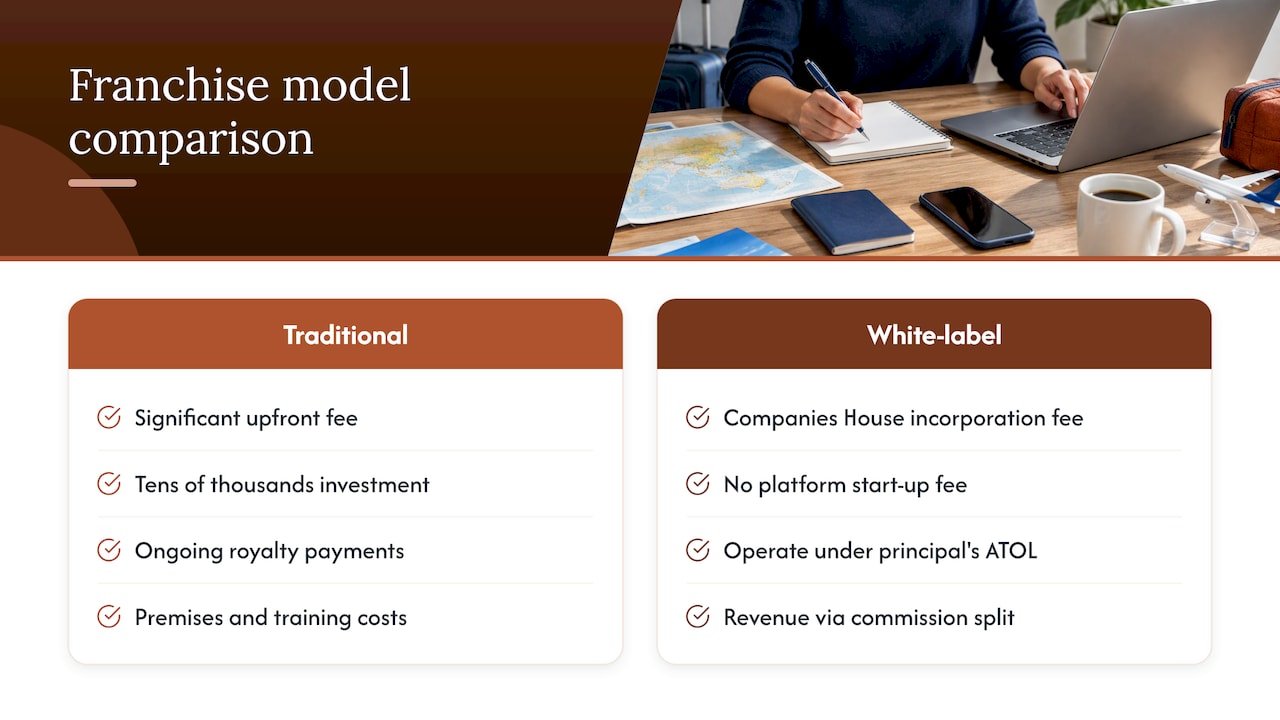
The practical difference for most aspiring entrepreneurs is risk exposure at the outset. A traditional franchise ties a large sum of capital to a single brand before you know whether your local market will support it, while the white-label route spreads cost into the commission split itself, so spending is proportional to what you actually sell.
Legal requirements and compliance costs specific to UK travel franchises
Compliance costs in this model sit mostly in documentation and process rather than fees.
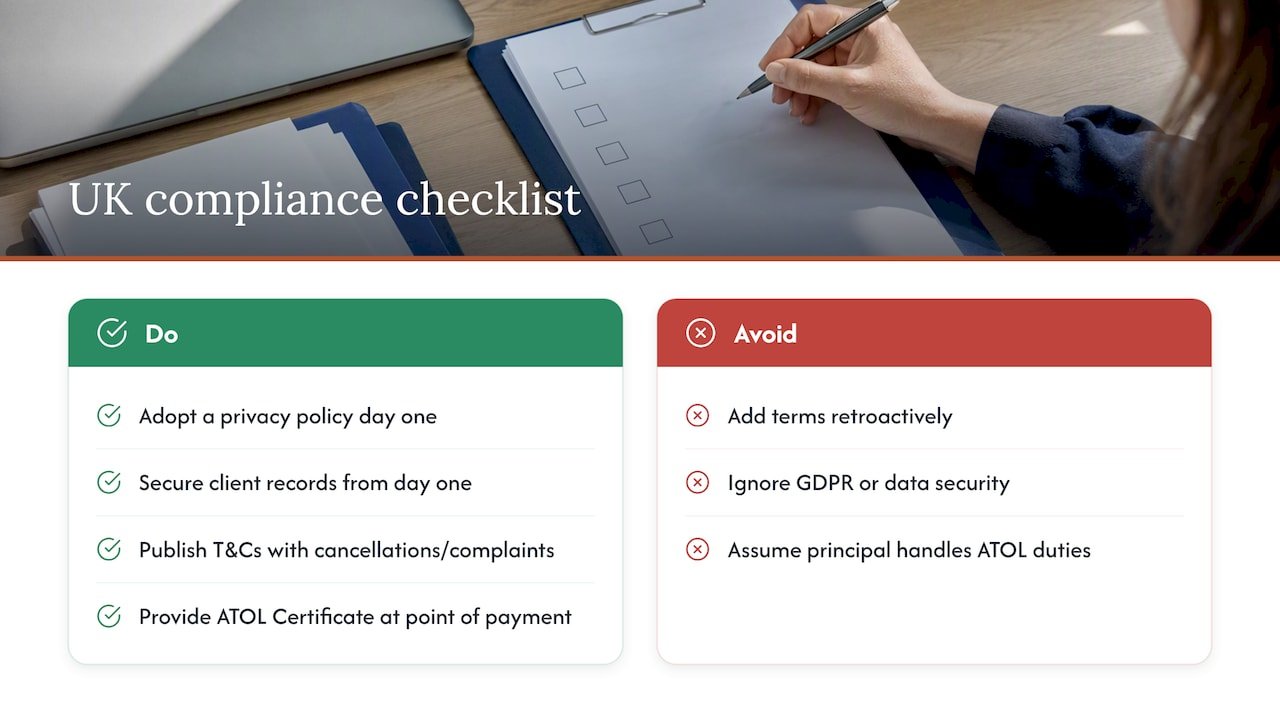
Data protection is a standing requirement under UK GDPR for any business holding client names, contact details and payment information, which means having a basic privacy policy and secure storage for client records from day one, regardless of business size. Consumer rights obligations, including clear terms on cancellations, amendments and complaints, should be built into your customer-facing terms and conditions before your first booking, not added retroactively.
On the travel-specific side, ATOL Standard Term 1 sets out the documentation and consumer-information requirements that apply to protected bookings, including supplying confirmed consumer documents and an ATOL Certificate at the point of payment. These obligations fall on you as the agent even though the ATOL itself belongs to your principal, so building a simple checklist for every booking, covering certificate issuance, payment confirmation and record keeping, is the cheapest way to avoid compliance problems later.
Who benefits most from this model, and who should think twice
In our view, this model suits people who already have an audience or a trusted relationship with potential clients far more than it suits someone starting from zero. Advisors, hospitality owners and niche specialists tend to convert that trust into bookings quickly. If you want full control over pricing, inventory or complex multi-supplier packages, holding your own ATOL may serve you better long term. Whichever route you choose, read the agency agreement and any income projections carefully before committing.
— Sam
TimesHunters: how the platform maps to the costs and revenue shown
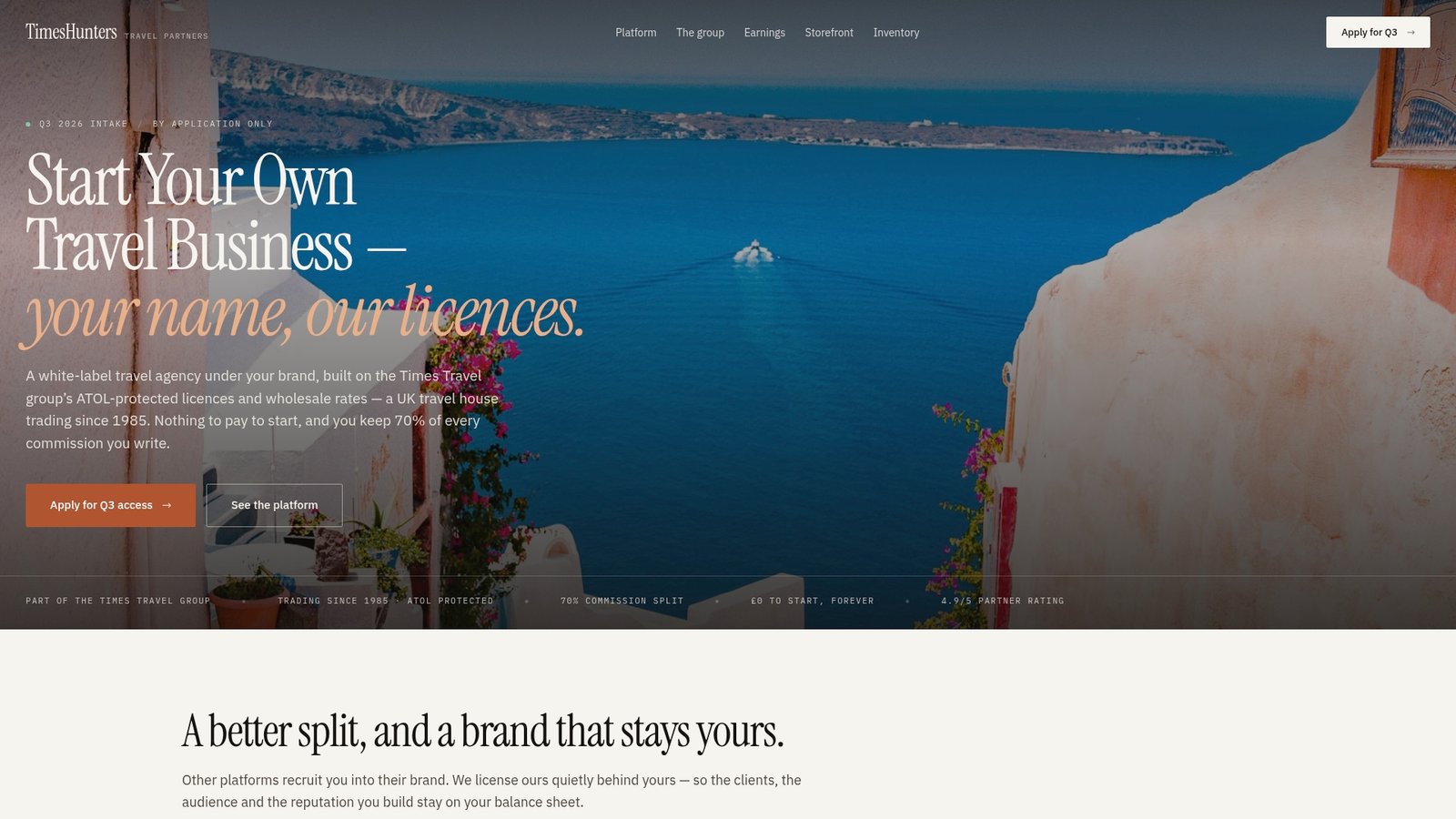
Everything in this guide points toward one practical choice: pay little or nothing upfront, and let your income scale with what you actually sell. That is the model we built with TimesHunters, a white-label travel agency platform that puts your own brand in front of clients while running on ATOL-protected licences through the Times Travel group. We offer partners a 70% commission split, access to wholesale rates across hotels, cruises, tours, villas, safari camps and rail, and automated booking management that handles certificates and confirmations without manual chasing.
If the numbers in this guide match what you are looking for, here is where to start:
- Read our white-label travel agency page for full detail on partner onboarding.
- Request a demo to see the booking flow and certificate issuance in practice.
- Prepare a short list of questions on commission timing and supplier access before you speak to our team.
Get in touch through our white-label platform to see whether this route fits your plans.
FAQ
Do I need my own ATOL licence to start a travel business?
No. Operating as an agent of an ATOL holder, under a written agency agreement, lets you sell protected travel without applying for your own licence, as set out in CAA guidance on selling through agents. You still need to issue ATOL certificates immediately on payment for every licensable booking.
How much does it cost to set up a white-label travel agency in the UK?
Company registration through Companies House costs £100 digitally or £124 by paper, following the 2026 fee update. Beyond that, costs depend on legal review, accounting setup and marketing, typically running to a few hundred pounds before your first booking if you operate as an agent rather than an ATOL holder.
How does the 70% commission model compare with a typical travel agency?
On a £1,500 booking, that difference is roughly £1,050, illustrating why the commission structure matters as much as booking volume.
What ongoing costs should I expect once I’m trading?
Expect platform or subscription fees where applicable, payment processing charges per transaction, and marketing spend that is usually highest in the first few months. Some bookings may also carry a per-passenger charge depending on your principal’s arrangements.
What documents do I need to keep for every booking?
You need a signed agency agreement with your ATOL principal, proof of immediate ATOL Certificate issuance on payment, and confirmed consumer documents as required under ATOL Standard Term 1. Keeping these on file protects you if a client dispute or principal failure ever arises.