
Launch Faster: 6 Essentials for a UK Travel Agency Technology Stack
Practical guide for UK travel agencies to build an integrated, compliant tech stack. Covers CRM, bookings, payments, NDC, PCI DSS and a white label launch.

A practical travel agency technology stack centres on a CRM, a booking and itinerary engine, distribution connectivity through GDS, NDC and direct APIs, payments and back-office tools, and a traveller-facing portal, all wired together so the advisor-client workflow and commission reconciliation sit at the core rather than bolted on afterwards. Analytics closes the loop by showing which bookings and suppliers actually pay.
TL;DR:
- Agencies should prioritize real-time booking engines with live, multi-supplier pricing over static quotes to ensure accurate offers at the moment of sale.
- Integrating NDC content via direct APIs provides more control but requires extensive engineering, while GDS or aggregator routes offer faster deployment with less control.
- Vendors should support transparent data security, encryption, and provide clear contractual audit rights to meet PCI-DSS and GDPR obligations.
- Choosing a technology stack relies on agent workflow fit, support capabilities, and the ability to export data, with pilot testing essential before full deployment.
- Implementing a white-label platform can streamline setup by providing prebuilt booking, licensing, and back-office tools, reducing the need for custom development.
Table of Contents
- Essential software categories and what each does for an agency
- Integration and architecture: APIs, middleware and GDS versus NDC
- Payments, data security and regulatory obligations
- How to choose and implement a technology stack
- Operational best practices and a real-world platform example
- What the next few years mean for agency technology
- A managed route to launch without building the stack yourself
- FAQ
- Sources
Essential software categories and what each does for an agency
Each layer of the stack solves a different operational problem, and vendors should be judged on how well they handle their specific job rather than on how many features they bundle in.
A customer relationship management (CRM) system tracks contacts, leads and the sales pipeline, and lets agencies segment travellers for automated follow-up campaigns. Without one, repeat business and referrals tend to fall through the cracks because nobody owns the relationship once the booking is confirmed.
Booking and itinerary builders assemble multi-supplier packages, such as flights, hotels and tours, with live pricing rather than static quotes that go stale within hours. Proposal and quoting tools sit alongside these, turning that pricing into branded, templated documents clients can approve with a click instead of a phone call.
Distribution and connectivity tools determine what inventory an agency can actually sell. This is where GDS platforms, NDC connections, direct supplier APIs and aggregators come in, each offering a different balance of content depth, cost and technical overhead.
Traveller-facing apps and portals handle confirmations, mobile itineraries and in-trip messaging, reducing the volume of calls an agency fields for information that should already be in the client’s hand.
Back-office systems handle commission reconciliation, invoicing, supplier settlement and refunds, the unglamorous work that determines whether an agency actually gets paid what it is owed. Analytics tools then report on booking KPIs, revenue per booking and supplier performance, turning operational data into decisions about which partnerships to grow.
A workable stack typically includes:
- A CRM for contact management, segmentation and automated follow-up.
- A booking or itinerary engine with live, multi-supplier pricing.
- Proposal and quoting tools that generate branded documents quickly.
- Distribution connectivity through GDS, NDC or direct APIs.
- A traveller portal for confirmations and mobile itineraries.
- Back-office tools for commission tracking and supplier settlement.
Integration and architecture: APIs, middleware and GDS versus NDC
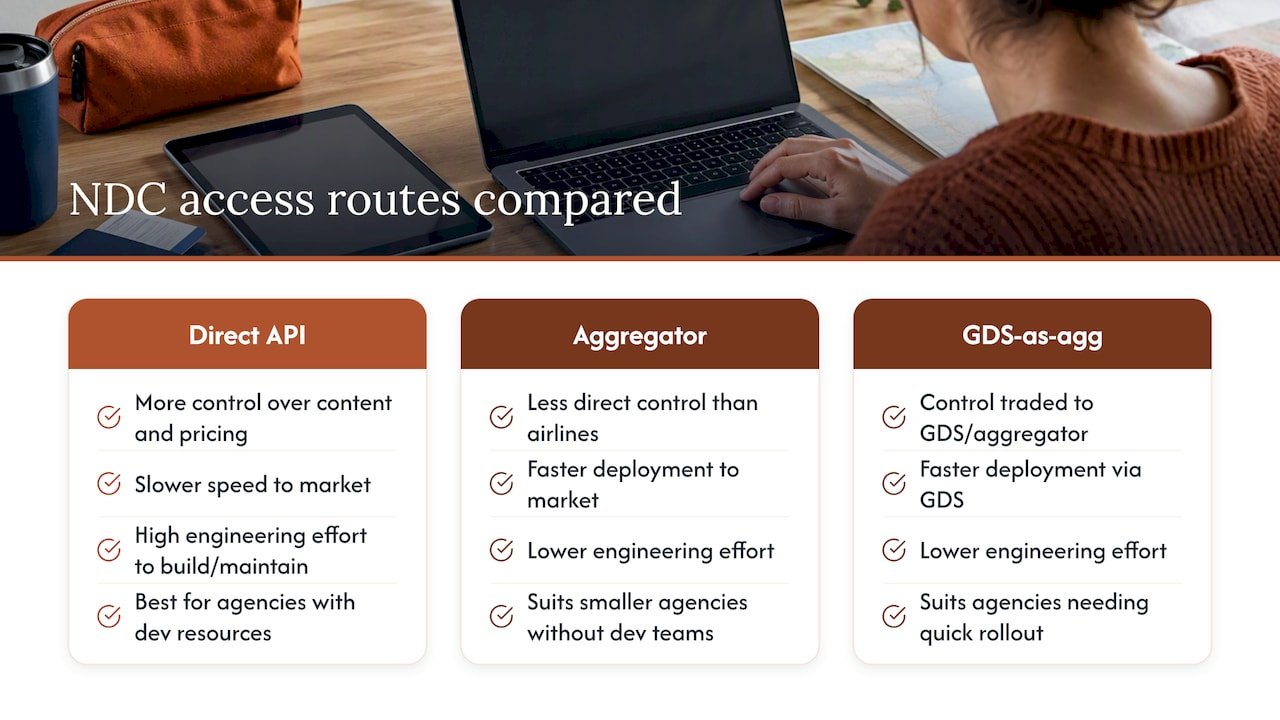
How these tools talk to each other matters more than any single feature. The New Distribution Capability, or NDC, is an XML-based standard that lets agencies pull richer airline content, including baggage and ancillary options, directly through airline APIs rather than relying solely on traditional GDS feeds, as Travelport explains. Agencies can reach NDC content through three routes: a direct connection to an airline, a new-entrant aggregator, or a GDS acting as an aggregator on their behalf, and each route trades control against speed to market.
NDC certification itself has levels, and IATA’s certification guidance sets out the message traces and schema versions required for capabilities such as offer shopping and order management. A vendor can be “NDC Capable” without being formally certified, so it is worth asking exactly which schema versions and message types they support and whether they hold production traces.
Direct API connections give agencies more control over content and pricing but demand more engineering effort to build and maintain. Aggregators and GDS-as-aggregator models trade some of that control for faster deployment, which suits smaller agencies without dedicated development resources.
Middleware, including API gateways, webhooks and caching layers with retry logic, sits between these supplier connections and the agency’s own systems, smoothing out inconsistent response times and preventing a single supplier outage from taking down the whole booking flow. Before committing to any integration, a developer-facing checklist should cover authentication methods, sandbox availability for testing, schema stability across vendor updates and the ability to trace messages end to end when something goes wrong.
Payments, data security and regulatory obligations
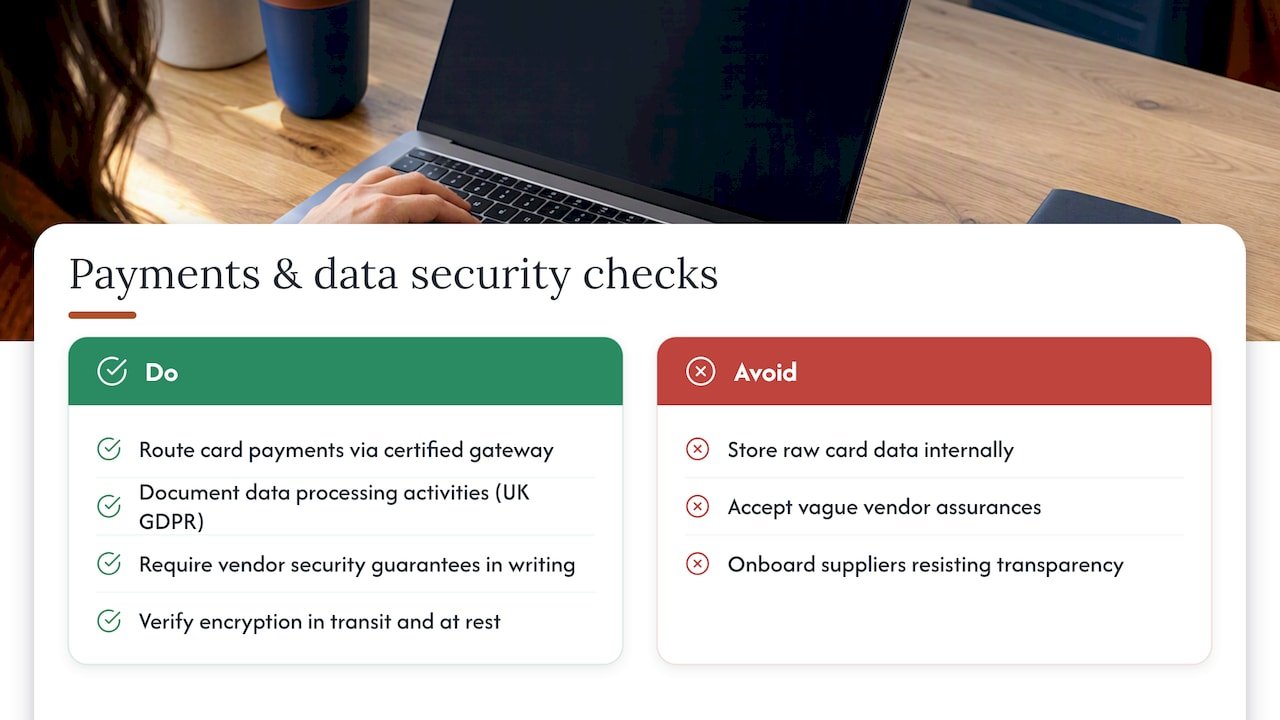
Any stack handling card payments needs to meet PCI-DSS requirements, typically by routing transactions through a certified payment gateway rather than storing card data directly, which keeps the bulk of the compliance burden with the gateway provider.
Data protection adds a separate layer of obligation. Under UK GDPR, agencies acting as data controllers need to document their processing activities and ensure any processor, including software vendors, provides adequate security guarantees, as the ICO’s guide to data security sets out. The ICO recommends practical technical measures including encryption, HTTPS and a Cyber Essentials baseline, and treats PCI-DSS compliance as a relevant factor when investigating payment-related breaches.
In practice this means checking that a vendor encrypts data in transit and at rest, enforces role-based access controls, and can produce documentation on request rather than vague assurances. Contracts should spell out audit rights and breach response responsibilities. A supplier that resists contractual transparency on either point is worth treating with caution before any data migration begins.
How to choose and implement a technology stack
Choosing a stack is less about comparing feature lists and more about testing whether a system fits how agents actually work day to day.
Prioritise, in roughly this order: advisor user experience, data ownership and export rights, how cleanly commission handling is automated, integration readiness with existing suppliers, and total cost of ownership once implementation and support fees are included. A system that scores well on paper but creates friction for agents will quietly get abandoned in favour of spreadsheets within months.
When evaluating vendors, ask pointed questions: Do they publish API documentation and offer a sandbox for testing before signing? What are their support hours and response-time commitments? Which NDC certification level do they hold, Capable or Certified, and for which message types? Watch for red flags such as closed data that cannot be exported, no sandbox environment, vague PCI-DSS or GDPR contract language, or an onboarding process with no clear milestones.
A phased rollout keeps risk manageable:
- Audit current tools, data and workflows to identify genuine gaps rather than assumed ones.
- Pilot the new stack with a small group of agents on live bookings.
- Run the new and old systems in parallel to catch discrepancies before full cutover.
- Cut over fully once the pilot group confirms the workflow holds up under normal volume.
- Measure adoption and commission accuracy, then iterate on configuration rather than switching vendors at the first hiccup.
Pro Tip: Run the parallel phase for at least one full commission cycle, so reconciliation errors surface before they become a backlog.
Operational best practices and a real-world platform example
Technology only pays off when agents actually use it instead of working around it. Training needs to happen before go-live, not after, and usage should be measured against defined KPIs rather than assumed from licence counts.
Commission reconciliation deserves particular attention: automated posting against each booking, supplier-by-supplier tracking, and a fixed reporting cadence catch underpayments that manual spreadsheets routinely miss.
A white-label model illustrates how these pieces can come together without an agency building each layer from scratch. We provide a white-label travel agency platform that lets individuals run a branded travel business under their own name while using Times Travel group’s ATOL-protected licences, with the licensing structure invisible to end clients.
Practical onboarding still matters regardless of platform: migrate existing client data cleanly, set role permissions before agents start logging in, and document standard procedures for booking changes and refunds so nothing depends on institutional memory.
- Train agents before launch and track actual usage, not just licence activation.
- Automate commission posting per booking rather than reconciling manually at month end.
- Document SOPs for changes and refunds so handling stays consistent across agents.
What the next few years mean for agency technology
NDC adoption is going to keep reshaping how agencies access airline content, and the agencies that treat integration flexibility as a priority, rather than locking into a single GDS relationship, will have an easier time adapting as airlines push more content through direct and NDC channels.
My practical advice: start with an honest inventory of what you already use, then run a three-month pilot with a handful of agents before committing to a full rollout. Adoption failures almost always trace back to skipping this step and assuming a system will work because it worked in a demo.
Usability, data ownership and security should outrank feature checklists every time. A platform with fewer features that agents actually use beats a comprehensive one that creates shadow workflows in spreadsheets.
— Sam
A managed route to launch without building the stack yourself
Building and maintaining every layer of a technology stack from scratch is a serious undertaking for anyone starting out, which is why we built a different route: a white-label travel agency platform that hands you the booking infrastructure, ATOL-protected licensing and automated back-office already assembled, while you keep your own brand and client relationships.

For agencies that also want to add curated local experiences into client itineraries, suppliers such as Comfort Tours in Krakow show how specialist ground operators can slot into a broader package.
If you want to see how the platform works before committing to anything, visit TimesHunters and explore the partner programme.
FAQ
What technologies are used in travel agencies?
Agencies typically run a CRM for client management, a booking or itinerary engine, distribution connectivity through GDS, NDC or direct APIs, payment gateways, back-office reconciliation tools and traveller-facing portals. These layers are usually integrated through middleware so data flows between them without manual re-entry.
What software is commonly used in travel agencies?
Common categories include CRM platforms, GDS terminals, proposal and quoting tools, booking engines and back-office accounting software, each chosen to fit the agency’s supplier mix and booking volume. Larger agencies tend to add dedicated analytics tools to track revenue per booking and supplier performance.
What are some examples of travel technology?
Examples span GDS connections, NDC-based airline APIs, payment gateways meeting PCI-DSS standards, mobile traveller apps and automated commission-reconciliation systems. A white-label platform is another example, bundling several of these layers, including ATOL-protected booking infrastructure, under one branded front end.
What is the use of computers in travel agencies?
Computers run the booking and distribution software that checks live availability and pricing across suppliers, process payments securely, and maintain client records in a CRM. They also support back-office functions such as commission tracking and reporting that would be impractical to manage manually at any real volume.