
Corporate vs Leisure Agencies: 3 Ways UK Agents Can Serve Both
See how UK travel agents can serve corporate and leisure clients with three operating models, separate sales workflows, and careful PTR and ATOL handling.

Corporate and leisure travel are distinct agency businesses with different clients, pricing models and paperwork, and yes, you can serve both, but only by separating sales, commercial terms and often the brand. UK bookings made under a general agreement can sit outside standard package travel protections, which raises the stakes for anyone mixing the two. We cover the practical steps for adding the other market further down.
TL;DR:
- Choose a separate corporate arm, a subbrand with shared back office, or one hybrid team with distinct booking workflows, reporting, and invoicing.
- A valid general agreement can leave qualifying business bookings outside package travel and ATOL protections; document eligibility, disclose status, recommend insurance, and retain booking records.
- For bleisure, set a written employer policy distinguishing work from personal time, split billing, and flag tax and insurance implications before booking.
- Target three to five signed corporate accounts in year one, set management fees before signing, and allow six to eighteen months for growth.
Table of Contents
- What separates corporate agencies from leisure agencies in practice
- Can one agent serve both markets? Practical models and bleisure
- UK regulatory checklist: general agreements, PTR and ATOL
- How to add the other market without breaking either one
- A founder’s lesson on why separation matters
- Another option: starting a branded agency without building the infrastructure yourself
- FAQ
- Sources
What separates corporate agencies from leisure agencies in practice
A corporate agency, often called a travel management company, sells to procurement officers and travel arrangers on behalf of employees who need to be somewhere for work. A leisure agency sells to holidaymakers planning a trip for its own sake. The client relationship, the sales cycle and the money all work differently.
Leisure business runs on per-booking commission: a client books a holiday, the agent earns a percentage, and the relationship often ends until the next trip. Corporate business runs on negotiated annual rates and management fees set out in a Master Service Agreement, with a playbook on adding a corporate arm noting that day-to-day bookings become largely administrative once those terms are in place. A travel buyer at a mid-sized firm cares about policy compliance and reporting; a honeymoon couple cares about the room view.
The two businesses also expect different things from their agents:
- Corporate clients want consolidated invoicing, volume rebates and management information reports that show spend by department or traveller.
- Leisure clients want curated recommendations, flexible payment options and a personal touch through the booking.
- Supplier relationships differ too: corporate agencies negotiate airline and hotel rates tied to volume, while leisure agencies work wholesale and tour operator rates tied to packages.
Trying to serve both groups with one undifferentiated sales process tends to disappoint everyone, which is why structure matters more here than enthusiasm.
Can one agent serve both markets? Practical models and bleisure
Running both is possible, but it rarely works as one blended team chasing one target. Three structures tend to hold up:
- Separate corporate arm: a distinct team, pipeline and often a different trading name, sharing only finance and premises with the leisure side.
- Sub-brand with shared back office: one legal entity, two client-facing identities, shared CRM and accounts but separate sales processes and reporting.
- Single hybrid team with strict process separation: the same agents handle both, but corporate and leisure bookings are tagged, quoted and invoiced through entirely different workflows.
Mixing without separation tends to fail in predictable ways. A leisure-sounding brand signals the wrong thing to a procurement officer comparing you against a specialist TMC. Forecasting gets contaminated when unpredictable leisure spikes sit in the same revenue line as steady MSA income, producing misleading numbers for cash planning, a failure mode the corporate arm playbook flags repeatedly. Invoices and pricing that blur the two models also confuse clients about what they’re actually paying for.
Bleisure, where a business trip is extended into a leisure break, is the cleanest bridge between the two worlds. Trade coverage on cross-selling business and leisure shows corporate advisors successfully pulling in leisure bookings from the same traveller, smoothing seasonality for both sides of the business. To exploit it safely, set a written employer policy on what counts as business versus personal time, split billing clearly between the two, and flag any tax or insurance implications of the leisure extension before it’s booked.
Pro Tip: Tag every bleisure booking at the point of sale so the leisure portion never gets lumped into corporate reporting by accident.
UK regulatory checklist: general agreements, PTR and ATOL
This is where getting the paperwork wrong becomes expensive rather than just untidy. Under the Package Travel Regulations 2018, business travel arranged under a valid general agreement can fall outside standard package travel and ATOL protections, meaning financial risk for a failed supplier can rest with the corporate client rather than being automatically covered. ABTA’s guidance on business travel liability confirms this is a common and legitimate model, provided the agreement is genuine and the agent is acting purely as agent, not organiser.
The wording on your invoices and booking confirmations matters because it’s often the only evidence of what protection was or wasn’t in place. Our guide on UK Package Travel Regulations changes covers the compliance actions agents should already have in hand.
A practical checklist for any agency relying on a general agreement:
- A signed GA that defines eligible travellers and the services in scope.
- Clear invoice wording stating the booking is not PTR/ATOL protected, where that’s the case.
- A recommendation that the client holds appropriate insurance for the trip.
- Records kept of every GA and its related bookings for at least the statutory period.
The Business Travel Survey 2025 found that corporate buyers increasingly prioritise traveller wellbeing alongside cost control, which means the paperwork now sits alongside a genuine duty-of-care conversation, not just a compliance box to tick.
How to add the other market without breaking either one
Adding corporate work to a leisure agency, or the reverse, is a structured project, not a side hustle you bolt on in a quiet month.
- Set account targets, not revenue targets, for year one. Three to five signed corporate accounts tells you more about traction than a revenue figure that one big booking can distort.
- Assess your brand signal honestly. If your name reads as a leisure specialist, a sub-brand or separate trading name will do more for corporate credibility than a rebrand of the whole business.
- Hire or partner for corporate expertise. An experienced corporate lead with existing procurement relationships shortens the ramp far more than training a senior leisure agent from scratch, according to the corporate arm playbook.
- Draft the Master Service Agreement essentials early: scope, eligible travellers, payment terms, rebate structure and a clear agent-not-organiser clause.
- Separate the operational plumbing. Tag every booking by market in your CRM, run distinct sales pipelines, set different credit and payment terms, and flag the accounting changes to your bookkeeper before the first corporate invoice goes out.
- Plan for 6 to 18 months of ramp, not a single quarter, before the corporate side carries its own weight.
Pro Tip: Price your management fee structure before you sign the first corporate client, not after, so the first account doesn’t set an awkward precedent for every one that follows.
A founder’s lesson on why separation matters
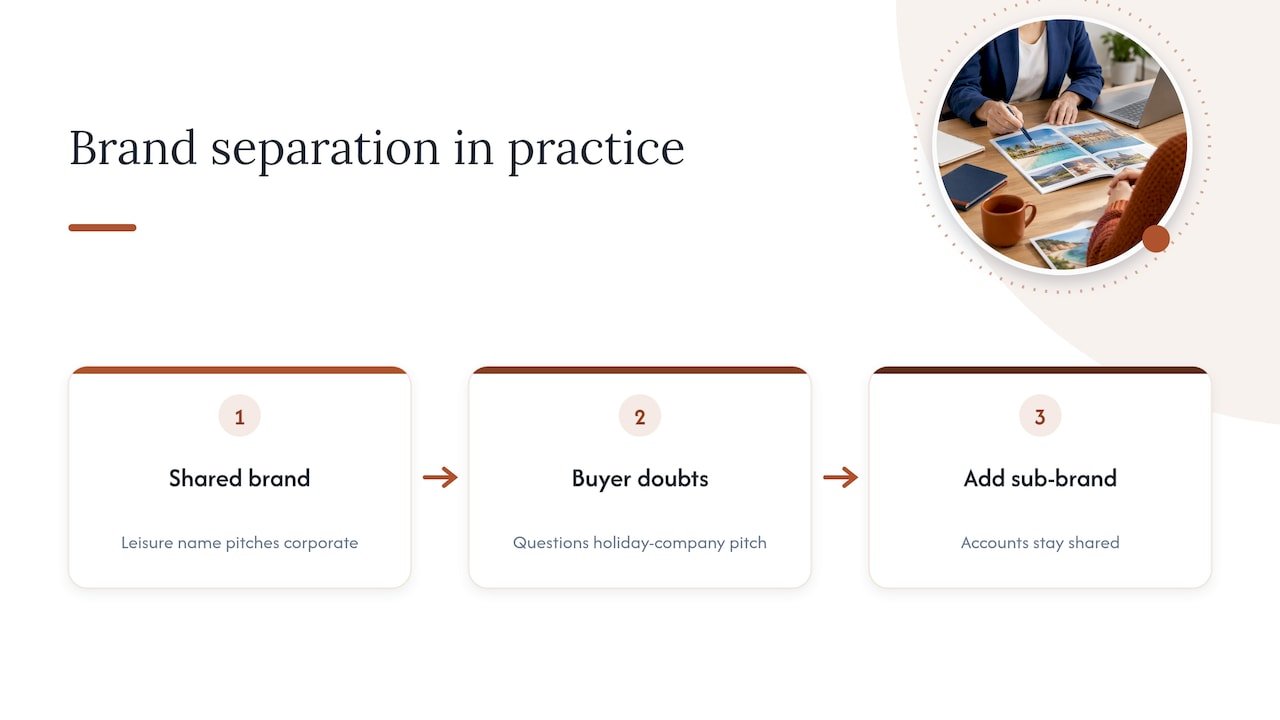
A leisure brand with a beach holiday name once tried to pitch corporate accounts under the same identity. Every meeting opened with the buyer asking why a holiday company was quoting for business travel. The fix was a simple sub-brand with shared accounts behind it.
The tactical takeaway: before you pitch a single corporate client, check whether your current brand name would survive being read aloud in a procurement meeting.
— Sam
Another option: starting a branded agency without building the infrastructure yourself
Building corporate infrastructure from scratch, MSAs, trust accounts, ATOL compliance, takes time most new agents don’t have. We offer a different route: a white-label platform that lets you launch a branded travel agency under your own name, backed by ATOL-protected licences, wholesale access to hotels, cruises, tours, villas, safari camps and rail, and automated booking management that handles the admin for you.
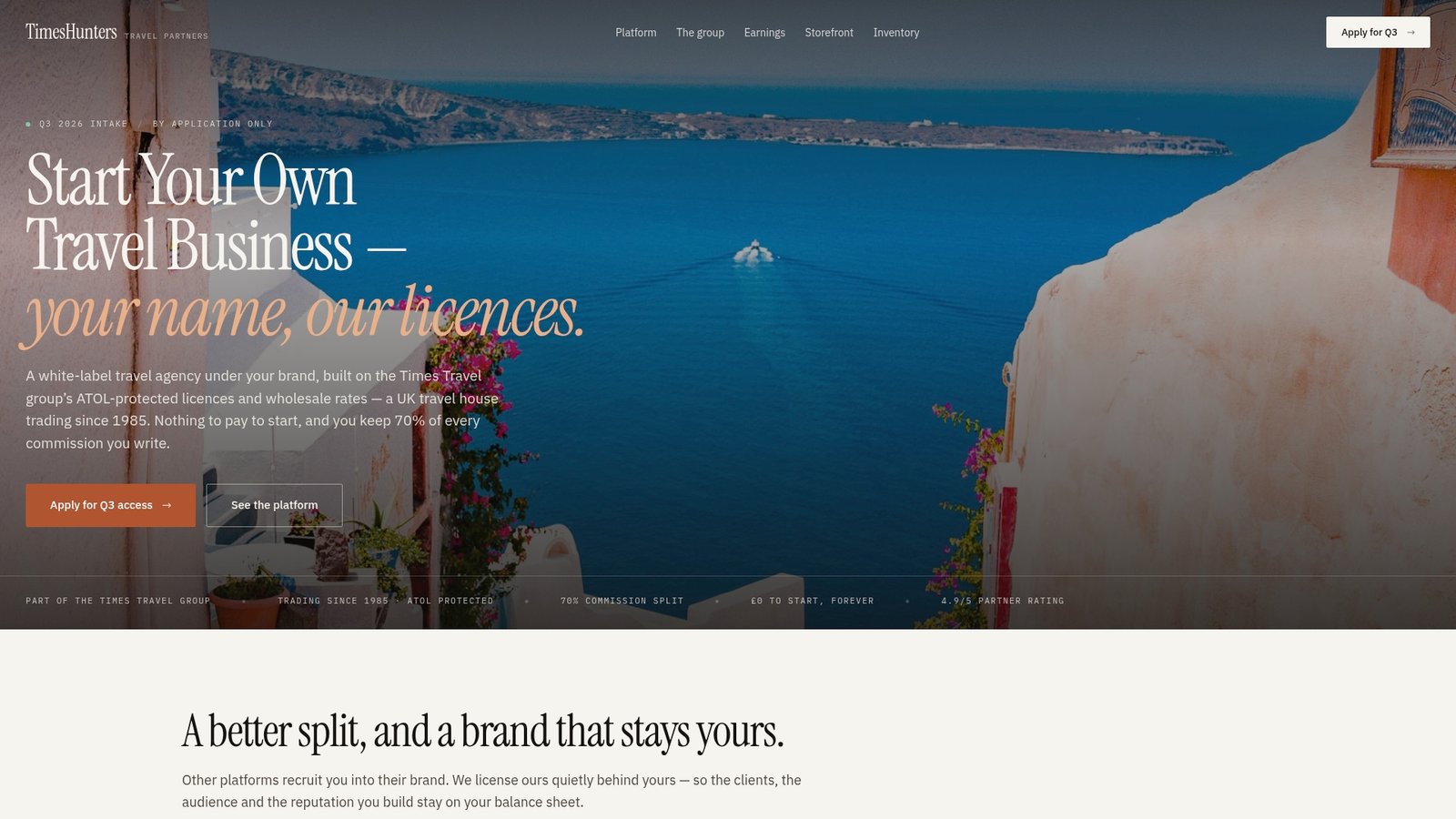
Instead of negotiating supplier rates or building a trust account from zero, you keep your own brand and client list while we handle the licensing and back-office work, with commission on bookings made through the platform. For readers weighing whether to build corporate capability in-house or start selling leisure trips under their own name straight away, our platform is worth a look before you commit to building everything yourself.
FAQ
What are the key differences between leisure and corporate travel?
Leisure travel is booked by individuals for personal trips and paid per booking through commission, while corporate travel is booked on behalf of employees under negotiated annual rates and management fees. Corporate clients also expect consolidated reporting and policy compliance that leisure clients rarely ask for.
Why do hotels ask if it’s business or leisure?
Hotels ask to apply the correct rate and billing terms, since corporate stays are often tied to negotiated rates, different cancellation terms and sometimes a company account, while leisure stays are typically paid directly by the guest. It also helps them route the booking to the right service expectations, such as express checkout for business guests.
What are the two types of travel agency?
The two broad types are corporate agencies, also called travel management companies, which serve business travellers under negotiated contracts, and leisure agencies, which serve holidaymakers on a per-booking commission basis. Some agencies run both, usually through a separate team, sub-brand or strict internal process separation to avoid confusing either client base.
What is the difference between leisure and business?
Business travel is undertaken to fulfil a work purpose, such as a client meeting or conference, and is usually paid for or reimbursed by an employer. Leisure travel is taken for personal enjoyment and paid for by the traveller, with no employer involvement in the booking or cost.
Sources
- The Package Travel Regulations 2018 (UK legislation)
- Business travel: Who’s responsible when things go wrong? | ABTA
- Adding a corporate travel arm to a leisure agency (playbook/case study)
- Business travel survey 2025 (DfT / Ipsos)
- How to cross-sell business and leisure to your clients | TTG