
Travel Agent Onboarding: 8 Compliance Steps for UK White Label Launch
Launch a UK travel agency on a white label platform with eight compliance steps for ATOL, payments, GDPR, and training before your first booking.

A practical route to launching a branded travel business is a compliant white-label onboarding pathway: register your business, secure a proper agency agreement that covers ATOL Certificate issuing, then lock in bookkeeping and payments before you take a single booking. Follow those three steps first and the rest of the checklist falls into place.
TL;DR:
- Sole traders must register for Self Assessment if business income exceeds £1,000 in a tax year, by October 5 after that year ends.
- Before accepting payment, secure a written agency agreement and confirm the certificate issuer; certificates must be issued immediately, even when you only capture card details.
- Invoices and receipts should distinguish travel funds protected by ATOL from your booking fee, and your agreement may require a trust account for client money.
- Marketing compliance requires unticked signup boxes for granular, affirmative consent, a clear privacy notice, and an easy opt out in every email.
- Before launch, test a complete booking from payment through certificate, invoice, and confirmation email, while training staff on required precontract information.
Table of Contents
- Your at-a-glance onboarding checklist
- Choose and register your business structure
- Put in place ATOL-related paperwork and agree certificate procedures
- Set up bookkeeping, invoicing and client-money handling
- Technology and operational tasks to support compliant bookings
- Build GDPR-compliant marketing and consent into onboarding
- Train on booking workflows, pre-contract information and customer service SOPs
- Timebound plan: 30, 60 and 90 days to first revenue
- Why structured onboarding matters more than enthusiasm
- How a white-label host can implement much of this checklist for you
- FAQ
- Sources
Your at-a-glance onboarding checklist
Before you touch a booking system, work through these steps in order. Several depend on the one before, so skipping ahead creates compliance gaps you will have to fix later.
- Decide your business structure (sole trader or limited company) and register it.
- Secure a written agency agreement and confirm who issues ATOL Certificates.
- Set up bookkeeping, a business bank account and an invoicing system.
- Choose a payment processor that supports immediate certificate issuing.
- Build or activate your branded booking site and CRM.
- Add GDPR-compliant consent fields and a privacy notice to your signup and marketing flows.
- Complete training on bookings, amendments, cancellations and pre-contract information duties.
- Run a full test booking end to end before your public launch.
The agency agreement and ATOL certificate process must be confirmed before you accept any client payment. Collect copies of the agreement, the issuer’s ATOL details and your booking terms templates now, since you will reference them constantly once bookings start.
Choose and register your business structure
Some new agents start as a sole trader, switching to a limited company once bookings justify the extra paperwork. GOV.UK requires you to register for Self Assessment if your business income exceeds £1,000 in a tax year, with the deadline falling on 5 October following the end of that tax year. Registering a limited company online through Companies House costs £100, with postal registration priced at £124.
- Get your National Insurance number and Unique Taxpayer Reference sorted early.
- Pick a trading name that matches how you will brand your bookings.
- Open a dedicated business bank account before your first sale.
- Set up basic record-keeping (spreadsheet or accounting software) from day one.
Pro Tip: Register before you take your first payment, not after. HMRC and Companies House deadlines are tied to when you start trading, not when you remember to file.
Put in place ATOL-related paperwork and agree certificate procedures
Deciding whether you trade as a retailer (agent) or a principal (organiser) shapes your legal liability and which documents you need. ABTA advises new agents to settle this status early, since it determines agency agreements and the scope of financial protection you carry.
CAA guidance on selling through agents sets out non-negotiable requirements: a written agency agreement with the CAA’s published schedule of terms, clear identification of protected versus non-protected money on every receipt, and immediate issue of an ATOL Certificate when you take the first payment, including when only card details are captured.
- Request the written agency agreement before onboarding any technology.
- Confirm in writing who issues ATOL Certificates and how quickly.
- Test the certificate-issuing workflow during your technical setup, not after launch.
Every ATOL Certificate must state the issuer’s name and ATOL number, a CAA requirement that protects both you and your client if a booking is ever queried.
Set up bookkeeping, invoicing and client-money handling
Clean records from your very first booking save weeks of work at tax time, whether you file Self Assessment as a sole trader or company accounts as a limited company. Every invoice and receipt needs to show, line by line, which funds are ATOL-protected and which represent your own agent booking fee.
- Choose an accountant or bookkeeping software before your first sale.
- Build an invoice template that separates protected travel funds from your fee.
- Segregate client money if your agreement requires a trust account.
- Mark Self Assessment or Corporation Tax deadlines in your calendar now.
Our travel agency business plan template and launch checklist walks through the paperwork side of this in more detail if you want a working document to fill in.
Technology and operational tasks to support compliant bookings
A branded booking site means nothing if the payment system behind it cannot issue an ATOL Certificate the moment money changes hands. Build your stack around that requirement, not around it as an afterthought.
- Set up a branded booking page or activate your white-label host site.
- Choose a payments processor built for immediate certificate issuing.
- Run a CRM or booking log that tracks every client interaction.
- Configure automated confirmation emails that include ATOL details.
Pro Tip: Run one complete test booking, payment, certificate, invoice and confirmation email, before you tell a single client you are open. Our guide to essential technology for a travel agency covers the specific systems worth checking first.
Build GDPR-compliant marketing and consent into onboarding
Consent has to be earned properly before you send a single marketing email. The ICO’s guidance on consent is explicit that consent must be granular and affirmative, which rules out pre-ticked boxes on your signup form.
- Add clear, unticked consent fields at signup, not buried in terms.
- Publish a plain-language privacy notice explaining how you use client data.
- Give every contact an easy opt-out on every marketing message.
- Screen business-to-business contacts against suppression lists before you email them.
Train on booking workflows, pre-contract information and customer service SOPs
Training is where compliance meets day-to-day reality. The Package Travel and Linked Arrangements Regulations 2018 set out exactly what pre-contract information a client must receive before you confirm a package booking.
- Practise taking a booking and confirming passenger names against travel documents.
- Rehearse issuing an ATOL Certificate and walking a client through it.
- Learn the pre-contract information required under PTR Schedule 1 before quoting any package.
- Build template scripts and emails covering amendments, cancellations and complaints.
- Confirm every booking email includes lead passenger name, flight times and accommodation details.
Our travel agent training programme covers these workflows with simulated bookings before you take a real client.
Timebound plan: 30, 60 and 90 days to first revenue
Breaking the checklist into windows keeps you moving without skipping a compliance step under pressure.
- Days 0 to 30: register your business, confirm your agency agreement, set up payments and booking technology, draft your first document templates.
- Days 31 to 60: run test bookings, soft-launch your marketing to a small list, finish training and complete one live sale with full documentation.
- Days 61 to 90: refine your processes, push for repeat bookings, and review your invoices and compliance checks against the first month of real trading.
Pro Tip: Treat day 60’s first live sale as a compliance audit, not just a milestone. If the certificate, invoice and confirmation email all came out right, your systems are working.
Our onboarding support page sets out what a guided version of this timeline looks like in practice.
Why structured onboarding matters more than enthusiasm
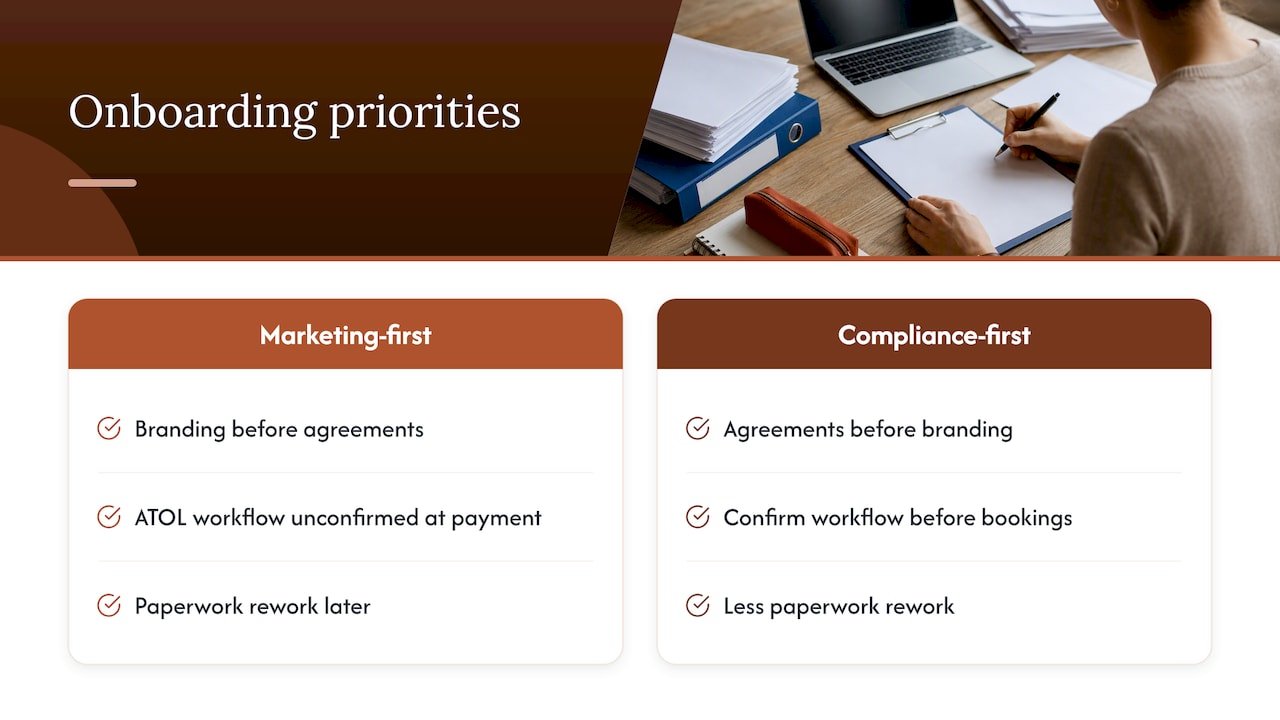
New agents tend to focus on marketing and branding first, then scramble to sort out agency agreements and ATOL paperwork once a client is already waiting to pay; one effective retention tactic is client gifting, such as through a trusted chocolate direct mail service for business clients. That order creates risk: a booking taken before your certificate-issuing workflow is confirmed is a booking you cannot properly protect.
The agents who move fastest to real income are the ones who treat registration, agreements and payment setup as the actual product launch, with branding and marketing as the layer on top. A structured checklist does not slow you down. It removes the rework that comes from building a brand on top of paperwork you have not finished.
— Sam
How a white-label host can implement much of this checklist for you
Working through agency agreements, ATOL certificate workflows, payment setup and training on your own takes real time, and getting any one piece wrong carries compliance risk. We built our white-label travel agency platform to support you with a branded booking site and training on bookings.
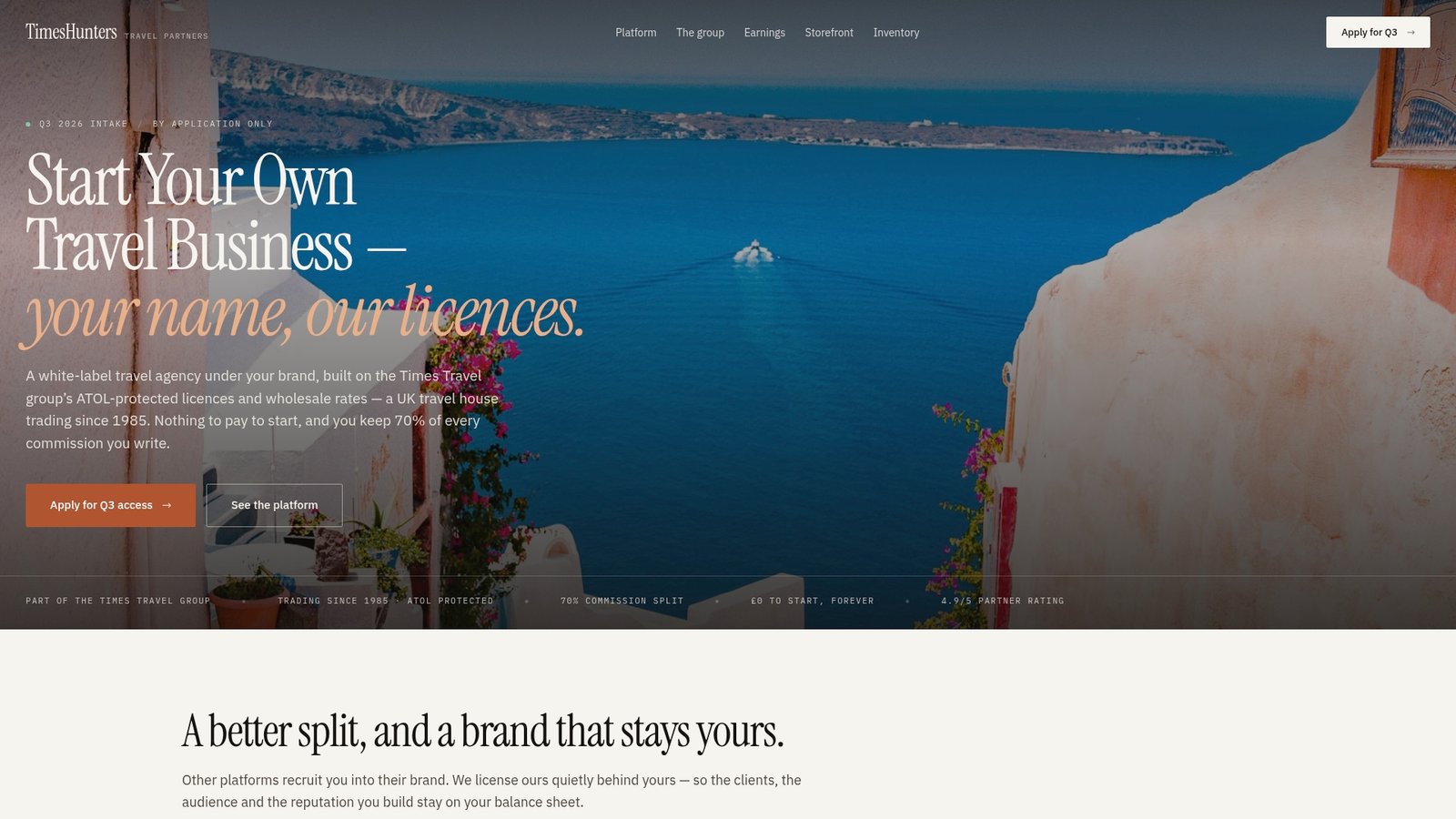
Our partners keep their own brand and their own client relationships while getting access to ATOL-protected infrastructure. Partners earn a 30% commission split; current prices are on our pricing page.
When you compare any white-label option against this checklist, ask directly: does it provide ATOL hosting, a tested certificate-issuing process, training and bookkeeping support? If any of those is missing, you will end up doing it yourself anyway.
- Our platform provides access to ATOL-protected licensing infrastructure.
- Our platform offers a branded booking site and automated client follow-up.
- Our platform includes training and launch support.
For more information, visit our UK travel agent training and launch page, or check how to start selling travel today.
FAQ
Do I need to register as a sole trader before taking my first booking?
Yes, if you expect to earn more than £1,000 in a tax year, you must register for Self Assessment with HMRC. The deadline is 5 October following the end of the tax year in which you started trading.
What is the difference between a travel retailer and an organiser?
A retailer sells travel on behalf of another company under an agency agreement, while an organiser (or principal) packages and sells travel under its own liability. ABTA guidance recommends deciding this early, since it determines your legal liability and financial-protection responsibilities.
When must I issue an ATOL Certificate to a client?
An ATOL Certificate must be issued immediately when you take the first payment from a client, including when only card details have been taken. CAA guidance requires the certificate to name the issuer and include their ATOL number.
What consent do I need before sending marketing emails to clients?
You need granular, affirmative consent collected without pre-ticked boxes, as set out in ICO guidance. Clients should also be told clearly how their data will be used before they opt in.
How much does it cost to set up as a limited company?
Registering a limited company online through Companies House costs £100, or £124 if you register by post, according to GOV.UK. You will also need to add Corporation Tax services once you start trading.
Sources
- Gov
- How your business trades | ABTA
- Ico
- Travel trade selling through agents | UK Civil Aviation Authority
- The package Travel and Linked Arrangements Regulations 2018 guidance for businesses