
Travel Agency Cancellation Policy: What to Include in the UK
How to write a travel agency cancellation and refund policy that is clear, fair and enforceable under UK consumer law, with the rules and fee tiers explained.

A UK travel agency’s cancellation policy has to do three jobs. It must tell customers what happens if they cancel. It must say what you will do if you or a supplier cancel. And it must stay fair enough to be enforced. Fees have to reflect real costs, a flat “no refunds” line is not safe, and everything must be explained clearly before the customer pays. This guide sets out what to put in the policy, how to build the fee tiers and how to run refunds without losing money or goodwill.
It is written for people starting or running a travel business, including freelancers, advisers building a personal brand and hospitality owners adding travel sales. It is not a guide for holidaymakers who want to cancel a trip.
TL;DR
- A term saying no refund is ever available is likely to be treated as unfair and unenforceable under UK consumer law.
- Cancellation fees must follow reasonable standard amounts tied to how close to departure the customer cancels and to the costs you cannot recover.
- If you or a supplier cancel a package, the customer must be given a refund. You owe it even if the airline or hotel has not yet paid you back.
- Show the policy before booking, in plain words, with a tier table and a worked example.
- Keep a written record of every cancellation request, with the date, the reason and the refund paid, so disputes can be settled from facts.
Table of Contents
- Why the policy matters more than the rest of your terms
- Know what you sold: package, linked arrangement or single service
- What a customer-cancellation policy should contain
- Why “no refunds” is not an option
- Situations that override your fee table
- When you or a supplier cancel
- Writing it so customers understand it
- Managing cancellations day to day
- Perspective: why the policy belongs to the brand
- Starting your own agency without writing it all from scratch
- A checklist before you publish
- FAQ
- Sources
Why the policy matters more than the rest of your terms
Customers read cancellation terms at the moment they are most anxious: when something has gone wrong. A vague policy turns a routine request into a complaint. A clear one turns it into a short email.
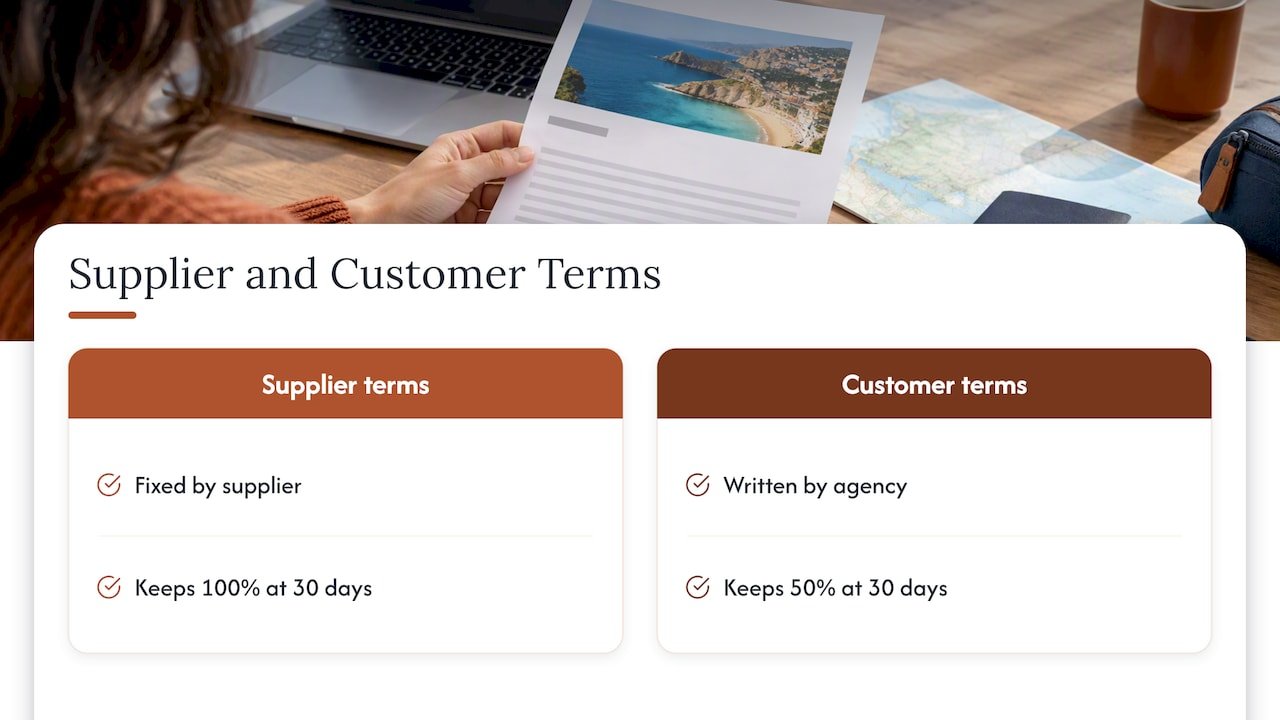
For a small agency there is a second reason. Your supplier terms are fixed by the hotel, cruise line or tour operator. Your customer terms are yours to write, and the gap between the two is where margin gets lost. If a supplier keeps 100% of the price 30 days out and your policy only keeps 50%, you pay the difference.
The policy also sits inside a legal frame. Which rules apply depends on what you sold, so start there.
Know what you sold: package, linked arrangement or single service
The rights a customer has when cancelling depend on the type of booking. The UK’s Package Travel and Linked Travel Arrangements Regulations 2018 cover packages and linked travel arrangements. A single stand-alone service, such as one hotel night booked on its own, sits outside the package rules and falls back on the supplier’s terms and general consumer law.
In practice that means three bands to describe in your policy:
- Packages, such as flights plus hotel, or a tour with accommodation sold at one price. The strongest customer protections apply.
- Linked travel arrangements, where separate services are bought through linked bookings. Protection is narrower, mainly around insolvency.
- Single services, where the supplier’s own conditions largely drive what you can charge.
Do not make the customer work out which band they are in. Say it at the top of the policy, and say it again on the confirmation.
What a customer-cancellation policy should contain
A workable policy answers the questions a customer will ask, in the order they will ask them.
How to cancel
Give one route: an email address or a form, and state that cancellation takes effect when you receive it in writing. Say what counts as received outside office hours. If you take phone cancellations, confirm them in writing the same day.
The fee tiers
Tiers by time before departure are the standard way to do this. The rule behind them is set out in official guidance: termination fees must be based on reasonable standard amounts that account for how long remains before the package starts, and for the cost savings or income expected from reselling the travel services.
That gives you a test for each number. Ask what you or the supplier actually lose at that point, and whether the room, seat or cabin can be resold. A charge that is far above the likely loss is the one that gets challenged.
A tier table for a package might look like this. The percentages are illustrations of the layout, not recommended figures, and yours must come from your suppliers’ terms:
| Cancellation made | Charge to customer | What it should reflect |
|---|---|---|
| More than 90 days before departure | Deposit only | Admin cost and any non-refundable supplier deposit |
| 89 to 60 days | Higher share of the total | Supplier deposit plus time to resell |
| 59 to 30 days | Larger share still | Supplier penalties starting to bite |
| 29 days or fewer | Up to the full price | Little or no chance to resell |
Where a supplier uses short cut-offs for ground services, copy that structure rather than inventing your own. Transfer and coach operators often state refund cut-offs in hours, as in this example of bus cancellation refund cut-offs. If you bundle such a transfer into a trip, your customer terms for that element should be no harsher than what you are charged.
Deposits
Deposits are a frequent source of complaints. The Competition and Markets Authority has said that deposits should generally be a small percentage of the total cost to be seen as fair, because what you keep must reflect actual losses. State the deposit, what it covers, and whether any part comes back.
Amendments
Separate a change from a cancellation. Say whether name changes, date changes and upgrades are allowed, what they cost, and the point after which a change is treated as a cancellation and a rebooking.
Insurance
Tell customers plainly that your cancellation charges are not the same as an insurance claim, and that cover has to be arranged before they need it. Do not give advice on a specific policy unless you are authorised to do so. Point customers to the insurer for what is covered.
Why “no refunds” is not an option
It is tempting to write a blanket rule for a non-refundable fare or a peak-season villa. The official guidance is direct: terms stating that no refund is available under any circumstances are likely to be deemed unfair and unenforceable. The CMA adds that a term it considers unfair cannot be enforced in court, even when the customer has signed.
The sensible wording is narrower. Say which parts of a booking are non-refundable because a supplier will not return them, say that you will pass on anything you recover, and keep the customer’s statutory rights untouched.
Situations that override your fee table
Some cancellations carry no fee whatever your tiers say. Build these exceptions into the policy so that a customer reads them from you first.
Unavoidable and extraordinary circumstances
If a traveller ends a package contract because of unavoidable and extraordinary circumstances at the destination or nearby, such as war, disease or a natural disaster, they are entitled to a full refund with no termination fee. Your policy should not claim a fee in these cases. It helps to say how a customer can show the circumstances apply, for example by pointing to official travel advice for the destination.
Price increases
You can only raise the price after booking if your contract allows it, and only for specific reasons such as fuel costs, taxes or exchange rates. Citizens Advice says customers must be told at least 20 days before departure, and that if the increase is more than 8% of the package cost they can cancel with a full refund. Write your surcharge clause to match, and do not promise a right to surcharge that you will not use.
Significant changes by you
If you make a significant change to a package after booking, the customer can cancel without charge and get a full refund, or accept an alternative if you offer one, according to Citizens Advice. Define in your policy what you treat as significant: a different resort, a change of airport, a large change of flight time or a lower hotel standard.
When you or a supplier cancel
This half of the policy is the one customers remember. The rules are less flexible, so write it simply.
- Refund the customer. The right to a refund when an organiser cancels applies regardless of whether the organiser has received funds back from a third party such as an airline. A supplier’s delay is your cash-flow problem, not the customer’s.
- Offer a genuine choice. ABTA’s Code of Conduct says members must give a real choice between an alternative holiday and a refund when a service is cancelled. Do not steer customers to the alternative.
- Do not insist on credit. GOV.UK states that customers have a right to a cash refund and are not obliged to accept a refund credit note or to rebook. Offer a credit note as an option only.
- Pay on time. GOV.UK sets the standard for package holidays cancelled by the organiser as a full refund within 14 days of cancellation. Put 14 days in your policy and meet it.
If a refund is late, the customer is pointed elsewhere. The Financial Conduct Authority’s guidance says that when a travel provider has not refunded within 14 days, consumers should contact ATOL or ABTA as relevant. That is a good reason never to let a refund drift.
Writing it so customers understand it
The law asks for clarity as well as fairness. Package organisers must give pre-contractual information, including cancellation terms, in a clear, comprehensible and prominent way. Some habits that meet that standard:
- Put the table before the legal text. Use a one-screen summary with the tiers, then the full wording beneath it.
- Use one worked example. “If your trip costs £2,000 and you cancel 45 days out, you pay X and we refund Y.” Calculate it with the real figures from your own tiers.
- Count days the same way everywhere. Say whether the departure day counts and which time zone applies.
- Say what is not refundable and why. Naming the supplier rule behind it makes a fee feel less arbitrary.
- Show it at the point of sale. Include it in the proposal and in the booking confirmation, and ask the customer to confirm they have read it.
- Keep the tone neutral. Avoid capital-letter warnings and phrases like “strictly no exceptions”.
Managing cancellations day to day
A good policy fails without a process behind it. This is where small agencies lose time, and where the owner of a one-person brand feels it most.
Keep a record of everything
For every cancellation, record when the request arrived, who made it, which booking and which travellers, which tier applied, what the suppliers charged, what you charged, and when the refund was paid. A shared spreadsheet is enough to start, though booking software that timestamps each action is better. If a dispute reaches a trade body or a card provider, a dated trail is your best evidence.
Work from a simple routine
- Acknowledge the request in writing within one working day.
- Check the booking type and the supplier’s terms for each element.
- Work out the fee from your tiers and any exception that applies.
- Send the customer the calculation, not just the total.
- Claim back what the supplier will return and set a diary date to chase it.
- Pay the refund and close the file with the date.
Settle disputes before they escalate
Most disputes come from surprise. If the customer says they were never told, you need proof of what was shown and when. If they argue the fee is too high, show how it maps to supplier charges. Where a charge cannot be justified, reducing it is cheaper than defending it. If you cannot agree, refer the customer to the route set out in your trade protection, such as ATOL or ABTA, rather than ignoring them.
Protect your own margin
Your supplier terms should drive your tiers, so keep a note of each supplier’s cut-off dates when you book. Tell customers early, in the proposal, which elements are least flexible. For travel sold under another firm’s licence, check how refunds and payments are handled so that your customer terms match the licence holder’s.
Perspective: why the policy belongs to the brand
We work with people building their own travel brands, and we see the same pattern. New advisers copy a template from a big operator, then find that it does not fit how they sell. A big operator can absorb a lost cabin. A solo adviser cannot.
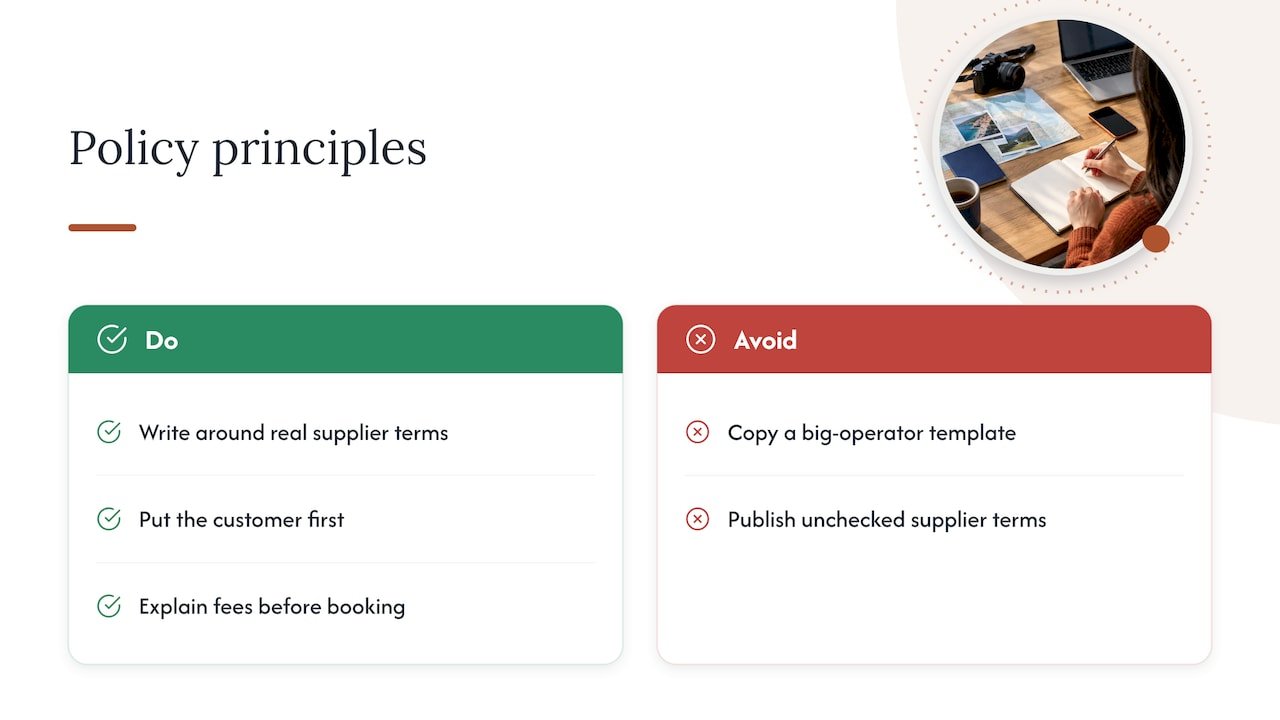
Our view is that the policy should be written once, around real supplier terms, and written for the customer first. A client who understands the fee before booking rarely argues about it later, and that helps the thing most advisers are really building: a client list that comes back and refers friends.
The structure behind a white-label agency also matters here. Under our model, partners trade under their own name, while the booking infrastructure and the ATOL-protected licence sit behind it. That lets a partner concentrate on explaining terms clearly and looking after clients, rather than working out how to protect payments from scratch. Whatever model you use, do not publish terms you have not checked against the suppliers behind each booking.
— Sam
Starting your own agency without writing it all from scratch
If you are reading this because you want to start selling travel, the cancellation policy is one of several things you need to get right. We built Timeshunters so that you can launch a branded travel business using Times Travel group’s ATOL-protected licences, with access to wholesale hotels, cruises and tours, a branded booking site, managed payments and financial protection, automated client follow-up and training. Partners keep a 70% commission share, and there is no cost to start.
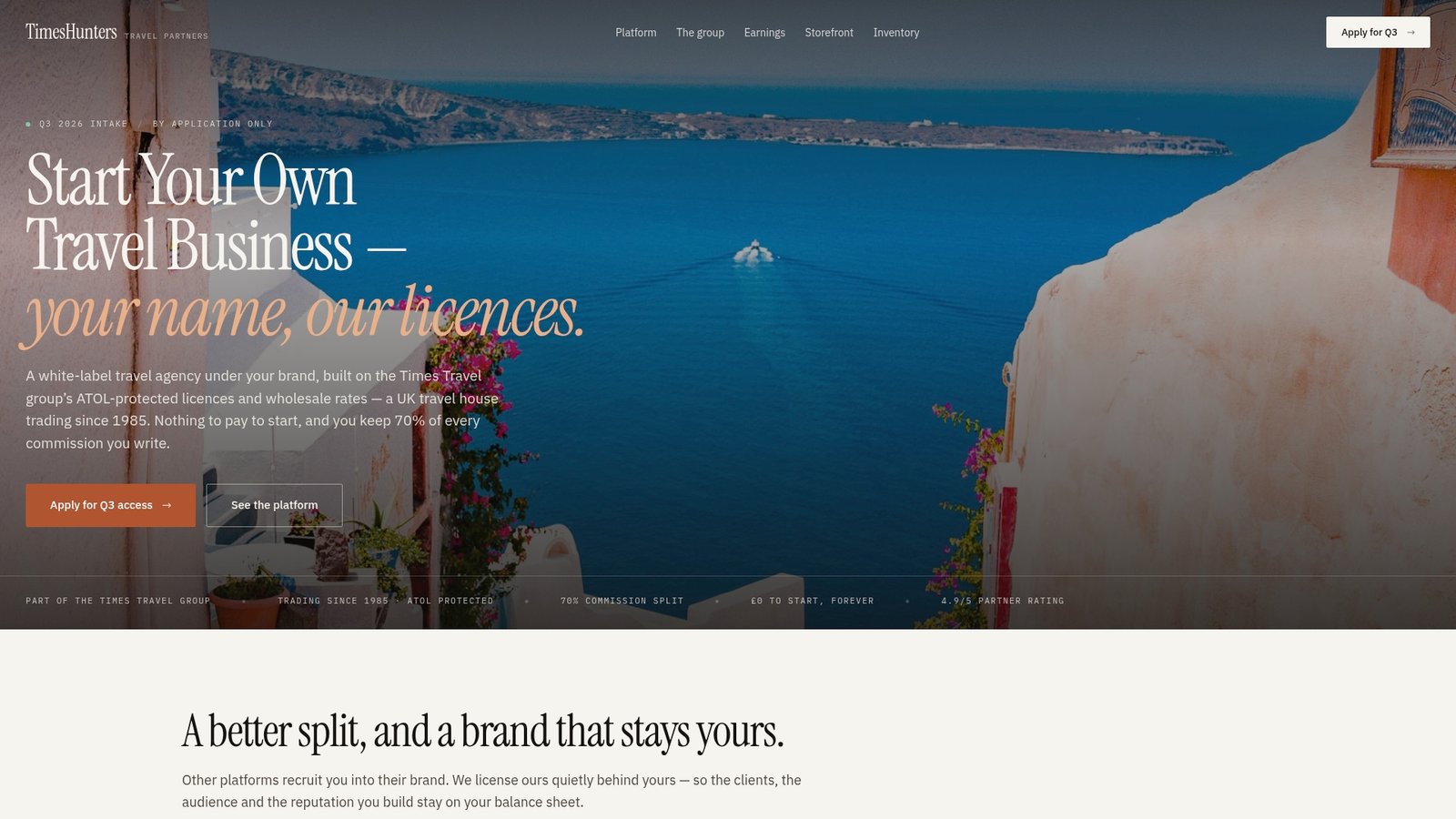
You can see what is included on our white-label travel agency page, including the hotel, cruise and tour inventory you can resell under your own brand.
A checklist before you publish
- Each fee tier matches a supplier term or a real, explainable cost.
- Deposits are a modest share of the price and the policy says what they cover.
- No clause says that refunds are never given.
- Exceptions are stated: extraordinary circumstances, large price rises and significant changes.
- Agency or supplier cancellations lead to a refund within 14 days, with a genuine choice of alternative.
- The table and a worked example appear before the legal text.
- Customers see the policy before they pay and again on confirmation.
- You have a written record process and a named route for unresolved disputes.
Trading standards or a solicitor who knows travel law can check the final wording. This is worth doing once, before the first booking, because the rules are updated: the official guidance linked above was revised in 2026.
FAQ
What is a reasonable cancellation policy for a travel agency?
One where charges rise as departure approaches and reflect real, unrecoverable costs. Official guidance asks for reasonable standard amounts that allow for the time before the trip and for any income from reselling the services. It should also be clear and shown before booking.
Can a travel agency refuse a refund?
Not by a blanket term. A clause that says no refund is ever given is likely to be unfair and unenforceable. You can keep amounts that are justified by genuine costs, but when you or a supplier cancel a package, the customer is entitled to a refund.
How long does a travel agency have to pay a refund?
For a package holiday cancelled by the organiser, GOV.UK sets 14 days from cancellation. If a refund is not paid in that time, customers are directed to ATOL or ABTA, so aim to pay well inside the period.
Do customers have to accept a credit note?
No. GOV.UK says customers have a right to a cash refund and need not accept a refund credit note or rebook. You can offer a credit note as a choice, with its protections explained, but you cannot make it the only option.
Do cancellation rules differ for a package and a single booking?
Yes. Packages and linked travel arrangements fall under the 2018 regulations, with stronger protections for packages. A single service such as one hotel night relies mainly on the supplier’s terms and general consumer law, so your policy should say which applies.
Sources
- Guidance on the Package Travel and Linked Travel Arrangements Regulations 2018 (amended 2026)
- CMA: Holiday deposits and cancellation fees
- GOV.UK: Information about package holiday refunds and cancellations
- Citizens Advice: Cancelling a package holiday
- ABTA: Guidance on the application of the Code of Conduct
- FCA: Cancellations and refunds, helping consumers understand their rights
- Bus cancellation refund cut-offs