
Agent Training Portal for Travel: What to Look For
What a travel agent training portal should teach, which UK rules to learn first, and how to choose online training that gets you selling under your own brand.

A good agent training portal does three things: it teaches you the products you will sell, it shows you how to run bookings and compliance in the UK, and it keeps supporting you once real clients arrive. You don’t need a formal qualification to start. What you need is training that leads to your first paid booking, not a certificate on the wall.
This guide is for people who want to sell travel under their own name: freelancers, influencers, hospitality owners and professionals with a client list. It covers what online training for travel agents should include, which UK rules to check first, how to judge a course or portal, and how a white-label model fits in.
TL;DR
- The National Careers Service says there are no set entry requirements for trainee travel agents, so a portal should be judged on what it helps you do, not on a badge.
- Look for product training, booking tools, compliance guidance and ongoing support in one place, plus a way to test what you have learned.
- Before you sell flights or packages, check whether you trade as an agent or a principal and who holds the ATOL.
- Our model gives you a branded agency on ATOL-protected licences, with training and support included and a 70% commission on bookings.
Table of Contents
- What an agent training portal actually is
- Do you need qualifications to become a travel agent in the UK?
- What good online training for travel agents covers
- The UK rules to learn before your first booking
- How to judge a course or portal
- Ongoing training once you are trading
- Our perspective: training works best when it sits inside the business
- How our white-label platform fits
- A practical first 30 days
- FAQ
- Sources
What an agent training portal actually is
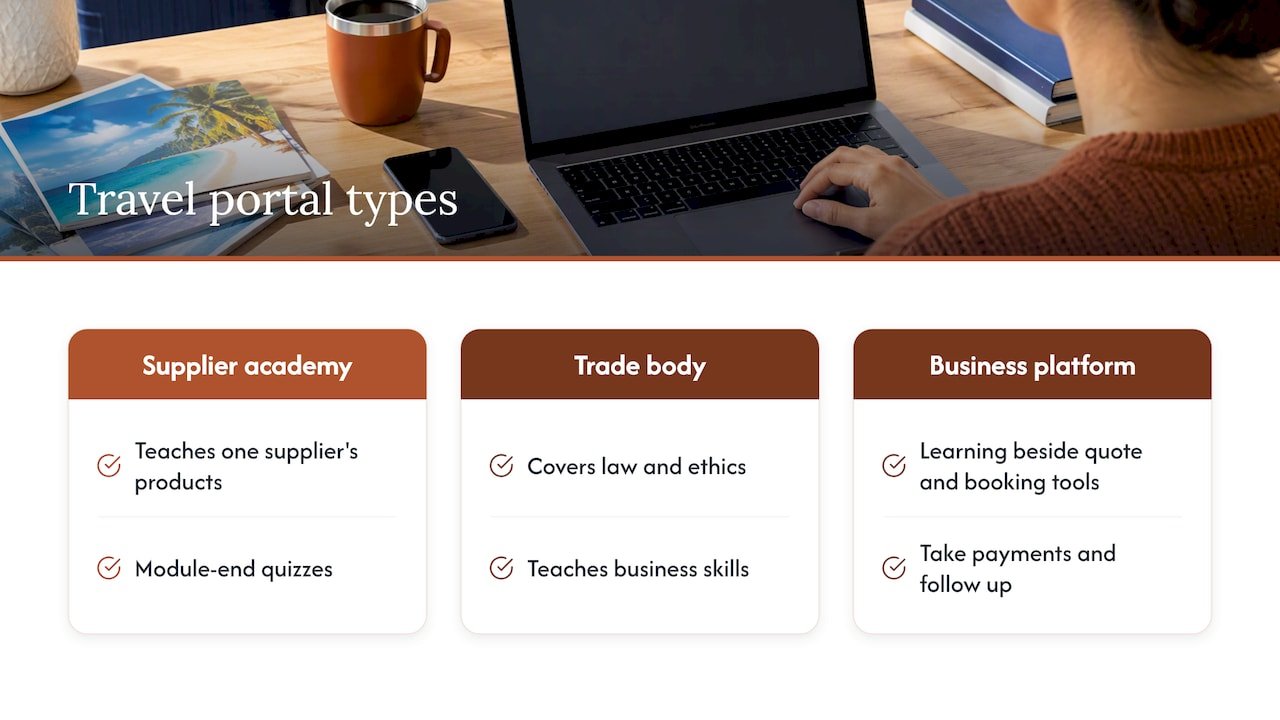
An agent training portal is a login area where people who sell travel learn about what they sell. In the broadest sense it is a library of short online courses, usually split into modules, with some form of assessment at the end. Some portals belong to a single supplier and teach only that supplier’s products. Others are run by trade bodies and cover law, ethics and business skills. A third kind sits inside a travel business platform and combines learning with the tools you use to quote, book and manage clients.
That third kind matters most if you plan to build your own brand. Learning about a destination is useful. Learning it in the same place where you build a proposal, take a payment and follow up with the client is faster, because you apply it the same day.
Training that ends in a quiz is a good sign. Some supplier academies, for example, assess agents with quizzes at the end of each module, which gives you a way to check that you have retained the material before you advise a paying client.
Do you need qualifications to become a travel agent in the UK?
No. The National Careers Service states that there are no set entry requirements for starting as a trainee travel agent. Routes in include college courses, apprenticeships and learning on the job. It also says employers expect a good general standard of education, that customer service experience can help, and that good geographical knowledge is useful.
That is worth taking in properly, because a lot of training marketing implies you cannot start without the right certificate. You can. What you cannot do is skip the legal groundwork, which we cover below.
If you do want a structured, recognised route, the Travel Consultant Level 3 apprenticeship is approved for delivery and runs for 12 to 24 months depending on prior attainment, with a typical duration of 12 months before assessment. It suits someone who wants to be employed in an agency while they learn. It is a different path from starting your own brand, where you are learning while you build your client base.
What good online training for travel agents covers
Whatever the format, the content falls into four blocks. Use these as a checklist when you compare portals.
1. Product knowledge
This is where most people start. You learn how hotels, cruises, tours, villas, rail and safari camps differ, how they are priced, what is included and what is not, and which type of traveller each suits. A cruise buyer asks different questions from a safari buyer. A client choosing a villa wants to know about transfers, staff and cancellation terms. Your credibility rests on answering these without hesitation.
A simple test: after a module, could you explain to a friend the difference between two products and recommend one? If not, the training is describing, not teaching.
2. Booking and business tools
The practical side is how you find availability, price a trip, send a proposal, take payment and manage the booking through to return. A portal that teaches these steps on the real system you will use saves weeks. Look for:
- Search across several types of inventory, not one product line.
- A way to produce a clear proposal for a client quickly.
- Payment handling that does not leave you holding client money informally.
- Automated reminders and follow-up so enquiries don’t go cold.
3. Law and consumer protection
This block separates a hobby from a business. You need to understand what you are legally selling, who the client contracts with and what protection applies if something fails. We go through it in the next section.
4. Marketing and client relationships
The best-paid agents are rarely the ones with the most product knowledge. They are the ones who know whom they serve. Good training shows you how to find a niche, talk to your audience, build repeat business and ask for referrals. If you have a social following, a loyal customer base or a professional network, this is where it turns into revenue.
The UK rules to learn before your first booking
This is the part to take slowly. The rules below come from official and professional sources. Check them against your own situation, and ask ABTA, the CAA or a solicitor about anything specific to how you plan to trade.
Agent or principal?
ABTA advises you to check whether you trade as a retail agent or as a principal, because it affects financial protection and your liability to customers. A retail agent receives an agreed commission from the principal and tells customers that they are an agent and who the customer will contract with. An agent that combines travel services itself into a package is responsible for protecting that package financially and is liable to its customers for providing it.
In plain terms: selling someone else’s product as their agent is a very different position from assembling your own packages.
ATOL and flights
The CAA states that a business selling a flight-inclusive package or Flight-Only to UK consumers must be an aircraft operator selling its own services, an ATOL holder, or exempt. Among the exemptions under ATOL Regulation 10 are agents for ATOL holders and members of accredited bodies.
This is why the licence behind your business matters more than most people expect. If you plan to sell anything with flights, you either hold the protection yourself, or you work as an agent for someone who does.
Linked travel arrangements
If you facilitate linked travel arrangements, you must give the traveller clear and prominent information, using prescribed forms, explaining that they do not get the rights that apply to a package. The detail is in the Package Travel and Linked Travel Arrangements Regulations 2018. A good portal teaches you when a booking is a package, when it is a linked arrangement and when it is neither, because the paperwork differs.
Questions to ask any portal about compliance
- Does it explain the agent and principal distinction in plain English?
- Who holds the licence and the financial protection for what I sell?
- Are disclosure documents built into the booking process, or left to me?
- Is guidance updated when regulations change?
How to judge a course or portal
Prices, claims and badges vary a great deal. Use these five checks.
| Check | What good looks like | Warning sign |
|---|---|---|
| Cost | Clear price, or clearly free with a stated reason | Upfront fees that unlock “the real content” |
| Accreditation | A named, checkable body behind the claim | Vague “industry approved” wording |
| Assessment | Quizzes or tasks that test knowledge | Videos only, no check on learning |
| Practical link | Teaches the booking tools you will actually use | Theory with no route to a live booking |
| Support | Named help after you finish | Access ends when the course ends |
On accreditation, the Institute of Travel and Tourism runs a Recognition programme that reviews training and professional development programmes against industry requirements and standards, and an endorsement can add weight to a provider’s profile. If a course cites a body, look up that body and see whether the programme is genuinely listed.
On duration, be realistic. Self-paced programmes vary widely. One US-based programme, for instance, asks for roughly 40 to 60 hours of learning. Hours of study tell you little by themselves. What counts is how quickly you can take a real enquiry from first message to confirmed booking.
Match the portal to your goal
The right training depends on where you are starting from.
- Career changer wanting a job in an agency: a recognised qualification or apprenticeship may suit you.
- Freelancer or influencer wanting your own brand: you need training tied to a platform that handles licensing, payments and bookings, so you can sell sooner.
- Hospitality owner adding revenue: you need product knowledge in the categories your guests ask about, and a way to book them without building a back office.
- Professional with an existing client list: focus on proposals, follow-up and compliance, since your clients already trust you.
Ongoing training once you are trading
Learning doesn’t stop after the first course. Rules change, suppliers change, and your clients’ expectations rise. Trade bodies address this directly. ABTA members, for example, can use Knowledge Zone online training, legal and compliance guidance notes, seminars including travel law conferences and weekly ABTA Today updates. The same report says ABTA provides Code guidance and training to support higher customer standards.
Whatever route you take, plan for three kinds of continuing support:
- Regulatory updates, so you know when the rules affecting your sales change.
- Product refreshers, because hotels, cruise lines and tour operators change their offers constantly.
- Someone to ask, ideally a named team who can answer a live booking question in real time.
Our perspective: training works best when it sits inside the business
We built TimesHunters because we saw the same pattern again and again. People complete a travel course, feel ready, and then discover that the hard part isn’t knowledge. It is the infrastructure. They need a licence they can sell under, access to inventory at wholesale rates, a way to take payments safely, and a system that doesn’t swallow their evenings in admin.
Our view is that training should be part of that infrastructure rather than a separate purchase. When you learn how to price a cruise on the same platform you will use to send the proposal, the lesson sticks, and your first client doesn’t feel like an experiment.
It is also why we care about the commission model. Online travel agencies typically offer around 4%, by our own comparison. Our partners keep 70% commission on their bookings, with the remaining 30% as our share. That gap changes what training is worth. A skill that earns you more on every booking pays back faster, and one partner has told us their income went from £400 to £1,200 per booking after moving to our model. That is one partner’s experience, not a promise for everyone, but it shows why we think the commission structure and the training belong together.
The third thing we believe is that your brand should be yours. Our licences’ branding is invisible to your clients. They book with you, you own the relationship and the client list, and you decide who you serve. We provide the ATOL-protected backbone and the support behind it.
— Sam
How our white-label platform fits
If you want to sell travel under your own name without applying for your own licence first, a white-label travel agency is the quickest route. You trade as your own brand, on Times Travel group’s ATOL-protected licences, so the financial protection question is handled by the infrastructure rather than left for you to solve alone. As the CAA explains, agents for ATOL holders are among those covered by the exemptions, which is the type of arrangement to understand when you assess any provider.
Our platform gives you:
- A branded booking site under your own name.
- Wholesale hotel, cruise and tour inventory, plus villas, safari camps and rail.
- Instant pricing proposals for clients.
- Managed payments and financial protection.
- Automated booking management and client follow-up.
- Training and support from our team.
There is no cost to start. Commission is split 70% to you and 30% to us, and nothing is priced on our side by category, because hotels, cruises, tours and the rest are resold at the rates available at the time of booking.
Ready to see how it would work for your audience? Explore our white-label travel agency or start from the TimesHunters homepage.
A practical first 30 days
Whatever platform you choose, a simple plan keeps you moving.
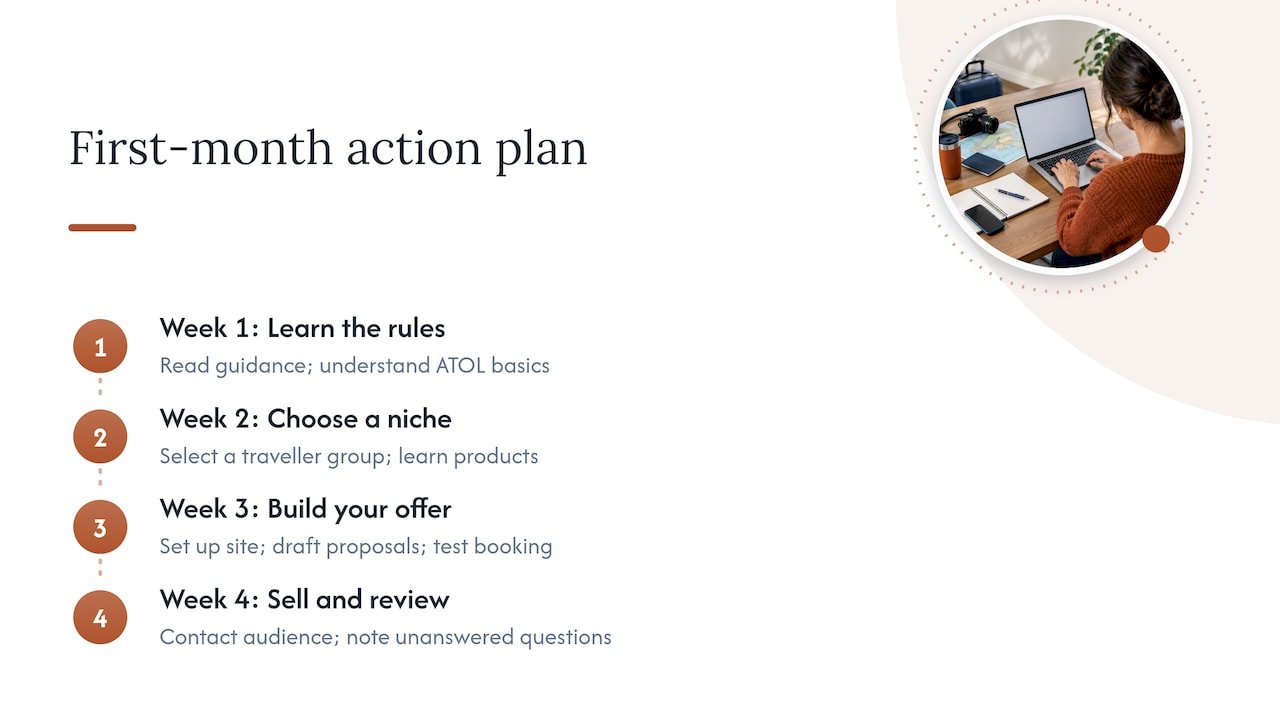
Week 1: learn the rules. Read the agent and principal guidance, understand ATOL basics and know which of your sales fall under which rules. Write down in one paragraph how you will trade.
Week 2: choose a niche. Pick one type of traveller you can serve better than a generic website: families you already know, a hospitality guest base, a following who share one interest. Learn the products that suit them first and ignore the rest.
Week 3: build your offer. Set up your branded site, draft two or three sample proposals for typical trips and test the booking flow end to end with a friendly first client.
Week 4: sell and review. Contact your existing audience, take your first enquiries and note what questions you couldn’t answer. Those gaps tell you which training modules to revisit.
The point of this plan is that learning and selling happen together. Nobody feels fully ready, and the quickest way to become competent is to handle real enquiries with support behind you.
FAQ
Do I need a qualification to work as a travel agent in the UK?
No. The National Careers Service says there are no set entry requirements for trainee travel agents. Courses and apprenticeships help, but you can learn on the job. You still need to understand ATOL, package travel rules and how you are trading.
How long does travel agent training take?
It depends on the route. A Level 3 Travel Consultant apprenticeship typically lasts 12 months and can run up to 24, while self-paced online programmes are often measured in tens of hours. Many people learn the basics quickly and then keep building product knowledge as they sell.
Is a free agent training portal worth using?
Yes, if it teaches products or skills you will really use and doesn’t hide the useful material behind a fee. Check who runs it, whether it includes assessment, and whether it connects to a way of actually booking and earning commission.
Do I need my own ATOL to sell travel?
Not necessarily. A business selling flight-inclusive packages or Flight-Only to UK consumers must be an ATOL holder, an aircraft operator or exempt, and agents for ATOL holders are among the exemptions. Check your own situation with the CAA before you trade.
Can I start a travel business with training and no experience?
Yes. Many people begin with a niche they already know and an audience that trusts them. Choose training that lets you practise on real bookings, and use a platform that provides licensing, payments and support so you can focus on clients.
Sources
- Travel agent | National Careers Service
- Travel consultant apprenticeship | Skills England
- How your business trades | ABTA
- Do I need an ATOL | UK Civil Aviation Authority
- Package Travel and Linked Travel Arrangements Regulations 2018, regulation 26
- Code of Conduct and ADR Annual Report 2024/2025 | ABTA
- Institute of Travel and Tourism
- TBO Academy
- TRIPKIT Travel Agent Training