
Tour Operator vs Travel Agent: What Actually Differs
A tour operator builds and is responsible for the holiday. A travel agent sells it for commission. See how the law, pricing and earnings differ in the UK.

A tour operator puts a holiday together and is contractually responsible for delivering it. A travel agent sells travel that someone else provides and earns commission for doing so. That one distinction, who holds the contract with the customer, drives almost everything else: legal liability, financial protection, pricing and how the money is made.
This guide explains the difference in plain terms, using UK rules, and shows where the two roles overlap. It also covers what it means if you are thinking of starting a travel business yourself.
TL;DR
- A tour operator (in legal terms, a principal) is bound to the customer to provide the travel services. A travel agent arranges a contract between the customer and that principal without being a party to it.
- Agents earn agreed commission from the principals they sell for. Operators earn the margin between what they buy and what they sell.
- One business can act as both, depending on the transaction. If an agent combines services itself into a package, it takes on the organiser’s duties, including financial protection.
- Booking through an agent is not always cheaper or dearer. Independent research shows direct booking is often cheaper for packages and flights, while agents add advice, convenience and support.
- If you want to sell travel without becoming an operator, you can do it as an agent under a licensed holder’s protection.
Table of Contents
- The short answer: who holds the contract
- Side by side: tour operator vs travel agent
- What a tour operator does
- What a travel agent does
- When an agent becomes an operator
- Is a travel agent the same as a travel consultant?
- Does booking through a travel agent cost more?
- Protection: what it means for the traveller
- How the money works for each role
- Perspective: why we think the agent model works, if the split is right
- Choosing between the two as a business
- Start your own branded travel agency
- FAQ
- Sources
The short answer: who holds the contract
The clearest UK definition comes from the trade body ABTA. In its guidance on how a travel business trades, a principal, such as a traditional tour operator, is contractually bound to customers to provide travel services. An agent sells or promotes a principal’s services for an agreed commission.
The same page describes the agent as an intermediary. It brings about a contract between the customer and the principal, but it is not a party to that contract.
In everyday terms:
- Tour operator: designs the product, buys the components (flights, rooms, transfers, excursions), prices the whole and sells it. If something goes wrong with the holiday, the customer’s claim is against the operator.
- Travel agent: shows you what is available, helps you choose, takes the booking and passes it to the operator or supplier. The holiday is the operator’s, not the agent’s.
A ski chalet week, a music festival trip or a safari itinerary can each be built by an operator. A high street shop, a home-based agent or an online agency can sell any of them.
Side by side: tour operator vs travel agent
| Tour operator | Travel agent | |
|---|---|---|
| Legal role | Principal, party to the contract with the customer | Intermediary, not party to the contract |
| What it does | Designs and runs the holiday, combining services | Advises, recommends and books services provided by others |
| Who sets the price | Sets its own prices | Generally sells at the principal’s price |
| How it earns | Margin on the packages it sells | Agreed commission from principals |
| Liability if the holiday goes wrong | Carries it | Normally does not, unless it acts as the organiser |
| Financial protection | Must provide it for packages it organises | Relies on the principal’s protection, or its own if it builds packages |
| Typical examples | Safari, ski, cruise-and-stay or escorted tour specialists | Independent home agents, high street agencies, online agencies |
The table shows the standard picture. The next sections explain where the edges blur.
What a tour operator does
An operator takes individual parts of a trip and makes them one product. Those parts might include flights, ground transport, accommodation, meals, guides and activities. Because the operator buys in bulk or under contract, it can often offer a single price for the whole holiday.
The operator also takes on the risk. Under the Package Travel and Linked Travel Arrangements Regulations 2018, which apply throughout the UK, organisers are liable for performance of the package and must provide insolvency protection. That includes refunds or repatriation if the organiser becomes insolvent. The guidance places that liability on the organiser regardless of whether third parties actually deliver the services.
For flight-inclusive holidays, ATOL adds a further layer. The Civil Aviation Authority says ATOL rules apply to overseas businesses selling to UK consumers, and to flight-inclusive packages sold to UK consumers whatever the departure point.
If you want the cost side of running as an operator, our guide to tour operator bonding in the UK sets out what it involves and what your options are.
What a travel agent does
An agent’s value is choice, advice and service. A good agent listens to what you want, compares options across several operators and suppliers, handles the booking and is the person you call if your plans change.
Commercially, agents generally earn agreed commission from principals, while principals typically set the prices of their services. The agent does not own the product and does not usually control its price.
The agent is not exempt from rules, though. The CAA says an ATOL holder selling flights or packages through agents must have a written agency agreement with each agent. Without one, both parties are in breach of the ATOL Regulations. Agents must also issue an ATOL Certificate to the consumer immediately on payment, however the booking is made.
Specialist agencies show how much service an agent can add. A specialist India travel agent, for example, can handle multi-city flights, private tours with custom routes and guides, and visa paperwork around a single trip. The customer gets expertise, while the contracts sit with the airlines, hotels and operators behind the booking.

When an agent becomes an operator
The line is not fixed by a job title. It is set by what you do in a particular transaction.
ABTA notes that a business may trade as both, depending on the transaction. When an agent combines travel services itself to organise a package, it is responsible for financially protecting that package and is liable to customers for providing it.
That matters if you sell more than a straight flight or hotel. Building a bespoke itinerary of flights, hotel and transfers for a single price can make you the organiser in law. For flight-inclusive packages, that means you need ATOL cover as well.
Tax can shift the same way. ABTA explains that an agent usually accounts for VAT on its own commission, but HMRC can treat a supply differently if the agent acts in its own name as an undisclosed agent. That can bring the sale under the Tour Operators’ Margin Scheme (TOMS). HMRC’s own guidance says operators acting as principals or undisclosed intermediaries account for bought-in supplies for resale under TOMS, while a disclosed agent’s VAT on commission depends on the place and liability of the underlying supply. Take advice from an accountant before you set up how you trade.
Is a travel agent the same as a travel consultant?
Usually, yes in practice, but the label is a job title, not a legal category. “Travel consultant”, “travel advisor” and “travel agent” are commonly used for people who advise on and sell travel for others. What counts legally is the role in the transaction: agent or principal. Check how a business describes its trading status and what protection it offers on your booking, whatever its staff call themselves.
Does booking through a travel agent cost more?
Not always, and the evidence is mixed enough that it is worth being straight about it.
- Which? found that package holidays were almost always cheaper booked directly online with the tour operator than through an agent.
- Which? research from 2023 also showed that booking flights through online travel agents can cost more overall, because of mark-ups on extras such as hold luggage and seat selection.
- Which? research from 2020 found that packages are often cheaper than DIY bookings of identical holidays, with the biggest saving in its sample at £442.
Why might agents charge more on some sales? An Office of Fair Trading decision in 2002 recognised that agents offer different, higher-cost services, and that it was not an abuse for an airline to set payments to agents at levels leading to higher total costs through agents. The OFT said agents provide convenience, tailored flight packages and other services, and can charge more to cover higher distribution costs.
So the honest comparison is price against service. If you are confident, simple and booking a single component, direct can be cheaper. If you want trip design, one person to call and a single point of contact when something changes, an agent earns their keep. The sensible way to compare is like for like: same dates, same room, same baggage, same protection.
Protection: what it means for the traveller
Whichever role your seller plays, check the protection on the booking.
- Is it a package? Packages organised in the UK come under the 2018 regulations, with insolvency protection and a single organiser liable for the whole.
- Does it include flights? Then ask for an ATOL Certificate. The agent must issue it immediately on payment.
- Who is the organiser? The name on your confirmation tells you who is responsible if something fails.
- What happens in a failure? The CAA says the consumer must complete the claim form through the Claim Portal on the failed ATOL holder information page at ATOL.org. Travel agents cannot complete it on the consumer’s behalf. Keep your paperwork and know where to go.
We are also tracking changes to the rules. Our summary of the UK Package Travel Regulations changes explains what travellers and sellers need to do.
How the money works for each role
If you are weighing up which model to build a business on, the economics differ sharply.
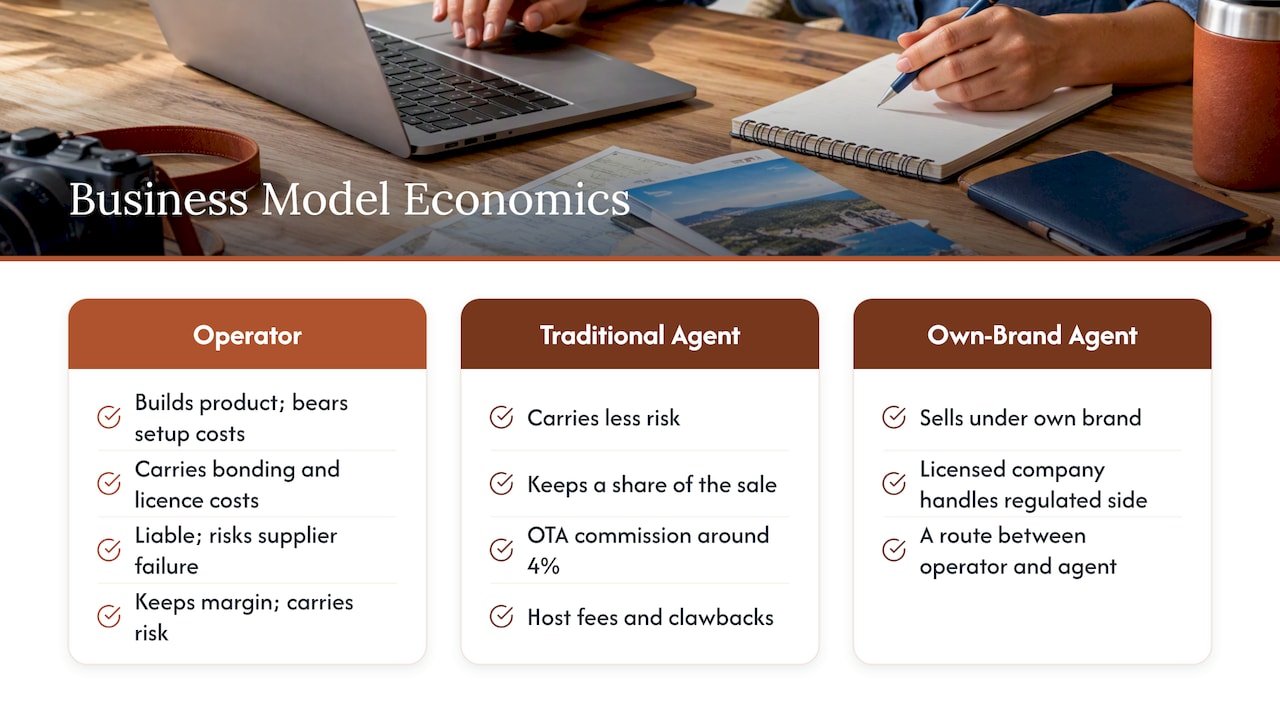
Operators carry the cost of building product, holding bonding or licences, and taking on liability. They keep the margin, but they also take the risk if a supplier fails or a departure does not fill.
Agents carry less risk and keep a share of the sale. The catch with most traditional agent models is the share. Online travel agencies typically offer around 4% commission, as we see it, and home-based agents who join a host agency often pay fees and face clawbacks. Our guides on host agency commissions and calculating net earnings per booking show how to work out what you keep after those deductions.
A third route sits between the two: you sell under your own brand as an agent, while a licensed company stands behind the regulated side. That is the route we built.
Perspective: why we think the agent model works, if the split is right
We built Timeshunters because we saw capable people with real client relationships earning very little from them. A planner with a loyal audience can book a £2,000 trip and end up with a small slice, because the agent model on offer to them took most of the margin.
For us, the question is not operator versus agent. Both are legitimate and both serve customers well. The question is whether you can sell under your own name, protect your customers properly and keep a fair share of what you earn.
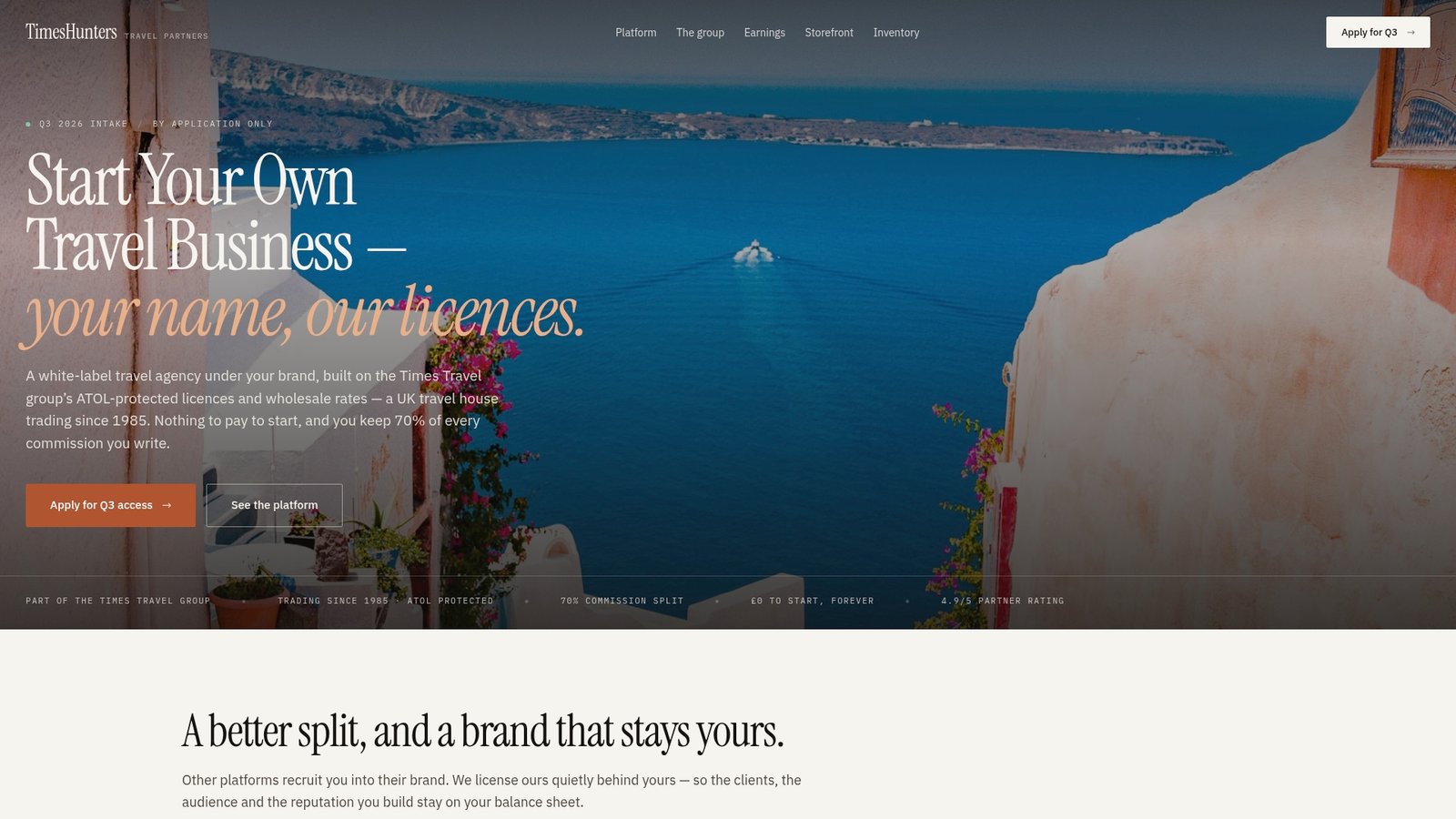
Our answer is a white-label travel agency platform. You keep your own brand, your client list and your autonomy. You sell through the ATOL-protected licences of the Times Travel group, and we say the licence’s branding is invisible to your clients. Our partners receive 70% of the commission on their bookings, and we keep a 30% split. One partner reports moving from £400 to £1,200 per booking, which is their experience and not a promise.
We also think the regulated side is the part most newcomers underestimate. Becoming an operator yourself means bonding, licences and waiting. Working as an agent under existing protection lets you start with customers rather than paperwork. Our guide to getting an ATOL route without the 12 week wait explains how that works in practice.
— Sam
Choosing between the two as a business
Use these questions to decide which role suits you.
- Do you want to design and run trips? Then you are heading toward being an operator. Expect to organise packages, hold the liability and fund protection. Read about bonding costs and options first.
- Do you want to advise, curate and build relationships? Then the agent role fits. Your edge is knowledge, trust and service, not owning inventory.
- Do you want your own brand but not the regulatory load? Look for a model where a licensed company carries the protection and you keep the client relationship. Our guide to becoming an independent travel agent in the UK covers the practical steps.
- Do you already have an audience? Creators and hospitality owners can add travel as a revenue stream without becoming operators. See how UK travel creators can monetise an audience through a compliant agent.
Whichever way you go, get the written agreements in order. For ATOL-covered sales, the written agency agreement between holder and agent is a legal requirement, not a courtesy.
Start your own branded travel agency
If you want to sell hotels, cruises, tours, villas, safari camps and rail under your own name, our white-label travel agency platform gives you a branded booking site, wholesale inventory, instant pricing proposals, managed payments and financial protection, automated client follow-up and training. We say there is no cost to start, and partners keep 70% of commission.
Want the full picture first? Read our guide to the UK travel agent referral programme, or visit Timeshunters to see how it works.
FAQ
What is the main difference between a tour operator and a travel agent?
A tour operator is the principal: it creates the holiday and is contractually bound to the customer to provide it. A travel agent sells services on behalf of operators and suppliers and earns commission. The agent helps form the contract but is not a party to it.
Can one business be both a tour operator and a travel agent?
Yes. ABTA says a business may trade as both, depending on the transaction. If an agent combines services itself to organise a package, it takes on responsibility for protecting that package and liability to the customer.
Do I pay more using a travel agent?
Sometimes. Which? found packages were almost always cheaper booked directly with the operator, and that online agents can add mark-ups to extras. Agents do offer advice, convenience and support, so compare like for like, including baggage and protection.
Do travel agents need ATOL protection?
If an agent sells flights or flight-inclusive packages, the ATOL holder must have a written agency agreement with it, and the agent must issue an ATOL Certificate immediately on payment. Many agents sell under a licensed holder’s ATOL rather than hold their own.
Is a travel agent the same as a travel consultant?
In everyday use the terms often describe the same job. Neither is a legal status, though. What matters is whether the business is acting as agent or principal on your booking, and what protection comes with it.
Sources
- How your business trades, ABTA
- Package Travel and Linked Travel Arrangements Regulations 2018 guidance, GOV.UK
- Do I need an ATOL, UK Civil Aviation Authority
- Travel trade selling through agents, UK Civil Aviation Authority
- Assigned Claims, UK Civil Aviation Authority
- VAT, TOMS and Agents, ABTA
- PE76100 Guidance for specific trade sectors: the travel industry, HMRC
- Is it cheaper to book my holiday online or with a travel agent, Which?
- Online travel agent flight deals, Which?
- Packages cheaper and more protected than DIY holidays, YourMoney
- CA98 decision, ABTA and BA, Office of Fair Trading