
Instagram Marketing for Travel Agents: A UK Guide
How UK travel agents can use Instagram to build trust and win enquiries: profile setup, content plan, Stories, WhatsApp follow-up and the rules to follow.

Instagram works for a travel agent when it does one job: it makes you a visible, trusted person that a would-be traveller can message. Set up a business profile, post a small number of useful things on a steady rhythm, answer every comment and DM quickly, and move serious enquiries to a private channel such as WhatsApp or email. Follow the UK advertising and marketing rules while you do it. You do not need to be an influencer, and you do not need to post daily.
This guide covers the setup, a content plan you can sustain, how to turn engagement into enquiries, how WhatsApp fits in, and what the ASA and the ICO expect from you.
TL;DR
- Use a Business account with a clear bio, one link and a contact button, so every profile visit has a next step.
- Post a few content types on a repeatable rhythm: inspiration, practical guides, itineraries and client stories. Consistency beats volume.
- Use Stories Questions, comments and DMs to start conversations, then move genuine enquiries to WhatsApp or email.
- Label ads and affiliate-style posts clearly, and get proper consent before you send marketing messages.
- Your edge over an online travel agency is you: show your face, explain how you work and be open about fees.
Table of Contents
- Why Instagram suits independent travel agents
- Set up your profile so it converts
- What to post when you cannot post daily
- Turn interest into enquiries
- Use WhatsApp to follow up
- The UK rules you need to follow
- Our perspective
- Measure what matters
- A 30-day starting plan
- Build the business behind the feed
- FAQ
- Sources
Why Instagram suits independent travel agents
Travel is bought with the eyes first and the head second. People save a hotel pool or a train journey months before they ask anyone about price. Instagram is where that dreaming happens, which is why it sits at the top of the funnel for most agents.
It is also where a person can beat a brand. The Travel Institute argues that an adviser’s human expertise, not simply price, is what separates them from an online travel agency, so showing the person, explaining your decisions and making the process transparent is central to earning trust. An anonymous feed of stock beach photos does none of that.
A realistic goal for Instagram is not “going viral”. It is a steady stream of people who know your name, have seen your taste and feel able to send you a message. Everything below is built around that.
Set up your profile so it converts
Your profile is the landing page. Most people who see a post will glance at your bio before they decide to follow, message or leave.
Switch to a Business account
Shopify’s UK guide recommends switching to a professional Business account, choosing a category, adding a high-quality profile image, a concise description and your contact details. That unlocks business functions such as advertising and contact buttons. If you trade under your own name, use a clear headshot rather than a logo, because people are buying you.
Write a bio that does a job
The bio is short, so each line should earn its place. Aim to cover four things:
- Who you help: for example, honeymooners, multi-generational families or cruise first-timers.
- Where you are strongest: a destination, a type of trip or a style of travel.
- Proof you are real: your name, your base and, if it applies, that your bookings are financially protected.
- What to do next: one clear action, such as “Message me to plan your trip”.
Use the Email or Call contact buttons and one link in your bio. That link can go to your booking site, an enquiry form or a simple landing page. If you are building a page to catch visitors, our guide to travel lead magnets for agents shows how to turn a download into a conversation.
Pick a name people can remember
Your handle should be easy to say aloud and easy to spell. If a client recommends you at dinner, the friend should be able to find you in ten seconds.
What to post when you cannot post daily
Most agents run a business, answer emails and sell trips. Posting every day is not realistic, and you do not need it. A better method is a small set of repeatable content types, sometimes called content pillars, that you rotate.
Finn Partners’ UK travel social report suggests content should follow the traveller from dreaming through research and booking to post-trip advocacy. It recommends destination inspiration, practical guides, costs, sample itineraries, booking links and post-trip sharing. Those map neatly onto five pillars.
| Pillar | What it looks like | Why it works |
|---|---|---|
| Inspire | A short Reel of a hotel, ship cabin or train route | Catches people in the dreaming stage |
| Educate | A carousel on “what to know before a first cruise” or “what a safari really costs” | Helps the research stage and shows your expertise |
| Itinerary | A sample seven-day plan, with the logic behind each choice | Shows the thinking people pay an adviser for |
| Proof | A client trip, testimonial or post-trip photo, shared with permission | Builds credibility from real travellers |
| Person | You on a call, at a site visit, or explaining how you work | Makes you the reason to choose an agent |
The same report says that 92% of UK travellers trust content from fellow travellers more than branded posts, so the Proof pillar deserves more weight than most agents give it. Ask happy clients if you can share their photos and a line about their trip. Always ask first.
A sustainable weekly rhythm
Three posts a week is a solid target, and even one or two is better than bursts followed by silence. Here is a simple pattern:
- Monday: an educational carousel.
- Wednesday: a Reel with a destination or property.
- Friday: a client story or a behind-the-scenes post.
Spend one block a fortnight planning and filming in batches, then schedule. Re-use your best content: a carousel on Greek island hopping can become a Reel, a Story and a caption on another post.
Use Stories for the everyday
Stories are where you can be less polished. Show what you are researching, which supplier call you have just finished, or a quick poll asking whether people prefer a city break or a beach week. Behind-the-scenes planning content also shows people how much work goes into a good trip. A detailed group cycling holiday planning guide is a good example of the depth that earns trust, and you can mirror it with a Story sequence showing how you plan a group trip step by step.
Turn interest into enquiries
Likes do not pay the bills. Enquiries do. The shift happens when you treat Instagram as a conversation rather than a noticeboard.
TTG’s guide for agents recommends using Instagram-native formats and community management: answer comments and direct messages, use Stories Questions, and add a link in bio, Story Link and profile Contact Options so that interest has a direct route to enquiry.
In practice:
- Use the Questions sticker. Ask “Where are you dreaming of next year?” or “What is stopping you booking?” The answers tell you what to post next and who to talk to.
- Reply fast and personally. A comment from a stranger is a warm lead. Answer it by name, and invite a DM for anything involving dates or budgets.
- Share itineraries while people are planning. A sample plan with a clear “message me to tailor this” line gives a reason to get in touch.
- Make the next step obvious. End posts with one action: message me, tap the link or save this for later.
Ask for a small commitment first
The Travel Institute points out that people are more comfortable taking small steps first, such as an email opt-in or a short consultation. Few people will go from a Reel to a £6,000 booking. Many will download a packing list, join a mailing list or book a fifteen-minute chat. Our walkthrough on building a UK travel client list covers how to capture those people so they are not lost when your next post pushes the last one down the feed.
Explain your fees and your process
Openness is a trust signal. Say how you are paid, what a client gets from working with you, and what happens after they message you. The Travel Institute lists transparency about fees and working process among the core trust builders. A pinned post titled “How I work” does this well and saves you repeating yourself in DMs.
Use WhatsApp to follow up
Instagram is good for discovery. WhatsApp is good for the conversation that follows, because clients already use it and it suits quick back-and-forth about dates, passports and room types.
A sensible set-up looks like this:
- Use the WhatsApp Business app on a separate number from your personal one, so your working life stays contained.
- Complete the business profile with your name, a short description and your hours.
- Set a greeting message so new contacts get an instant reply.
- Save quick replies for the questions you answer weekly, such as “what do I need to send you to get a quote?”.
- Move the formal parts, such as quotes, terms and payment, into email or your booking system so there is a clear record.
The flow most agents settle on is simple: someone replies to a Story or sends a DM, you answer with something useful, then you suggest carrying on over WhatsApp or a call once they are serious. Do not send a client from Instagram to WhatsApp as a way to start broadcasting promotions to them. That is where the rules below start to matter.
For email follow-up after the first chat, ready-to-use travel agent email templates cover each stage from enquiry to post-trip.
The UK rules you need to follow
Social media feels informal, but the rules are the same as for any other marketing.
Advertising and endorsement
The ASA says the CAP Code covers some content on company social channels, and marketing communications within its scope must be obviously identifiable as ads. The same page treats affiliate marketing, where you promote a product for commission, as advertising, and unlabelled posts risk breaching the rules on recognising marketing.
This matters if you are paid to promote a hotel, a cruise line or a tourist board, or if you earn commission by pointing followers to a product. In an ASA ruling, a clear, prominent upfront identifier such as #ad is given as an example of how to make commercial intent clear. Put it at the start of the caption, not hidden among a pile of hashtags. If you are unsure whether a post is covered, check the ASA’s guidance for your situation.
Direct marketing and consent
DMs count. The ICO’s guidance on electronic mail marketing says that social media direct message marketing to individuals requires specific consent, unless the recipient bought or negotiated to buy a similar service and was given an opt-out when their details were collected and in every message.
In plain terms:
- Replying to someone who messaged you is a conversation, not a mass promotion.
- Adding people to a WhatsApp broadcast list or mailing list without them agreeing is a risk.
- Consent should be specific, easy to withdraw and not a condition of booking. Pre-ticked boxes do not count.
If your list is built through a sign-up form, say clearly what people will receive and how often. For anything beyond that, the ICO’s guidance is the reference point, and a data protection adviser can help if your set-up is complex.
Photos of clients and children
Always get permission before sharing client photos. Children need extra care. The ICO says that people can ask for images of themselves or their children to be removed, and that posting to a public account can go beyond personal use, so data protection obligations apply. That guidance is written for schools, but the principle is a good guide: ask first, keep a record and take posts down promptly if asked.
Our perspective
Most agents tell us the same thing: they are good at selling travel and tired of earning very little for it. Instagram can grow your audience, but the real question is what happens when someone says “I would like to book”.
We built TimesHunters so that a person with an audience, or simply a lot of goodwill with their clients, can sell under their own name. Our partners keep their own brand and client relationships, with ATOL-protected licences behind them, and receive 70% commission on bookings. The licence’s branding is invisible to the end client.
That changes how we think about social content. When the brand on your profile is the brand on the booking site, every Story, comment and DM builds an asset that is yours. You are not sending your followers to someone else’s shop. We would rather see an agent post three honest things a week and own the client relationship than chase reach for a platform that keeps the margin.
Sam
Measure what matters
Ignore vanity numbers. Track a handful of things monthly:
- Saves and shares. Finn Partners recommends tracking saves, which signal that someone intends to come back to a post when planning.
- DMs and Story replies. These are your real conversations.
- Link clicks and contact-button taps. They show how many profile visitors take the next step.
- Enquiries by source. Ask every new client how they found you and record it.
- Bookings that began on Instagram. Even a few of these will tell you which content pillar is working.
After a quarter, you will see which pillar drives conversations. Do more of that and drop the rest. Pair this with your website: our notes on travel agent lead generation and travel agency SEO show how to catch people who find you on search as well as on social.
A 30-day starting plan
Week 1: foundations. Switch to a Business account, write your bio, add your contact button and link, and pin a “How I work” post. Write down your three main types of client.
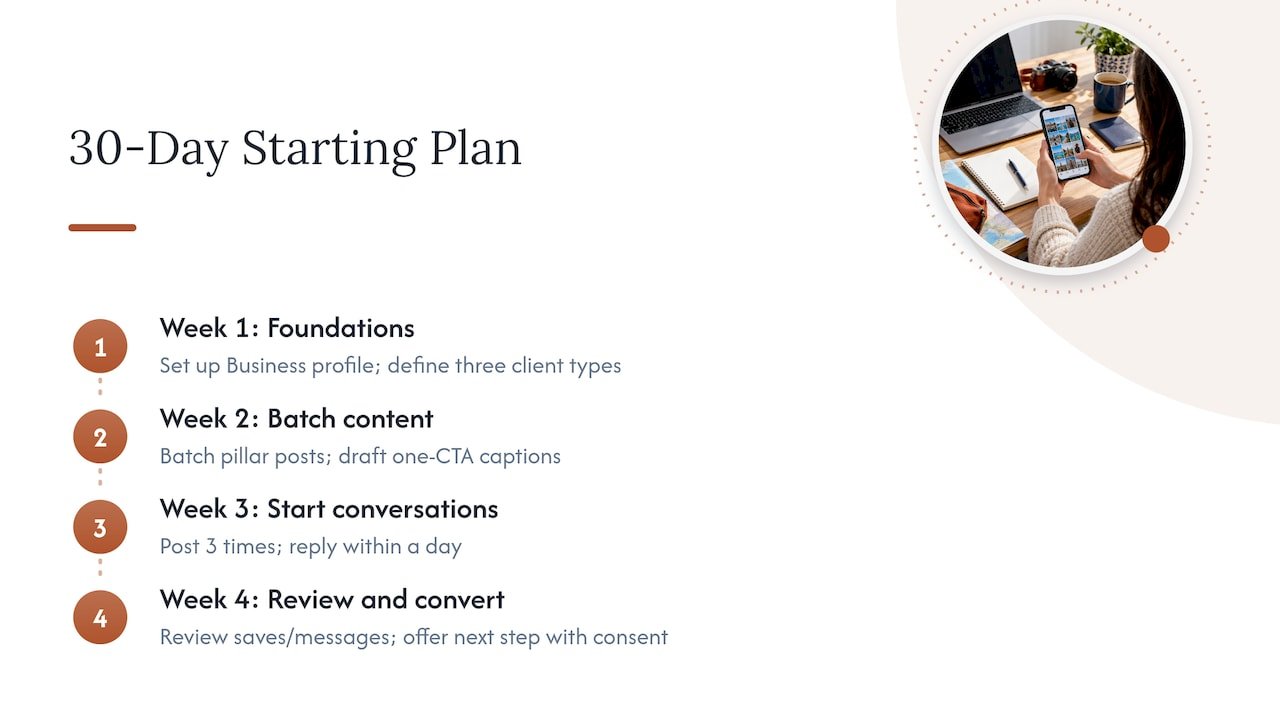
Week 2: batch your content. Plan and film a month of posts across your pillars. Draft captions with a single call to action each.
Week 3: start conversations. Post three times, use a Questions sticker, and reply to every comment and message within a day. Set up WhatsApp Business with a greeting and quick replies.
Week 4: review and convert. Note which posts brought messages or saves. Offer one small next step, such as a free checklist or a short call, and capture details with proper consent.
If you want to understand what happens after the first message, our guide to how to sell travel to clients walks through the stages a UK independent agent goes through, from the first chat to the booking.
Build the business behind the feed
If you already have followers or client relationships and want to sell travel under your own name, we give you the tools to do it. The TimesHunters white-label travel agency platform lets you launch a branded travel business using Times Travel group’s ATOL-protected licences, with a branded booking site, wholesale hotel, cruise and tour inventory, instant pricing proposals, managed payments and automated client follow-up. Partners receive 70% commission on bookings, and there is no cost to start.
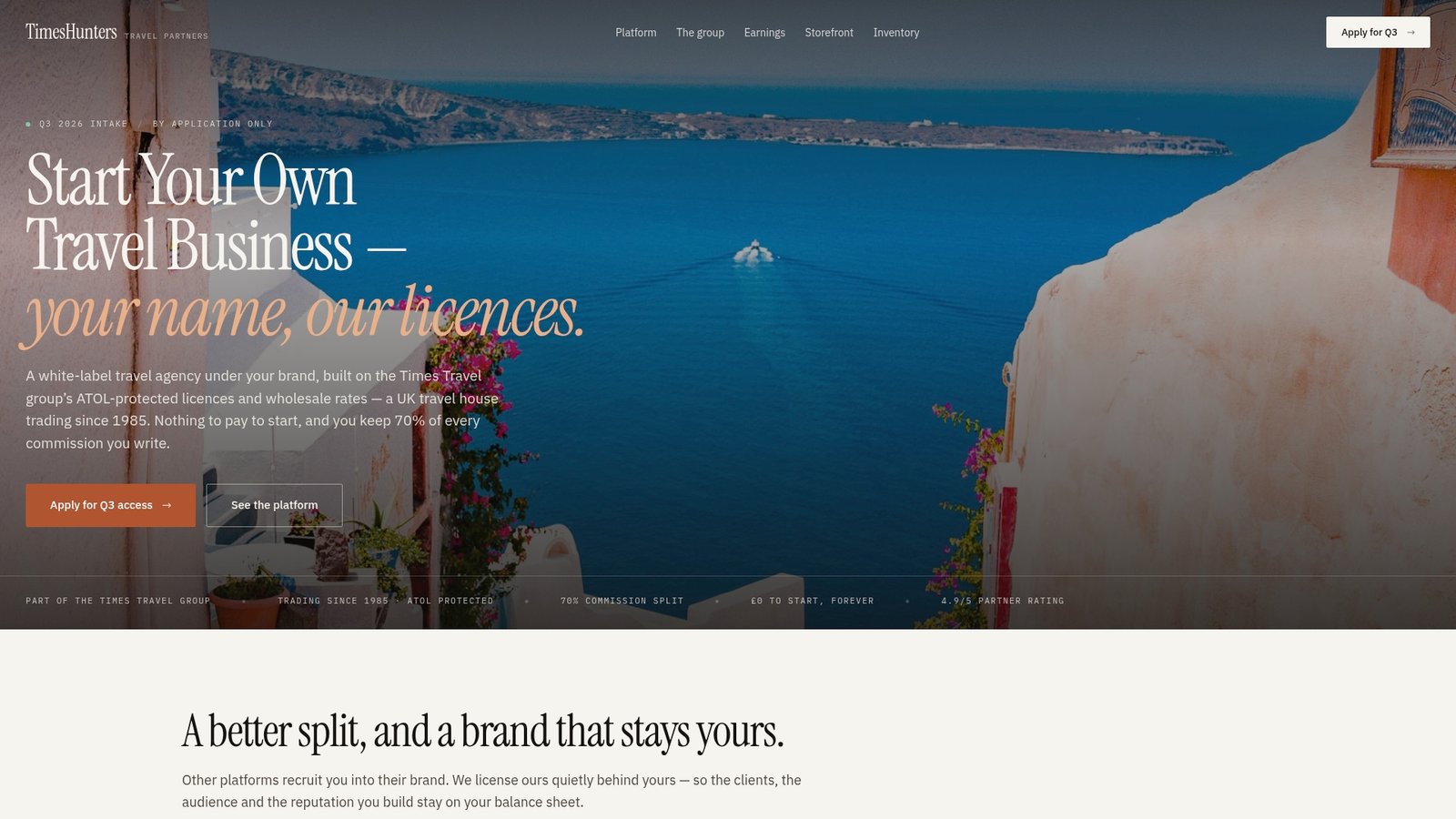
See how the model works on the white-label travel agency page, or if you are a creator with an audience, read about selling travel as a creator.
FAQ
Do travel agents need to post on Instagram every day?
No. Consistency matters more than volume. Pick a small number of platforms and content types and keep to a rhythm you can sustain, such as two or three posts a week. Batch your filming and re-use your best content in different formats.
What should a travel agent put in their Instagram bio?
Say who you help, what you are strongest at, and what to do next. Add a contact button and one link, to a booking page, enquiry form or landing page. Keep it short and written in your own voice.
Is it legal to message people on Instagram or WhatsApp about holidays?
Replying to someone who has contacted you is normal conversation. Sending marketing messages to individuals needs specific consent under PECR, unless the narrow soft opt-in applies, and every message needs an opt-out. Check the ICO’s guidance on electronic marketing before you build a broadcast list.
Do I have to label travel posts as ads?
Yes, if the post is advertising. The ASA treats affiliate promotions, where you earn commission, as advertising, and ads must be obviously identifiable. A clear label such as #ad placed at the start of the caption is the usual approach.
Should I use Instagram or WhatsApp for client enquiries?
Use both for different jobs. Instagram helps people discover you and start a conversation. WhatsApp Business suits the detailed follow-up once they are serious. Keep quotes, terms and payments in email or your booking system so you have a clear record.
Sources
- An agent’s guide to formulating a social media strategy, TTG
- 5 Ways to Build Client Trust Before They Buy from You, The Travel Institute
- How to Create an Instagram Business Account, Shopify UK
- The art of precision in travel social media, Finn Partners UK
- Remit: Social media, ASA
- ASA Ruling on J Choo Ltd
- Electronic mail marketing, ICO
- Taking photos in schools, ICO