
Wholesale Travel Inventory: What It Is and How to Access It
What wholesale travel inventory is, where it comes from, how net rates and markups work, and what UK rules apply when you resell it as a new travel business.

Wholesale travel inventory is the stock of hotel rooms, flights, cruise cabins, transfers, tours and other travel products that a wholesaler contracts from suppliers and sells on to other businesses, not to the public. If you want to sell travel under your own name, it is the raw material of your business. Access to it, the price you pay for it and the rules you sell it under decide how much you keep from each booking.
This guide explains what the term covers, how wholesalers source stock, how resellers connect to it, how rates and margins work, and what to check before you commit to a supplier. It is written for people starting or growing a UK travel business, not for holidaymakers looking for a deal.
TL;DR
- Wholesale inventory is travel product contracted in bulk by an intermediary and resold through travel agents, tour operators and other trade buyers.
- You usually get it in one of two ways: net rates that you mark up, or commissionable rates where the supplier pays you a percentage after the stay.
- Access comes through a booking portal, an API feed or a GDS, and each suits a different size of business.
- In the UK, selling flights or flight-inclusive packages brings ATOL and package travel rules, so your licensing set-up matters as much as your rates.
- A white-label platform gives you inventory, licence cover and booking tools in one place, so you can start without building supplier relationships yourself.
Table of Contents
- What wholesale travel inventory actually means
- Where wholesalers get their stock
- How resellers connect to inventory
- How wholesale rates, retail prices and margins work
- Wholesaler or consolidator: does the difference matter to you?
- What to check before you choose a wholesale supplier
- UK rules that apply when you resell wholesale product
- Starting without building supplier relationships yourself
- Our perspective: inventory is the easy part
- FAQ
- Sources
What wholesale travel inventory actually means
In the UK travel trade, wholesalers contract supplier products and sell them business to business through travel agents, tour operators, coach operators and other third parties. They act as a silent partner: the customer rarely sees their name. VisitBritain also notes that tour operators may take products from wholesalers and package ground arrangements with flights.
“Inventory” is the word for what is on the shelf. It can include:
- Accommodation: hotel rooms, apartments, villas and safari camps.
- Air and rail: seats on scheduled flights and train journeys.
- Car hire and transfers: airport pick-ups, private drivers, rental cars.
- Cruises: cabin allocations on ocean and river sailings.
- Tours, attractions and events: guided programmes, tickets and theatre allocations.
- Insurance and extras: add-ons sold alongside the main booking.
That breadth is not theoretical. One UK booking-technology provider says contracted inventory can include flights, hotels, cruise allocations, transfers, events and insurance, managed alongside live supplier content. A UK tourism distribution platform says its distributors can see live availability, prices and content for accommodation, tours, events and attractions.
The key point for a new business owner: wholesalers sell to the trade. They do not usually deal with consumers, so you need to be a business, or sell through one, to get in.
Where wholesalers get their stock
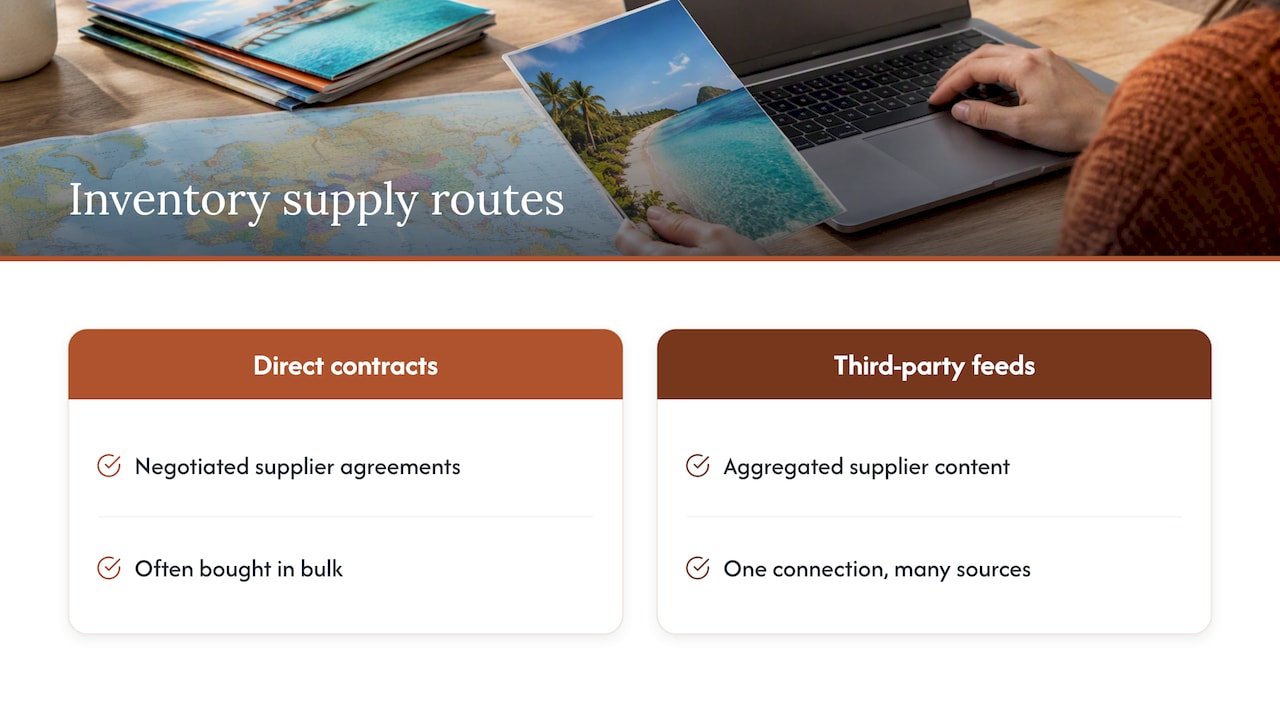
Wholesalers build inventory through negotiated agreements with airlines, hotels and other service providers, often buying in bulk. They then pass it to B2B partners through integrated platforms or booking systems. Some stock is contracted directly. Some is aggregated from third-party feeds, so a single connection can give you content from many sources.
There is also the wider distribution landscape. VisitBritain describes global distribution systems such as Amadeus and Sabre that hold airline, hotel and car-hire inventory sellers can access directly. It also warns that technology and company mergers have transformed distribution, so it pays to understand who actually holds the contract behind the product you are selling.
Why contract timing matters
Hotels generally fix their trade pricing long before guests arrive. According to the English Tourism Association Group’s guidance, net trade rates are generally static rates agreed 18 to 24 months in advance. For a reseller, that means a wholesale rate is a negotiated figure that someone else has already locked in. Your job is to find the right product and present it well, not to haggle room by room.
How resellers connect to inventory
There are three common routes, and the right one depends on your size and technical resources.
| Route | How it works | Suits |
|---|---|---|
| Booking portal | You log into a supplier’s B2B sales system, search, quote and book | Independent agents, home-based sellers, small teams |
| API or XML feed | Supplier content is embedded in your own website or app | Businesses with developers and their own booking engine |
| GDS | You search airline, hotel and car content through a global distribution system | Established agencies with flight-heavy trade |
The distinction is practical. One international wholesaler says resellers can reach its products through its B2B sales system or an embedded XML API. The portal is quick to start with. The API gives you control of design and customer experience but costs development time.
Most new sellers are better off with a portal or a platform that already wraps the supply in a booking site, quoting tools and payment handling. Building an API integration before you have a client list is a lot of work for no revenue.
How wholesale rates, retail prices and margins work
There are two main pricing models, and the ETAG guidance sets them out clearly.
- Net rates. The supplier gives you a lower rate and you add your own markup. You decide the retail price, so your margin is the gap between the two.
- Commissionable rates. You sell at the supplier’s Best Available (gross) Rate and the supplier pays you an agreed percentage, typically 10 to 30%, usually after the guest has stayed or visited.
A simple worked example shows the difference. Suppose a supplier’s gross rate for a hotel stay is £1,000. Under a 15% commissionable model, you earn £150 once the guest has stayed. Under a net-rate model, if the net rate is £850 and you sell at £1,000, you also keep £150, but you collect the money upfront, set the price yourself and carry the pricing risk. The numbers can match; the cash flow, control and risk do not.
Commission is not the same as margin
Two things get confused. The supplier’s commission to you is one thing. The commission a platform shares with you out of its own take is another. If you join a platform or agency model, ask what percentage of the booking’s earnings you keep, when it is paid, and what is deducted before the split. A headline number means little without those answers.
Wholesaler or consolidator: does the difference matter to you?
A wholesaler is a silent partner that sells contracted product to the trade. The word “consolidator” is more often used for businesses that buy blocks of flight seats and resell them. In practice many businesses do a bit of both, and the label matters less than three questions:
- What product types can you actually book through them?
- Who holds the licence or financial protection for what you sell?
- Do you get net rates, commissionable rates or both?
If a supplier cannot answer those clearly, keep looking.
What to check before you choose a wholesale supplier
A good supplier relationship is a commercial arrangement, not just a login. One B2B distribution operator lists the settings a buyer should expect to configure, including credit and deposit terms, currency rules, rate and markup settings, and reporting and settlement. Turn those into a checklist:
- Payment terms: do you pay at booking, on a deposit, or on credit? What happens on cancellation?
- Currency: are rates in sterling or converted, and who carries the exchange risk?
- Markup control: can you set your own markup per product, or per client?
- Reporting and settlement: how do you see your bookings, and when is commission paid?
- Support: who do you call when a client is stuck abroad on a Saturday night?
- Breadth: can one supplier cover the mix you want to sell, such as hotels, cruises and tours, or will you need several accounts?
Breadth matters more than people expect. Villas, for instance, range from large managed portfolios to individual local operators, such as Cape Town villa services that bundle a property with transfers, private chefs and local experiences. Clients buying a special trip often want the property and the extras handled together, so a supplier that makes that easy is worth more than one with a slightly lower rate.
UK rules that apply when you resell wholesale product
This is where most new sellers get caught out. Buying wholesale inventory is easy. Selling it lawfully in the UK depends on how you trade.
Are you an agent or an organiser?
ABTA says that businesses organising their own packages must financially protect them and are liable to their customers, and that flight-inclusive packages and flight-only sales are licensable ATOL business. The same page says an agent should have agreements with its principals appointing it as agent, and should tell customers that it is an agent and who the principal is.
Under the 2018 package travel regulations, businesses that organise packages are liable for package performance and must have insolvency protection. ABTA’s guidance noted that agents and retailers could become package organisers for the first time, which would require operational changes. Putting together a hotel from one supplier and a flight from another for one client can tip you from agent into organiser.
The agency agreement
The Civil Aviation Authority is direct on this: ATOL holders selling through agents must have a written agency agreement with each agent. Without one, both parties are in breach of the ATOL Regulations. If an ATOL holder fails, agents must give the CAA a copy of a compliant agreement so consumer claims can be processed, and documentation failures can result in a claim being referred back to the agent for a refund.
The practical lesson: before you sell a single flight-inclusive trip, get the agreement in writing and keep it. If you are unsure which category you fall into, ask ABTA or the CAA, or take advice from a travel law specialist.
Starting without building supplier relationships yourself
Most people who want a travel business do not want to negotiate contracts, apply for their own licence and build a booking system first. That is the gap our platform fills.
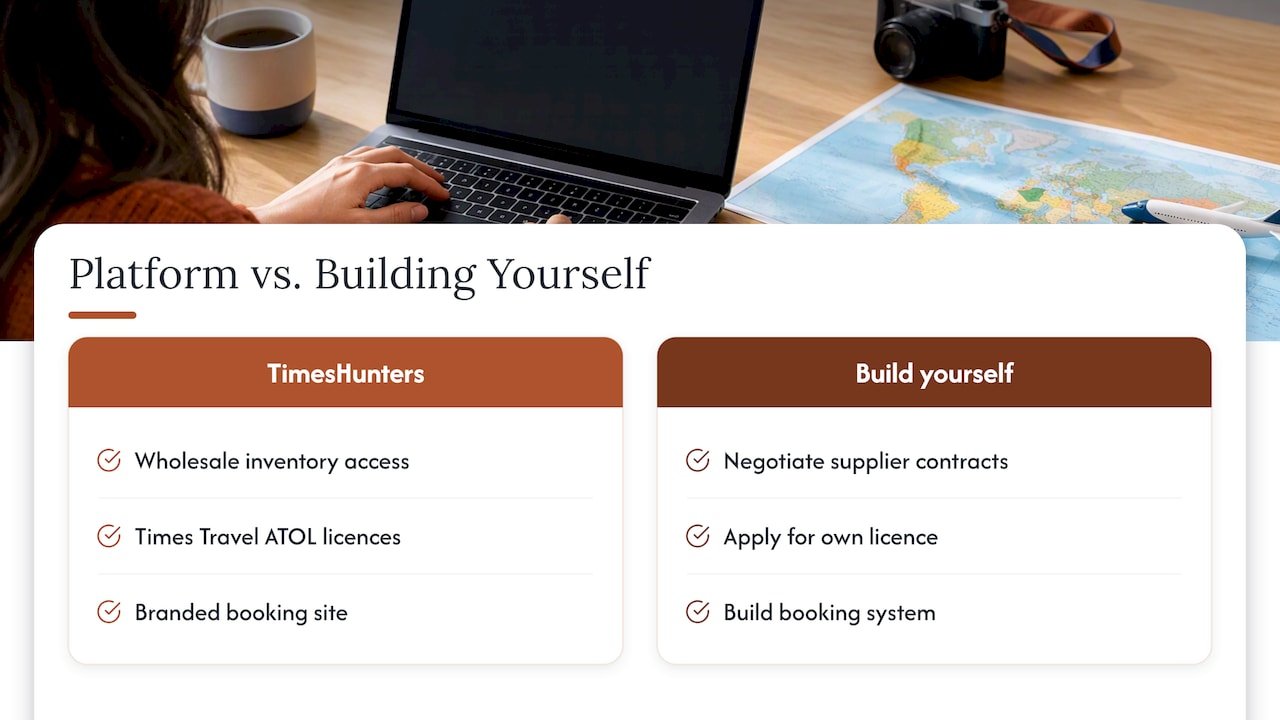
TimesHunters is a white-label travel agency platform. You start your own travel business under your own name, using Times Travel group’s ATOL-protected licences. You get access to wholesale hotel, cruise and tour inventory, plus villas, safari camps and rail, a branded booking site, instant pricing proposals, managed payments and financial protection, automated client follow-up, and training and support. The licence’s branding is invisible to your clients, so the relationship and the brand stay yours, and there is no cost to start.
The commercial model is simple. You earn a 70% commission split on bookings, and we keep 30%. We say that plainly because the usual online travel agency programme pays around 4%, and the gap shows up quickly once you have repeat clients. One partner reports moving from £400 to £1,200 per booking.
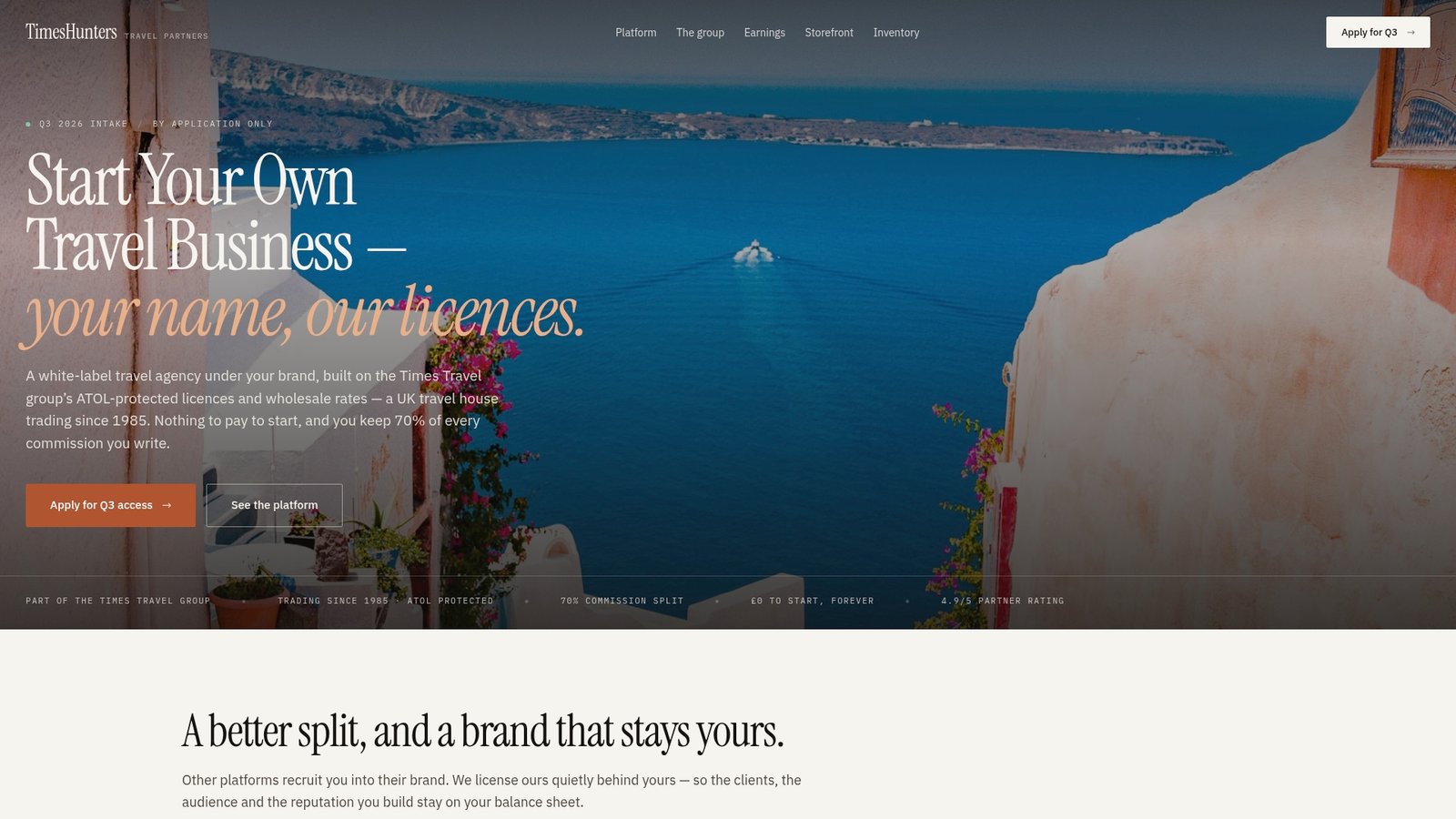
If you want to see how the inventory, licensing and booking tools fit together, look at our white-label travel agency page for hotels, cruises and tours, or start from the TimesHunters homepage.
Our perspective: inventory is the easy part
We talk to a lot of people who want to sell travel: freelancers, hospitality owners, influencers with an engaged audience, professionals with a network of clients who already ask them for holiday advice. Almost all of them start by asking where to find wholesale inventory. It is a reasonable question, but it is rarely the one that decides whether they succeed.
Inventory is available. Rate access is available. What is hard is the stack around it: a licence that lawfully covers what you sell, financial protection your clients can trust, a way to quote quickly, a system that chases the client for you, and a payout model that rewards you for the relationship you built. Low commission is the quiet killer. If you do the work of finding the client and shaping the trip, and the model hands you 4% of it, the sums never work however good your supplier is.
Our view is that a new travel seller should keep three things: their brand, their client relationships and their autonomy. The infrastructure is something they should be able to rent, not rebuild. That is why we built partners’ businesses on a licensed, protected base and a higher split, so the first booking looks like a business, not a hobby.
Whatever route you take, ask every supplier the same direct questions about rates, licences, payment timing and support, and write down the answers before you sign.
— Sam
FAQ
What is wholesale travel inventory?
It is travel product such as hotel rooms, flights, cruise cabins, transfers and tours that a wholesaler has contracted from suppliers and sells to the trade. Travel agents, tour operators and other resellers buy it and sell it to consumers, often with their own markup or commission.
Can I buy from wholesale travel suppliers without a travel business?
Usually not directly. Wholesalers sell business to business, so they expect you to trade as a business or sell under an existing one. A white-label platform is one way to start, since the licences and supplier access are already in place.
Do I need ATOL to sell wholesale travel in the UK?
If you sell flight-inclusive packages or flight-only products, ABTA says that is licensable ATOL business. You either hold your own licence or sell as an agent of an ATOL holder under a written agency agreement, as the CAA requires.
How much can I earn reselling wholesale travel?
It depends on the model. Commissionable hotel rates are typically 10 to 30% according to ETAG guidance, while net rates leave the markup to you. On our platform partners receive a 70% commission split on bookings.
Sources
- The travel distribution system, VisitBritain
- Supplytek: Load & Sell Your Own Contracted Inventory, Traveltek
- TXGB online travel distributors
- Travel Wholesalers, Travelopro
- Rates and Pricing, ETAG 2022
- Paximum ecosystem
- Wholesale Tourism, Outmazed
- How your business trades, ABTA
- Travel Law, ABTA 2018
- Travel trade selling through agents, UK Civil Aviation Authority
- Cape Town villa services