
How to Automate Travel Bookings: A UK Guide for Independent Agents
Which parts of a travel booking you can automate, what it costs, where ATOL rules apply and where a person must still check. A practical UK guide.

You can automate most of the admin around a travel booking: enquiry capture, quotes, confirmations, payment reminders, pre-trip messages and post-trip follow-up. The decisions that carry legal or financial weight, such as taking money and issuing ATOL paperwork, need the right protection in place first and a person checking the result. This guide shows what to automate, in what order, what it costs in the UK and where to keep a human in the loop.
TL;DR
- Automate the repeatable middle of the process: lead intake, quotes, confirmations, payment reminders, pre-trip messages and follow-up.
- In the UK, automation never replaces financial protection. An ATOL Certificate must be issued immediately when a protected payment is made, so build payment flows around that rule.
- A solo UK agent can start on a technology budget of £150 to £500, according to one industry guide. A traditional agency with its own licence needs far more.
- Keep a person on payment, ticketing and anything a client will rely on as fact.
- A white-label platform bundles the booking tools and the licence cover, so you do not have to assemble them yourself.
Table of Contents
- What “automating travel bookings” actually means
- The stages you can automate, in order of payoff
- A suggested set-up sequence
- What it costs in the UK
- Payments, ATOL and customer data: the rules automation must follow
- What still needs a person
- Features to look for in a booking system
- Run your own automated travel business with TimesHunters
- Common mistakes to avoid
- FAQ
- Sources
What “automating travel bookings” actually means
A travel booking is not one event. It is a chain: someone asks a question, you send options, they pick one, they pay a deposit, you confirm with suppliers, you chase the balance, you send documents, they travel and you follow up. Automation means software handles the steps in that chain that follow a fixed rule, so you spend your time on the steps that need judgement, which is mainly advice and relationships.
For an independent agent, freelancer or someone adding travel to an existing audience, this matters for one practical reason. Without it, every booking costs the same admin hours whether it earns you £400 or £1,200. With it, you can handle more clients without working evenings, and the client sees a prompt, consistent service.
There are two different things people mean by the phrase, and it helps to separate them:
- Workflow automation: rules that send messages, create tasks, generate quotes and update records when something happens.
- Booking engine automation: the connection to hotel, cruise, tour and other inventory that lets a booking be made and tracked without you retyping details into supplier systems.
Most small agents need both, and the second is where a platform saves the most time, because building supplier connections yourself is slow and costly.
The stages you can automate, in order of payoff
Work through the booking journey from the front. Each stage below is a self-contained win, so you do not need to switch everything on at once.
1. Enquiry capture and first reply
Every enquiry, whether from a website form, Instagram message or email, should land in one place and get an immediate acknowledgement. The acknowledgement can ask the two or three questions you always ask: dates, budget and who is travelling. This is the cheapest automation to set up and it stops leads going cold overnight.
2. Quotes and proposals
Drafting a proposal by hand, pasting hotel details and working out a price, is the biggest single time drain for most small agencies. Tools that pull live pricing into a branded proposal remove the retyping. The skill that stays with you is choosing the right hotel or cruise for the client. If you want a framework for that, our guide to selling travel to clients covers the stages from first conversation to booking.
3. Booking confirmation
Once the client says yes, confirmation should be generated from the booking record rather than typed. That means the same details appear in the confirmation, the invoice and your own records. We go deeper on this in our piece on booking confirmation automation.
4. Payment requests and reminders
Deposit requests, balance due dates and gentle reminders are rule-based, so they automate well. The rules you set must respect how the money is protected, which is covered in the next section.
5. Itinerary and pre-trip messages
Documents, check-in reminders and destination tips can be scheduled against the departure date. A small set of well-timed messages beats a long drip sequence. See our guide to automating itinerary delivery for six messages UK agents commonly use.
6. Post-trip follow-up and reviews
A thank-you, a request for feedback and a prompt to book next year’s trip bring repeat business, which is where a personal travel brand earns most. Two or three messages is usually enough, as we explain in automated client follow-up. Ready-made wording is in our travel agent email templates.
If you would rather start with a short list, our article on five automations for travel agency owners picks the ones to turn on first.
A suggested set-up sequence
You do not need a long project plan. This order keeps the risk low and the benefit quick.
- Map your current process. Write down every step from enquiry to post-trip, with how long each takes you. Automate where the time and repetition are highest, not where the software looks most impressive.
- Fix the money flow first. Decide how deposits and balances are taken and protected before any payment message is automated.
- Automate the front and back. Enquiry replies and post-trip follow-up carry the least risk, so start there.
- Add quotes and confirmations. Once your records are clean, generate proposals and confirmations from them.
- Add reminders and pre-trip messages. Schedule them against departure dates.
- Review monthly. Check which messages get replies, which bookings stall and what you still do by hand.
The point of the sequence is that each step builds on a reliable booking record. Automation on top of messy records only spreads the mess faster.
What it costs in the UK
The honest answer is that costs depend heavily on whether you build your own stack or join a platform that supplies it.
One UK small-business guide puts the cost of starting as an independent travel agent at roughly £500 to £5,000 in total. Countingup breaks that into technology costs of £150 to £500 for basic setup, working capital of £2,000 to £5,000, and ongoing fees of £50 to £150 a month plus a commission split of 20% to 40%. The same guide contrasts this with a traditional agency, which it puts at £70,000 to £100,000 including ATOL licensing, with a minimum bond of £50,000 or more plus an application fee of £1,400 to £2,400.
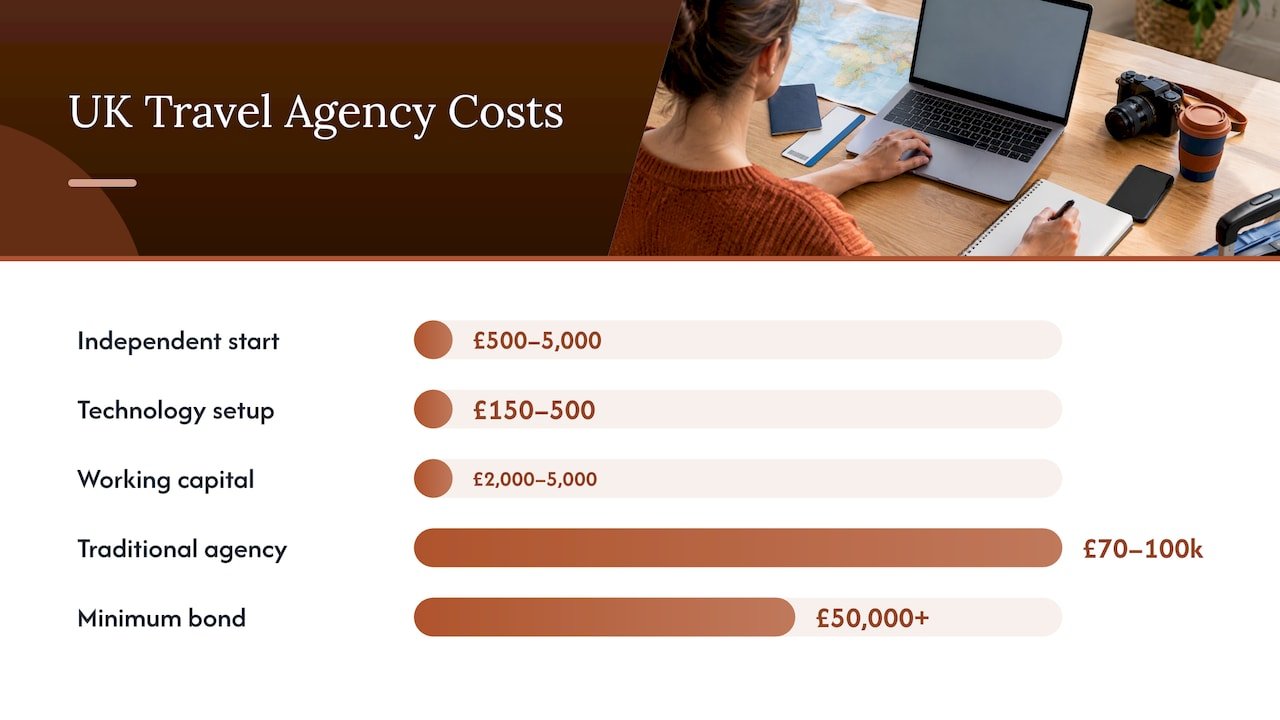
That gap explains why most newcomers do not apply for their own licence. It also shows why the commission figure matters as much as the software price. A tool that costs £60 a month but leaves you with a 4% commission on each sale will not pay for itself the way a high-share model does.
When you budget, allow for these categories:
| Cost area | What to ask |
|---|---|
| Software subscription | Is it per user, per booking or flat? What is included? |
| Set-up and data migration | Do you do it yourself or pay for help? |
| Integrations | Payments, email, accounting and supplier connections |
| Training and support | Your own time counts as a cost |
| Contingency | Leave room for things that do not connect first time |
Our platform has no cost to start, and partners keep 70% of commission, so the main cost to model is your own time while you learn. Our UK travel agent training page sets out how the first weeks work.
Payments, ATOL and customer data: the rules automation must follow
This is the part that separates a travel business from any other online shop. Automation has to fit the protection rules, not work around them.
ATOL certificates and payment timing
The Civil Aviation Authority says an ATOL Certificate must be issued immediately when a consumer makes their first payment on a flight or trip covered by ATOL. If the customer is not with you, that means emailing or otherwise electronically sending it straight after payment. An agent must not accept any payment until a certificate can be issued.
In practice, any automated payment link you send should be tied to a system that produces the certificate at the same moment. A link that takes money first and sorts the paperwork later breaks the rule.
Selling through a licence holder
The CAA also requires that an ATOL holder selling through agents has a written agency agreement with each agent, including the CAA’s Schedule of Terms. Agents must make sure their documentation complies with that agreement and with ATOL Standard Term 1, including showing which money is protected and which is not on receipts. Whatever you automate, your receipts and confirmations need to carry that information correctly.
Packages, bonding and card surcharges
The Chartered Trading Standards Institute’s guidance, Practical Holiday Law (February 2026), explains that organisers of flight-inclusive packages sold in the UK need an ATOL. Organisers of non-flight packages and facilitators of linked travel arrangements must arrange bonding, insurance or a trust account. It also notes that the Consumer Rights (Payment Surcharges) Regulations 2012 prohibit surcharges for paying by consumer debit or credit card, so an automated checkout must not add one.
Two of our guides cover the practical side: trust accounts versus insurance and five checks on client money protection. The rules for packages are also changing, and our summary of the UK package travel regulations covers what sellers need to do from 6 April 2027.
Records that make automation auditable
Accountancy firm Glazers advises connecting booking platforms to accounting software where possible. Each booking record should show product type, departure date, customer payment status, supplier liability and whether the sale is ATOL-licensable. It also advises keeping confirmations, ATOL certificates, invoices, refund calculations, customer communications and supplier terms in one structured place linked to the booking reference. That is exactly what a good automated system does for you, provided you use one booking reference throughout.
What still needs a person
Automation is strongest where the answer is the same every time. It is weakest where the situation is new or the cost of an error is high. Keep a human check on:
- Payment and ticketing. Before anything non-refundable is purchased, someone should look at the details. A wrong name or date on a hotel hold can be fixed. On a non-refundable ticket it usually cannot.
- Anything generated by AI. If you use AI to summarise baggage allowances, cancellation terms or visa notes, read them against the supplier’s own terms before they reach a client. A wrong material fact in a client document is your responsibility.
- Changes and cancellations. A client who wants to move dates needs a conversation, and the refund calculation needs checking.
- Complaints and sensitive trips. Honeymoons, accessibility needs and family emergencies call for a human voice.
- Month-end reconciliation. Glazers recommends regular reconciliations: deposits matched to booking records, supplier liabilities matched to departure obligations, and licensable sales compared with the figures used for ATOL submissions.
A practical rule: automate the message, review the money. If a step moves funds or commits you to a supplier, it should either be checked by you or run inside a platform that manages payments and financial protection as part of its design.
Features to look for in a booking system
Whether you build or join, measure any system against the same short list:
| Feature | Why it matters |
|---|---|
| One booking record | Confirmations, invoices and reminders all draw on the same data |
| Supplier inventory | Hotels, cruises, tours and more without retyping |
| Instant proposals | Cuts quote time from hours to minutes |
| Managed payments and protection | Keeps deposits, balances and certificates in step |
| Branded client experience | Clients see your name, not a third party’s |
| Automated follow-up | Reminders and reviews without manual chasing |
| Export to accounting | Makes reconciliation quicker |
If you also plan to attract your own clients online, a branded travel agency website should plug into the same booking records rather than sit separately.
Our view: automate the admin, protect the relationship
Most agents who struggle with low earnings are not short of clients. They are short of hours. Commission of 4% on a booking leaves too little margin to justify spending an evening on paperwork, so the work gets rushed or put off.
We built TimesHunters around the opposite idea. You keep 70% of commission, so each booking is worth your attention, and the repetitive parts run automatically: branded booking site, instant pricing proposals, automated booking management, managed payments and financial protection, and automated client follow-up. The ATOL-protected licences sit behind your brand and are invisible to your clients. They see you.
Our advice is to automate everything that is the same every time, and spend the time you save on the conversation that wins the booking. That is what a personal travel brand is for.
Sam
Run your own automated travel business with TimesHunters
If you want the booking tools and the licence cover in one place, our white-label platform is built for that. You sell under your own name using Times Travel group’s ATOL-protected licences, with access to wholesale hotel, cruise and tour inventory, and there is no cost to start. We keep a 30% commission split and you keep 70%.
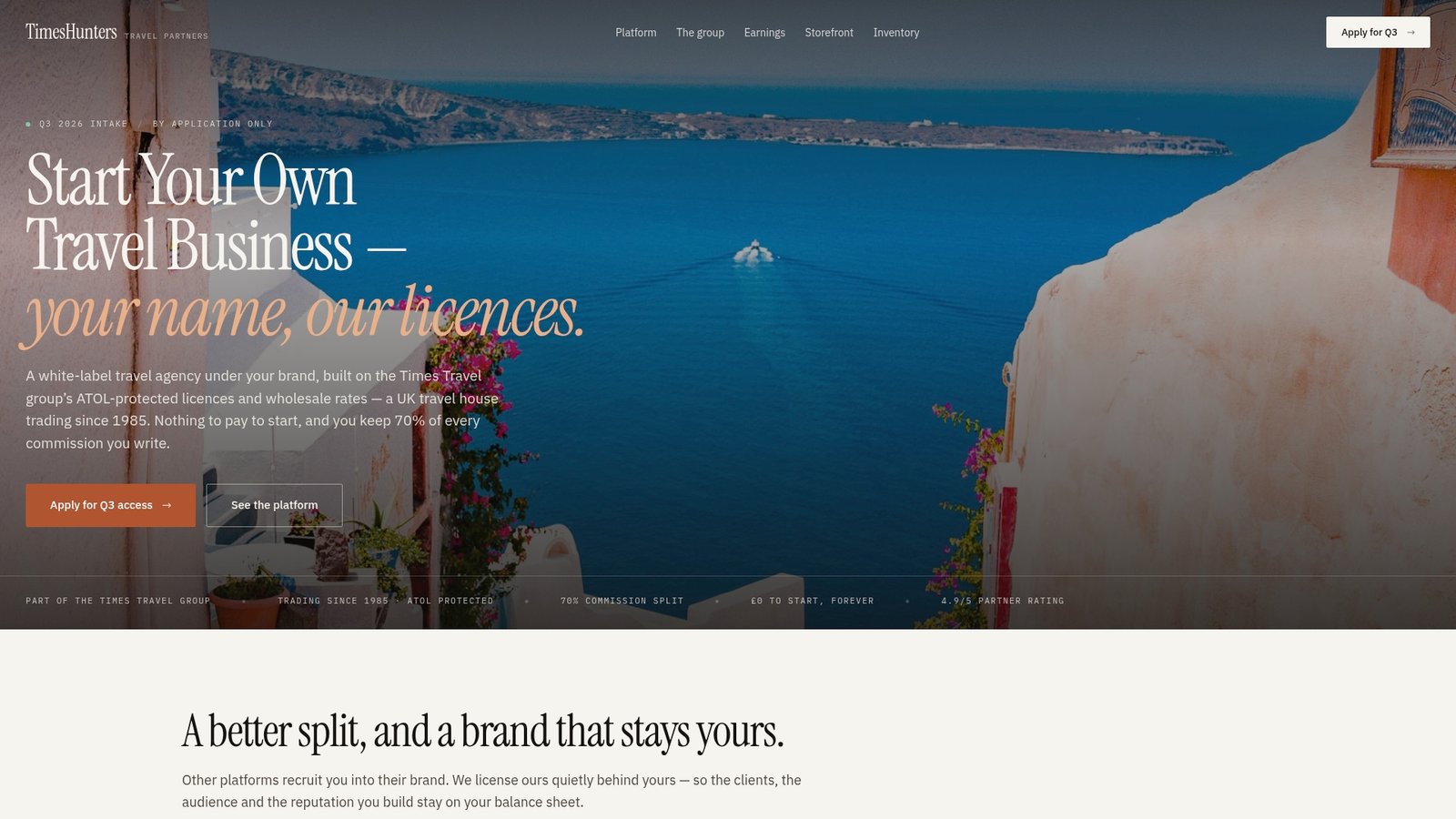
See how it works on the white-label travel agency page, or read about the 70% commission referral programme. If you are an influencer or creator with an audience, our page on selling travel as a creator is the place to start. You can also see the full offer on the TimesHunters home page.
Common mistakes to avoid
Automating before you have a process. Software repeats whatever you give it. If your quote format changes every time, automating it just produces inconsistent quotes faster.
Skipping the money rules. A payment link is a regulated step in a travel business. Check how deposits are protected before you share one.
Over-messaging. A client who receives ten automated emails before departure stops reading them. Fewer, better-timed messages work better.
Forgetting upsells. Transfers, excursions and cabin upgrades are natural additions that a confirmation message can prompt. Our guide to upselling travel extras explains how UK agents add them without losing the personal touch.
Losing the personal voice. Write templates the way you speak. Clients booked with you, not with a system.
FAQ
Can I fully automate travel bookings?
You can automate most of the admin, but not all of the decisions. Messages, quotes, confirmations and reminders suit automation well. Payments, ticketing and changes should have a human check, or run through a platform that manages payments and financial protection.
Do I need my own ATOL licence to sell automated bookings in the UK?
Not necessarily. The CAA requires an ATOL holder that sells through agents to have a written agreement with each agent, so you can sell under a licence holder’s cover. Our platform lets partners sell using Times Travel group’s ATOL-protected licences. Check the CAA’s guidance for your own circumstances.
How much does it cost to start?
One UK guide estimates technology costs of £150 to £500 for a basic independent setup, and £500 to £5,000 in total. With TimesHunters there is no cost to start, and partners receive 70% commission on bookings.
What should I automate first?
Start with enquiry replies and post-trip follow-up, as they carry the least risk and save time at once. Then add quotes and confirmations once your booking records are tidy, and payment reminders last.
Sources
- ATOL Certificates, UK Civil Aviation Authority
- Travel trade selling through agents, UK Civil Aviation Authority
- Practical Holiday Law, February 2026, Chartered Trading Standards Institute
- How travel firms can keep financial records ATOL- and ABTA-ready, Glazers
- How to start a travel business online in 2026, Countingup