
Can you really start a travel agency using a white label platform?
Discover how to launch a successful travel agency with a white label platform, enjoying brand control and increased commissions today!

Yes. A white label travel platform lets you launch a fully branded travel agency without holding your own ATOL licence, building booking technology, or negotiating supplier contracts from scratch. For most entrepreneurs weighing this up, Timeshunters is the direct route worth investigating first: it hands you an ATOL-protected licence through Times Travel group, wholesale rates, and a significantly higher commission split compared to the low single-digit percentages typical of standard online travel agency reseller schemes.
- Brand control plus protection: you trade under your own name while consumer protection and supplier relationships sit with an established licence holder.
- Best fit: freelancers, hospitality owners, and anyone with an existing audience who wants a serious commission split rather than pocket money from affiliate links.
The next step is practical, not theoretical: request a platform demo, confirm exactly how ATOL cover applies to your bookings, and check how payments and refunds flow before you commit.
TL;DR:
- A white label travel platform allows you to operate a branded agency with a significantly higher commission split, often around 70%, compared to standard OTA rates of 4%.
- You must have clear licensing or ATOL coverage, a suitable brand presence, supplier access, and a defined payment flow before launching to avoid operational issues.
- The platform handles supplier contracts, booking technology, and financial protection, which accelerates setup time from months to days, with most costs upfront handled by the provider.
- Choosing a provider depends heavily on commission structure, liability clarity, inventory breadth, and reporting transparency, not just interface quality or supplier size.
- Scaling relies on deepening customer relationships and adding team members, as the platform’s automated tools simplify growth without needing extensive new contracts or negotiations.
Table of Contents
- What is a white label travel agency and how does the model work?
- What do you need to launch a branded travel business?
- How do you actually make money as a white label travel agent?
- How do you choose the right white label platform?
- What does the first 90 days of a white label agency look like?
- How does Timeshunters work in practice?
- How do you market a white label travel agency?
- What does good customer service look like for a white label agency?
- How is a white label agency different from a traditional travel agency?
- Can a white label travel business actually scale?
- Key Takeaways
- What actually matters when you’re picking a white label provider
- Ready to launch your own branded travel agency?
- Sources
What is a white label travel agency and how does the model work?
A white label travel platform is technology and licensing supplied by one company, rebranded and sold under another company’s name. You get the booking engine, the supplier deals, and often the financial protection, while your customers only ever see your logo, your domain, and your prices.
It sits apart from two other common setups. Affiliate travel is the loosest arrangement: you send traffic to someone else’s site and earn a small referral fee, with zero control over branding, pricing, or the customer relationship. Private label travel usually implies deeper customisation of the underlying technology, sometimes with you owning more of the infrastructure. White label sits in the middle: you own the brand and the client list, the provider owns the booking engine, the supplier contracts, and typically the licence.
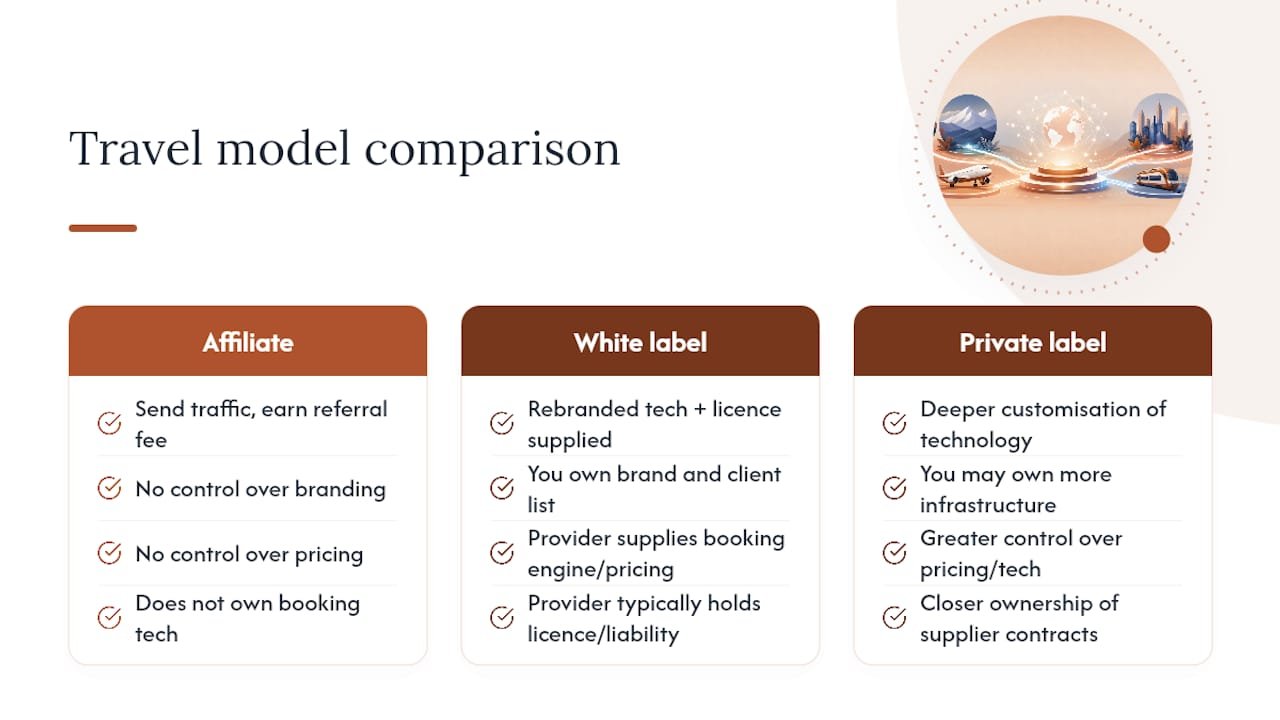
Payments and supplier relationships stay with whoever holds the licence in a true white label arrangement. That is the detail most first-time buyers skip past, and it is the one that determines who is liable if a supplier fails or a customer needs a refund.
What do you need to launch a branded travel business?
Before you take a single booking, five things need to be in place. Skipping any of them is how new agencies end up with angry customers and no recourse.
- Brand assets and a working domain. A logo, a colour palette, and a live website are the minimum. Most white label providers can have your branded booking site running within days once assets are supplied, since providers advertise rapid time to market precisely because they host the backend.
- A registered business and a merchant account. You will need a legal trading entity and a payment processor such as Stripe, or access to the provider’s managed payment system.
- Licensing or ATOL cover. Either you hold financial protection yourself, which is expensive and slow to arrange, or you operate under a provider’s ATOL-covered licence. This single decision determines who is legally responsible when things go wrong.
- Supplier access. You need wholesale hotel, cruise, and tour inventory, either through your own contracts or a managed provider’s existing relationships, since white label engines typically require supplier contracts or GDS connections unless a managed provider covers that layer for you.
- Clear payment and refund flow. Know precisely who holds customer funds and who is liable if a supplier cancels.
Most entrepreneurs never touch an IATA or Sabre line directly, because acquiring one is technically and commercially heavy. A managed provider that already holds those connections removes that burden entirely.
How do you actually make money as a white label travel agent?
Income comes from three levers: commission splits, mark-ups you add on top of wholesale rates, and occasional service fees for bespoke itineraries. Commission is the one that matters most, and the gap between providers here is enormous.
Typical online travel agency reseller programmes pay a low single-digit commission rate. Timeshunters pays partners a significantly higher share of the commission on every booking made through the platform.
That difference changes what a single sale is worth. A £2,000 package holiday at a typical low single-digit commission rate returns modest earnings. The same booking through a much higher commission model, once Times Travel group’s own share and payment processing are accounted for, can put substantially more earnings in your pocket.
Three costs eat into that figure before you see it:
- Payment processing fees on the transaction value.
- Occasional supplier cancellations that reduce or delay commission.
- Support overhead if you are managing client queries alongside sales.
Pro Tip: Ask any provider for a sample commission reconciliation report before signing anything. If they can’t show you exactly how a £1,000 booking becomes your take-home figure, treat that as a warning sign, not an oversight.
How do you choose the right white label platform?
Not all white label providers are built the same, and the differences show up in your monthly income long before they show up in customer complaints. Judge any platform against six things.
- Inventory breadth: hotels, cruises, and tours from multiple wholesalers beat a single-supplier feed, because one supplier going quiet leaves you with nothing to sell.
- API depth: platforms with strong travel and booking APIs let you set your own mark-ups and business rules without waiting on a developer every time you want to adjust pricing.
- Customisation and user experience: your booking site needs to look and feel like your brand, not a template with your logo pasted on top.
- Payment security and financial protection: look for PCI-compliant processing and confirm exactly how ATOL or equivalent cover applies to your bookings, since broad inventory and secure payment integration tend to travel together on established platforms.
- Onboarding time: days or weeks is realistic; months should raise questions about what you are actually being sold.
- Support and reporting: platforms that expose clear reporting and booking management tools make it far easier to track commission and retain clients.
Red flags worth walking away from: opaque fee structures, vague answers about who is liable for refunds, a single supplier relationship dressed up as “extensive inventory,” and reporting dashboards that don’t reconcile to actual commission paid.
Before you commit, ask for a live demonstration of a full booking flow from search to confirmation, a sample supplier invoice, a test refund, and a reporting export that reconciles to commission owed. Any provider confident in their operation will show you this without hesitation.
What does the first 90 days of a white label agency look like?
The gap between signing up and taking consistent bookings is shorter than most people expect, but it still needs a sequence.
- Set up your technical foundations. Confirm brand assets, connect your domain and DNS, and run test bookings through to a completed payment and a test refund before you go live.
- Build your operational backbone. Set up your CRM, write confirmation email templates, and agree a standard process for handling supplier cancellations before your first real customer hits a problem.
- Launch your commercial activity. Set introductory pricing, run a first campaign to your existing audience or network, and put a simple referral mechanic in place from day one.
- Track three numbers weekly. Conversion rate from enquiry to booking, average booking value, and cancellation rate. These three tell you more about the health of your agency in month one than revenue alone.
Most of this work happens before you take a single booking, which is exactly why providers who advertise fast setup times still expect you to do real preparation in parallel.
How does Timeshunters work in practice?
Timeshunters gives partners access to Times Travel group’s ATOL-protected licence, wholesale hotel, cruise, and tour rates, and automated booking management, so you are not manually chasing suppliers for every itinerary.
One partner reported their income per booking significantly increasing after switching to the platform’s higher commission structure.
That jump illustrates exactly why commission split matters more than almost any other variable in this business. The features map directly onto the selection criteria above:
- ATOL licence access answers the financial protection question without you needing your own licence.
- 70% commission solves the income problem that makes most affiliate and reseller models barely worth the effort.
- Wholesale rates give you pricing flexibility to add your own mark-up.
- Automated booking management cuts the operational overhead that would otherwise eat your evenings.
How do you market a white label travel agency?
Your biggest advantage over a faceless OTA is that customers are buying from you, not a logo. Lean into that instead of trying to out-advertise Booking.com.

Build your first client base from people who already trust you: past colleagues, social media followers, or a local network if you run another business. Personal referrals convert far better in travel than cold ads, because holidays are high-trust, high-value purchases. A simple referral incentive, a discount or a small credit for the referrer, turns happy clients into your unpaid sales team.
Content that showcases real itineraries you have booked works harder than generic destination posts. Share the cruise you arranged, the mark-up you applied, and the client’s reaction, without breaching confidentiality. Email remains underrated in this business: a monthly newsletter with a curated deal or two keeps your list warm between bookings, and travel has long booking-to-trip gaps where repeat touchpoints matter.
Loyalty mechanics matter more than most new agents assume. Platforms that build in engagement and repeat-booking features tend to see higher customer lifetime value, because a client who books once through you and has a good experience is your cheapest possible source of the next booking. Retention, not constant new-customer acquisition, is where a small agency’s margins actually improve over time.
What does good customer service look like for a white label agency?
Your customers don’t know or care that a wholesale supplier sits behind your booking engine. They know your name, your website, and whoever answers the phone when a flight gets cancelled, which means every service failure lands on your reputation, not the provider’s.

Set expectations early and in writing. A confirmation email that clearly states what’s included, what happens if a supplier changes a booking, and how refunds are handled prevents most disputes before they start. Respond fast: travel queries are often time-sensitive, and a client stuck at an airport needs an answer in minutes, not the next working day.
Know your escalation path before you need it. When a hotel cancels or a cruise line reschedules, you need to know instantly whether your platform’s managed payment and supplier relationships handle the resolution, or whether you’re expected to sort it directly with the supplier. Ask this during your platform evaluation, not after your first crisis.
Keep a simple record of every booking’s status, payment stage, and any issues raised. This isn’t just good practice, it’s what lets you spot patterns (a supplier that cancels often, a route that generates complaints) before they damage your brand at scale.
How is a white label agency different from a traditional travel agency?
A traditional travel agency typically holds its own ATOL licence, negotiates its own supplier contracts, and builds or buys its own booking technology. That’s a significant upfront investment in capital, compliance, and time, often months of licensing paperwork before a single booking.
A white label agency inherits all of that infrastructure from day one. You’re not applying for financial protection bonds or building relationships with hundreds of hotel chains; you’re stepping into a system that already has both. The trade-off is that you don’t own the underlying supplier contracts or the licence itself, which is why understanding who holds liability matters so much when you choose a provider.
The other major difference is speed and cost of entry. A traditional agency can take months and significant capital to set up properly. A white label operation can have a branded, bookable website live within days, because the technical and legal heavy lifting has already been done by the provider. What you’re really buying isn’t just software; it’s someone else’s years of supplier negotiation and compliance work, rented rather than built.
Can a white label travel business actually scale?
Scaling a white label agency looks different from scaling a traditional one, mostly because your biggest constraints (licensing, supplier access, booking technology) are already handled by the platform. What’s left to scale is your brand, your client base, and your team.
The most natural growth path is deepening relationships with existing clients rather than chasing constant new leads. A client who books a city break through you this year is a strong prospect for a cruise next year, provided you’ve kept in touch. Segmenting your list by travel type and following up at the right moments turns a one-off booking into repeat revenue with almost no additional acquisition cost.
Adding team members is straightforward under most white label structures, since the platform’s automated booking management and reporting tools are built to handle multiple users without each one needing separate supplier negotiations. This is where a solo operator can start looking more like a small agency without the overhead of hiring a compliance team or renegotiating hotel contracts.
The ceiling on growth in this model tends to be commercial, not technical: how many clients you can serve well, not how much booking infrastructure you can afford to build. That’s a far friendlier constraint than the one traditional agencies face when they try to expand supplier relationships market by market.
Key Takeaways
A white label travel platform lets entrepreneurs launch a branded, ATOL-protected agency in days rather than months, earning commission far above typical OTA reseller rates.
| Point | Details |
|---|---|
| Verdict | White label platforms let you trade under your own brand while a licence holder covers financial protection and supplier access. |
| Commission gap is real | Standard OTA reseller splits sit around 4%, while models like Timeshunters offer partners 70% of booking commission. |
| Five launch prerequisites | Brand assets, a merchant account, licensing clarity, supplier access, and a defined refund flow must all be settled before launch. |
| Choose on liability and reporting | Prioritise ATOL clarity, inventory breadth, and reconciled commission reporting over flashy interface features. |
| Timeshunters as the direct route | Timeshunters pairs ATOL-covered licensing with 70% commission and wholesale rates for entrepreneurs ready to launch a branded agency. |
What actually matters when you’re picking a white label provider
Most advice on this topic focuses on inventory size and interface polish, and that’s the wrong place to start. The number that determines whether this business is worth your time is the commission split, full stop.
The conventional wisdom also underplays licensing risk. Plenty of first-time buyers assume “white label” automatically means someone else carries the legal liability. It doesn’t, not unless you confirm exactly how ATOL cover applies to bookings made under your brand. That single conversation, before signing anything, protects you more than any feature comparison.
If you’re weighing this up, prioritise in this order: commission structure, licensing and liability clarity, then supplier breadth, then everything else. The technology will always look fine in a demo. What separates a sustainable agency from a stalled one is whether the money and the legal protection were sorted properly on day one.
— Sam
Ready to launch your own branded travel agency?
Everything covered above, licensing, commission structure, supplier access, comes bundled into what Timeshunters actually offers: an ATOL-protected licence through Times Travel group, wholesale hotel, cruise, and tour rates, and a 70% commission split on every booking you make under your own brand.
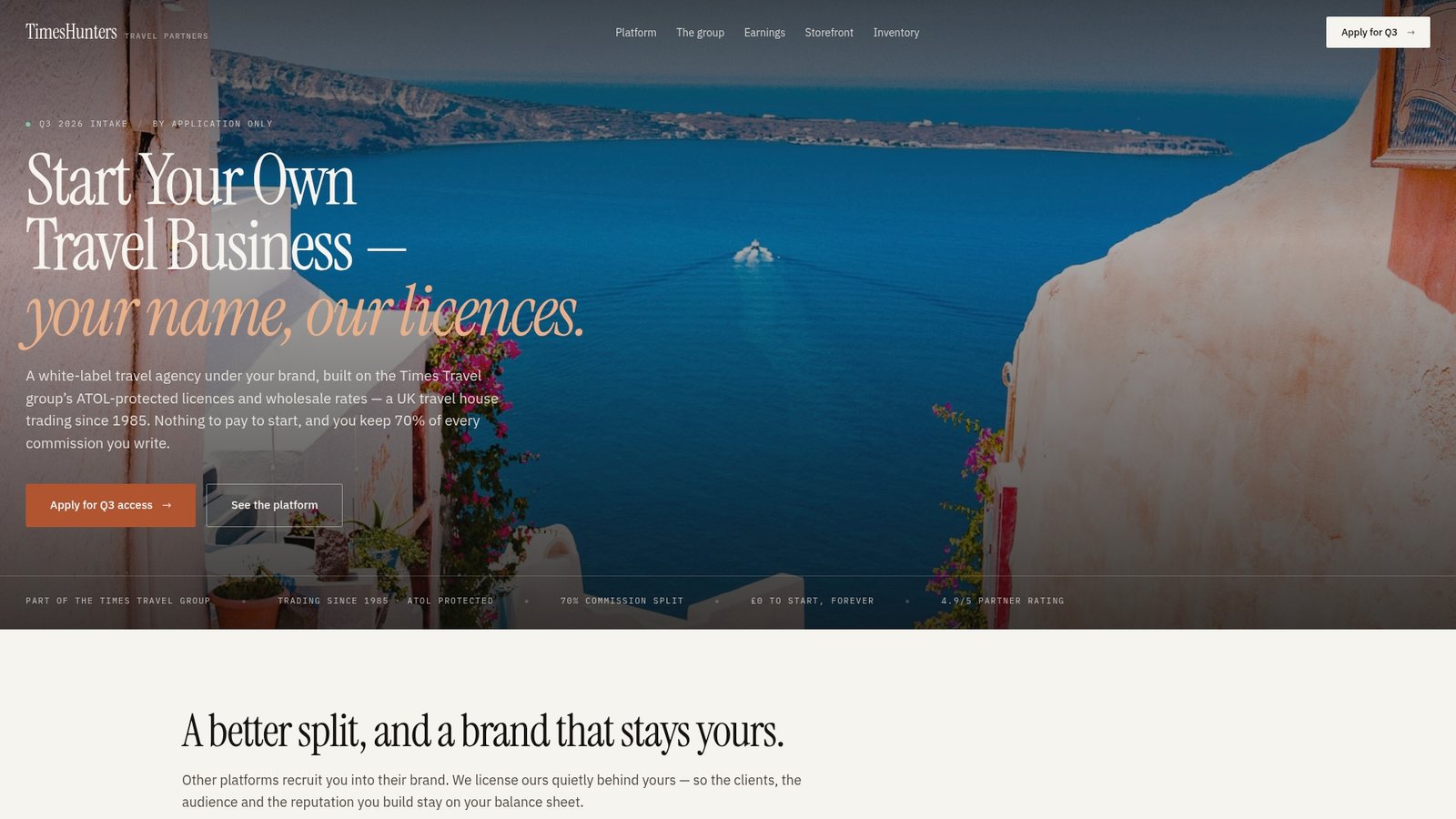
That split is the detail that changes the maths on this business entirely. Where a standard OTA reseller programme leaves you with roughly 4% of a booking’s value, Timeshunters partners keep 70%, backed by automated booking management so you’re not manually chasing confirmations and payments for every client. You bring the brand and the client relationships; the licensing, supplier contracts, and financial protection are already in place.
If you’re weighing up whether this model suits you, the sensible next step is to request a platform demo and ask to see exactly how ATOL cover applies to bookings made under your name, along with a sample commission reconciliation. That single conversation will tell you more than any amount of further reading.
Sources
For technical depth, see travel booking APIs, white label booking engines, and booking website setup requirements. For partnership details, visit Timeshunters.
- Travel and booking APIs for online travel and tourism service providers | AltexSoft
- Customizable white label travel booking engines | Arrivia
- Build a premium white label travel platform | Custom Travel Solutions