A memorable travel agency brand sells feelings, not flights
Discover how effective travel agency branding sells emotions, not just flights, to enhance customer connections and boost sales.

A travel agency brand’s job is to sell a feeling, not a fare. That single distinction decides whether a customer books with you or clicks through to whichever OTA has convinced them that branding reduces reliance on commission-driven platforms they last saw on a comparison site. Price-matching against Expedia is a losing game for a small agency. Emotional differentiation is not.
Two things prove the point. First, OTAs win on price and lose on personality; they cannot build a relationship with a client because their entire model depends on interchangeability. Second, agencies that reposition around a clear emotional promise report real commercial upside: one Timeshunters partner increased their average booking value from £400 to £1,200 once they stopped competing on price and started selling under their own name.
Here is your one-minute task before reading further:
- Write one sentence answering “what feeling does my agency sell?” (calm, adventure, status, belonging). If you cannot answer in ten seconds, that is your starting point.
Key Takeaways
A distinctive travel agency brand sells an emotional promise before it sells a destination, and that promise is what earns direct bookings, premium pricing, and supplier trust.
| Point | Details |
|---|---|
| Lead with emotional intent | Define the single feeling your agency sells before any design work begins. |
| Sequence strategy before visuals | Lock positioning and naming first to avoid costly redesign cycles later. |
| Build operational assets early | Templates for itineraries, emails and proposals keep the brand consistent as you grow. |
| Track direct booking ratio | Rising direct-to-referred bookings is the clearest sign your brand is working. |
| Consider a white-label launch | Timeshunters offers ATOL-protected licences and a branded booking site, with partners keeping 70% commission. |
Table of Contents
- Why travel agency branding matters more than you think
- What makes up a complete travel agency brand identity?
- How do you actually build and launch a travel brand?
- How should the brand show up on your website?
- Where should you look for travel brand inspiration?
- Can a white-label platform speed up your branding launch?
- How do you know if your travel branding is actually working?
- Sources
Why travel agency branding matters more than you think
Branding is the mechanism that gets a customer to book direct instead of defecting to a marketplace at the last click. Without it, you are just a price line in someone else’s search results.
The commercial case is straightforward. A distinct identity lets you charge for expertise rather than compete on the lowest fare, and it opens doors to partnerships (hotels, DMCs, tour operators) who want to be associated with a credible name rather than an anonymous reseller. Consistent visual identity and visible social proof directly increase the likelihood a traveller books with an agency over an OTA, because trust signals do the persuading that price alone cannot.
The evidence for rebranding as a growth lever is not theoretical. A documented rebrand and content refocus around authentic traveller stories lifted engagement and downstream commercial metrics rather than product screenshots, which tells you where the effort should go.
- Reduced OTA dependence means keeping more margin per booking.
- Premium pricing becomes defensible once clients see you as a specialist, not a search result.
- Stronger supplier relationships follow from a name partners recognise and trust.
What makes up a complete travel agency brand identity?
A brand identity has three layers: strategy, visuals, and the assets that carry both into daily operations. Skip the strategy layer and you end up with a nice logo attached to nothing.
Strategy outputs come first. You need a documented audience persona (who exactly you serve and what they fear or crave), a one-line emotional intent (adventure, calm, belonging, status), and a value proposition that says why you, specifically, rather than any other agency or app. Emotion-led storytelling builds stronger loyalty than feature-led or price-led messaging, so this is not a box-ticking exercise, it is the foundation everything else sits on.
Visual identity follows strategy, never the reverse. This covers your logo system (a primary mark plus simplified variants for social avatars and favicons), a colour palette that reflects your emotional intent rather than generic travel clichés, typography that reads well on both a website and a printed itinerary, and a photography direction, real destinations and real clients wherever possible, not stock imagery of an infinity pool nobody in your client base will ever visit.

Verbal identity is the part founders skip. Your tone of voice, whether that is warm and reassuring or sharp and adventurous, should be written down in two paragraphs so anyone drafting an email sounds consistent. Draft three messaging pillars (for example: “we know the places you can’t Google,” “your money is protected,” “we plan around your actual life”) and use them everywhere.
Operational assets make the brand usable day to day:
- A short brand guidelines document (colours, fonts, logo rules, voice notes) that a freelance designer could follow without you present.
- Branded itinerary and proposal templates so every client touchpoint looks considered.
- Email and social templates that keep tone consistent across a growing team.
- Templated assets across itineraries, emails and social posts reduce launch friction and stop the brand fragmenting the moment someone else joins the business.
How do you actually build and launch a travel brand?
Building a brand is a sequence, not a mood board. Jumping to design before positioning is the single most common (and expensive) mistake founders make.
- Discovery (week 1). Write your founder story in 200 words: why you started this agency, and what frustrated you about the alternatives. Interview two or three past or prospective clients and ask what they feared about booking, what they’d pay more for, and what they’d tell a friend about you.
- Naming and positioning sprint (week 1 to 2). Lock your agency name, your one-line emotional intent, and your value proposition before a single design brief goes out. Positioning agreed before design work begins avoids costly redesign cycles later.
- Design and asset production (weeks 2 to 5). Commission logo, palette, typography, and photography direction. Budget two to three weeks for a competent freelance designer, longer for a full studio brief.
- Digital build and launch (weeks 5 to 8). Build the branded site, load your first curated content, and soft-launch to your existing network before any paid marketing. A strategy-led studio can deliver identity, digital platform and initial content in under twelve weeks even with a lean team, so an eight to twelve week window is realistic for a solo founder working with contractors.
How should the brand show up on your website?
Your website is where the brand either earns trust or loses it in the first five seconds. Structure matters as much as styling.
Build your information architecture around discovery, not just search: a homepage that states your emotional intent immediately, curated destination pages that read like a knowledgeable friend wrote them, and a conversion path that never buries the enquiry button. Use a CMS built for scalable content, not a static template, because a flexible content platform supports the destination pages that drive long-tail organic discovery over time. Real photography beats stock every time; if budget is tight, prioritise images of your own trips or client experiences over generic sunset shots.
- Show ATOL protection and financial safeguards clearly, near the booking button, not buried in a footer.
- Keep pricing transparent enough that visitors trust you before they enquire.
- Offer a real contact method (phone or WhatsApp), not just a form.
- Pair operational software with your booking flow. Tools reviewed in guides like TravelEngine’s overview of agency operations platforms show how the back end and the brand front end need to work together, not as separate projects.
Where should you look for travel brand inspiration?
Borrowing a mood, not a template, is what separates a distinctive agency from a forgettable one. Three starting directions:
- Quiet luxury: muted neutrals, generous white space, serif typography. Works for agencies targeting discerning, older travellers who associate restraint with quality.
- Adventure grit: bold contrast, textured photography, condensed sans-serif fonts. Fits agencies selling expedition or off-grid travel.
- Family warmth: rounded typography, warm earth tones, candid (not staged) photography of real families.
Avoid the trap designers call “wanderlust copy-paste”, the same palm tree icon, the same script font, the same stock sunset every competitor uses. Commission one piece of bespoke illustration or lean on your founder story as a visual anchor instead; it costs little and instantly separates you from the template crowd.
Can a white-label platform speed up your branding launch?
Yes, and it removes the single biggest bottleneck founders face: getting ATOL protection and supplier access without years of industry relationships. Timeshunters gives partners a fully branded booking site under their own name, backed by Times Travel group’s ATOL-protected licences, wholesale hotel, cruise and tour inventory, and automated booking management, so the brand work you’ve just planned has somewhere real to live from day one.
The commercial model matters here too. Partners keep a significantly higher commission on bookings compared to the typical OTA reseller model, which contributed to one partner increasing their average booking value after trading under their own name rather than a marketplace’s.
Before choosing any white-label partner, ask: who holds the ATOL licence, what percentage of commission do I actually keep, and how much control do I have over my own site’s branding?
How do you know if your travel branding is actually working?
Branding without measurement is just decoration. Track a small set of numbers monthly rather than guessing from gut feel.
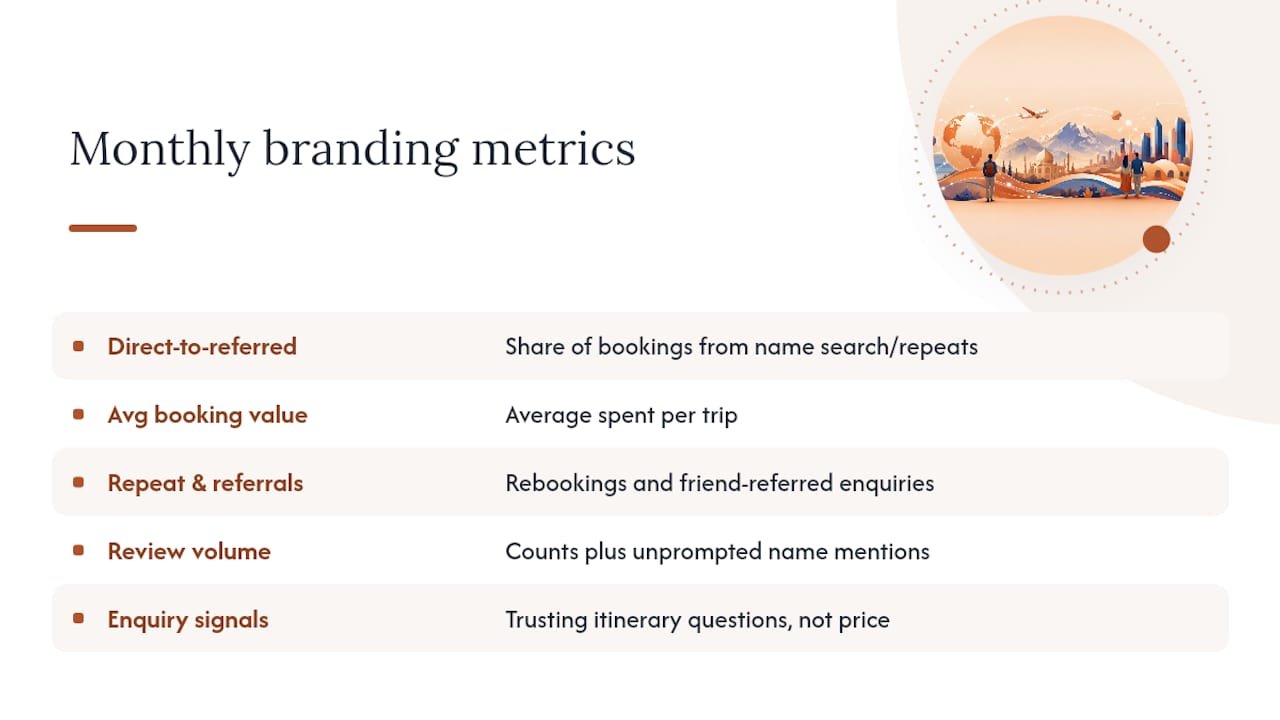
The clearest signal is your direct-to-referred booking ratio: what proportion of bookings come from people who searched your name or returned as repeat clients, versus those funnelled through a comparison site or ad. A rising direct share means your brand is doing the work an OTA relationship used to do.
Watch average booking value alongside it. If premium positioning is working, clients should be spending more per trip and asking fewer questions about price. Repeat and referral rate matters just as much: a brand that creates real loyalty shows up in clients rebooking without a fresh sales pitch, and in new enquiries that mention a friend’s recommendation by name.
Beyond the numbers, watch qualitative signals: are enquiries coming in already trusting you (asking about itinerary details rather than negotiating price), and does your name get used unprompted in reviews and social mentions? Visible social proof and consistent messaging are what move a prospect from comparing prices to trusting a specific agency, so review volume and sentiment deserve a place on your monthly dashboard alongside bookings and revenue.
What I’d tell a founder starting this today
Most founders overspend on a logo and underspend on positioning, then wonder why the brand feels hollow. Invest first in the one-line emotional intent; the visuals should follow from that, not the other way round. The two things worth doing this week: write your founder story in 200 words, and interview one past client about why they actually chose you.
— Sam
Launch your own branded agency with Timeshunters
Building the identity is half the job; the other half is having somewhere credible to put it. Timeshunters gives you a branded booking site under your own name, ATOL-protected licences through Times Travel group, wholesale hotel, cruise and tour inventory, and automated booking management, so the brand you’ve just designed can start taking real bookings without you first spending years building supplier relationships from scratch.
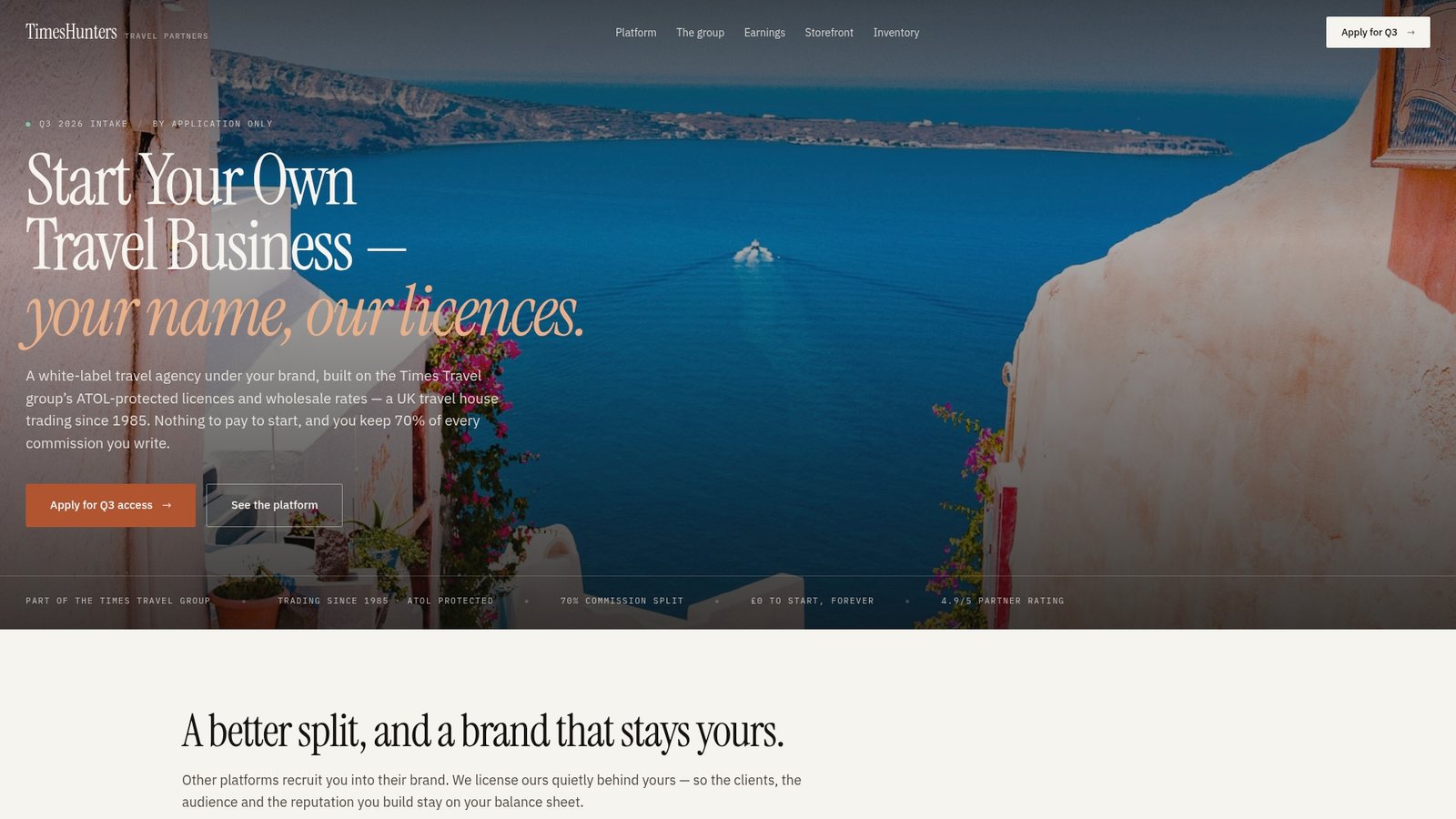
If you’ve got your positioning and visuals sketched out, the practical next move is to visit the Timeshunters platform page and see what setting up your own branded agency actually involves.
Sources
- Supercharged Studio — designing a travel brand
- PHPTravels — travel branding guide
- Séntire case study — brand development