
ATOL licence for UK sellers: avoid the 12 week wait with white label
UK ATOL checklist for travel businesses: fees and bond rules, required documents, verification steps, realistic timelines, and white label routes to start...

An ATOL licence is the UK financial protection scheme, run by the Civil Aviation Authority, guaranteeing refunds or repatriation if a flight inclusive tour operator collapses. Anyone selling flight accommodation as part of a package must hold one, join an accredited body, or trade through a franchise. Check a business’s status instantly using the CAA’s Check for ATOL tool or ask for a certificate before you pay.
TL;DR:
- Most new entrants should consider franchising or accredited body membership to bypass full financial scrutiny and accelerate market entry.
- Applying for an ATOL requires detailed financial documentation, passing an accountability course, and a formal CAA review, which usually takes around 12 weeks once complete.
- An ATOL certificate must be issued at the time of payment with clear booking details, and verifying the number through the CAA’s online check is essential for genuine protection.
- ATOL only covers refunds and repatriation if the business collapses but does not includeTrip cancellations, medical expenses, or personal losses, making travel insurance still necessary.
Table of Contents
- Who actually needs an ATOL licence?
- Which ATOL type fits your business?
- What does an ATOL licence actually cost?
- How do you apply for an ATOL licence?
- What must an ATOL certificate show, and how do you check it?
- What ATOL covers, and what it doesn’t
- Typical timelines and documentation you’ll need
- Renewing an ATOL licence and staying compliant
- Why ATOL licences get refused or revoked
- What happens if an ATOL holder stops trading?
- How ATOL fits alongside other travel protections
- Why most guides oversell the paperwork and undersell the strategy
- Start selling ATOL protected holidays without the twelve week wait
- Sources
Who actually needs an ATOL licence?
Regulation 9 of the Civil Aviation (Air Travel Organisers’ Licensing) Regulations 2012 is blunt about it: anyone in the UK who makes flight accommodation available, other than the airline itself, must hold an ATOL. That covers tour operators, travel agents packaging flights with hotels, and increasingly, entrepreneurs selling holidays through their own branded businesses.
There are real exemptions, though. You’re generally off the hook if you’re:
- An agent selling on behalf of an ATOL holder, rather than contracting directly with the customer
- A member of an accredited body that already carries its own protection arrangements
- Purely an airline ticket agent with no package element involved
The Civil Aviation Authority supervises the whole system and can refuse or revoke a licence on fitness and competence grounds. Funding comes via the Air Travel Trust, into which every ATOL holder pays a fixed contribution per traveller, the pot that pays for refunds and repatriation when a business fails.
Which ATOL type fits your business?
Not every operator needs the full Standard licence. The CAA runs five distinct routes, and picking the wrong one wastes time and money.
- Standard ATOL: for established operators selling flight packages directly, with revenue and passenger numbers that justify a full financial review.
- Small Business ATOL (SBA): designed for start ups and smaller operators, with a lighter touch application but still a genuine bond requirement.
- Franchise ATOL: you trade under an existing ATOL holder’s licence and protection, useful if you want to launch fast without building your own financial infrastructure from scratch.
- Accredited Body membership: certain trade bodies hold their own ATOL and extend protection to members, which suits agents who sell packages but don’t want the compliance burden of a personal licence.
- Trade ATOL: aimed at businesses selling primarily to other travel trade customers rather than the public.
Passenger volume and revenue expectations tend to push new entrants towards SBA or franchise routes first. Joining an accredited body or franchise often removes the bond and full financial scrutiny that Standard ATOL demands, though you’ll still need to satisfy that body’s own membership conditions.
Pro Tip: If you’re testing a holiday concept before committing capital, a franchise or accredited body route lets you sell ATOL-protected packages without first clearing a full CAA financial review.
What does an ATOL licence actually cost?
Fees scale with the licence type and your expected passenger numbers. A Standard ATOL application costs £2,606 plus 16.35 pence per passenger, while the Small Business ATOL carries a fixed £1,538 fee. Franchise membership starts from £981 for operators expecting under 1,001 passengers.
| Licence type | Application fee | Notes |
|---|---|---|
| Standard ATOL | £2,606 + 16.35p per passenger | Full financial review required |
| Small Business ATOL (SBA) | £1,538 | Fixed fee, lighter scrutiny |
| Franchise (under 1,001 passengers) | From £981 | Trades under existing ATOL holder |
Bonding is where costs bite hardest. Standard ATOL typically requires a bond of 15% of licensable revenue, subject to a £50,000 minimum, and SBA holders usually face the same £50,000 floor. Limited companies must also hold a minimum £30,000 paid up share capital for some licence categories. A business projecting £2 million in licensable revenue, for instance, should expect a bond calculation starting around £300,000, not the bare minimum. The CAA sets the exact figure after reviewing your projections, so treat these numbers as planning benchmarks rather than fixed quotes.
How do you apply for an ATOL licence?
The process is administrative but unforgiving on documentation. Miss a step and you’ll be sent back to the queue.
- Register for an ATOL Online account and submit your application alongside the relevant fee.
- Prepare and upload supporting financial documents: historical accounts where they exist, revenue projections, an opening balance sheet, and for sole traders or partnerships, certified statements of personal assets and liabilities.
- Complete the mandatory ATOL Accountable Persons course, which every director or accountable individual must pass.
- Attend a formal meeting with the CAA, where financial fitness and competence get scrutinised in detail.
- Meet any conditions set, which sometimes include a cash injection or capital top up, usually within a two month deadline.
Decisions typically land within around 12 weeks of a complete submission, though incomplete financial paperwork is the single biggest cause of delay.
Pro Tip: Get your accountant to prepare the opening balance sheet and projections before you touch the online application. Applicants who submit financials alongside the form, rather than promising them “shortly”, tend to move through the CAA meeting stage far faster.
What must an ATOL certificate show, and how do you check it?
A certificate must be issued the moment a customer makes any payment, not at the point of booking confirmation. It has to display three non-negotiable details: the issuer’s name, the ATOL number, and a unique reference for that specific booking.
- If booking details change significantly more than 72 hours before departure, a new certificate must be issued to reflect the update.
- Always request a certificate before parting with money if one hasn’t been offered automatically.
- Cross check the ATOL number against the CAA’s Check for ATOL search facility rather than trusting a printed number alone.
That last step matters more than people assume. Anyone can print a number on a page; only the CAA’s own search confirms it’s live and belongs to the business you’re paying.
What ATOL covers, and what it doesn’t
ATOL only pays out when a licence holder stops trading, refunding customers or arranging repatriation if they’re already abroad. It does not cover cancelled flights, medical expenses, or personal loss caused by anything other than the operator’s collapse.
That gap is exactly why travel insurance still matters even on a fully ATOL protected booking. Package holiday regulations add separate consumer rights around misrepresentation and quality, working alongside ATOL rather than replacing it. A holidaymaker whose operator folds mid trip gets flown home under ATOL; a holidaymaker who falls ill on that same trip needs a proper insurance policy, because ATOL was never built to touch that risk.
Typical timelines and documentation you’ll need
Budget more time than the headline “12 weeks” suggests, because that clock starts only once your application is genuinely complete. Gathering the paperwork first usually takes new applicants four to eight weeks on its own.
Expect to assemble historical trading accounts if the business already exists, forward looking revenue and passenger projections, an opening balance sheet, and bank statements demonstrating working capital. Sole traders and partnerships face an extra layer: certified statements of personal assets and liabilities, since there’s no corporate structure separating personal and business finance.
Once submitted, the sequence runs roughly like this: initial CAA review of the paperwork, the ATOL Accountable Persons course completion, a formal meeting to discuss the application, then a decision, often with conditions attached rather than an outright yes. Conditions might mean topping up working capital or adjusting projected passenger numbers downward before the licence is confirmed.
Franchise and accredited body routes cut this timeline considerably, since the financial review sits with the parent licence holder rather than being duplicated for every member. That’s the main practical trade off: speed to market against full independence over your own ATOL number.
Whichever route you take, keep every document dated and version controlled. CAA case officers routinely ask for updated projections if the review drags past a few months, and stale figures are a common reason applications stall at the meeting stage rather than being refused outright.
Renewing an ATOL licence and staying compliant
An ATOL licence isn’t a one off certificate you file away. It requires annual renewal, and the CAA reviews your financial position again each time, not just your paperwork from the original application.
Renewal means resubmitting current accounts, updated revenue projections, and confirmation that your bond still matches your actual licensable revenue, not the figure you estimated a year earlier. Growing businesses often get caught out here: if turnover has risen sharply, the bond calculated at 15% of licensable revenue needs topping up before renewal is granted, not after.
Ongoing compliance runs deeper than the annual paperwork cycle. Holders must report material changes promptly, a change of directors, a shift in trading model, or a significant drop in bookings, rather than waiting for the renewal window. The CAA can request an interim review at any point if it has concerns about financial stability, and ignoring that request is one of the fastest routes to licence suspension.
Keep management accounts current throughout the year rather than reconstructing them under pressure at renewal time. Businesses that treat ATOL compliance as a continuous discipline, checking bond adequacy quarterly rather than annually, rarely face the awkward conversations that come with an under bonded licence discovered mid year. The Accountable Persons named on the licence also carry personal responsibility for flagging problems early, which is worth remembering if you’ve delegated day to day compliance to someone else in the business.
Why ATOL licences get refused or revoked
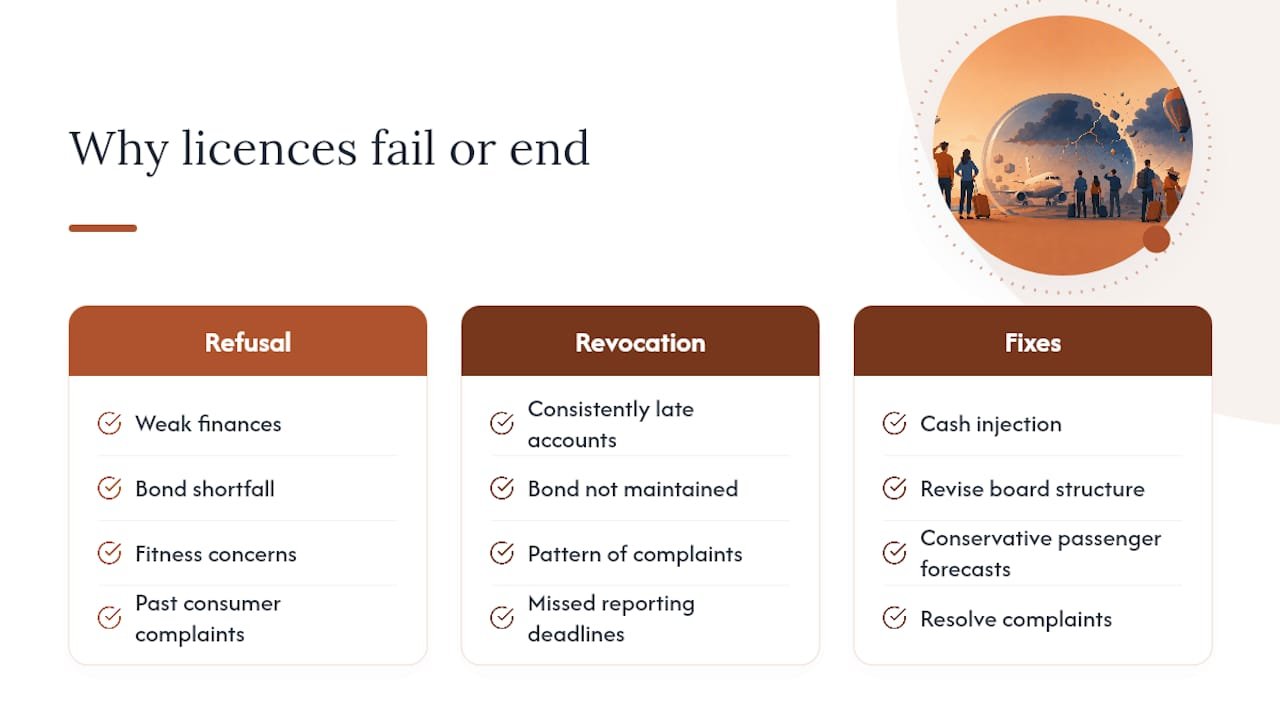
Financial weakness is the single most common reason applications fail. If projections show insufficient working capital, or the bond calculation reveals a shortfall the applicant can’t cover, the CAA will refuse rather than approve conditionally.
Fitness and competence problems form the second major category. A history of business failures, unresolved consumer complaints against a previous venture, or a director with a track record of financial mismanagement can all trigger refusal under the fitness test built into Regulation 9’s framework. The CAA isn’t just checking numbers on a spreadsheet; it’s assessing whether the people running the business can be trusted with customer money.
Revocation of an existing licence tends to follow different triggers: consistently late accounts, failure to maintain the required bond level as revenue grows, or a pattern of consumer complaints that suggests the business isn’t honouring its obligations. Missed reporting deadlines matter more than people expect, since they signal to the CAA that financial oversight inside the business has slipped.
Addressing a refusal usually means going back with stronger financials, often after a cooling off period. A cash injection to fix a bond shortfall, a revised board structure to answer fitness concerns, or simply more conservative passenger projections can turn a refusal into an approval on resubmission. Businesses that treat a first refusal as a data point rather than a dead end, fixing the specific gap the CAA identified, generally succeed at the second attempt.
What happens if an ATOL holder stops trading?
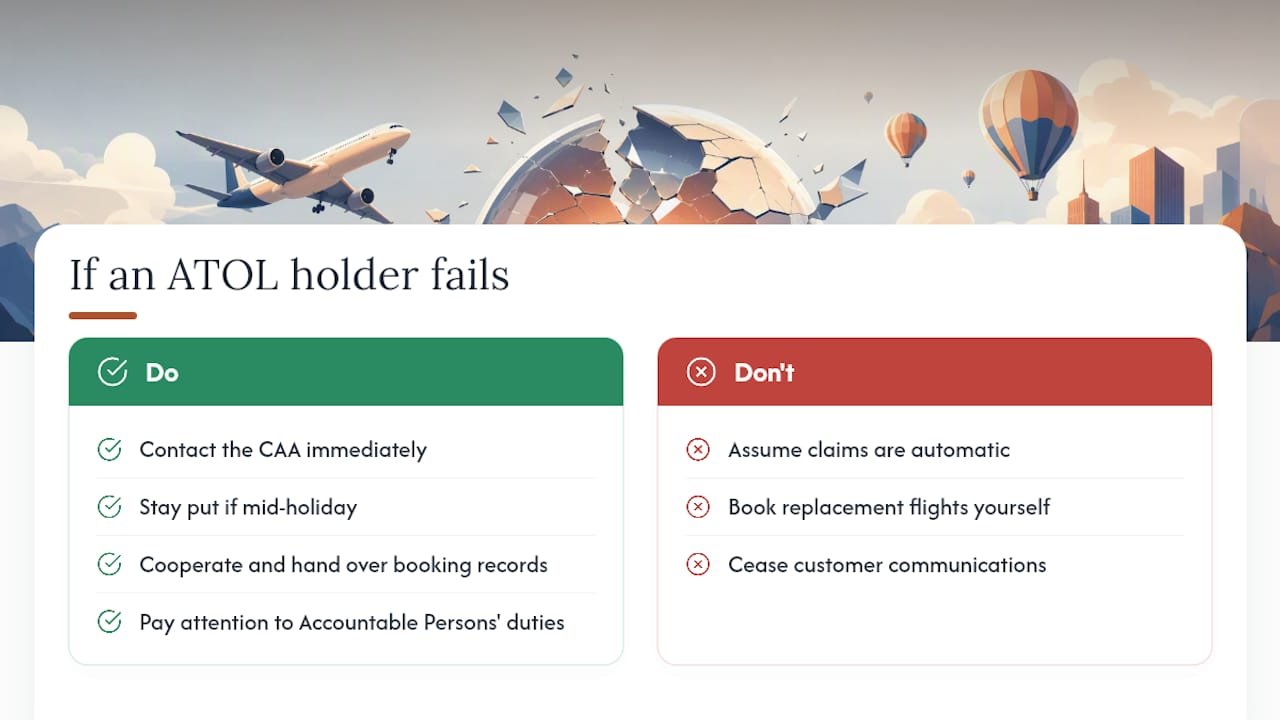
This is the scenario the entire scheme exists for. When an ATOL holder ceases trading, the Air Travel Trust activates, and customers who’ve already paid get either a full refund or, if they’re currently abroad, repatriation arranged and funded through the trust.
Customers should contact the CAA directly rather than assuming automatic processing, since claims need to be lodged and matched against booking records the failed business held. Anyone mid holiday when a collapse happens should stay put and wait for CAA or its appointed agents to arrange onward travel or return flights, rather than booking replacement flights independently and hoping for reimbursement later.
For the business side, insolvency triggers immediate licence revocation and a duty to cooperate with the CAA’s wind down process, handing over booking records and customer data so claims can be processed accurately. Directors named as Accountable Persons carry ongoing responsibility here too; a poorly managed insolvency, where records are incomplete or customer communication stops, can follow those individuals into future ATOL applications elsewhere.
The £2.50 per traveller contribution every ATOL holder pays into the trust exists precisely to fund this eventuality, spreading the cost of failure across the whole industry rather than leaving it to chance. It’s a blunt but effective piece of collective insurance, and it’s the reason a UK holidaymaker booking through a properly ATOL protected business faces genuinely lower financial risk than one booking through an unprotected seller abroad.
How ATOL fits alongside other travel protections
ATOL doesn’t operate in isolation. Package Travel Regulations sit alongside it, giving consumers rights around misleading descriptions, quality standards, and organiser liability that go beyond simple financial protection. A holiday that’s badly delivered but financially uneventful is a Package Travel Regulations issue, not an ATOL one.
Section 75 of the Consumer Credit Act offers a separate layer for card payments over £100, giving cardholders a claim against their card provider in certain failure scenarios, though it works differently from ATOL’s trust based refund mechanism. Travel insurance covers the risks ATOL explicitly excludes: medical emergencies, cancelled flights unrelated to operator failure, and personal belongings.
Accredited bodies add another layer again, since their own protection schemes sometimes run alongside ATOL for members rather than replacing it outright. Understanding where each protection starts and stops matters more for a business owner than a general awareness that “cover exists somewhere”. A holiday seller who can explain precisely which protection applies to which risk, ATOL for operator failure, insurance for personal misfortune, Package Travel Regulations for delivery standards, builds far more customer trust than one who waves vaguely at “full protection” without specifics.
Why most guides oversell the paperwork and undersell the strategy
Most ATOL guides treat the licence as a compliance hurdle: fill in the form, pay the bond, wait twelve weeks. That framing misses the real decision most entrepreneurs actually face, which isn’t “how do I get compliant” but “which route gets me trading fastest without starving my cash flow.”
The conventional advice pushes everyone towards Standard ATOL as the “proper” route, as though franchise or accredited body membership were somehow lesser. In practice, a £50,000 minimum bond plus a full financial review is a serious barrier for anyone starting from scratch, and it delays revenue by months while the CAA works through your application.
What gets underestimated is how much a franchise route changes the maths. Trading under an established ATOL holder’s protection means you’re selling protected packages from day one, building a client base and brand while someone else carries the compliance burden. Timeshunters’ white label model is exactly this kind of route, using Times Travel group’s existing ATOL protection so partners can start earning commission immediately rather than waiting on their own licence application.
Prioritise speed to market first, full independence second. You can always graduate to your own Standard ATOL once revenue justifies the bond.
— Sam
Start selling ATOL protected holidays without the twelve week wait
Timeshunters gets you trading under an ATOL protected licence in days rather than months, because you’re operating through Times Travel group’s existing protection rather than applying for your own from scratch. That’s the practical difference against building a Standard ATOL business alone: no £50,000 bond to raise, no CAA financial review to pass, no waiting on a decision before you can take your first booking.
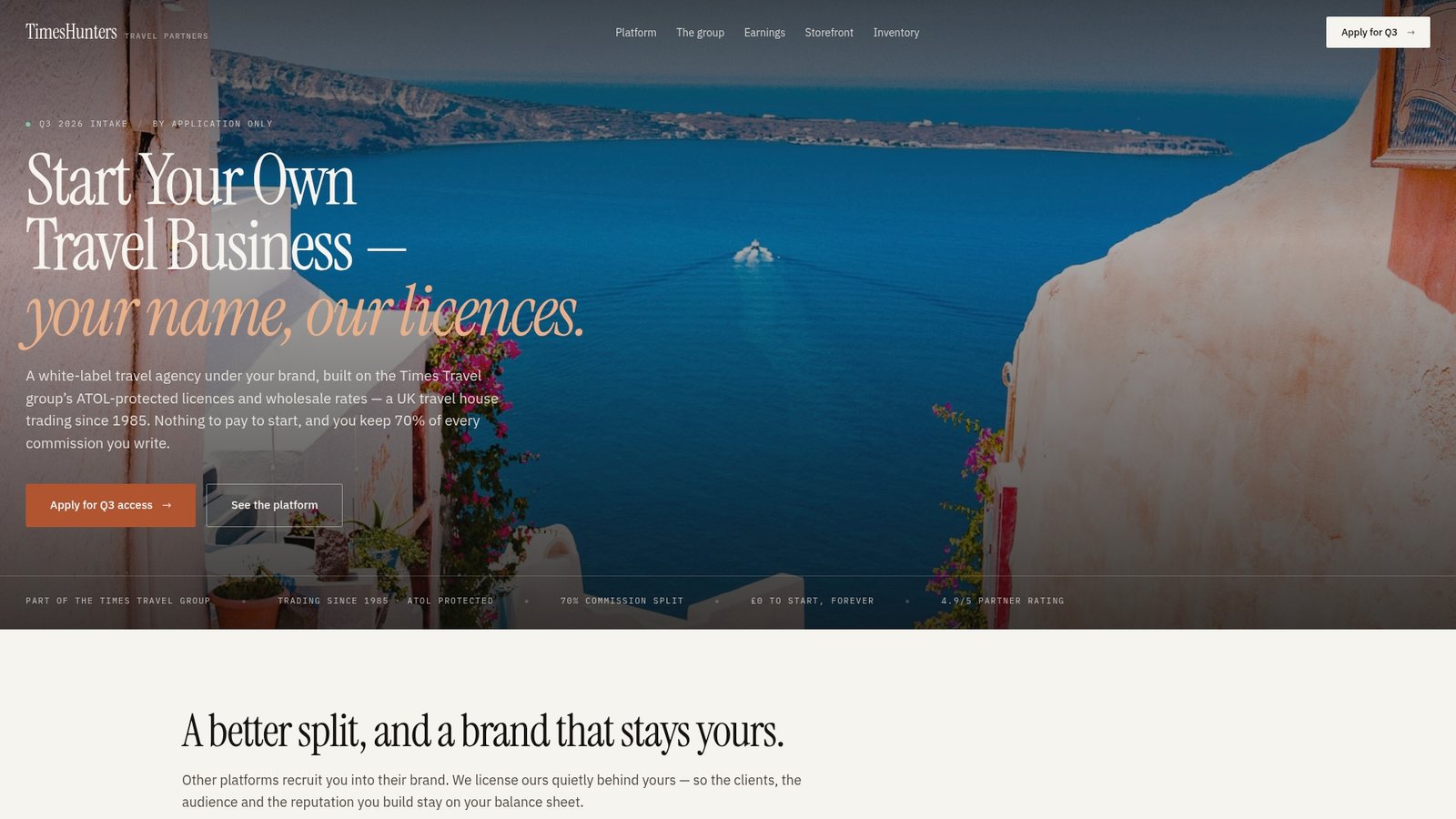
The platform gives partners a branded booking site, automated booking management, and managed payments, so the operational side runs itself while you focus on clients. One partner reported income per booking rising from £400 to £1,200 after switching to this model.
If you’ve got an audience or client base already and want ATOL protected packages behind your brand without the licensing overhead, start your Timeshunters application and get your branded booking site live.