
From 6 Apr 2027: UK Package Travel Regulations: Travellers & Sellers Must Act
See how UK package travel regulations change on 6 Apr 2027 and what travellers, organisers and retailers must do to comply, with checklists and timelines.

The Package Travel and Linked Travel Arrangements Regulations 2018 still govern every UK package holiday, but the goalposts move on 6 April 2027. The Package Travel and Linked Travel Arrangements (Amendment) Regulations 2026 broaden the definition of a “package,” pulling in bookings that currently dodge full protection as linked travel arrangements. Anyone booking, selling, or facilitating travel from that date needs to know which side of the line they now sit on.
TL;DR:
- The definition of a package will include arrangements where travelers select and pay for multiple services during a single visit, even if sold as separate contracts.
- From April 2027, arrangements like link transfers or dynamic packages that facilitate multiple bookings within 24 hours will be classified as full packages under the law.
- Businesses must audit booking flows, data transfers, and their contracts now to prepare for the broadened scope, as the compliance clock starts immediately.
- All bookings perceived as a single transaction, including redirecting to partner suppliers or shared checkouts, should be treated as packages after April 2027.
- Relying on lightweight linked travel arrangements will no longer keep a business outside full package liability, especially for high-volume or automated booking systems.
Table of Contents
- What’s changing and the timeline for the 2026 amendments
- What counts as a package now: definition and key tests
- Traveller rights and remedies under the package travel regulations
- Business obligations: organiser and retailer duties, liability and insolvency protection
- Linked travel arrangements: what they were and how the reforms change them
- Practical compliance checklist for UK travel businesses before 6 April 2027
- Implications for travel entrepreneurs and white label agents
- What the compliance timeline actually demands of you
- Another route: a white label platform built around ATOL compliance
- Sources
What’s changing and the timeline for the 2026 amendments
The reform doesn’t tear up the 2018 rulebook. It amends it. The Package Travel and Linked Travel Arrangements (Amendment) Regulations 2026 tighten the definition of “package” and reshape how linked travel arrangements, or LTAs, get treated in law. Nothing here is retrospective. If your customer booked a trip to March 2027, the old rules apply for the life of that contract. The new regime only bites on bookings made on or after 6 April 2027.
That gap matters more than it sounds. Travel businesses running dynamic packaging engines, multi-supplier checkouts, or referral partnerships have a defined runway to restructure before the switch, rather than facing a hard cutover with live bookings caught mid-flight.
Three changes sit at the centre of the amendment:
- A broader package definition. The rules now catch separate contracts arranged through a single point of sale, where one trader facilitates a traveller’s selection and payment for multiple services in one visit or session, even if each service is technically sold under its own separate contract.
- Absorption of LTA Type A. What used to sit in the lighter-touch “linked travel arrangement” category, where a trader passed a customer’s data to a second supplier for an additional booking within 24 hours, largely becomes a package outright.
- Removal of LTA Type B. The category covering separate, targeted invitations to book additional travel services disappears from the framework. Businesses using this route need a different structure.
There’s also a practical clarification worth flagging on its own: the government’s response to its 2025 consultation confirms a 14 day window for refunds tied to redress and cancellation scenarios, closing off ambiguity that businesses had previously exploited or, in fairness, genuinely struggled to interpret.
Why bother widening the definition at all? The policy logic is straightforward: too many multi-service bookings were slipping into the lighter LTA category purely because of how the checkout was structured, not because the trip itself was any less “packaged” from the traveller’s point of view. A flight booked on one screen and a transfer added on the next, both paid for in the same session with the same trader, looked and felt like a package to the traveller. It just wasn’t treated as one legally. The 2026 amendment closes that gap by focusing on the facilitation, not the contract paperwork behind it.
For businesses, this means the compliance clock starts now, not in April 2027. Booking flows, supplier agreements, and standard information forms typically take months to redesign and test, particularly where automated systems pass data between suppliers in real time. Waiting until the new year to start the audit leaves very little margin for error.
What counts as a package now: definition and key tests
A package, under regulation 2 of the 2018 Regulations, is a combination of at least two different types of travel service for the same trip, sold or arranged by a single trader, or bought as a bundle put together by a single point of sale. That’s the baseline test. The 2026 amendment adds a further category: separate contracts, sold separately, where a single trader still facilitated the traveller’s selection and payment for both during the same visit or contact.
That last addition is the one businesses most often miss, because it targets behaviour rather than paperwork. You can structure two bookings as entirely separate contracts, with separate terms and separate suppliers, and still find yourself running a package if the customer selected and paid for both in one seamless session with you.
A few tests and exemptions decide where the line actually falls:
- The 24 hour rule. A combination of services lasting less than 24 hours is exempt from package status, unless it includes overnight accommodation. A day trip with a lunch stop is not a package. A day trip that includes a hotel night is.
- The 25% threshold for “other tourist services.” Where a trip combines transport or accommodation with a genuinely minor add-on, such as a single museum ticket, the add-on only tips the booking into package territory if it represents a significant proportion, broadly a quarter or more, of the trip’s value or is otherwise presented as an essential feature.
- The single point of sale test. If a traveller selects and pays for more than one travel service in one visit to your website, app, or shop, and you facilitated that combined selection, you’re likely running a package regardless of how many separate invoices or confirmation emails follow.
- The data transfer test. Where a trader passes a customer’s name, payment details, or booking reference to another supplier so that supplier can complete a second sale, and that second sale happens within 24 hours, the arrangement has historically counted as an LTA. After April 2027, this scenario is far more likely to be treated as a full package.
Consider three practical examples. A high street travel agent selling flights and a separately contracted hotel, both booked at the same desk in the same conversation, has long been a package, and stays one. A comparison site that lets a customer book a flight, then redirects them with pre-filled details to a partner’s car hire page, used to sit in LTA territory; from 2027 it likely becomes a package because the trader facilitated the second selection during a single visit. Dynamic packaging platforms that build a bespoke itinerary from separate supplier contracts, a common model for independent tour operators, have generally already met the package test under the existing definition, and the 2026 changes mostly close remaining loopholes rather than creating new liability from scratch.
The practical upshot: if your booking journey feels like one transaction to the customer, treat it as a package. Regulators are following the customer’s experience of the sale, not the label on the invoice.
Traveller rights and remedies under the package travel regulations
UK consumers booking package holidays get a specific bundle of statutory protections that go well beyond a standard consumer contract, and they’re worth knowing before you fly, not after something goes wrong.
Before you book, the organiser must give you clear pre-contract information, covering the destination, transport, accommodation standard, meal arrangements, and total price, using a standardised information form. Once you’ve paid, you’re entitled to a confirmation on a “durable medium,” meaning a document you can keep and refer back to, not just a verbal assurance at the counter.
Price changes are tightly restricted. Under the 2018 Regulations’ schedules, an organiser can only increase the price after booking in limited circumstances, such as fuel cost rises or currency fluctuations, and the increase is capped at a small percentage of the total package price in most cases. Going beyond this cap gives travellers the right to terminate the contract and receive a full refund, rather than simply accepting the price increase.
Pro Tip: *Always check your booking confirmation for the exact price shown, not just the headline advertised figure.
Your core remedies break down as follows:
- Significant changes before departure. If the organiser makes a significant change, such as switching your hotel category or altering flight times substantially, you can accept a substitute package or terminate and get your money back.
- The 14 day refund rule. Where you terminate because of a significant change or an excessive price rise, the regulations require the refund within 14 days of termination, not “in due course.”
- Extraordinary circumstances. You can cancel without paying a termination fee if unavoidable and extraordinary circumstances, war, a serious disease outbreak, a natural disaster, significantly affect the performance of the package or transport to the destination.
- Assistance and repatriation. If you’re stranded abroad because the organiser can’t ensure your return, they must still offer appropriate assistance, and in many cases cover reasonable accommodation costs while a solution is arranged.
- Transferring your booking. You can transfer your package to someone else who meets the conditions of the contract, provided you give the organiser reasonable notice before departure.
That 14 day refund rule is the one travellers most often don’t realise they can enforce. Delayed refunds are one of the most common complaints raised with travel trade bodies, and knowing the statutory deadline turns a vague grievance into a concrete demand with a date attached.
Business obligations: organiser and retailer duties, liability and insolvency protection
The regulations draw a firm line between an “organiser,” the business that puts the package together, and a “retailer,” the business that sells someone else’s package on their behalf. That distinction decides who’s on the hook when something goes wrong, and contracts between the two need to say so explicitly.
The organiser carries strict liability for the performance of every service in the package, even services delivered by third party suppliers they don’t directly control. If the hotel botches the booking or the transfer company doesn’t show up, the traveller’s claim sits with the organiser first, not the supplier. The organiser can then pursue the supplier for redress separately, but that’s the organiser’s problem to chase, not the customer’s.
Retailers carry a narrower but still meaningful set of duties: giving accurate pre-contract information, passing on the standard information form correctly, and not misrepresenting who’s actually responsible if things go wrong. A retailer who sells someone else’s package badly can still end up liable for their own failures in that sales process.
Insolvency protection is where ATOL enters the picture. The Civil Aviation Authority’s ATOL scheme remains the primary insolvency protection mechanism for flight inclusive packages sold from the UK. If you sell a package that includes a flight, you generally need ATOL cover, full stop. Packages that don’t include flights need alternative insolvency protection, such as bonding arrangements, insurance backed schemes, or trust accounts, but the underlying obligation, protecting customer money if the business collapses mid-trip, is the same.
Worth stressing here: ATOL cover doesn’t mean you’ve ticked every PTR box. It protects customer money if you go insolvent. It says nothing about whether your pre-contract information duties, price variation clauses, or refund timing comply with the rest of the regulations. Businesses that treat “we have ATOL” as a full compliance answer are missing most of the picture.
Practical duties to build into every contract:
- Set out full contract content upfront, including departure and return dates, transport details, accommodation, meal plans, and total price, matching the schedules prescribed in the regulations.
- Confirm on durable medium promptly, ideally at the point of booking, not days later.
- Draft price variation clauses precisely, naming the specific triggers, fuel costs, taxes, exchange rates, that justify an increase, and stating the 8% cap explicitly.
- Have a documented supplier failure process, so when a hotel or transport supplier lets you down, you know exactly how redress against that supplier works under the amended framework.
Pro Tip: Build your redress clause with suppliers before you need it, not after a complaint lands. A contract that specifies how quickly a supplier must respond to a claim saves weeks of back and forth when a customer is chasing their 14 day refund.
Linked travel arrangements: what they were and how the reforms change them
Linked travel arrangements sat below packages in the 2018 framework, offering travellers a lighter, partial set of protections, mainly limited insolvency cover, without the full weight of organiser liability that comes with a package.
Type A LTAs covered situations in which a trader helped a customer book a second travel service from a different supplier within 24 hours of the first booking, typically by passing on the customer’s details. Type B covered a narrower scenario: a trader sending a targeted invitation to book an additional service, without the tighter timing link that defined Type A.
Both categories always felt like a compromise, and the government’s 2025 consultation response essentially says as much. Type B disappears from the framework entirely.
The policy reasoning splits two ways. Consumer protection groups pushed for years to close the gap between what a package delivers and what an LTA delivers, arguing travellers rarely understood the difference until something went wrong. At the same time, the government wanted to protect genuinely simple referral arrangements, a B&B recommending a local activity provider, from being dragged into full package compliance purely because a booking link was involved. Removing Type B, rather than expanding it, was framed as the way to let small domestic operators keep making simple referrals without becoming accidental package organisers.
What this means in practice for common scenarios:
- A hotel recommending a local tour operator with a simple link or phone number, no data transfer, no combined checkout, generally stays outside package rules entirely under the removal of Type B.
- A flight booking site redirecting to a car hire partner with pre-filled customer details, so the customer completes a second purchase within the same session or shortly after, is very likely to become a full package after April 2027.
- An independent hotel emailing past guests a discount code for a partner airport transfer service, without facilitating the actual booking or payment, typically remains outside scope, provided there’s no direct data handoff at the point of sale.
If your business model currently leans on the Type A structure, treat this as the year to redesign, not the year to wait and see. Small operators relying on genuinely arm’s length referrals, no shared checkout, no data handoff, are in a stronger position and likely won’t need to change much at all.
Practical compliance checklist for UK travel businesses before 6 April 2027
Getting ready for the widened package definition isn’t a single afternoon’s paperwork exercise. It touches your booking technology, your contracts, and your insolvency arrangements all at once, so sequencing the work matters.
- Audit every booking journey for single point of sale indicators. Map each step where a customer selects and pays for more than one travel service in one session, whether that’s your own checkout or a redirect to a partner site.
- Trace data transfer points between suppliers. Log exactly where customer names, payment details, or booking references move from your system to another supplier’s, and how quickly the second booking follows.
- Reclassify any Type A style arrangements now. If a current LTA relies on the 24 hour data handoff pattern, assume it becomes a package from April 2027 and start pricing, contracting, and insuring it as one.
- Update your standard information forms. Make sure the pre-contract information you issue matches the schedules required for packages, not the lighter LTA version, wherever a booking now falls into that category.
- Rewrite price variation clauses with the 8% cap stated plainly. Ambiguous “prices may change” wording won’t survive scrutiny once a booking is a package.
- Confirm your insolvency protection covers the new volume. If reclassifying LTAs as packages pushes more flight inclusive bookings into ATOL scope, check your ATOL certificate limits and bonding arrangements can absorb the increase.
- Retrain booking staff and update automated confirmation templates so every package booking gets a durable medium confirmation at the right moment, not as an afterthought.
- Test your redress process against suppliers before a real complaint forces you to improvise one under pressure.
Pro Tip: Run the single point of sale audit before touching anything else on this list. Everything downstream, contracts, ATOL cover, refund processes, depends on knowing exactly which bookings will become packages, and guessing wrong here means redoing the other six steps twice.
Businesses that leave this until March 2027 will be racing a deadline with live bookings already flowing through unaudited systems. Starting the mapping exercise now, even informally, buys the time needed to fix problems before they become customer complaints.
Implications for travel entrepreneurs and white label agents
Anyone building a travel business around referral links, affiliate bookings, or a loose network of suppliers should read the LTA changes as a warning, not a footnote. Relying on the Type A structure as a long term way to avoid organiser liability stops working from April 2027. The safety valve closes, and businesses still leaning on it will find themselves running full packages without the contracts, insurance, or information duties to match.
The smarter long term position is building for package compliance from day one, rather than structuring around LTA loopholes that are visibly shrinking. That’s particularly true for entrepreneurs launching a branded travel business now, who have the chance to design compliant booking flows and contracts before they’ve built years of legacy processes around a structure the law is about to phase out.
A few things worth building into your setup early:
- Separate B2B framework agreements from consumer packages clearly in your terms, so bulk or trade bookings don’t accidentally pick up consumer package status meant for retail travellers.
- Treat ATOL, or an equivalent robust insolvency protection arrangement, as a baseline requirement, not a nice to have added once you’re established. It’s both a legal necessity for flight inclusive sales and a genuine trust signal to customers comparing you against unprotected sellers.
- Favour a platform or partnership model that already operates under established ATOL licensing, rather than building insolvency protection from scratch as a solo operator.
Entrepreneurs running under TimesHunters’ white label model sell trips under their own brand while operating through ATOL protected licences already in place, sidestepping the insolvency protection question entirely rather than solving it retroactively once volume grows.
What the compliance timeline actually demands of you
Enforcement of these reforms will follow the pattern most consumer protection law does in the UK: complaints driven, not proactive sweeps. Trading standards and the Civil Aviation Authority don’t have the resources to audit every booking flow in the country, which means the businesses that get caught out are usually the ones a customer complains about first, not the ones a regulator happens to inspect.
That changes how I’d prioritise the work. Fix the booking journeys most likely to generate a dispute, refunds, cancellations, price changes, before worrying about edge cases that rarely reach a complaint. A single point of sale audit, an honest look at your price variation wording, and a check that your insolvency cover actually matches your current booking volume will cover the vast majority of real world risk.
The businesses that struggle after April 2027 won’t be the ones who misunderstood the law. They’ll be the ones who understood it correctly in principle and simply ran out of runway to fix their systems in time.
— Sam
Another route: a white label platform built around ATOL compliance
There’s a genuine cost to building package compliance alone: legal review, ATOL licensing applications, insolvency bonding, and the technical work of getting booking flows right before April 2027. Timeshunters offers a different starting point for entrepreneurs who’d rather launch selling trips than spend months building the compliance infrastructure first.
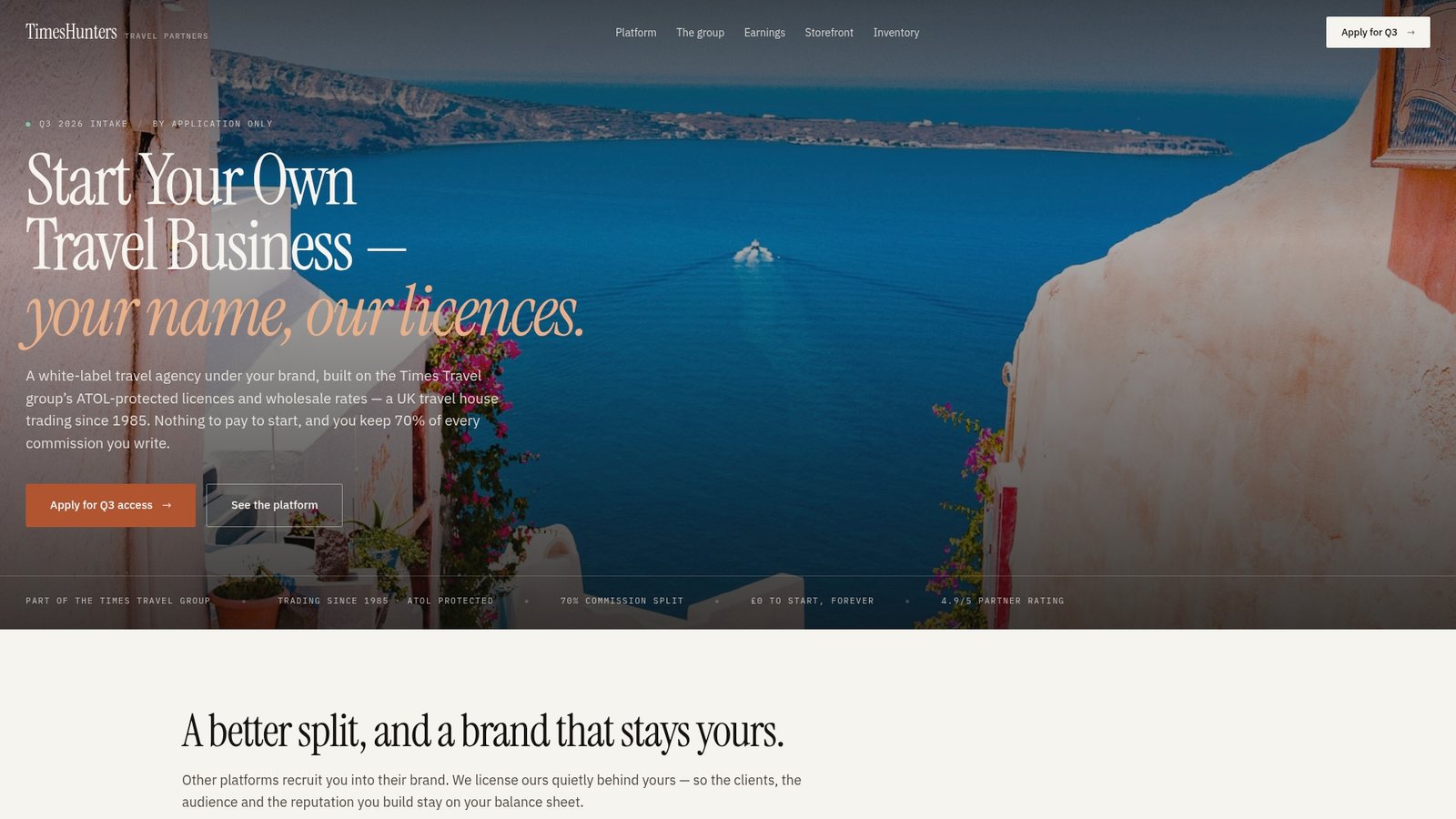
The platform gives partners a branded booking site running under Times Travel group’s existing ATOL protected licences, so flight inclusive packages are covered from the first sale rather than after a lengthy application process. Partners get access to wholesale hotel, cruise, and tour rates, automated booking management, and instant pricing proposals, alongside training and support built specifically for people launching a travel business rather than running one that’s already established.
For anyone weighing up the compliance workload this article has just walked through against actually getting a travel business off the ground, Timeshunters’ partner platform is worth a look before committing to build the ATOL and insolvency side from scratch.