Business Coaching for Travel Agents: What to Expect and Cost
What business coaching for travel agents covers, what UK coaching costs, how it differs from mentoring, and how to pair it with a commission model that pays.
Business coaching for travel agents is a structured, goal-led process in which an experienced coach helps you sharpen your niche, win clients, tighten your sales process and put numbers behind your plans. In the UK, published prices run from a single paid hour to programmes costing four figures. The coaching works best when the business model underneath it already pays you properly, because no amount of coaching fixes a commission rate that leaves you with pennies per booking.
TL;DR
- Travel business coaching usually covers niche, ideal clients, marketing, the sales conversation, systems and financial targets, often ending in a written 90-day plan.
- Coaching is performance-focused and goal-based, while mentoring is usually longer term and built on shared experience.
- UK examples we found range from £250 plus VAT for a one-hour session to a £1,375 group-and-one-to-one programme run by a UK tour operator in 2025.
- Before paying for coaching, check your commission model: a higher share per booking makes every hour of coaching work harder.
- Pick a coach by what you will have built at the end, not by the length of the course.
Table of Contents
- What business coaching for travel agents covers
- How coaching helps you start, win clients and grow
- Coaching, training, mentoring or a host agency: what is the difference?
- What does it cost in the UK?
- Why the commission model decides whether coaching pays
- A 90-day way to use coaching well
- Launch under your own brand with Timeshunters
- FAQ
- Sources
What business coaching for travel agents covers
Most programmes sold to UK travel consultants and independent homeworkers cover the same ground, with different emphasis. A UK coaching programme run for agents by a tour operator in 2025 focused on business goals, strategies and practices, growth opportunities, and personal brand and presence, delivered through one-to-one online sessions and workshops.
In practice, the topics tend to fall into six buckets:
- Vision and numbers. What you want the business to earn, how many bookings that takes, and what an average booking is worth to you.
- Niche and ideal client. Who you serve, why they would choose you, and what you will say no to.
- Marketing and visibility. Social content, email lists, partnerships and referral routes.
- The sales conversation. First contact, consultation, recommendation, follow-up and closing.
- Systems and processes. Enquiry handling, quotes, documents, repeat contact and anything you can delegate.
- Mindset and leadership. Confidence in pricing, discipline with your time, and working on the business rather than only in it.
Some coaches go further into specialist territory: packaging and pricing, group sales, luxury positioning, upselling, or scaling with subcontractors. If you already know where your business is weakest, choose a coach whose strongest module matches it.
How coaching helps you start, win clients and grow
Starting out
New agents tend to lose months on decisions that a coach can compress: which niche, which price point, what to say in a first message. Coaching aimed at independent agents often includes defining your niche and ideal client, personal branding, a social-media review, a content plan, lead generation and a first offer, finishing with an action plan.
If you are still deciding whether to go self-employed at all, start with the practical route rather than a coach: our guide on how to become a travel agent in the UK sets out the choices, and the travel agency business plan template and launch checklist gives you something concrete to bring to a first coaching session.
Attracting clients
Client-acquisition coaching generally looks at target customers, marketing opportunities, partnerships, referral strategies, online presence and customer engagement. The useful version ends with something you can do on Monday: a 30-day visibility plan, a simple email-list step, a short list of people who could refer you.
A well-run client journey matters as much as the marketing. Good coaching maps it from enquiry through booking, travel, return home, repeat business and referrals. That last stretch is where independent agents often leave money on the table, because the trip is booked and the contact goes quiet.
The sales conversation
Many agents are good at travel and uncomfortable with selling. Conversion coaching works on the stages in between: the opening conversation, consultation, recommendation, follow-up and closing. Our own piece on selling travel to clients in seven stages takes the same view, and our sales scripts built around three to five questions give you wording to practise before you pay anyone to role-play it with you.
Small operational details change how a sale feels to the client. Thinking about improving your booking process from the first conversation to a confirmed travel booking, including what happens on the ground when the client arrives, is often where a coach’s questions pay off most.
Growing and measuring
A recurring theme in UK guidance is that growth is a systems problem as well as a marketing one. One UK travel-business health-check recommends a quarterly financial and operational audit tracking profit per booking, repeat-booking rate, average order value, lead-conversion rate and fixed against variable costs, with the next review date set in advance. Whether or not you hire a coach, those five numbers are worth tracking from your first month.
Coaching, training, mentoring or a host agency: what is the difference?
These terms get used loosely, and the difference affects what you pay for.
The Chartered Institute of Personnel and Development describes coaching as generally a skilled, non-directive, performance-focused process centred on specific skills and goals, whereas mentoring involves a more experienced person sharing knowledge and is usually longer term.
| Option | What you get | Best when |
|---|---|---|
| Coaching | Questions, accountability and a plan built around your own business | You already trade and want to improve specific results |
| Mentoring | An experienced person’s advice and contacts, often over a long period | You want to learn how someone else built a travel business |
| Training | Taught content, such as product knowledge or booking systems | You need skills or knowledge, not diagnosis |
| Joining a host agency or platform | Licensing, supplier access, booking tools and a commission split | You need the legal and operational base to trade |
The last row is the one coaching cannot replace. A coach will not give you consumer protection, supplier access or a booking system. If you plan to sell packages in the UK, you need to understand how protection works before you sell anything; our five-step onboarding guide for UK travel agencies covers ATOL, ABTA and white-label arrangements in order.
What does it cost in the UK?
There is no single UK going rate for travel business coaching, and anyone quoting an average is guessing. The published examples we found show the spread:
- One-off session: a business coach lists a one-hour tailored strategy session at £250 plus VAT, including an action plan you can implement immediately. This is one provider’s price, not a sector figure, and it is general business coaching rather than travel-specific.
- Structured programme: a UK tour operator’s 2025 coaching programme for agents cost £1,375, with £375 contributed by the operator for early enrollers, and included one-to-one online sessions and workshops.
Private programmes for travel advisors are typically described by length and format: eight weeks of weekly calls, twelve weeks of one-to-one support, or three months of fortnightly sessions. Check each provider’s current page for the price, because they change and we do not quote prices we cannot source.
How to judge value for money
Ask five questions before you pay:
- What will I have produced at the end: a plan, a documented process, a client profile?
- How many sessions are one-to-one, and how long are they?
- Does the coach understand UK rules, such as package-travel protection and how agents are licensed?
- What happens between sessions: templates, messaging support, accountability?
- Can I see a plan of what we will cover week by week?
A simple test of return: divide the fee by the profit you keep on an average booking. If you keep £150 per booking, a £1,375 programme needs roughly nine extra bookings to pay back. If your model lets you keep far more per booking, the same programme pays back sooner.
Why the commission model decides whether coaching pays
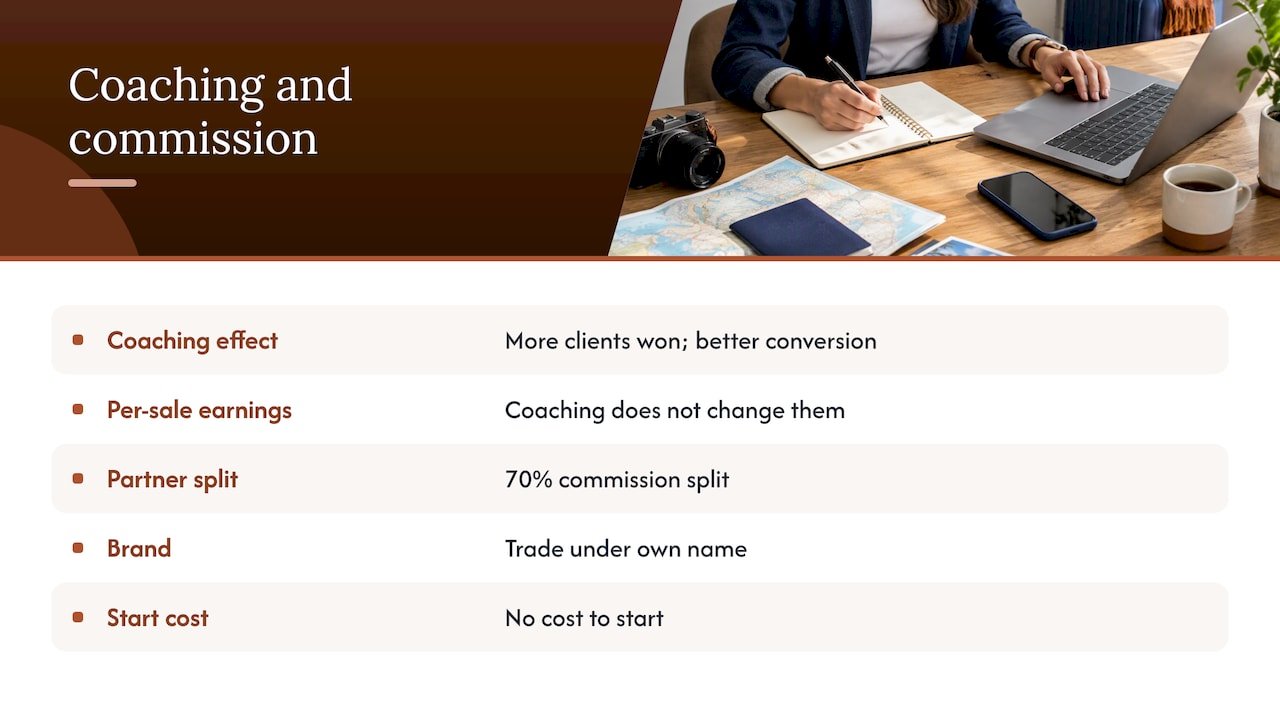
Coaching improves how many clients you win and how well you convert them. It does not change what you earn on each sale. Many new agents work hard on marketing only to find that the model they joined takes most of the margin.
We would put it plainly: if you are comparing coaching with your options for earning more, look first at your split. Our breakdown of host agency commissions after fees and clawbacks shows what UK agents can actually take home, and the same logic applies by product. Our pages on cruise agent commissions and tour operator commissions show how to calculate net earnings per booking before you decide how much to invest in anything else.
Then build the coaching around a niche you can price properly. If luxury is your direction, our 90-day plan for building a luxury travel niche is designed to be worked through alongside, or instead of, a paid coach.
Our view: coach the business, but fix the economics first
We built Timeshunters because we saw capable, personable advisors working at the mercy of low commission rates, with their clients effectively belonging to someone else’s brand. Our position is simple: the best coaching result is a business where you own the brand, you own the client relationship, and you keep most of what you sell.
That is why we offer a white-label model in which partners earn a 70% commission split on bookings, trade under their own name and use ATOL-protected licences, with the licence’s branding invisible to end clients and no cost to start. Our model is designed so that the time you spend learning to sell goes into your own client list, not into someone else’s.
A coach can sharpen your niche, your scripts and your follow-up. We give you the infrastructure to put that work to use: a branded booking site, wholesale hotel, cruise and tour inventory, instant pricing proposals, managed payments and automated client follow-up. Pair the two and each hour of coaching is applied to a business that keeps more of every booking.
Sam
A 90-day way to use coaching well
Whether you hire a coach or work alone, structure the first three months around outputs rather than hours.
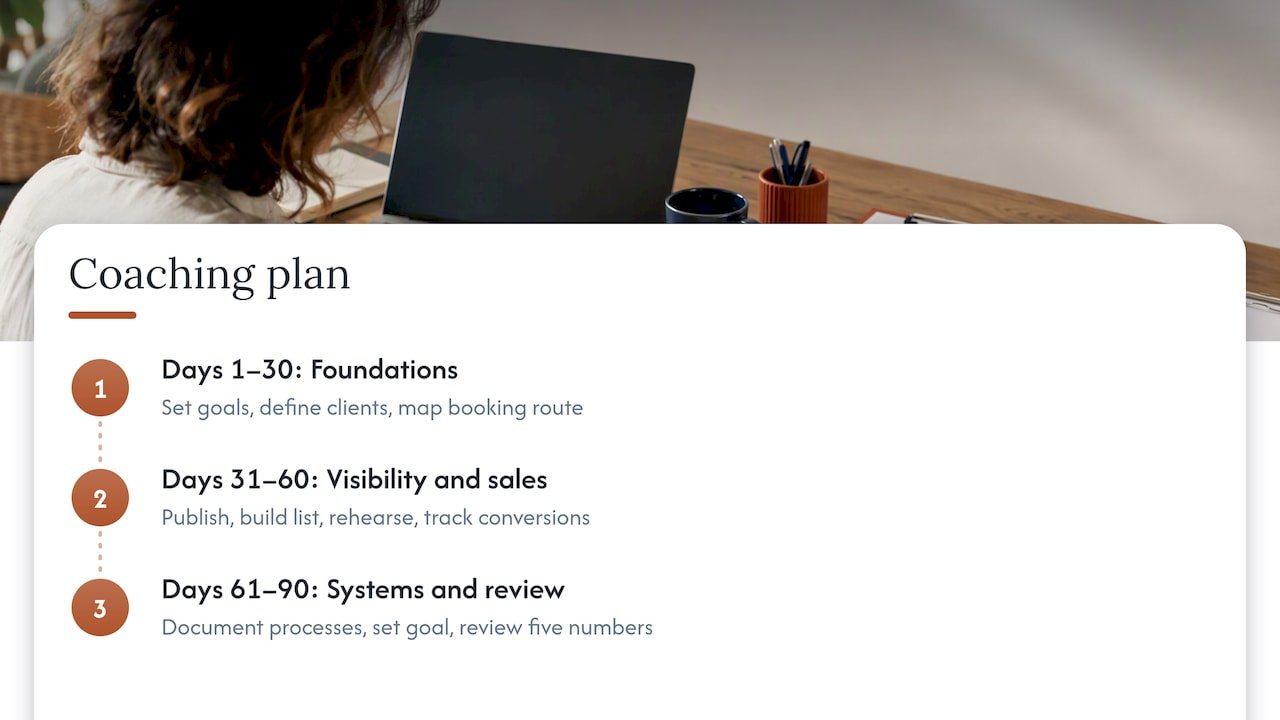
Days 1 to 30: foundations. Write your vision and three goals. Define your ideal client in one paragraph and your value in one sentence. Map what happens from enquiry to repeat booking. Choose your licence and booking route, with the help of our agent support onboarding plan.
Days 31 to 60: visibility and sales. Publish consistently to one or two channels, start an email list, and rehearse your consultation until the first five minutes feel natural. Track enquiries and conversions from day one.
Days 61 to 90: systems and review. Document two processes you repeat constantly, such as quoting and post-booking follow-up. Set a sales goal for the next quarter and hold your first quarterly review using the five numbers above. Decide whether you need coaching on a specific weak spot, and book it for that purpose.
If you are choosing training alongside this, our notes on what to look for in an agent training portal and our UK agent training and four-week launch guide show what a sensible programme should include.
Launch under your own brand with Timeshunters
If you want to coach your way into a business you actually own, we can provide the base. Timeshunters is a white-label travel agency platform that lets you sell hotels, cruises, tours, villas, safari camps and rail under your own name, with ATOL-protected licences behind you, a branded booking site, automated booking management and training and support. Partners receive a 70% commission split, and there is no cost to start.
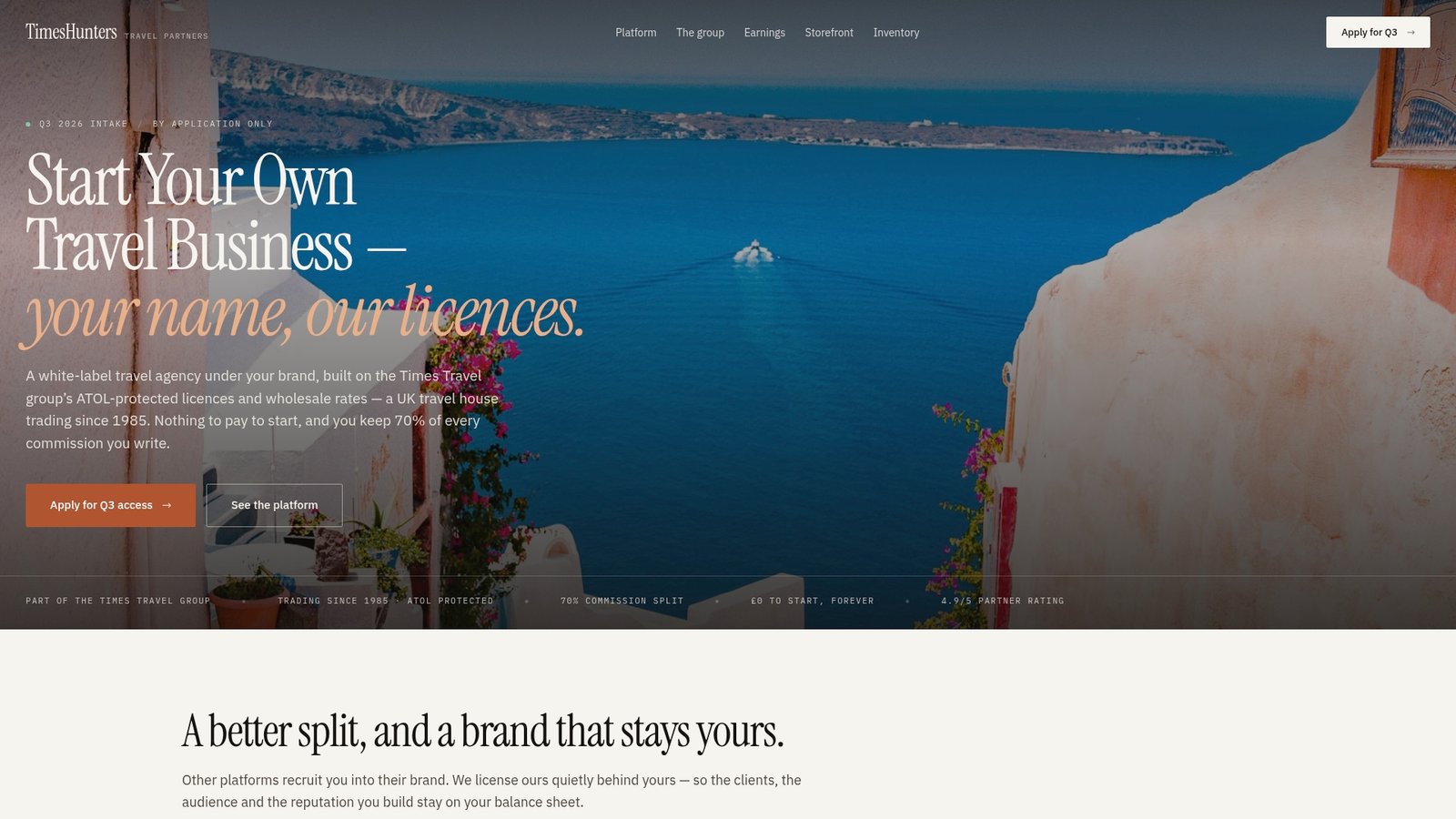
See how the model works on our white-label travel agency page, or read about the 70% commission referral programme if you want to start by passing on enquiries. You can also begin at timeshunters.com.
FAQ
How much should I pay for a business coach?
There is no standard fee. Published UK examples include a one-hour session at £250 plus VAT and a £1,375 structured programme run in 2025. Judge a fee by what you will have built at the end and by how quickly your profit per booking can repay it.
Do I need a coach to start a travel business?
No. You need a legal and operational base first: protection, supplier access and a booking system. Coaching is most useful once you are trading and know which part of the business to improve. Many people start with a plan and a launch checklist, then add coaching for a specific problem.
What is the difference between a coach and a mentor?
Coaching is generally a non-directive, performance-focused process around specific skills and goals. Mentoring usually means learning from a more experienced person over a longer period. Choose a coach for results on a defined problem, and a mentor for broader guidance.
What should a travel business coach cover?
Look for niche and ideal-client work, marketing and lead generation, the sales conversation, follow-up, systems and financial targets. A good programme finishes with written outputs, such as a client profile, documented processes and a 90-day plan, rather than general encouragement.
Sources
- Carrier launches business coaching programme for agents (Aspire Travel Club)
- Coaching and mentoring factsheet (CIPD)
- Business Strategy Power Hour (AJ Lakes)
- Where are you now? Travel Business Growth Bible (Purple Umbrella)